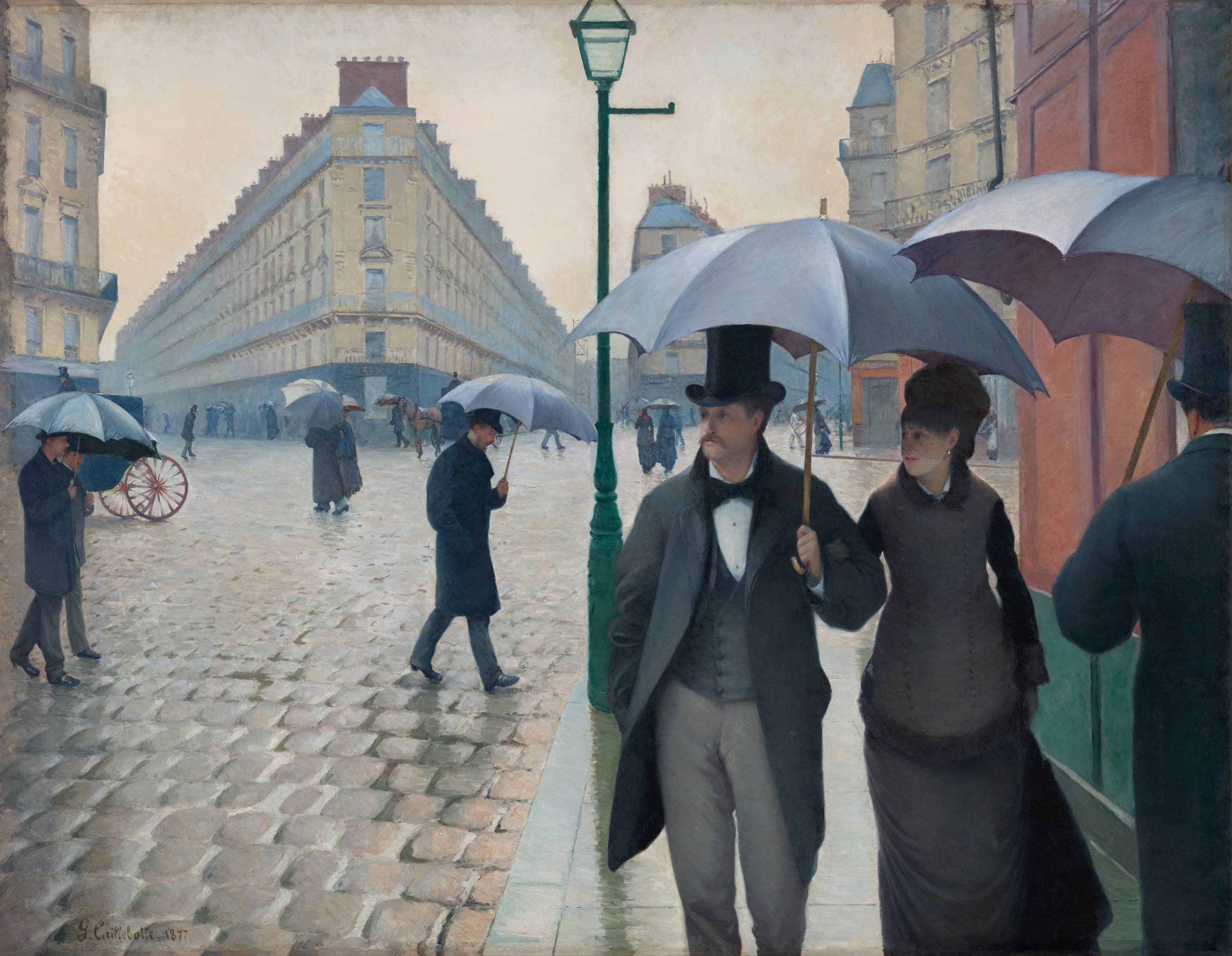
Paris Street; Rainy Day
A top-hatted couple share an umbrella at a wet Paris intersection, walking straight at the viewer across almost ten feet of canvas. Gustave Caillebotte painted the crossing near his home in 1877, hung it as number 1 at the third Impressionist exhibition, and made the rebuilt city itself the subject. The Art Institute of Chicago calls it his largest and most ambitious work.
- 1877
- Oil on canvas
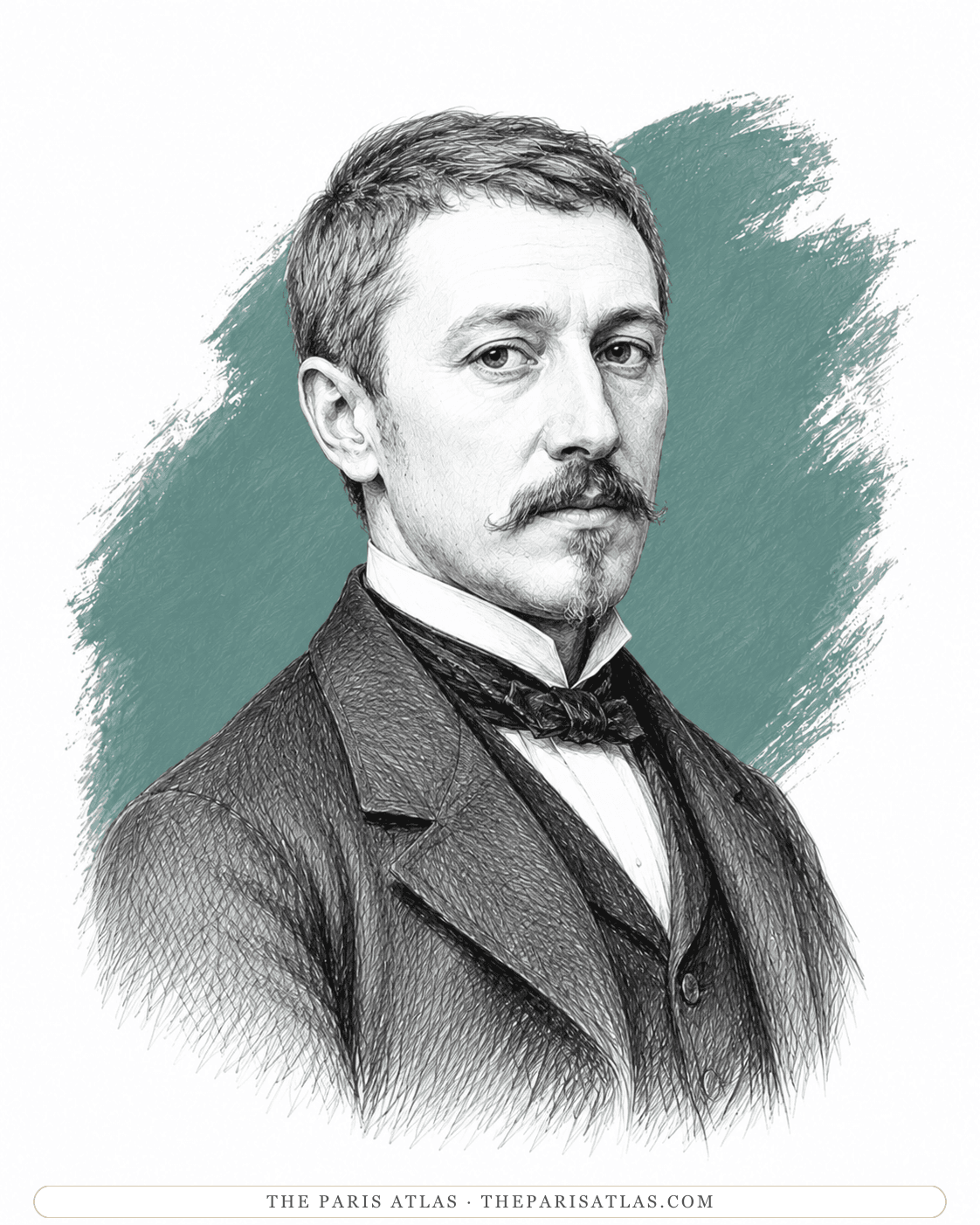
About Gustave Caillebotte
What the painting shows
A couple comes toward you under one umbrella — he in a top hat and moustache, she in fur-trimmed brown, her hand on his arm, both glancing off to the left at something outside the frame. A green cast-iron lamppost splits the canvas exactly in half. Behind it the intersection opens out: a wedge of Haussmann building running away like a ship's prow, wet cobbles in pale gold, at least two dozen figures under umbrellas, a carriage, a ladder on a workman's shoulder. On the right a third pedestrian is sliced by the picture's edge, walking in.
It is raining, but there is no rain. The Art Institute's notice points out that Caillebotte gives the weather entirely by proxy — the newly available retractable umbrellas, and reflections on the paving. The figures are near life size; the canvas is roughly seven feet by nine, painted when the artist was twenty-eight, and nothing else in the 1877 exhibition approached its scale.
The crossing is real and still walkable. It is the meeting of the rue de Turin, the rue de Moscou, the rue de Saint-Pétersbourg and the rue Clapeyron, a few blocks from the family house at 77 rue de Miromesnil, on Caillebotte's regular walk toward the cafés of the New Athens quarter. In his lifetime the intersection had no official name — people said 'carrefour de la rue de Moscou' — and it was streets this new that Baron Haussmann's rebuilding had cut through the city. Since January 1987 the spot has been the place de Dublin.
Pinholes and a drawn horizon
The picture's strange calm is engineered. The Art Institute's technical study found a drawn horizon line in the underlayers and small pinholes at the two principal vanishing points, just right of center — Caillebotte anchored his perspective lines with pins and ruled the city into place. The same study weighed the old suspicion that he traced a photograph and argued against it, concluding he more likely worked with a camera lucida, the draftsman's optical device of the day. One 1877 reviewer, Paul Sébillot, saw where this pointed: the painting, he wrote, 'gives an idea of what photography will become.'
Two preparatory documents survive in public collections. The Art Institute holds a graphite study of the empty intersection — architecture and perspective only, the figures still to come — that once belonged to Kirk Varnedoe, the scholar who did most to revive Caillebotte's reputation. The Musée Marmottan Monet in Paris holds the oil sketch, looser and yellower-skied than the finished picture. Caillebotte gave that sketch to Claude Monet, and it was hanging in Monet's bedroom at Giverny when he died; it came to the Marmottan with Michel Monet's bequest in 1966.
Number 1 in the catalogue
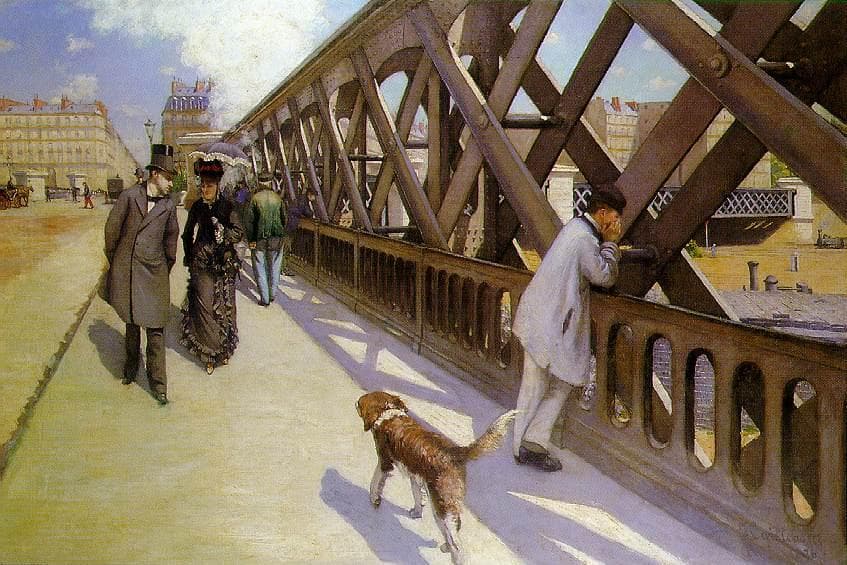
At the third Impressionist exhibition, which opened in April 1877 in an apartment at 6 rue Le Peletier, the painting hung as catalogue number 1, under the title Rue de Paris; temps de pluie. Caillebotte was more than a participant by then — the Art Institute describes him as the most active member of the newly nicknamed Impressionists, and he showed six canvases, this one and The Pont de l'Europe the pair the press called his 'immense pictures.'
The reviews fixed on two things: the size, and the dryness. L'événement's critic granted 'the most remarkable canvases' of the show to 'a millionaire who paints in his spare time' — 'both too uniformly grey, but very well drawn' — and another line in the same press run complained that 'M. Caillebotte forgot to represent the rain.' A review in the Sémaphore de Marseille attributed to Émile Zola called him 'a young painter of the finest courage' who 'does not shrink from modern subjects at life size,' and picked out the foreground couple as 'of a fine truth.' The barb that stuck longest was meant as one: Caillebotte, a reviewer said, is an Impressionist in name only — he knows how to draw.
How Chicago got it
The painting stayed with the family for three-quarters of a century: to his brother Martial's household on Gustave's death in 1894, stored from 1900 at the Château de Montglat, back to Martial's daughter Geneviève Chardeau in Paris in 1950. In 1954 the family sold it to Walter P. Chrysler Jr., and in 1964 it passed through Wildenstein to the Art Institute of Chicago, where it entered the collection on the Charles H. and Mary F. S. Worcester fund.
The museum's own notice makes the timing plain: it bought the picture 'well before the artist's contributions to the Impressionist movement were widely recognized.' The purchase looks prescient now. It hangs in Gallery 201, and the Art Institute's curator of European painting, Gloria Groom, calls it 'one of the most iconic works in the collection' — 'because of the near-life-size scale of the figures, it's a painting that one wants to just walk into.'
Close reading
Reading the work, detail by detail
Caillebotte makes a newly rebuilt Paris feel both open and strangely isolating. Details of the foreground couple, the broad intersection, and the wet paving reveal how scale and spacing keep people near one another without bringing them together.
1.The foreground couple is close but self-contained
Their bodies overlap and move together, yet both gaze past the viewer rather than outward to the street. The umbrella encloses them in a portable private space within the public city.
2.The intersection creates distance faster than people can fill it
Several avenues open around the wedge-shaped building, producing deep, clean sightlines. The few dispersed pedestrians make Haussmann's expanded city feel emptier precisely because it is so easy to cross visually.
3.Wet cobbles turn geometry into atmosphere
The paving grid fixes perspective underfoot, but soft reflections blur its hard surface. Rain lets Caillebotte combine the measured new street with the changing light associated with Impressionism.
4.Umbrellas repeat without making the crowd uniform
Dark arcs recur at different sizes and angles throughout the intersection. The repetition unifies the scene while each umbrella still marks a separate person moving along a different route.
5.The cropped man makes the viewer part of the traffic
A passerby enters so close that the frame cuts through his body and umbrella. Caillebotte uses that interruption to make the scene feel observed from within the moving crowd rather than arranged at a safe distance.
6.The gas lamp pins the open intersection in place
The slender post rises through the broad empty crossing and supplies a firm vertical measure. It separates routes without blocking them and helps the viewer understand the scale of the rebuilt avenue.
Timeline
1877
Painted, signed and dated lower left. Shown that April as catalogue number 1 of the third Impressionist exhibition, 6 rue Le Peletier, as Rue de Paris; temps de pluie.
1894
On Caillebotte's death, descends to his brother Martial Caillebotte and Marie Minoret, Paris.
1900
Placed at the Château de Montglat, near Provins, with Georges Minoret.
1950
Returned to Paris, to Albert and Geneviève Chardeau, Martial's daughter.
1954
Sold to Walter P. Chrysler Jr., New York.
1964
Through Wildenstein to the Art Institute of Chicago — the Charles H. and Mary F. S. Worcester Collection, accession 1964.336.
1987
The unnamed intersection it shows officially becomes the place de Dublin in January.
2024–25
Anchors the Caillebotte retrospective tour: Painting Men at the Musée d'Orsay and the Getty, then Painting His World at the Art Institute.
Where to see it
Art Institute of Chicago
111 South Michigan Avenue, Chicago, IL 60603, United States
Displays and loans can change. Check whether this work is on view before making a special trip.
Plan your visit on the museum’s official website (opens in a new tab)Frequently asked questions
Where is Paris Street; Rainy Day?
The Art Institute of Chicago, Gallery 201 — accession number 1964.336, in the Charles H. and Mary F. S. Worcester Collection. The museum bought it in 1964 and it has been one of the collection's signature paintings since.
What intersection does Paris Street; Rainy Day show?
The crossing of the rue de Turin, the rue de Moscou, the rue de Saint-Pétersbourg and the rue Clapeyron in the 8th arrondissement, a few blocks from Caillebotte's family home. The intersection had no official name in his lifetime; since January 1987 it has been the place de Dublin, and it is still recognizable today.
Why is there no rain in Paris Street; Rainy Day?
Caillebotte painted the weather by its effects instead: open umbrellas — a newly available retractable model — and light reflecting off the wet cobblestones. One 1877 critic complained that he 'forgot to represent the rain.'
Is Paris Street; Rainy Day an Impressionist painting?
It hung as number 1 at the third Impressionist exhibition in 1877, but its tight drawing and ruled perspective sit far from Monet's handling, and a critic of the day quipped that Caillebotte was an Impressionist in name only because he knew how to draw. The painting is usually described as urban realism made inside the Impressionist movement.
How big is Paris Street; Rainy Day?
212.2 by 276.2 centimetres — about seven by nine feet — with foreground figures near life size. The Art Institute calls it Caillebotte's largest and most ambitious work.
Did Caillebotte use a photograph for Paris Street; Rainy Day?
Probably not a photograph directly. The Art Institute's technical study found pinholes at the vanishing points and a drawn horizon under the paint, and concluded he likely used a camera lucida — a draftsman's optical device — rather than tracing a photograph. The cropped figures still show how much the new medium shaped his eye.
Where is the sketch for Paris Street; Rainy Day?
The oil sketch is at the Musée Marmottan Monet in Paris. Caillebotte gave it to Claude Monet, in whose bedroom it hung at his death; it entered the museum with Michel Monet's bequest in 1966. The Art Institute also holds a graphite perspective study of the empty intersection.
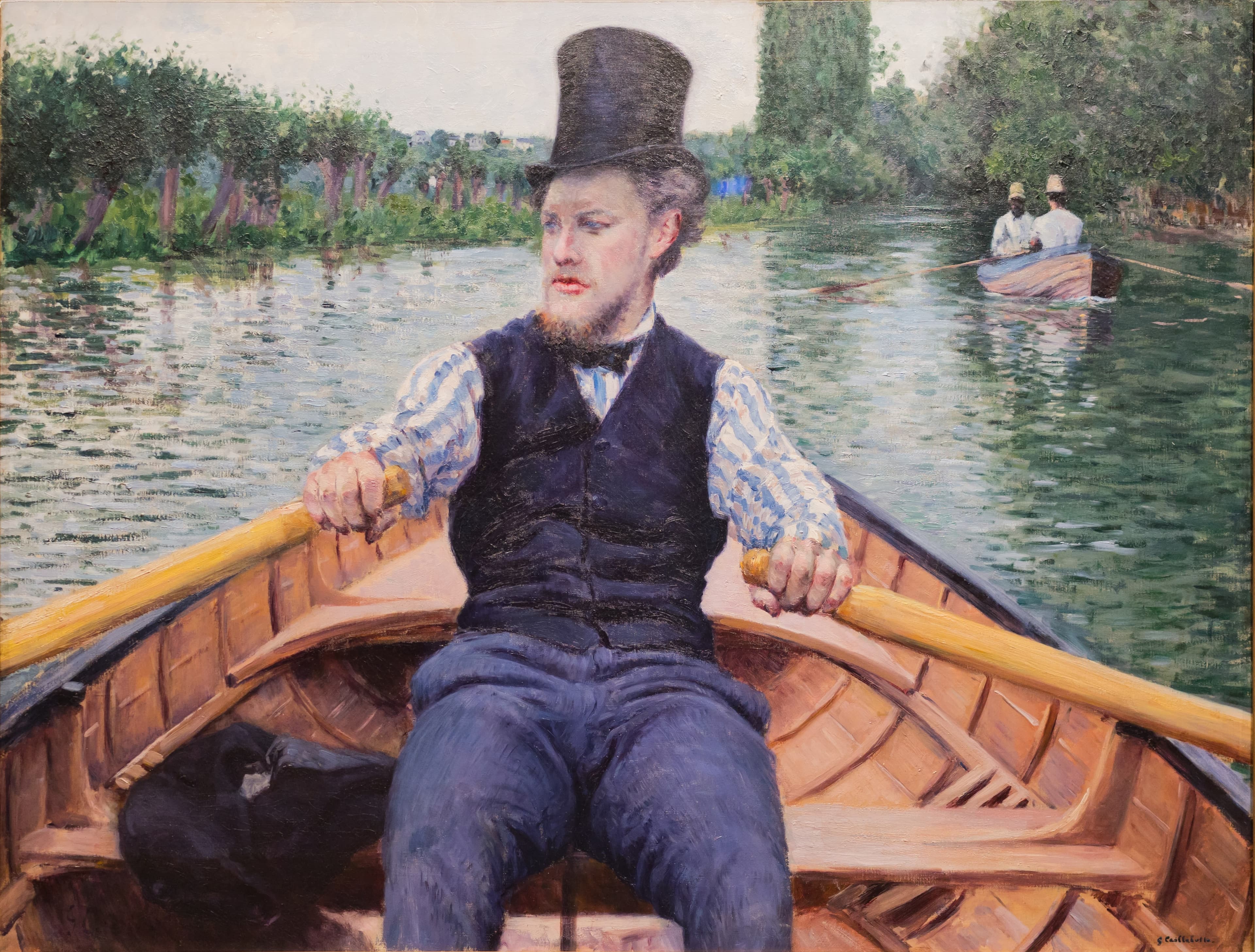
More by Gustave Caillebotte
If you like Gustave Caillebotte
Explore painters from the same movements and circles.
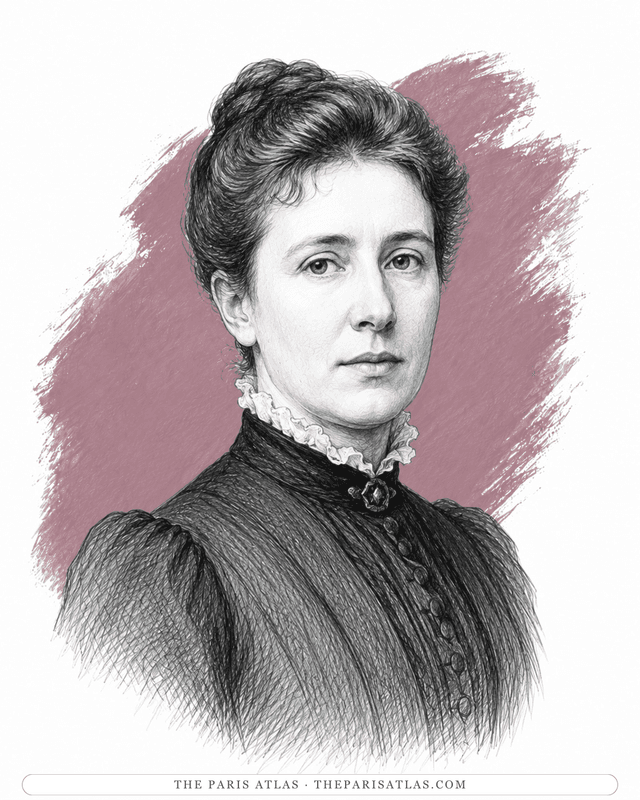
Mary Cassatt
Mary Cassatt was an American painter and printmaker known for her depictions of women and children. Based in France for the last fifty-two years of her life, she was the only American to exhibit with the original French Impressionist group, participating in four of its eight exhibitions. Edgar Degas invited her to exhibit with the group in 1877 after the Salon jury rejected her submissions.
View artist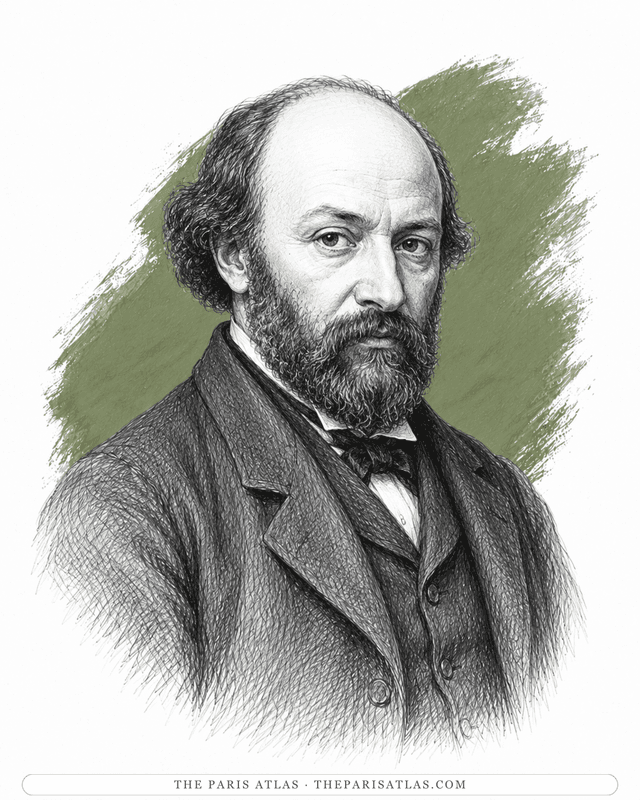
Paul Cézanne
Painter between Impressionism and everything after — shown in the independents' exhibitions, emulated by the Cubists, and present at the Orangerie through 15 works in the Walter-Guillaume collection.
View artist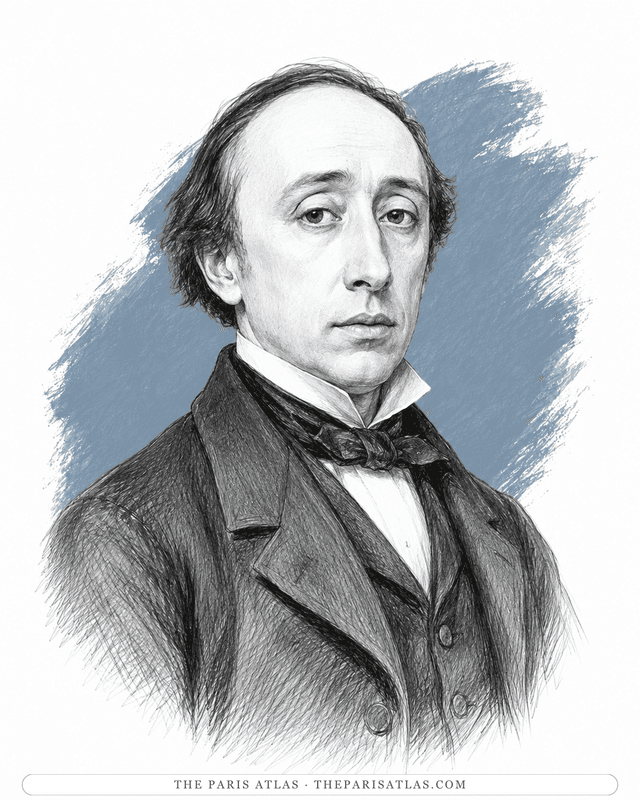
Edgar Degas
Painter of dancers, racecourses, and café interiors — among the founders of the independent exhibitions that became Impressionism, though he preferred the word 'independent' himself.
View artist
References
The sources below include collection records, catalogues, scholarly research, and primary materials that informed this page. They document Paris Street; Rainy Day, its making, and its place in cultural history.


1Paris Street; Rainy Day (Gustave Caillebotte) — Art Institute of Chicago
WebsiteArt Institute of ChicagoUsed forWeb source consulted for documented facts and historical context presented on the Paris Street; Rainy Day page.
2Cat. 2: Paris Street; Rainy Day, 1877 — Caillebotte Paintings and Drawings at the Art Institute of Chicago (Gloria Groom and Kelly Keegan)
WebsiteArt Institute of ChicagoUsed forWeb source consulted for documented facts and historical context presented on the Paris Street; Rainy Day page.
3Rue de Paris. Temps de pluie (Gustave Caillebotte, sketch) — Musée Marmottan Monet
WebsiteMusée Marmottan MonetUsed forWeb source consulted for documented facts and historical context presented on the Paris Street; Rainy Day page.
4Gustave Caillebotte: Painting Men — exhibition presentation, Musée d'Orsay
WebsiteMusée d'OrsayUsed forWeb source consulted for documented facts and historical context presented on the Paris Street; Rainy Day page.
These references provide the documented foundation for this work's history and interpretation. Claim-level citations remain attached to the specific claims they support.
 Explore more resources