JOB
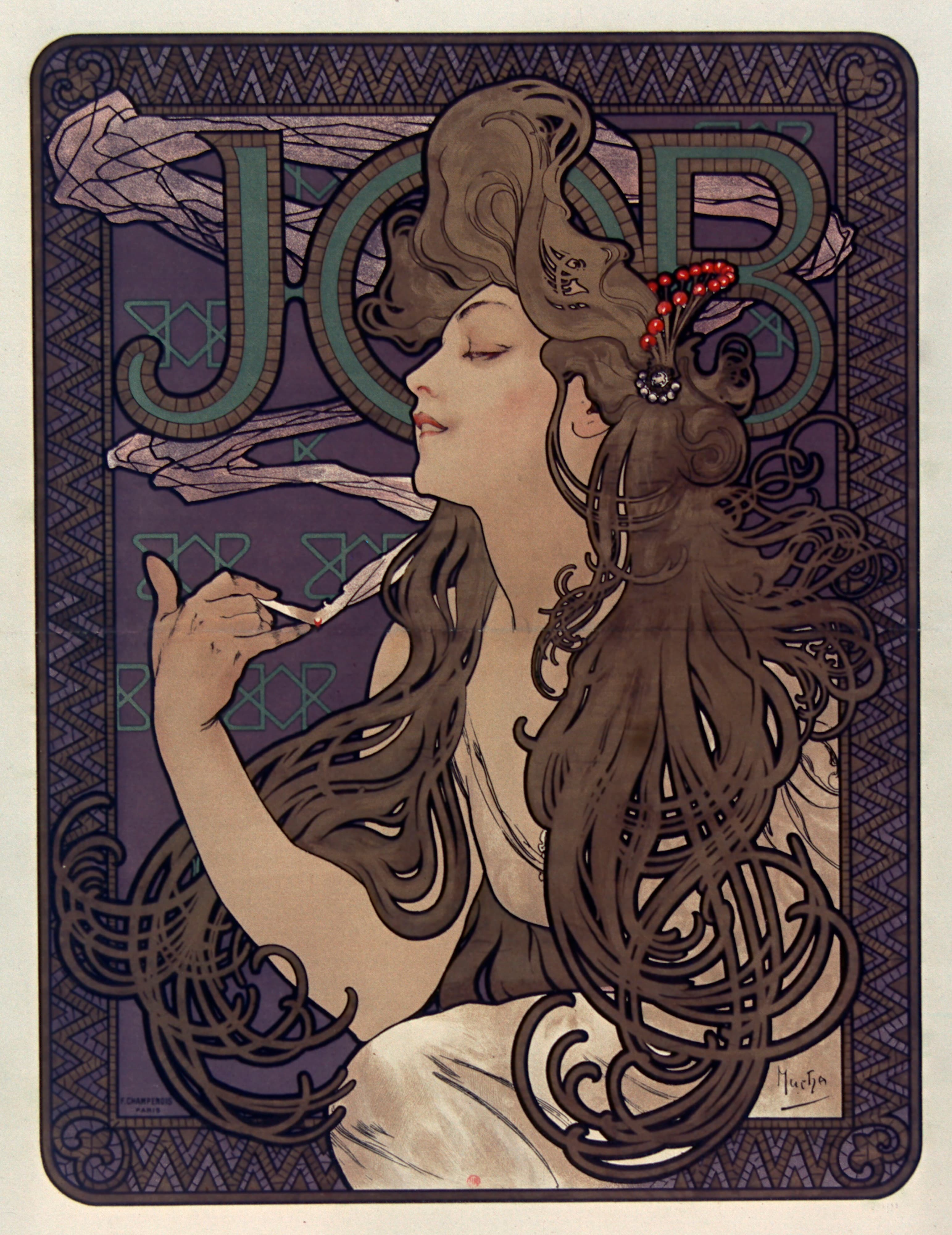
A woman with her eyes closed tips her head back and holds a lit cigarette, her dark hair swirling in huge loops across a violet ground, under the letters JOB in green outlined with gold mosaic. Alphonse Mucha designed it in 1896 for the cigarette-paper brand of the Joseph Bardou company, and F. Champenois printed it in Paris. It is the most reproduced of his advertising posters, and a second, larger JOB design followed in 1898.
- 1896
- Color lithograph
- Bibliothèque nationale de FranceParis, France
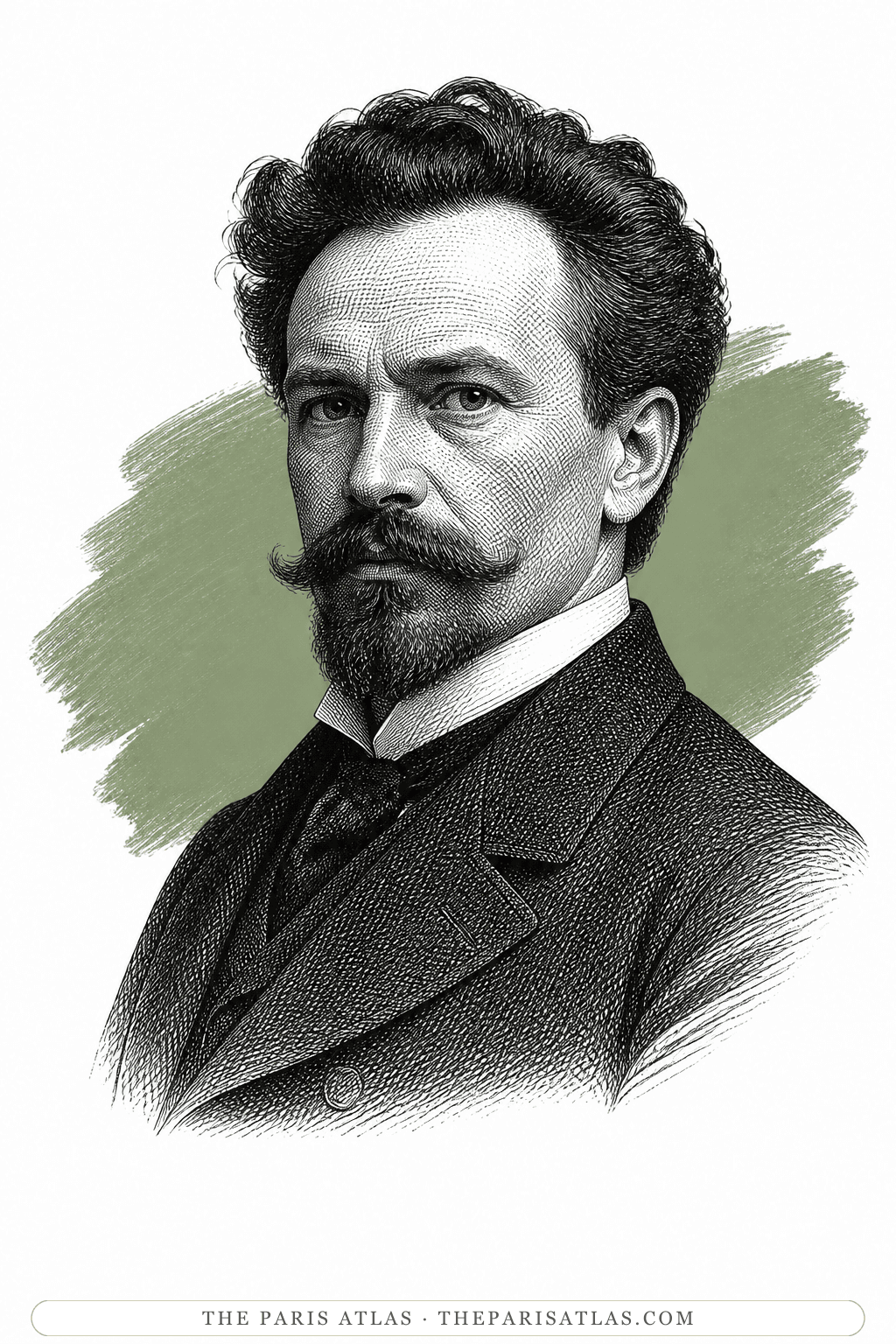
About Alphonse Mucha
What the poster shows
The woman is shown from the shoulders up in profile facing left, her head tipped back and her eyes closed. She holds a lit cigarette between two fingers of her raised right hand, its tip glowing red, and ribbons of pale violet smoke drift up and across the letters. Her hair is the largest thing on the sheet: olive-brown, drawn as thick looping strands that rise above her head and spill down over her bare shoulder and the whole right half of the design.
The word JOB stands behind her in three tall green letters outlined with gold mosaic bricks, the O half hidden by her hair. The violet ground is patterned with the brand's monogram, a J, an O and a B interlaced in green line, repeated in rows. A border of dark blue and violet mosaic with a gold zigzag runs round the whole design, with rounded corners.
A spray of red berries and a clasp of pearls sit in her hair above the ear. A loose white drape covers her at the bottom edge. Mucha's signature, underlined, is at lower right on the pale drape, and F. CHAMPENOIS PARIS is printed small in the lower left corner of the violet ground.
What JOB is
JOB was not a person. The Mucha Foundation records that it is the trademark of the Joseph Bardou company, a maker of cigarette papers, so the poster advertises the papers rather than a brand of cigarettes. The monograms in the background and the three letters are the whole of the message; there is no slogan and no price.
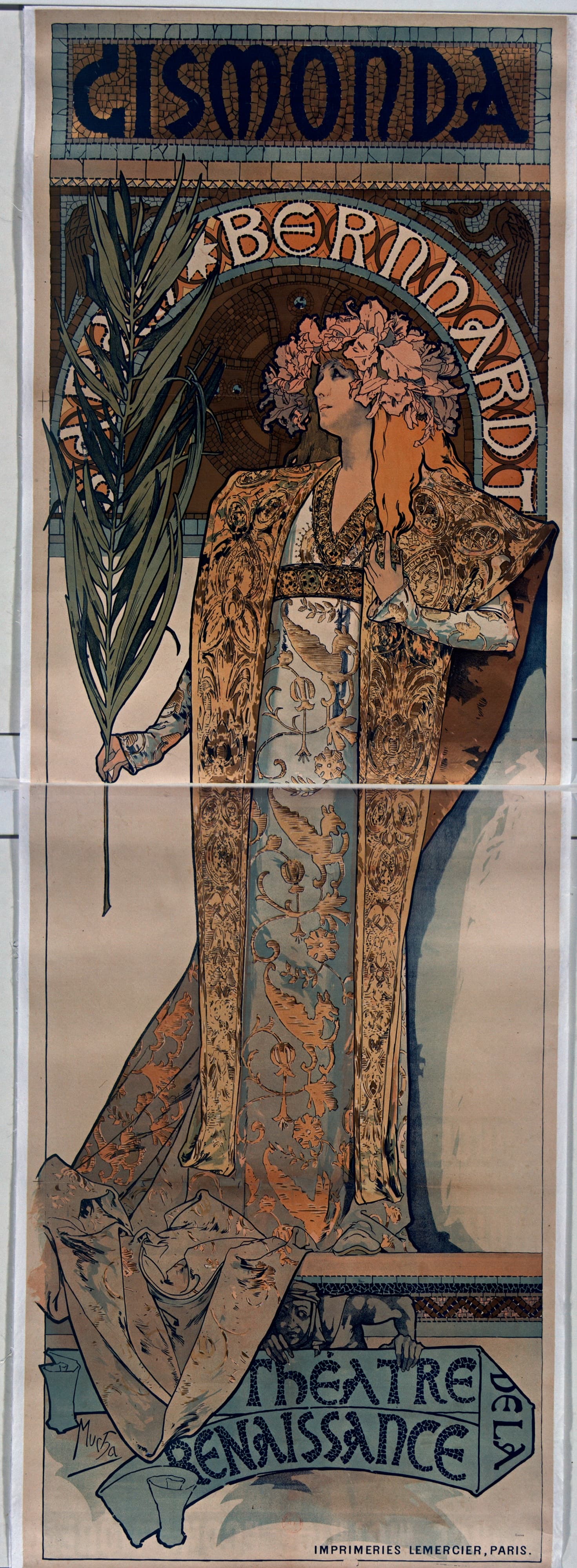
The Mucha Foundation notes the mosaic border as a Byzantine touch carried over from Gismonda, giving a commercial poster an air of dignity. It calls the design one of Mucha's best-known advertising posters, reissued in many formats for markets abroad. In 1898 Mucha made a second, much larger JOB poster, known as the great JOB; the Museum of Modern Art's copy, which the museum dates 1897, measures 154.9 by 101 centimeters.
Champenois, 1896
In 1896 Mucha signed a contract with the printer and publisher Ferdinand Champenois, moved to a studio at 6 rue du Val-de-Grâce, and designed the JOB poster. The Mucha Foundation's timeline lists it among that year's work, describing a woman with golden hair and smoke wrapping around her head. Champenois's imprint is on the sheet at the lower left.
The Bibliothèque nationale de France catalogues its copy as a lettering variant, 64 by 46 centimeters, and cites number 15 in Jack Rennert and Alain Weill's 1984 catalogue of Mucha's posters and panels. The Mucha Foundation gives 66.7 by 46.4 centimeters for the Mucha Trust's copy. The BnF's copy was mounted on cloth and carries a horizontal and a vertical fold across the design.
Where an original is
The Bibliothèque nationale de France keeps its copy in the prints and photographs department at the Richelieu site, shelfmark ENT DN-1 (MUCHA, Alphonse /2)-FT 6, consulted in the reading room rather than shown on a wall. The Mucha Foundation's copy is in the Mucha Trust Collection.
The Museum of Modern Art in New York holds the larger JOB design as object number 167.1968, a gift of Lillian Nassau, in its Architecture and Design department. Copies of both designs come up regularly at poster auctions, along with later reprints in other sizes.
Close reading
Reading the work, detail by detail
There is no slogan on the sheet, only three letters, a monogram and a woman with a cigarette. Close up the design is a set of contrasts: green letters outlined in gold mosaic against violet, a lit tip of red in a field of brown and mauve, and hair drawn as thick looping strands that take up more of the sheet than the face. The copy is the Bibliothèque nationale de France's.
1.JOB in green and gold mosaic
The three letters are green with a thick outline of gold mosaic bricks, drawn tall enough to fill the upper half of the sheet. The O sits behind the woman's head and is more than half covered by her hair, so the word reads as J and B with the O inferred. Ribbons of pale violet smoke cross the letters.
2.The head tipped back, eyes closed
The face is in profile facing left with the eyes closed and the lips slightly parted, and the head is tipped back into the hair. The skin is pale cream with a touch of red at the lips and cheek, the only warm color on the face. The Mucha Foundation describes the pose as leaning the head back sensually.
3.A lit cigarette between two fingers
The right hand is raised with the fingers extended, the cigarette held between the index and middle finger. Its tip is a single spot of red, the brightest mark on the sheet apart from the berries in her hair. The hand is drawn in outline with a few lines of shading and no rings.
4.Smoke drawn as ribbons
The smoke is not a haze but a set of flat, twisting ribbons in pale violet, drawn with the same outline as everything else. One band drifts across the top of the J toward the border and another crosses the middle of the sheet below the letters. The Mucha Foundation describes the smoke as forming an arabesque with the hair and the logo.
5.Red berries and a clasp of pearls
A spray of round red berries on thin stalks stands up from the hair above the ear, about a dozen of them, and a clasp of white pearls around a dark center sits just below. The berries and the cigarette tip carry all the red on the sheet. The ear shows beneath the clasp, drawn in a single line.
6.The JOB monogram on the ground
The ground is patterned with the brand's monogram in green line: a J, an O drawn as a hexagon and a B interlaced into one device, repeated in rows. The one beside the foot of the J is the clearest. It is the same mark the papers carried, and the poster's only text apart from the letters and the imprint.
7.Hair drawn as loops
The hair falls over the bare shoulder in thick strands that loop back on themselves, each outlined in dark brown and filled with a flat olive-brown. There is no attempt at individual hairs. Here the hair takes up more of the sheet than the face and the letters together.
8.The signature on the white drape
Mucha signed in dark script with a flourish underneath, at lower right on the pale drape that covers the woman's body. The printer's name, F. CHAMPENOIS PARIS, is in the opposite corner in tiny capitals on the violet ground. Both sit inside the mosaic border.
Timeline
1896
Mucha signs a contract with the printer Ferdinand Champenois and moves to a studio at 6 rue du Val-de-Grâce.
1896
Designs the JOB poster for the Joseph Bardou company's cigarette papers; F. Champenois prints it.
1898
Makes a second, much larger JOB poster, known as the great JOB.
1968
Lillian Nassau gives the Museum of Modern Art its copy of the larger design, object number 167.1968.
Where to see it
Bibliothèque nationale de France
58 rue de Richelieu, 75002 Paris, France
The posters are kept in the prints and photographs department at the Richelieu site and are not on public display. They are consulted in its reading room with a research pass, and large-format items are seen by appointment only.
Kept in the prints and photographs department at the Richelieu site and consulted in its reading room with a research pass; it is not on public display.
Plan your visit on the museum’s official website (opens in a new tab)Frequently asked questions
What does JOB mean on the Mucha poster?
JOB is a brand of cigarette paper, the trademark of the Joseph Bardou company. The poster advertises the papers, and the interlaced J, O and B monogram repeated across the violet ground is the company's mark.
Who is the woman in the JOB poster?
The poster does not name her, and the Mucha Foundation's record does not identify a model. She is drawn with closed eyes, her head tipped back, a lit cigarette in her raised hand and hair that fills half the sheet.
How big is the JOB poster?
The 1896 design is about 64 by 46 centimeters, which is the Bibliothèque nationale de France's measurement; the Mucha Foundation gives 66.7 by 46.4. The larger JOB poster of 1898 is about 155 by 101 centimeters.
Are there two JOB posters by Mucha?
Yes. The 1896 design shows a woman in profile with a cigarette against a violet ground with the JOB monogram. In 1898 Mucha made a second, much larger poster for the same company, which the Mucha Foundation calls the great JOB and the Museum of Modern Art dates 1897.
What does the lettering say?
JOB in three tall green letters outlined in gold mosaic across the top, with the JOB monogram repeated in green across the ground. F. CHAMPENOIS PARIS is printed small at the lower left, and Mucha's underlined signature is at the lower right.
Where can I see an original JOB poster?
The Bibliothèque nationale de France in Paris holds the 1896 design in its prints and photographs department, and the Mucha Trust Collection holds another. The Museum of Modern Art in New York holds the larger design as 167.1968. None is on permanent display.
Can I reuse the image?
Yes. Alphonse Mucha died in 1939, so the poster is in the public domain worldwide, and the Bibliothèque nationale de France publishes its scan on Gallica as public domain.
More by Alphonse Mucha
If you like Alphonse Mucha
Explore painters from the same movements and circles.
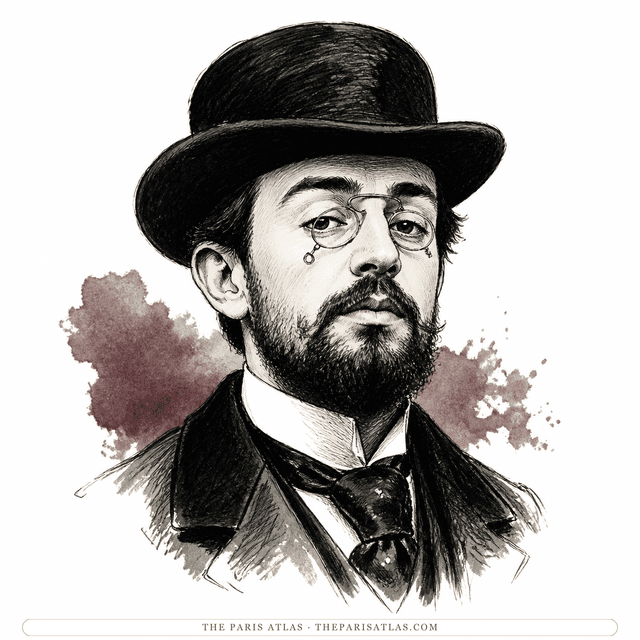
Henri de Toulouse-Lautrec
Aristocrat, painter and printmaker who moved to Montmartre in the 1880s and made its nightlife his single subject. His 1891 Moulin Rouge poster of the dancer La Goulue changed what a poster could be; he died at thirty-six leaving more than five thousand drawings.
View artist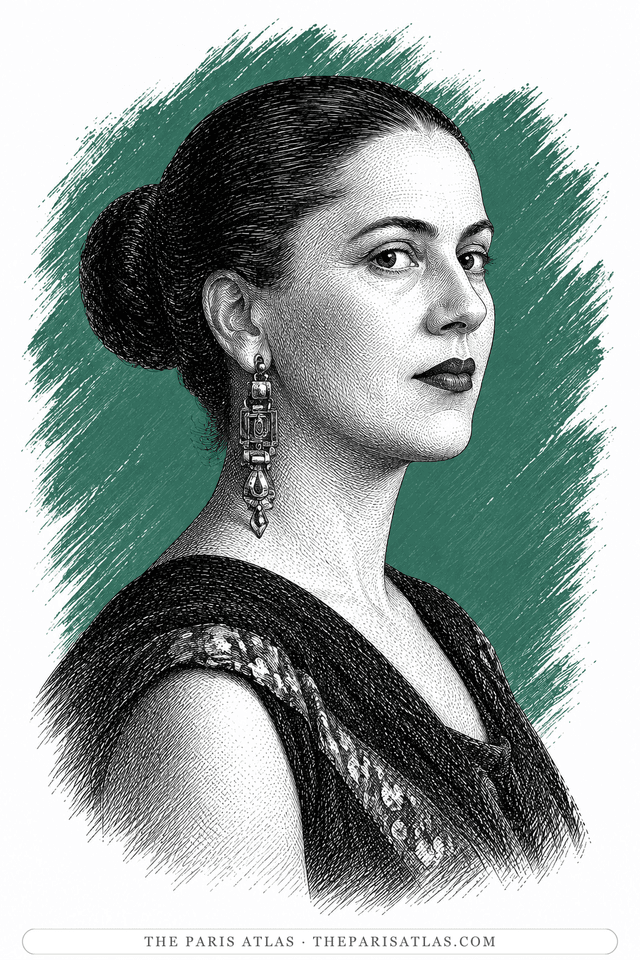
Tarsila do Amaral
Brazilian painter who spent the 1920s moving between São Paulo and Paris, studied Cubism under André Lhote, Albert Gleizes and Fernand Léger, and used what she learned to paint Brazilian towns, railways, plants and bodies. Her 1928 painting Abaporu prompted the manifesto that gave the Anthropophagic movement its name.
View artist
Pierre Bonnard
French painter, printmaker and illustrator whose intimate rooms, Paris streets, gardens and bathing figures transformed everyday life into complex fields of color, memory and perception.
View artist
References
The sources below include collection records, catalogues, scholarly research, and primary materials that informed this page. They document JOB, its making, and its place in cultural history.


1Job (papier à cigarettes): affiche, variante de lettre (ENT DN-1 (MUCHA, Alphonse /2)-FT 6)
WebsiteBibliothèque nationale de France, département Estampes et photographie, on GallicaUsed forWeb source consulted for documented facts and historical context presented on the JOB page.
2Job (papier à cigarettes): affiche, notice bibliographique FRBNF40461224
WebsiteBibliothèque nationale de France, Catalogue généralUsed forWeb source consulted for documented facts and historical context presented on the JOB page.
3Poster for Job cigarette paper (1896)
WebsiteMucha FoundationUsed forWeb source consulted for documented facts and historical context presented on the JOB page.
4Alphonse Mucha Timeline
WebsiteMucha FoundationUsed forWeb source consulted for documented facts and historical context presented on the JOB page.
5Alphonse Mucha, Job, 1897 (167.1968)
WebsiteThe Museum of Modern Art, New YorkUsed forWeb source consulted for documented facts and historical context presented on the JOB page.
6Ferdinand Champenois: the printer’s full name
WebsitePrinceton University Art MuseumUsed forWeb source consulted for documented facts and historical context presented on the JOB page.

7Alphonse Mucha: The Complete Posters and Panels
NonfictionJack Rennert and Alain Weill, 1984Used forPublished analysis and historical context used in preparing the JOB page.
These references provide the documented foundation for this work's history and interpretation. Claim-level citations remain attached to the specific claims they support.
 Explore more resources