Gismonda
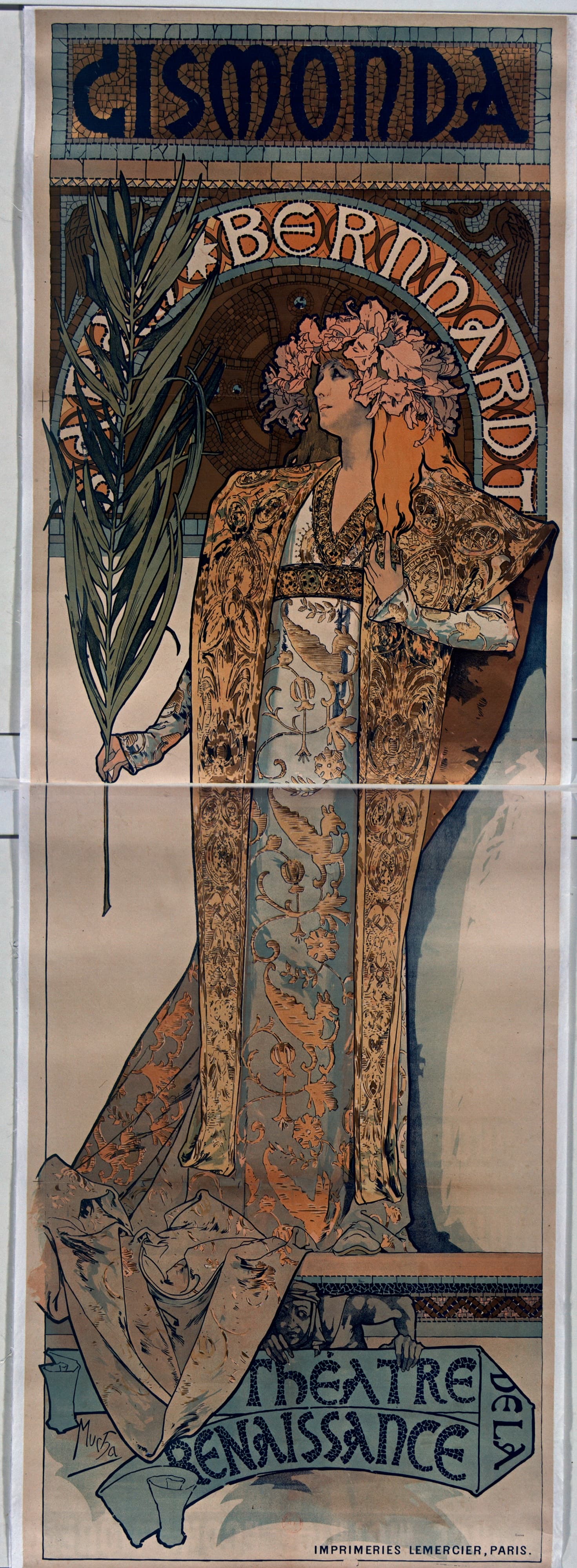
Sarah Bernhardt stands life-size in a robe of gold brocade with a palm branch in her hand, under her own surname set in mosaic letters. Alphonse Mucha designed the poster in the last week of December 1894 for the return of Victorien Sardou's play Gismonda at the Théâtre de la Renaissance. Lemercier printed it, it went up across Paris on 1 January 1895, and it won Mucha a six-year contract with the actress.
- 1894–95
- Color lithograph on two joined sheets
- Bibliothèque nationale de FranceParis, France
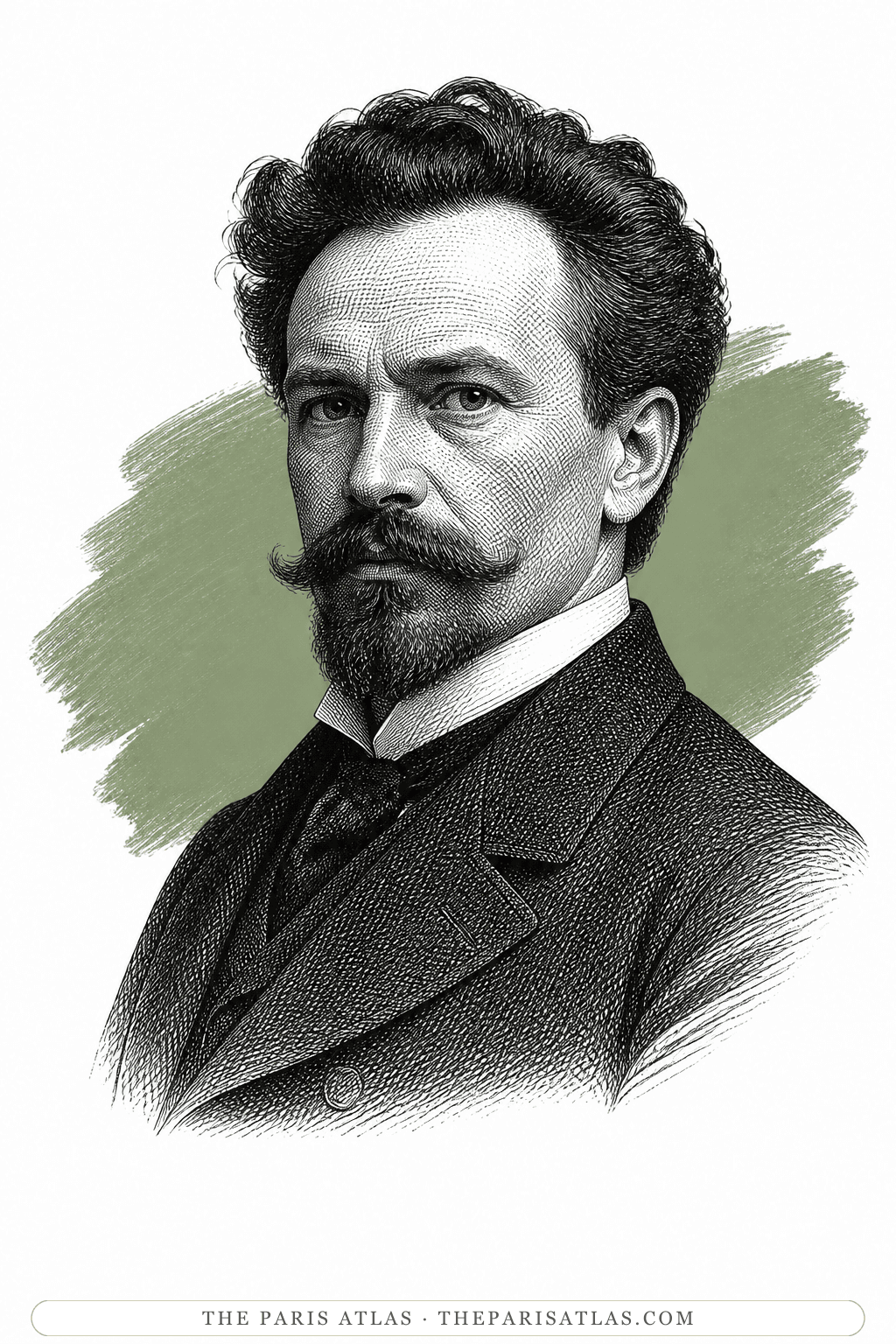
About Alphonse Mucha
What the poster shows
The sheet is more than two meters tall and only 75 centimeters wide, and Sarah Bernhardt fills its full height. She stands facing the viewer with her head turned to her left, in a long robe of gold brocade over a pale under-robe patterned with orange scrolls and flowers. A crown of pink orchids covers her hair, which falls in a red-gold sweep over her shoulder. Her right hand is raised to her chest. Her left holds a tall palm branch whose fronds rise past her head to the top of the arch.
Behind her is a mosaic arch in gold, orange and brown, and a dark blue-gray shadow curves down the right side of the sheet. The word GISMONDA runs across the top in dark blue mosaic capitals on a gold ground. BERNHARDT curves over her head along the arch in cream letters. At the bottom a crouching figure in a cap holds up a pale blue banner reading THÉÂTRE and RENAISSANCE, with DE LA set vertically at its right end.
Mucha signed the sheet at lower left, and the printer's line, IMPRIMERIES LEMERCIER, PARIS., runs along the bottom right. The costume is the one Bernhardt wore in the last act, when Gismonda joins an Easter procession, which is why she carries the palm.
Designed in a week
Victorien Sardou's four-act play Gismonda opened at the Théâtre de la Renaissance in Paris in the autumn of 1894, with Sarah Bernhardt directing and playing the title role. The production needed a new poster for its return on 4 January 1895. On 26 December 1894 Mucha was at the Lemercier printing works, correcting proofs as a favor to a friend, when the last-minute commission came in. The firm's regular artists were away for the holidays, and he took it.
He drew a poster unlike anything on the city's walls: a single tall figure, a subdued palette of golds, olive and pale blue, and an arch behind the head that reads as a halo. It was printed on two sheets joined end to end and went up across Paris on 1 January 1895. The Mucha Foundation records that it caused a sensation and that collectors bribed bill-stickers to get copies.
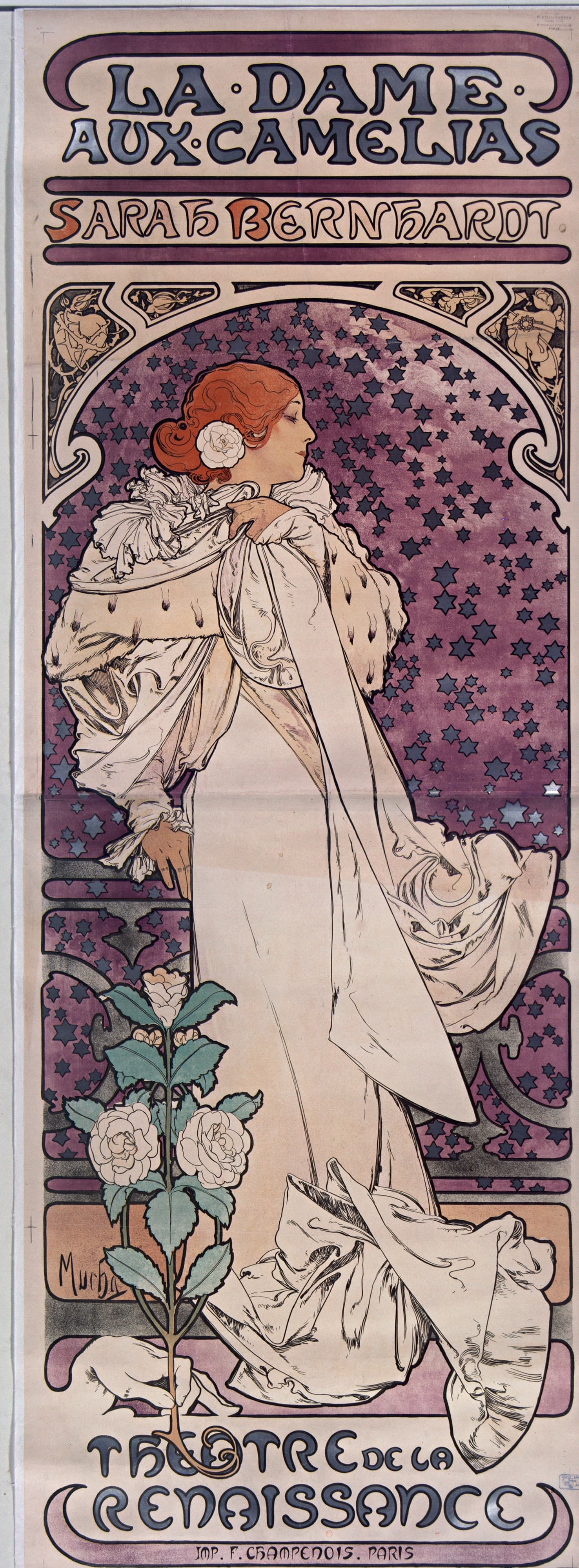
Bernhardt signed Mucha to a six-year contract in 1895, covering posters, stage sets and costumes, and she kept the Gismonda design for her American tour in 1896. Six more theater posters followed under the contract: La Dame aux Camélias and Lorenzaccio in 1896, La Samaritaine in 1897, Médée and La Tosca in 1898, and Hamlet in 1899.
Two sheets from Lemercier
Imprimerie Lemercier of Paris printed the poster, the firm where Mucha was working when the order came. The Art Institute of Chicago describes its copy as a color lithograph in lavender, salmon, cobalt blue, light blue and olive on two sheets of tan wove paper. The join runs across the middle of the design at about the level of Bernhardt's left hand, and it shows on most surviving copies.
Measurements vary a little from copy to copy, as they do for any large poster trimmed and mounted over more than a century. The Bibliothèque nationale de France gives 217 by 75 centimeters, the Art Institute of Chicago 214 by 74, the Victoria and Albert Museum 219.7 by 76.2, and the Musée Carnavalet 220 by 75. The Mucha Foundation gives 216 by 74.2.
The Bibliothèque nationale de France catalogues its copy as a proof of the final printing, and the join of the two sheets shows on it as a line across the middle. Jack Rennert and Alain Weill list the design as number 3 in their 1984 catalogue of Mucha's posters and panels.
Where an original is
Because the poster was printed in quantity, several institutions hold a copy. In Paris, the Bibliothèque nationale de France keeps one in its prints and photographs department at the Richelieu site, under the shelfmark ENT DN-1 (MUCHA, Alphonse /3)-ROUL, consulted in the reading room rather than shown on a wall. The Musée Carnavalet holds another, inventory number AFF1134, acquired in 1952.
The Art Institute of Chicago's copy is reference number 1923.1442, a gift of Mrs. F. W. Gookin, and its record last listed it as not on view. The Victoria and Albert Museum in London holds E.1281-1963, consulted in its Prints and Drawings Study Room. The Mucha Foundation's copy is part of the Mucha Trust Collection.
Close reading
Reading the work, detail by detail
The sheet is seven feet tall and a single figure holds all of it, so the poster reads from a distance as one shape. Close up it is built from lettering, mosaic and pattern: three separate pieces of text, an arch of tesserae, a brocade drawn stroke by stroke, and a join where the two printed sheets meet. The copy is the Bibliothèque nationale de France's proof of the final printing.
1.GISMONDA set in mosaic across the top
The title runs the full width of the sheet in dark blue capitals, each letter built from small tesserae so the word reads as an inlay rather than type. The ground behind it is gold and tan mosaic, edged by a band of pale blue squares. Nothing else on the sheet is lettered this large.
2.BERNHARDT curves along the arch
The actress's surname follows the curve of the arch in cream capitals, beginning with a small white star at the left and ending with the T low on the right side. The letters sit on orange and brown mosaic and are the only text inside the arch. Her first name is not lettered at this size anywhere on the sheet.
3.A crown of pink orchids and a turned head
The head is turned to her left, in three-quarter profile, under a dense crown of pink orchids drawn petal by petal. The hair falls red-gold beneath the flowers over her shoulder. Behind her the mosaic changes from the gold of the arch to a darker brown field set with small blue-green stones.
4.The raised hand and the jeweled belt
Her right hand is raised to the chest with the fingers spread, drawn in outline against the gold brocade of the robe. Below it a belt of round bosses crosses the waist, and the white under-robe shows a small embroidered spray of leaves. The gold brocade on either side is a pattern of scrolls and palmettes drawn in orange and tan.
5.The palm branch held at the hip
The left hand holds the palm's stem at hip height, the sleeve patterned in the same brocade as the robe. The fronds rise from here past the lettering to the top of the arch, olive green against the pale ground. The Mucha Foundation records that the palm belongs to the costume of the last act, when Gismonda joins an Easter procession.
6.The train spreads across the floor
The train of the robe spreads across the lower left of the sheet in heavy folds, patterned in orange scrolls on a pale blue-gray ground. The stem of the palm runs down past it to the floor. The folds are drawn with a dark outline and almost no shading, which keeps the pattern flat.
7.A crouching figure holds up the theater's name
A small crouching figure in a cap holds up the top edge of a pale blue banner with both hands. The banner reads THÉÂTRE on the upper line and RENAISSANCE on the lower, with DE LA set vertically in the tab at the right end. The letters are the same mosaic capitals as the title at the top.
8.The signature at the lower left
Mucha signed in dark blue script at the lower left, below the folds of the train and level with the banner. The signature is drawn in the stone, so it prints on every copy. The printer's line, IMPRIMERIES LEMERCIER, PARIS., is set in small capitals at the opposite corner along the bottom edge.
Timeline
1894
Victorien Sardou's Gismonda opens at the Théâtre de la Renaissance in Paris in the autumn, with Sarah Bernhardt directing and playing the title role.
1894
On 26 December, at the Lemercier printing works to correct proofs for a friend, Mucha takes the last-minute commission for a new Gismonda poster.
1895
The poster goes up on hoardings across Paris on 1 January; the production reopens on 4 January.
1895
Bernhardt signs Mucha to a six-year contract for posters, stage sets and costumes.
1896
Bernhardt reuses the Gismonda design for her American tour.
1923
The Art Institute of Chicago's copy enters the museum as a gift of Mrs. F. W. Gookin, reference number 1923.1442.
1952
The Musée Carnavalet acquires its copy, inventory number AFF1134.
Where to see it
Bibliothèque nationale de France
58 rue de Richelieu, 75002 Paris, France
The posters are kept in the prints and photographs department at the Richelieu site and are not on public display. They are consulted in its reading room with a research pass, and large-format items are seen by appointment only.
Kept in the prints and photographs department at the Richelieu site and consulted in its reading room with a research pass; it is not on public display.
Plan your visit on the museum’s official website (opens in a new tab)Frequently asked questions
What is the Gismonda poster?
A theater poster Alphonse Mucha designed for Sarah Bernhardt in the last week of December 1894, advertising the return of Victorien Sardou's play Gismonda at the Théâtre de la Renaissance in Paris. It shows Bernhardt life-size in her last-act costume, holding a palm branch. It is the poster that made Mucha famous.
When was the Gismonda poster made?
Mucha took the commission on 26 December 1894 at the Lemercier printing works, and the poster was on the walls of Paris on 1 January 1895. Museums date it 1894, 1895 or 1894–95 for that reason. The production it advertised reopened on 4 January 1895.
What does the lettering on the Gismonda poster say?
GISMONDA across the top in mosaic capitals; BERNHARDT curving around the arch over her head; THÉÂTRE DE LA RENAISSANCE on the banner at the foot, with DE LA set vertically; and IMPRIMERIES LEMERCIER, PARIS. along the bottom edge. Mucha's signature is at the lower left.
How big is the Gismonda poster?
About 217 by 75 centimeters, roughly seven feet by two and a half, printed on two sheets joined across the middle. Copies vary by a few centimeters: the Art Institute of Chicago gives 214 by 74 and the Victoria and Albert Museum 219.7 by 76.2.
Why is Sarah Bernhardt holding a palm branch?
It is her costume from the last act of the play, in which Gismonda joins an Easter procession. The Mucha Foundation describes the outfit as that of a Byzantine noblewoman, with an orchid headdress and the palm in her hand.
Where can I see an original Gismonda poster?
In Paris, at the Bibliothèque nationale de France (prints and photographs department, Richelieu site) and the Musée Carnavalet (AFF1134). Elsewhere, at the Art Institute of Chicago (1923.1442), the Victoria and Albert Museum in London (E.1281-1963), and in the Mucha Trust Collection. None of them keeps it on permanent display, so check before traveling.
Did Gismonda really make Mucha famous in a week?
The Mucha Foundation says so: the poster went up on 1 January 1895, caused a sensation, and Sarah Bernhardt signed him to a six-year contract that year. He had been in Paris since 1888 working as an illustrator, and Gismonda was his first poster for her.
Can I reuse the image of the Gismonda poster?
Yes. Alphonse Mucha died in 1939, so the poster is in the public domain worldwide, and the Bibliothèque nationale de France publishes its scan on Gallica as public domain.
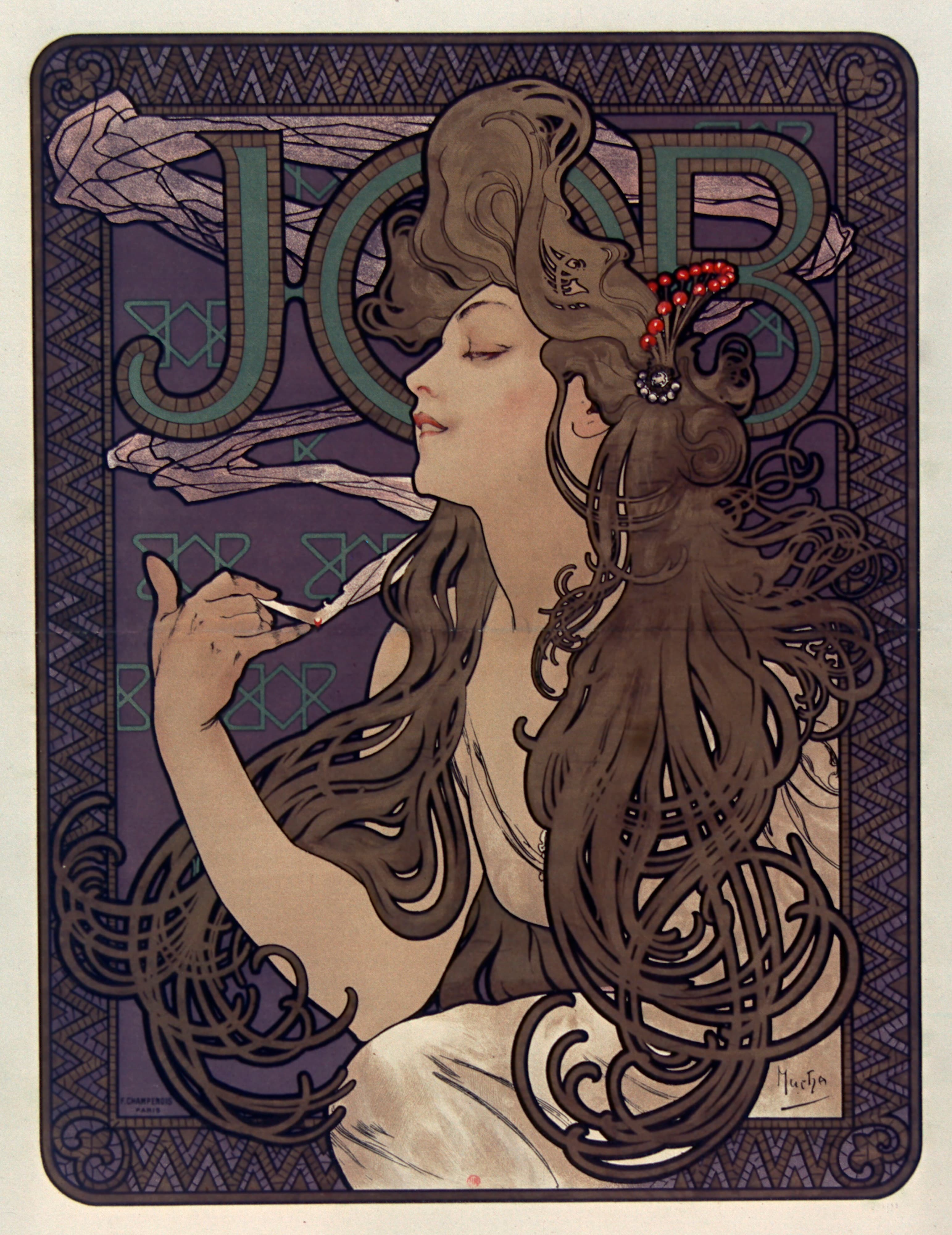
More by Alphonse Mucha
If you like Alphonse Mucha
Explore painters from the same movements and circles.
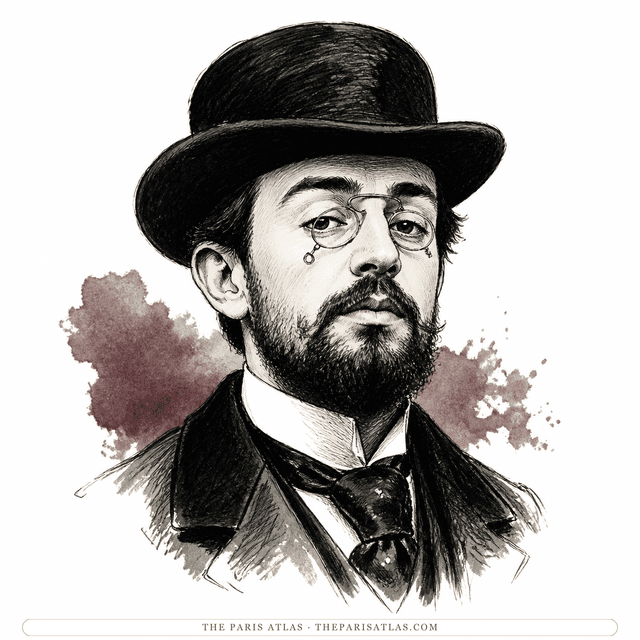
Henri de Toulouse-Lautrec
Aristocrat, painter and printmaker who moved to Montmartre in the 1880s and made its nightlife his single subject. His 1891 Moulin Rouge poster of the dancer La Goulue changed what a poster could be; he died at thirty-six leaving more than five thousand drawings.
View artist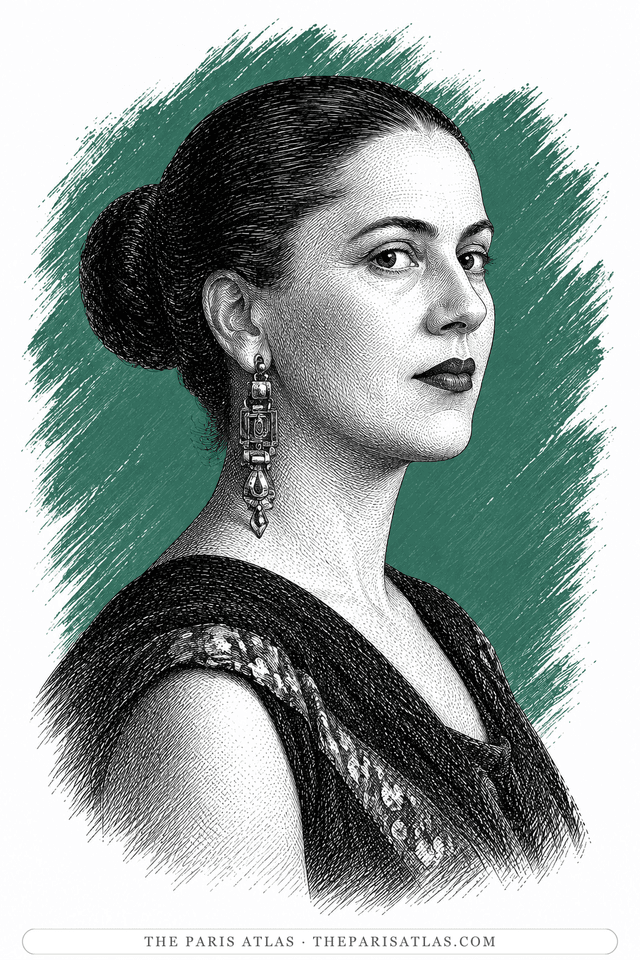
Tarsila do Amaral
Brazilian painter who spent the 1920s moving between São Paulo and Paris, studied Cubism under André Lhote, Albert Gleizes and Fernand Léger, and used what she learned to paint Brazilian towns, railways, plants and bodies. Her 1928 painting Abaporu prompted the manifesto that gave the Anthropophagic movement its name.
View artist
Pierre Bonnard
French painter, printmaker and illustrator whose intimate rooms, Paris streets, gardens and bathing figures transformed everyday life into complex fields of color, memory and perception.
View artist
References
The sources below include collection records, catalogues, scholarly research, and primary materials that informed this page. They document Gismonda, its making, and its place in cultural history.


1Gismonda. Sarah Bernhardt. Théâtre de la Renaissance: affiche, épreuve du tirage définitif (ENT DN-1 (MUCHA, Alphonse /3)-ROUL)
WebsiteBibliothèque nationale de France, département Estampes et photographie, on GallicaUsed forWeb source consulted for documented facts and historical context presented on the Gismonda page.
2Poster for Gismonda
WebsiteMucha FoundationUsed forWeb source consulted for documented facts and historical context presented on the Gismonda page.
3Alphonse Mucha Timeline
WebsiteMucha FoundationUsed forWeb source consulted for documented facts and historical context presented on the Gismonda page.
4Sarah Bernhardt
WebsiteMucha FoundationUsed forWeb source consulted for documented facts and historical context presented on the Gismonda page.
5Alphonse Mucha, La Gismonda (Sarah Bernhardt), 1894/95
WebsiteArt Institute of ChicagoUsed forWeb source consulted for documented facts and historical context presented on the Gismonda page.
6Gismonda, poster by Alphonse Mucha (E.1281-1963)
WebsiteVictoria and Albert MuseumUsed forWeb source consulted for documented facts and historical context presented on the Gismonda page.
7Gismonda / Sarah Bernhardt / Théâtre de la Renaissance, affiche (AFF1134)
WebsiteMusée Carnavalet - Histoire de Paris, Paris MuséesUsed forWeb source consulted for documented facts and historical context presented on the Gismonda page.

8Alphonse Mucha: The Complete Posters and Panels
NonfictionJack Rennert and Alain Weill, 1984Used forPublished analysis and historical context used in preparing the Gismonda page.
These references provide the documented foundation for this work's history and interpretation. Claim-level citations remain attached to the specific claims they support.
 Explore more resources