Paris and the development of her modernist style
When Tarsila returned to Paris at the end of 1922, her artistic priorities had changed. Rather than continuing exclusively within academic painting, she sought direct contact with the avant-garde. During 1923 she studied for short periods with André Lhote, Albert Gleizes, and Fernand Léger. Cubism offered her a means of reorganizing the visible world through geometric construction, selective simplification, and departures from conventional perspective. She later described this training as her “military service in Cubism,” suggesting both its disciplinary importance and its status as a stage through which she passed rather than a permanent artistic allegiance. Her ambition was already national rather than Parisian: writing home from Paris on 19 April 1923, she declared that she wanted to be “the painter of my country.”[7]
Léger's influence is especially apparent in Estudo (Academia nº 2), or Study (Academy No. 2) (1923). The painting constructs the body from rounded, separately articulated masses and places it among simplified forms and vegetation. Rather than dissolving the figure into the fragmented planes associated with some earlier Cubist painting, Tarsila retained its weight and physical presence. This combination of geometric organization, bodily fullness, and vivid color became an important foundation of her independent style. As MoMA's curatorial account emphasizes, she absorbed Cubist methods without becoming a straightforward follower of her teachers.[8]
The Franco-Swiss poet Blaise Cendrars helped introduce Tarsila and Oswald to the Parisian artistic community. Her acquaintances included Constantin Brancusi, Robert and Sonia Delaunay, Pablo Picasso, Jean Cocteau, and Erik Satie, as well as Brazilian figures working in Paris, including Heitor Villa-Lobos and Di Cavalcanti. These relationships placed her within an international exchange involving painting, sculpture, poetry, music, and design.[3]
Tarsila also became an important collector and intermediary. Her collection included works by Léger, Lhote, Gleizes, Juan Gris, Picasso, Marie Laurencin, Modigliani, and Robert Delaunay. She purchased works for other Brazilian collectors, including Mário de Andrade and the patron Olívia Guedes Penteado. When displayed in her São Paulo studio, these acquisitions gave local artists opportunities to study European modernism firsthand. Her role in the movement therefore extended beyond her own paintings to the circulation of artworks and ideas between France and Brazil.[7]
In Autorretrato (Manteau Rouge), Tarsila presented herself as a fashionable, self-possessed modern woman wearing a voluminous red coat. The controlled arrangement of the figure and the prominence of the garment turn personal appearance into an element of artistic self-definition. The painting belongs to the Museu Nacional de Belas Artes in Rio de Janeiro. Her self-presentation had particular significance in a European art world that frequently interpreted women and Latin American artists through restrictive expectations. Critics sometimes described her work in terms of femininity or exoticism rather than treating it solely as an intellectual and formal achievement. Tarsila's cultivated appearance allowed her to work within those expectations while asserting a distinctive identity as a Brazilian participant in the avant-garde. Her self-portraits consequently concern not only individual likeness but also the public identity of the modern artist.[9]
The Pau-Brasil period
From 1924, Tarsila developed the body of work associated with Pau-Brasil. The name is the Portuguese for brazilwood, the dyewood whose export gave the country its name and which colonial Brazil shipped to Europe as raw material. Oswald de Andrade's Pau-Brasil manifesto of 1924 took that history and turned it around. Brazilian culture was to be something the country exported on its own terms, not something assembled out of imports. It is a separate and earlier text from the Anthropophagic manifesto of 1928. A journey to Rio de Janeiro for Carnival and through the historic towns of Minas Gerais, undertaken with Oswald and Cendrars, was particularly important. She studied colonial architecture, religious traditions, ordinary buildings, vegetation, and the relationship between towns and surrounding landscapes. These experiences encouraged her to represent Brazilian subjects through the modern methods she had acquired abroad.[12]
Color became a defining feature of this development. Tarsila later recalled encountering in Minas Gerais the vivid colors she had loved as a child but had been discouraged from using because they were considered provincial. She deliberately reclaimed them, integrating bright pinks, blues, yellows, and greens into rigorously organized compositions. Rural settlements and industrial infrastructure could coexist within the same picture, allowing her to represent Brazil as a country in which older cultural forms and technological modernization remained visibly intertwined.[12]
Carnaval em Madureira (Carnival in Madureira) records a striking encounter between European imagery and Brazilian popular culture. For Carnival, residents of Madureira, on the outskirts of Rio de Janeiro, had constructed a replica of the Eiffel Tower. Tarsila placed this structure within a landscape of houses, figures, rounded hills, and unusual rock formations. The painting's simplified forms and carefully balanced arrangement transform the observed scene without removing its recognizable local character. The imported monument is significant because it has become part of a Brazilian celebration rather than remaining an emblem of distant European authority. The painting can therefore be read as an early visual expression of the cultural transformation that later became central to Anthropophagy.[13]
In Estrada de Ferro Central do Brasil, often abbreviated as E.F.C.B., Tarsila organized railway infrastructure, buildings, and vegetation into a densely constructed composition. Tracks, signals, structural beams, and architectural forms create an interlocking arrangement of verticals, horizontals, and diagonals. The railway is not treated simply as an isolated machine but as part of a changing environment in which industrial development and inherited forms of settlement occupy the same space. Now in the collection of the Museu de Arte Contemporânea da Universidade de São Paulo, it received an acquisition prize at the first São Paulo Biennial in 1951.[14]
A Cuca introduces a more fantastic dimension into Tarsila's Brazilian imagery. The painting depicts a strange creature within an exuberant landscape populated by animals and plants. In a letter to Dulce, Tarsila described the scene as including a frog, an armadillo, and an invented animal, demonstrating that observation and imagination were already closely connected in her work. Rather than constructing a naturalistic account of a forest, she converted its inhabitants into simplified, decorative, and sometimes unclassifiable forms. The painting anticipates the later Anthropophagic period through its unstable boundary between recognizable nature and invention.[15]
Tarsila held her first solo exhibition at Galerie Percier in Paris in 1926, following travels through Greece, Turkey, the Middle East, and Egypt. She married Oswald in São Paulo in October of that year. For the Paris exhibition, she commissioned frames from the Art Deco designer Pierre Legrain, linking the presentation of her paintings to contemporary decorative design. A second solo exhibition at Galerie Percier followed in 1928.[16]
Abaporu and the Anthropophagic movement
In January 1928, Tarsila painted Abaporu as a birthday present for Oswald. The composition shows a solitary figure seated beside a cactus beneath a bright sun. Its anatomy is radically altered: a large foot dominates the foreground, while the head is small and the limbs extend in unexpected proportions. Tarsila later recalled that she had intended to produce something extraordinary enough to surprise him. The painting measures 85 by 73 centimetres and belongs to MALBA, the Museo de Arte Latinoamericano de Buenos Aires.[17]
The title, derived from Tupi terms and generally translated as “person who eats human flesh,” connected the image with the idea of anthropophagy. Oswald's Manifesto Antropófago, published in May 1928, developed cultural cannibalism as a metaphor for the active transformation of external influences. Rather than treating European art as a model to be copied, the movement proposed that imported forms could be appropriated, changed, and incorporated into an independent cultural practice.[17]
The paintings that followed pushed out the recognizable towns and railways of Pau-Brasil. In their place came imaginary landscapes, oversized plants, and creatures hard to name. These pictures describe less and suggest more. Their imagery came from remembered stories, from dreams, and from turning familiar things into unfamiliar ones. That carried the idea of creative assimilation out of cultural theory and into the making of the paintings themselves.[18]
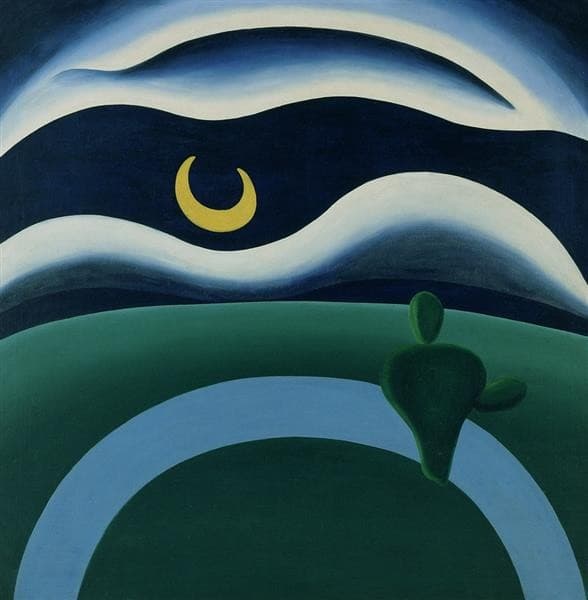
In A Lua (The Moon), a cactus resembling a human figure stands within a landscape of undulating land, water, and sky. The limited number of elements gives the composition an unusual concentration, while the resemblance between plant and body makes the scene difficult to classify as either ordinary landscape or figurative painting. Its clearly defined forms contrast with the uncertainty of what they represent. The work is in the collection of the Museum of Modern Art in New York.[19]
Antropofagia (Anthropophagy) brings together the monumental figure of A Negra and the elongated anatomy of Abaporu. The two figures occupy an environment of transformed cactus and banana-tree forms, creating a close relationship between bodies and vegetation. By combining images from her own earlier paintings, Tarsila made the process of assimilation visible within her artistic development. The work is therefore more than an illustration of Oswald's manifesto. It demonstrates how an artist could revise and recombine an established visual vocabulary to produce something new. The painting is in the Fundação José e Paulina Nemirovsky collection, on loan to the Pinacoteca de São Paulo.[20]
Style and technique
Tarsila's mature style depended on the selective reduction of forms rather than the elimination of recognizable subject matter. Buildings could be organized into rectangular masses, hills into repeated curves, and vegetation into a limited vocabulary of cones, ovals, and rounded volumes. These elements remained identifiable while also serving the internal structure of the composition. Her drawings in pencil and ink were important to this process, allowing her to extract the features of a landscape that could be translated into a coherent pictorial arrangement.[21]
The resulting space was not uniformly flat. Some paintings preserve a strong sense of weight, distance, or bodily volume, while others compress their subjects into shallow arrangements of overlapping shapes. Her relationship to Cubism is therefore best understood as selective rather than doctrinal. She used geometric construction and freedom from conventional perspective while retaining the sensuous presence of figures, plants, and objects.[8]
Color in Tarsila's work functions as both subject matter and structure. Her adoption of bright colors associated with provincial buildings, popular decoration, and remembered rural environments challenged the assumption that such combinations were unsuitable for serious painting. Within the pictures, contrasting areas of color separate forms, establish visual relationships, and guide attention. Their purpose is not always to reproduce the effects of natural illumination.[12]
Clear contours reinforce this organization. In many of her mature paintings, forms are sharply bounded and their surfaces relatively controlled, although this handling differs from the looser brushwork of her early studies. The combination of distinct outlines, broad color areas, and modeled volumes gives her work an unusual balance between decorative clarity and physical solidity. These characteristics help explain why even her most unfamiliar creatures and distorted bodies appear deliberate rather than improvised.[5]
Tarsila used changes in proportion to alter the relationship between the human body and its surroundings. Enlarged feet, reduced heads, elongated limbs, and swelling organic forms undermine ordinary expectations of anatomy and scale. In Abaporu, the foreground foot carries much of the composition's visual weight, while the small head and adjacent cactus create a different balance from that of a conventional seated portrait. In other works, the resemblance between bodies and plants makes the distinction between figure and landscape increasingly uncertain.[17]
The dreamlike character of these paintings has encouraged comparisons with Surrealism, but their sources also include childhood memories, Brazilian stories, and Tarsila's own methods of stylization. Her work should not be reduced to the application of a European movement to tropical subjects. Its imaginative forms developed through an interaction between international artistic experiments and experiences that she repeatedly revisited and transformed.[22]
Financial crisis and the transition to social painting
The financial crisis beginning in 1929 severely affected the coffee-growing economy and Tarsila's family resources. At approximately the same time, her relationship with Oswald broke down as he became involved with the writer Patrícia Galvão, known as Pagu. These events disrupted the material and personal circumstances in which her celebrated paintings of the 1920s had been produced. In November 1929 she mortgaged her property, and she subsequently had to sell much of the European art collection she had assembled.[23]
Composição (Figura só), or Composition (Lonely Figure) (1930), has been interpreted in relation to this period of loss. It depicts a solitary woman with her back to the viewer, standing in a dark landscape as her long hair is swept sideways by the wind. MASP's interpretation treats it as a possible indirect self-portrait, contrasting its isolation and subdued atmosphere with the more expansive imagery of preceding years. In 1930, Tarsila also briefly worked as conservator at the Pinacoteca do Estado de São Paulo, losing the position amid the political changes that brought Getúlio Vargas to power.[23]
In 1931, she traveled to the Soviet Union with her partner Osório César, a psychiatrist and left-wing intellectual, and exhibited at the State Museum of Modern Western Art in Moscow. Her encounters with Soviet society and politically engaged art contributed to a growing interest in labor and social inequality. In 1932, she was imprisoned for approximately a month in Brazil in connection with suspicions surrounding her political associations and Soviet journey. These experiences accompanied a marked change in both the subjects and atmosphere of her painting. She left Paris for the last time in 1932; the years of moving between the two cities were over.[24][16]
Operários (Workers) is the best-known painting of Tarsila's social period. Rows of closely grouped faces rise before an industrial background of buildings and smokestacks, presenting the workforce as both a collective presence and a gathering of individuals. Differences in age, appearance, and complexion evoke the diverse population of industrial São Paulo. At 150 by 205 centimetres it is among her largest canvases. Tarsila explained that she drew on photographs and visual memories of people she knew when constructing the composition, and the faces gathered there carry both the internal migration that filled industrial São Paulo and the arrival of immigrants from abroad.[25]
The state collection's account names several faces from her own circle. Among them are the architect Gregori Warchavchik, the singer Elsie Houston-Péret, the writer Eneida de Moraes, and Benedito Sampaio, an administrator on her father's estate. That changes how the crowd reads. The mass is built out of particular lives rather than a generalized image of labor. The pyramid of heads and the repeated faces also show that compositional order still mattered to her in this more openly political work.[26]
Painted in the same year, Segunda Classe (Second Class) represents impoverished adults and children in a railway setting. It is in a private collection, and no holding institution publishes its measurements. Its emphasis on vulnerable travelers differs substantially from the more affirmative treatment of transport and infrastructure in the Pau-Brasil paintings. The railway remains a sign of modern society, but attention has shifted toward the people whose circumstances are shaped by economic inequality. Read alongside Operários, the painting demonstrates that Tarsila's social turn involved more than replacing fantastic subjects with realistic ones.[24]


 View source