Médée
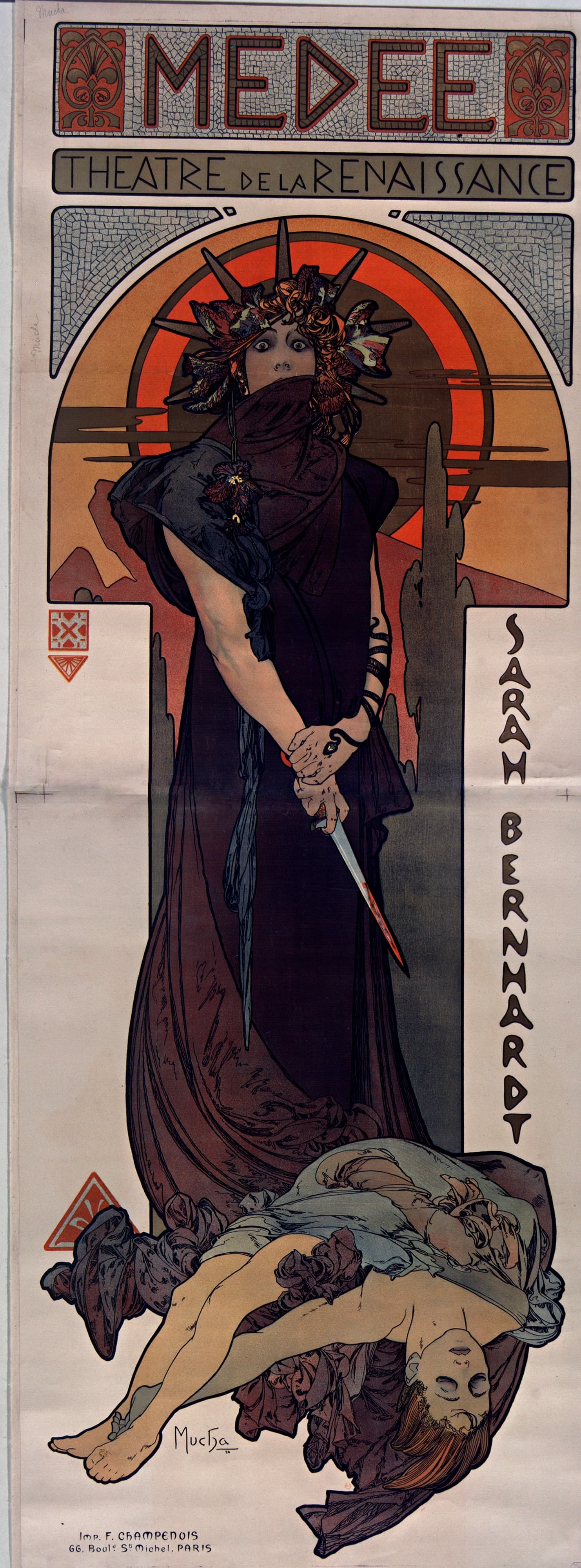
Sarah Bernhardt as Medea stares out wide-eyed over a dark veil, a bloodied dagger in her clasped hands and a dead child at her feet, against a red sunset framed by a mosaic arch. Alphonse Mucha designed the poster for Catulle Mendès's Médée, which opened at the Théâtre de la Renaissance on 28 October 1898, and F. Champenois printed it. The snake coiled on her forearm became the model for the bracelet the jeweler Georges Fouquet made for Bernhardt.
- 1898
- Color lithograph
- Bibliothèque nationale de FranceParis, France
About Alphonse Mucha
What the poster shows
Bernhardt stands facing the viewer in a dark robe that falls straight to the ground, a dark veil drawn across her mouth and nose. Her eyes are wide and fixed on the viewer. A crown of dark spikes radiates around her head, set with flowers and feathers in dark red, blue and cream, and her hair shows red-gold beneath it. Behind her head an orange-red sun sits in concentric rings inside a round arch, with bands of cloud across it and a brown landscape with dark spires below.
Her bare arms are crossed low in front of her, both hands clasped on the hilt of a dagger that points to the ground. The blade carries streaks of red toward its tip, and there are drops of red on her hands. A snake coils in dark bands up her left forearm, its head at the wrist. At her feet lies a child, the body wrapped in blue-gray and brown drapery, the head hanging back toward the viewer with the eyes closed and red-gold hair spilling down.
MEDEE is lettered across the top in gray mosaic capitals with a triangular D, between two square panels of red palmettes, and THEATRE DE LA RENAISSANCE runs in a band beneath it. SARAH BERNHARDT is printed letter by letter down the right margin. Two small red devices, a mosaic square and a triangle, sit in the left margin, with another red triangle lower down. Mucha signed the sheet at the bottom left beside the child's feet, and the printer's line reads Imp. F. CHAMPENOIS, 66. Boul'd St Michel, PARIS.
Mendès's Médée, October 1898
Catulle Mendès wrote Médée as a three-act tragedy in verse for Bernhardt, reworking the Greek story of Medea, who kills her two children when her husband Jason abandons her. It opened at the Théâtre de la Renaissance on 28 October 1898 with Bernhardt as Médée, Albert Darmont as Jason and Blanche Dufrêne as Callidice, with music by Vincent d'Indy. Bernhardt and Maurice Grau were the directors.
The Mucha Foundation counts the poster among the six Mucha made for Bernhardt's productions after Gismonda, under the six-year contract of 1895. It keeps the format of the earlier ones, a single standing figure in a tall shallow alcove, and the Foundation describes the stylized landscape behind her as showing the influence of the fashion for Japanese prints.
The snake bracelet
The bracelet coiled on Bernhardt's forearm was drawn before it existed. The Mucha Foundation records that it was the prototype for the snake bracelet with a ring that the jeweler Georges Fouquet made for Bernhardt to Mucha's design in 1899, now in the Sakai City collection in Japan. Mucha began working with Fouquet in 1899, and in 1901 he designed the interior of the jeweler's Paris shop, which the Musée Carnavalet has since reconstructed.
Champenois, and where an original is
F. Champenois printed the poster at 66 boulevard Saint-Michel, the address on the sheet. The Bibliothèque nationale de France measures its copy at 210 by 78 centimeters and cites number 53 in Jack Rennert and Alain Weill's catalogue. The Mucha Foundation gives 206 by 76 for the Mucha Trust's copy, and the Museum of Modern Art in New York 206.4 by 76.2 for its own. On the BnF's copy a join runs across the middle of the sheet at the level of the dagger's hilt.
The BnF keeps its copy in the prints and photographs department at the Richelieu site, shelfmark ENT DN-1 (MUCHA, Alphonse /2)-ROUL, consulted in the reading room rather than shown on a wall. MoMA's copy is object number 2280.1967, a gift of Joseph H. Heil, in its Architecture and Design department.
Close reading
Reading the work, detail by detail
The other Bernhardt posters are still; this one is the moment after a killing. Close up, Mucha keeps the same tall format, mosaic lettering and single standing figure, and fills it with a wide-eyed stare, a bloodied blade, a snake on the arm and a child's face hanging upside down at the foot of the sheet. The copy is the Bibliothèque nationale de France's.
1.MEDEE with a triangular D
The title is set in gray mosaic capitals across the top, the D drawn as a triangle so the word reads MEDEE with a spike in the middle. Square panels of red palmettes close each end. There are no accents; the mosaic lettering does not carry them.
2.Wide eyes over the veil
The eyes are wide open and fixed on the viewer, the only part of the face not covered by the dark veil. Around the head a crown of dark spikes radiates outward, set with flowers and feathers in dark red, blue and cream, with red-gold hair showing beneath. Behind it the sun is drawn as concentric rings of orange-red and tan inside the arch.
3.Cloud bands and dark spires
Dark horizontal bands of cloud cross the sun on the right, and beneath them a landscape of brown and pink hills rises to tall dark spires drawn like cypresses. The Mucha Foundation describes the stylized landscape as showing the fashion for Japanese prints. None of the other Bernhardt posters has a landscape behind the figure.
4.The snake on her forearm
A snake coils in dark bands up the bare left forearm, its head resting at the wrist. The Mucha Foundation records that this drawing was the prototype for the snake bracelet with a ring that Georges Fouquet made for Bernhardt in 1899. The arm is one of the few pale passages on the dark figure.
5.A bloodied blade held point down
Both hands are clasped on the hilt with the blade pointing straight down, the pale steel streaked with red toward the tip and the hands spotted with red. The hands are drawn in outline with the knuckles marked. The join of the two printed sheets runs across the design at this height.
6.SARAH BERNHARDT down the right margin
The actress's name is printed letter by letter down the right margin in dark gray capitals, SARAH above BERNHARDT, on the cream of the paper outside the picture. It is the only lettering on the sheet outside the top panels and the imprint. The dark robe runs beside it the whole way down.
7.The child's head hangs back
The child lies across the foot of the sheet with the head hanging back toward the viewer, the eyes closed and the mouth slightly open, red-gold hair spilling down. The body is wrapped in blue-gray and brown drapery, and the bare legs stretch to the left. In the play Medea kills both her children; the poster shows one.
8.The printer's address
The imprint at the lower left gives the printer and his address on two lines: Imp. F. CHAMPENOIS, then 66. Boul'd St Michel, PARIS. Mucha's signature sits above and to the right, beside the child's feet. Champenois printed Mucha's Bernhardt posters after Gismonda, which Lemercier had printed.
Timeline
1895
Sarah Bernhardt signs Mucha to a six-year contract for posters, stage sets and costumes, after his Gismonda poster.
1898
Catulle Mendès's Médée opens at the Théâtre de la Renaissance on 28 October with Bernhardt in the title role; Mucha's poster is printed by F. Champenois.
1899
Mucha begins working with the jeweler Georges Fouquet, who makes the snake bracelet with a ring for Bernhardt from the design on the poster.
1901
Mucha designs the interior of Fouquet's Paris shop.
1967
Joseph H. Heil gives the Museum of Modern Art its copy, object number 2280.1967.
Where to see it
Bibliothèque nationale de France
58 rue de Richelieu, 75002 Paris, France
The posters are kept in the prints and photographs department at the Richelieu site and are not on public display. They are consulted in its reading room with a research pass, and large-format items are seen by appointment only.
Kept in the prints and photographs department at the Richelieu site and consulted in its reading room with a research pass; it is not on public display.
Plan your visit on the museum’s official website (opens in a new tab)Frequently asked questions
What does Mucha's Médée poster show?
Sarah Bernhardt as Medea, facing the viewer with wide eyes over a dark veil, a crown of dark spikes on her head, a bloodied dagger held point-down in her clasped hands, and a dead child lying at her feet. Behind her a red sun sets inside a mosaic arch.
Which play was the poster for?
Médée, a three-act verse tragedy by Catulle Mendès with music by Vincent d'Indy, which opened at the Théâtre de la Renaissance in Paris on 28 October 1898. Bernhardt played Médée, Albert Darmont Jason and Blanche Dufrêne Callidice.
What is the snake on her arm?
A bracelet Mucha drew for the poster. The Mucha Foundation records that it became the prototype for the snake bracelet with a ring that the jeweler Georges Fouquet made for Bernhardt in 1899, now in the Sakai City collection in Japan.
What does the lettering say?
MEDEE in mosaic capitals across the top, THEATRE DE LA RENAISSANCE in the band beneath, SARAH BERNHARDT letter by letter down the right margin, and the printer's line Imp. F. CHAMPENOIS, 66. Boul'd St Michel, PARIS at the lower left. Mucha signed it at the bottom left beside the child's feet.
How big is the Médée poster?
About 210 by 78 centimeters, close to seven feet tall, in the same tall narrow format as Mucha's other Bernhardt posters. The Museum of Modern Art gives 206.4 by 76.2 for its copy and the Mucha Foundation 206 by 76.
Where can I see an original?
The Bibliothèque nationale de France in Paris holds one in its prints and photographs department at the Richelieu site, the Museum of Modern Art in New York holds 2280.1967, and the Mucha Trust Collection holds another. None is on permanent display, so check before traveling.
Can I reuse the image?
Yes. Alphonse Mucha died in 1939, so the poster is in the public domain worldwide, and the Bibliothèque nationale de France publishes its scan on Gallica as public domain.
More by Alphonse Mucha
If you like Alphonse Mucha
Explore painters from the same movements and circles.
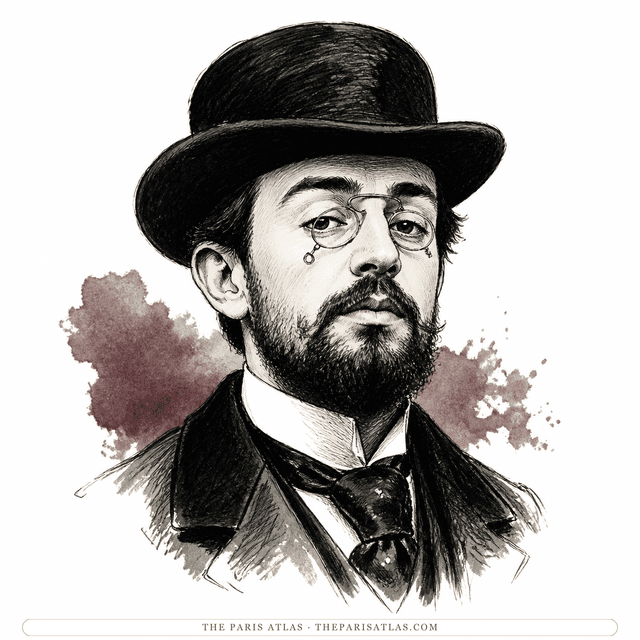
Henri de Toulouse-Lautrec
Aristocrat, painter and printmaker who moved to Montmartre in the 1880s and made its nightlife his single subject. His 1891 Moulin Rouge poster of the dancer La Goulue changed what a poster could be; he died at thirty-six leaving more than five thousand drawings.
View artist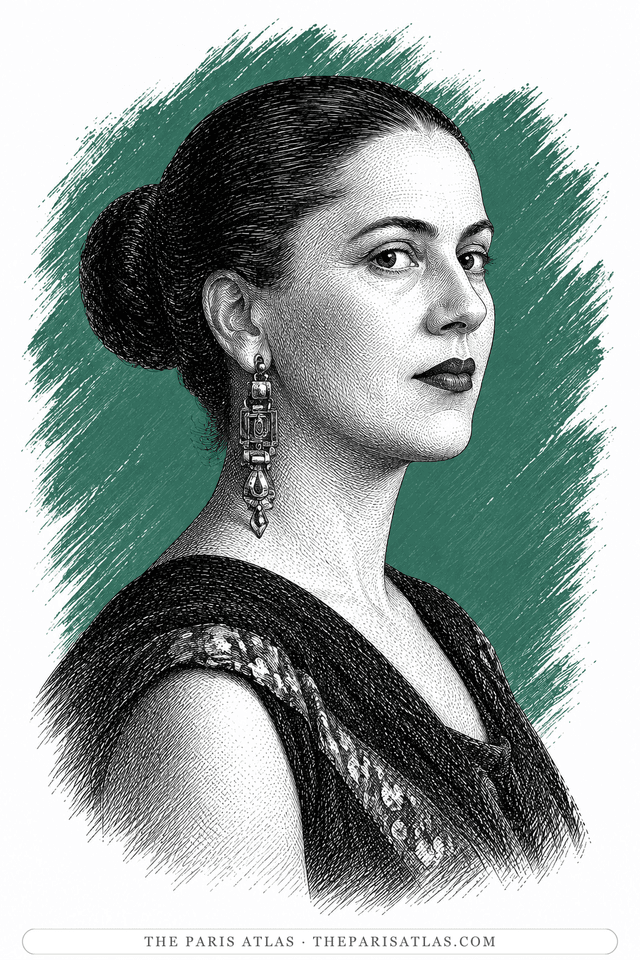
Tarsila do Amaral
Brazilian painter who spent the 1920s moving between São Paulo and Paris, studied Cubism under André Lhote, Albert Gleizes and Fernand Léger, and used what she learned to paint Brazilian towns, railways, plants and bodies. Her 1928 painting Abaporu prompted the manifesto that gave the Anthropophagic movement its name.
View artist
Pierre Bonnard
French painter, printmaker and illustrator whose intimate rooms, Paris streets, gardens and bathing figures transformed everyday life into complex fields of color, memory and perception.
View artist
References
The sources below include collection records, catalogues, scholarly research, and primary materials that informed this page. They document Médée, its making, and its place in cultural history.


1Médée. Théâtre de la Renaissance. Sarah Bernhardt: affiche (ENT DN-1 (MUCHA, Alphonse /2)-ROUL)
WebsiteBibliothèque nationale de France, département Estampes et photographie, on GallicaUsed forWeb source consulted for documented facts and historical context presented on the Médée page.
2Médée, tragédie en trois actes de Catulle Mendès, musique de Vincent d'Indy: notice de spectacle, Théâtre de la Renaissance, 28 octobre 1898
WebsiteBibliothèque nationale de France, Catalogue généralUsed forWeb source consulted for documented facts and historical context presented on the Médée page.
3Poster for Médée (1898)
WebsiteMucha FoundationUsed forWeb source consulted for documented facts and historical context presented on the Médée page.
4Sarah Bernhardt
WebsiteMucha FoundationUsed forWeb source consulted for documented facts and historical context presented on the Médée page.
5Alphonse Mucha Timeline
WebsiteMucha FoundationUsed forWeb source consulted for documented facts and historical context presented on the Médée page.
6Alphonse Mucha, Medée (Medea), poster for a performance by Sarah Bernhardt at the Théâtre de la Renaissance, 1898 (2280.1967)
WebsiteThe Museum of Modern Art, New YorkUsed forWeb source consulted for documented facts and historical context presented on the Médée page.
7The Fouquet shop: design, dismantling and reconstruction
WebsiteMucha FoundationUsed forWeb source consulted for documented facts and historical context presented on the Médée page.

8Alphonse Mucha: The Complete Posters and Panels
NonfictionJack Rennert and Alain Weill, 1984Used forPublished analysis and historical context used in preparing the Médée page.
These references provide the documented foundation for this work's history and interpretation. Claim-level citations remain attached to the specific claims they support.
 Explore more resources