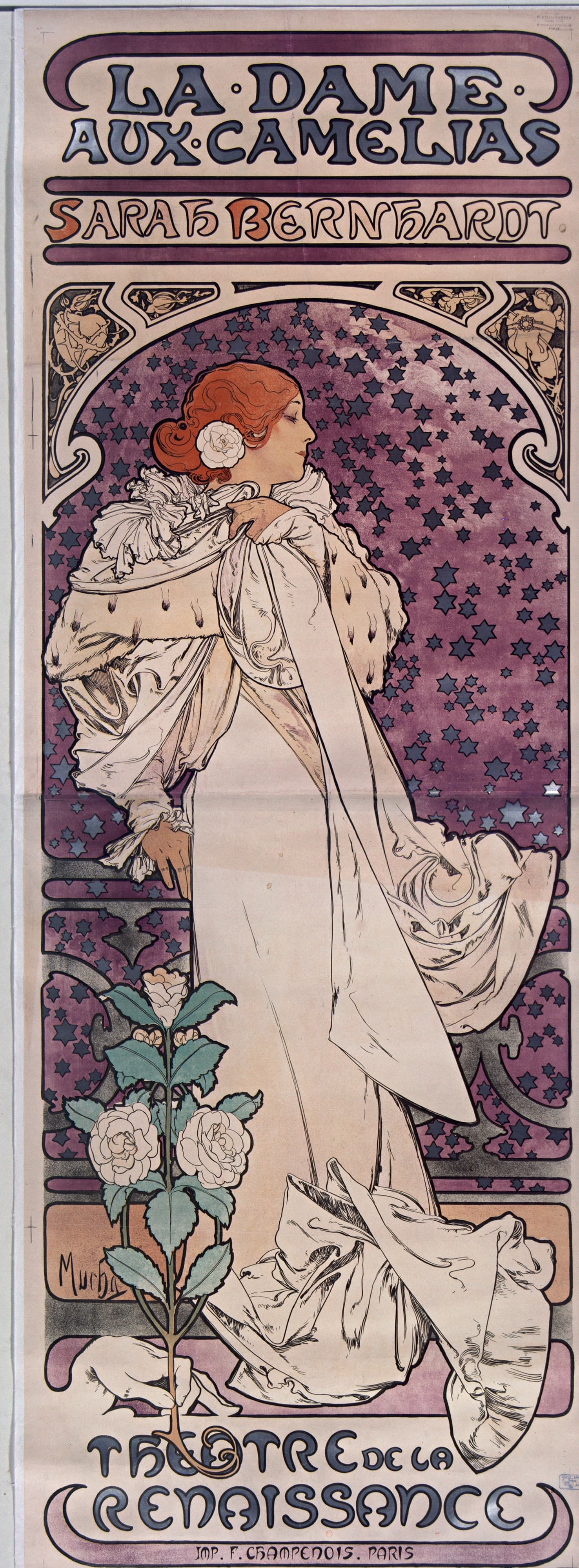
La Dame aux Camélias
Sarah Bernhardt stands in profile in a long white gown and a fur-trimmed cape against a mauve ground scattered with silver stars, a white camellia in her red hair. Alphonse Mucha made the poster in 1896 for her revival of Alexandre Dumas fils's play at the Théâtre de la Renaissance, under the six-year contract she had signed with him the year before. F. Champenois printed it on two sheets, and a hand at the foot of the sheet holds up a second camellia.
- 1896
- Color lithograph with metallic ink on two joined sheets
- Bibliothèque nationale de FranceParis, France
About Alphonse Mucha
What the poster shows
Sarah Bernhardt stands in profile facing right with her eyes lowered, her red hair gathered at the nape and a white camellia over the ear. She wears a long white gown with a deep ruffled collar and a cape whose cream fur is spotted with black tails, the way ermine is drawn. Her right hand rests on the cape at her chest; her left hangs at her side in a frilled cuff. The cape and the gown's train sweep out to the right in long loops of drapery.
Behind her is a mauve field scattered with six-pointed stars, printed in a metallic ink that reads gray-blue on the Bibliothèque nationale de France's copy, framed by an arch. The top of the sheet carries LA·DAME·AUX·CAMELIAS in two lines of gray-blue capitals, then SARAH BERNHARDT in cream letters on a mauve band, with the S and the B picked out in red. Two small panels above the arch each show a heart pierced by a thorny rose stem.
At lower left a tall camellia stem rises from a hand drawn in outline at the edge of the sheet: two open white blooms below and a bud at the top, with dark green leaves. Mucha's signature sits just above the hand. The lower band reads THEATRE DE LA RENAISSANCE, and IMP. F. CHAMPENOIS. PARIS runs along the bottom edge. A small printer's stamp for F. Champenois is printed at the top right corner.
The Mucha Foundation reads the flower held up from below as a sign of death and the pierced hearts as the sacrifice of love in the play. The picture itself gives only the objects: a woman in white, stars, a flower in her hair and a flower offered from below.
Bernhardt's key role
The play is La Dame aux Camélias by Alexandre Dumas fils, the son of the novelist Alexandre Dumas, adapted from his own novel of 1848. Its heroine, Marguerite Gautier, is a Paris courtesan dying of consumption who gives up the man she loves. The Victoria and Albert Museum calls the role one of Bernhardt's greatest successes, and the Mucha Foundation records that she regarded the play as the key drama in her repertoire.
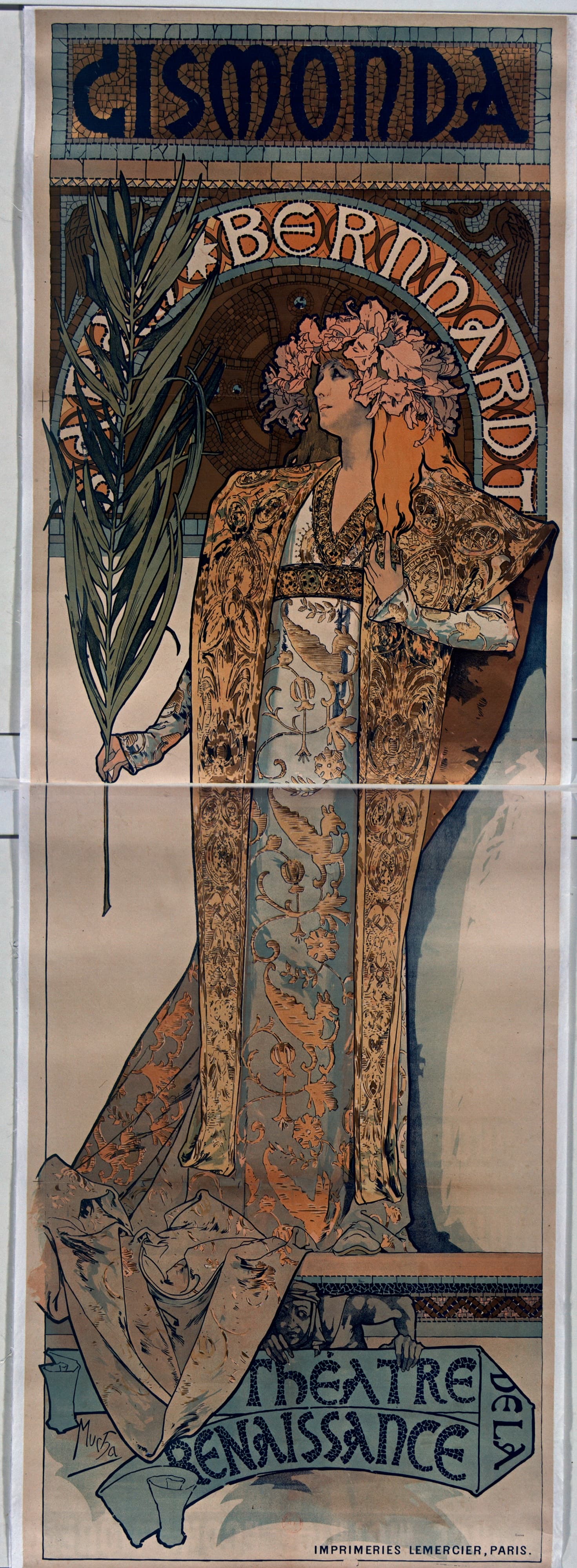
Bernhardt revived the play at the Théâtre de la Renaissance in 1896, and the poster was made for that production. She had signed Mucha to a six-year contract in 1895, after his Gismonda poster, covering posters, stage sets and costumes. The Mucha Foundation lists La Dame aux Camélias and Lorenzaccio as the two posters of 1896, and records that she went on using the design for her American tours of 1905–06 and 1910–11.
Champenois and the silver stars
The printer was F. Champenois of 66 boulevard Saint-Michel, whose name is on the bottom edge and in the small stamp at the top right corner. Mucha signed a contract with Ferdinand Champenois in 1896, and the firm printed most of his Paris posters and panels from then on. The Museum of Fine Arts, Boston describes its copy as printed in five colors on two sheets of paper, and the V&A notes the use of metallic ink, which is the silver of the stars.
The Bibliothèque nationale de France measures its copy at 210 by 80 centimeters. The MFA Boston gives 209.6 by 76.2, the V&A 208.5 by 78.5, and the Mucha Foundation 207.3 by 76.2. Jack Rennert and Alain Weill catalogue the design as number 13. On the BnF's copy the join of the two sheets shows as a line across the middle, just below Bernhardt's hanging hand.
Where an original is
The Bibliothèque nationale de France keeps its copy in the prints and photographs department at the Richelieu site, shelfmark ENT DN-1 (MUCHA, Alphonse /1)-ROUL, consulted in the reading room rather than shown on a wall. The Library of Congress in Washington holds one in its Prints and Photographs Division.
The Museum of Fine Arts, Boston holds accession number 1970.514, a gift of Charles Sumner Bird in November 1970, last listed as not on view. The Victoria and Albert Museum in London holds E.515-1939, given by Noel D. Sheffield. The Mucha Foundation's copy is in the Mucha Trust Collection.
Close reading
Reading the work, detail by detail
The poster is white on mauve: a woman in white against a field of stars, with a white flower in her hair and another offered from the bottom edge. Close up, the stars are printed in a metallic ink, the fur of the cape is drawn as ermine, and the only things in strong color are the red hair and two red initials. The copy is the Bibliothèque nationale de France's, printed on two sheets.
1.The title in two lines of capitals
The title takes two lines at the top of the sheet, LA·DAME· above AUX·CAMELIAS, in gray-blue capitals with dots between the words. The letters are drawn with rounded, uneven forms rather than set from type. A rounded cartouche outlined in mauve encloses both lines.
2.A heart pierced by thorny stems
Each of the two small panels above the arch holds a heart shape crossed by thorny rose stems, with a bud at the top. The Mucha Foundation reads them as the sacrifice of love in the play. They are drawn in outline in cream and dark brown and are easy to miss beside the stars.
3.The camellia over the ear
The face is in strict profile facing right with the eyes lowered. The red hair, the strongest color on the sheet, is gathered into a loose chignon at the nape with a white camellia over the ear. Below the chin the deep ruffled collar begins, and her right hand rests on the cape at her chest.
4.Fur drawn as ermine
The cape's fur is cream, spotted with black tails in the way ermine is conventionally drawn, and its edge is a soft fringe of strokes. Below it the white gown falls in folds drawn in a single dark outline. The fur is the only passage on the sheet with texture rather than pattern.
5.Stars in metallic ink
The stars are six-pointed and come in several sizes, scattered without a grid across the mauve ground. They were printed in a metallic ink, which the Victoria and Albert Museum notes on its copy; on the Bibliothèque nationale de France's sheet the silver has dulled to gray-blue. The mauve behind them varies from pale to deep.
6.Two blooms and a bud
The stem carries two open white double blooms low down and a bud higher up, with dark green leaves drawn in outline. It stands in front of the lower star field and a dark band. The Mucha Foundation reads this second camellia as a sign of death, set against the living one in her hair.
7.A hand from the edge of the sheet
A pale hand enters from the left edge of the sheet, drawn in outline with no body behind it, and holds the stem between finger and thumb. Mucha's signature is written in dark script just above it, in the mauve band. The stem runs up from the hand into the flowers.
8.The theater's name and the printer's line
THEATRE DE LA and RENAISSANCE fill the cartouche at the foot in the same gray-blue capitals as the title, DE LA set smaller. Under them IMP. F. CHAMPENOIS. PARIS runs in small capitals along the mauve bottom band. Champenois's name appears again in a tiny stamp at the top right corner of the sheet.
Timeline
1848
Alexandre Dumas fils publishes the novel La Dame aux Camélias, on which his play is based.
1895
Sarah Bernhardt signs Mucha to a six-year contract for posters, stage sets and costumes, after his Gismonda poster.
1896
Bernhardt revives La Dame aux Camélias at the Théâtre de la Renaissance; Mucha designs the poster and F. Champenois prints it on two sheets.
1905–06
Bernhardt uses the design for her American tour, and again on the tour of 1910–11.
1939
Noel D. Sheffield gives the Victoria and Albert Museum its copy, E.515-1939.
1970
Charles Sumner Bird gives the Museum of Fine Arts, Boston its copy, accessioned on 10 November as 1970.514.
Where to see it
Bibliothèque nationale de France
58 rue de Richelieu, 75002 Paris, France
The posters are kept in the prints and photographs department at the Richelieu site and are not on public display. They are consulted in its reading room with a research pass, and large-format items are seen by appointment only.
Kept in the prints and photographs department at the Richelieu site and consulted in its reading room with a research pass; it is not on public display.
Plan your visit on the museum’s official website (opens in a new tab)Frequently asked questions
What does Mucha's La Dame aux Camélias poster show?
Sarah Bernhardt in profile in a white gown and a fur-trimmed cape, a white camellia in her red hair, against a mauve ground full of silver stars. At the foot of the sheet a hand holds up a camellia stem with two open blooms and a bud. The lettering names the play, the actress and the Théâtre de la Renaissance.
Who is Sarah Bernhardt playing?
Marguerite Gautier, the courtesan in Alexandre Dumas fils's play La Dame aux Camélias, adapted from his 1848 novel. The Victoria and Albert Museum calls it one of her greatest successes, and she revived it at the Théâtre de la Renaissance in 1896, the production the poster advertises.
What do the camellia and the hearts mean?
The Mucha Foundation reads the second camellia, held up by a hand at the foot of the sheet, as a sign of death. It reads the hearts pierced by thorny rose stems in the two panels at the top as the sacrifice of love. The camellia in her hair is the flower of the title.
How big is the poster?
About 210 by 80 centimeters, close to seven feet tall, printed on two sheets joined across the middle. The Museum of Fine Arts, Boston gives 209.6 by 76.2 for its copy and the Victoria and Albert Museum 208.5 by 78.5.
What does the lettering say?
LA·DAME·AUX·CAMELIAS in two lines at the top, SARAH BERNHARDT on the band below it, THEATRE DE LA RENAISSANCE across the foot, and IMP. F. CHAMPENOIS. PARIS along the bottom edge. Mucha signed it at the lower left, above the hand holding the flower.
Who printed the poster?
F. Champenois of 66 boulevard Saint-Michel, Paris. Mucha signed a contract with Ferdinand Champenois in 1896, and the firm went on to print most of his posters, decorative panels, calendars and postcards.
Where can I see an original?
The Bibliothèque nationale de France in Paris, the Library of Congress in Washington, the Museum of Fine Arts, Boston (1970.514), the Victoria and Albert Museum in London (E.515-1939) and the Mucha Trust Collection all hold copies. None is on permanent display, so check before traveling.
Can I reuse the image?
Yes. Alphonse Mucha died in 1939, so the poster is in the public domain worldwide, and the Bibliothèque nationale de France publishes its scan on Gallica as public domain.
More by Alphonse Mucha
If you like Alphonse Mucha
Explore painters from the same movements and circles.

Henri de Toulouse-Lautrec
Aristocrat, painter and printmaker who moved to Montmartre in the 1880s and made its nightlife his single subject. His 1891 Moulin Rouge poster of the dancer La Goulue changed what a poster could be; he died at thirty-six leaving more than five thousand drawings.
View artist
Tarsila do Amaral
Brazilian painter who spent the 1920s moving between São Paulo and Paris, studied Cubism under André Lhote, Albert Gleizes and Fernand Léger, and used what she learned to paint Brazilian towns, railways, plants and bodies. Her 1928 painting Abaporu prompted the manifesto that gave the Anthropophagic movement its name.
View artist
Pierre Bonnard
French painter, printmaker and illustrator whose intimate rooms, Paris streets, gardens and bathing figures transformed everyday life into complex fields of color, memory and perception.
View artist
References
The sources below include collection records, catalogues, scholarly research, and primary materials that informed this page. They document La Dame aux Camélias, its making, and its place in cultural history.


1La Dame aux Camélias. Sarah Bernhardt. Théâtre de la Renaissance: affiche (ENT DN-1 (MUCHA, Alphonse /1)-ROUL)
WebsiteBibliothèque nationale de France, département Estampes et photographie, on GallicaUsed forWeb source consulted for documented facts and historical context presented on the La Dame aux Camélias page.
2Poster for La Dame aux Camélias (1896)
WebsiteMucha FoundationUsed forWeb source consulted for documented facts and historical context presented on the La Dame aux Camélias page.
3Sarah Bernhardt
WebsiteMucha FoundationUsed forWeb source consulted for documented facts and historical context presented on the La Dame aux Camélias page.
4Alphonse Mucha Timeline
WebsiteMucha FoundationUsed forWeb source consulted for documented facts and historical context presented on the La Dame aux Camélias page.
5La Dame aux Camélias, poster by Alphonse Mucha (E.515-1939)
WebsiteVictoria and Albert MuseumUsed forWeb source consulted for documented facts and historical context presented on the La Dame aux Camélias page.
6La Dame aux Camélias / Sarah Bernhardt / Théâtre de la Renaissance (1970.514)
WebsiteMuseum of Fine Arts, BostonUsed forWeb source consulted for documented facts and historical context presented on the La Dame aux Camélias page.
7La dame aux camelias, Sarah Bernhardt, Théâtre de la Renaissance / Mucha (poster)
WebsiteLibrary of Congress, Prints and Photographs DivisionUsed forWeb source consulted for documented facts and historical context presented on the La Dame aux Camélias page.
8Ferdinand Champenois: the printer’s full name
WebsitePrinceton University Art MuseumUsed forWeb source consulted for documented facts and historical context presented on the La Dame aux Camélias page.

9Alphonse Mucha: The Complete Posters and Panels
NonfictionJack Rennert and Alain Weill, 1984Used forPublished analysis and historical context used in preparing the La Dame aux Camélias page.
These references provide the documented foundation for this work's history and interpretation. Claim-level citations remain attached to the specific claims they support.
 Explore more resources