Zodiac
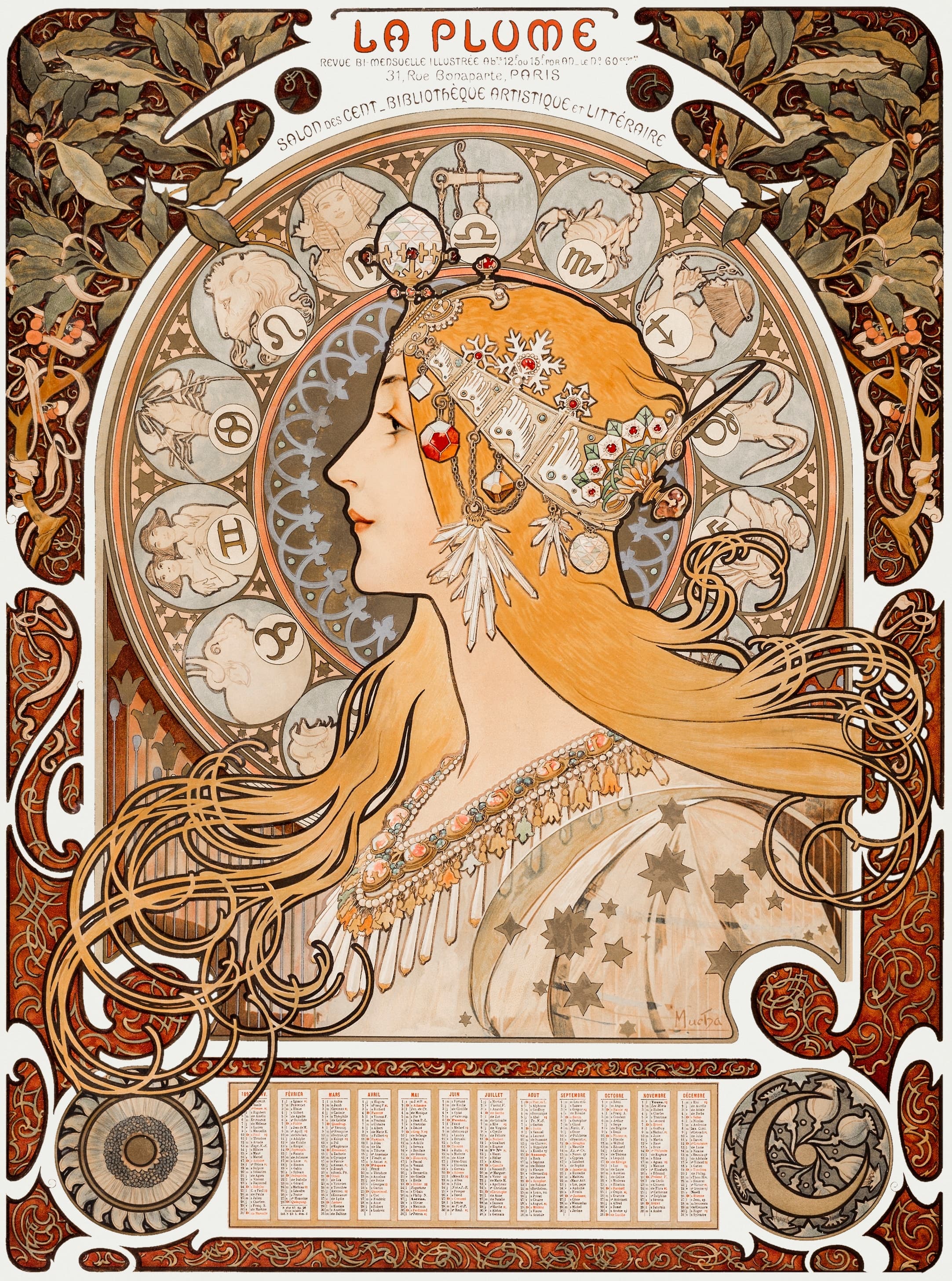
A woman in profile with red-gold hair and a jeweled headdress sits inside a halo carrying the twelve signs of the zodiac. Alphonse Mucha designed it in 1896 as an in-house calendar for his printer, F. Champenois, and Léon Deschamps bought the rights to issue it as the 1897 calendar of his magazine La Plume. The version reproduced carries the magazine's name, its address at 31 rue Bonaparte, and a twelve-month calendar for 1897.
- 1896–97
- Color lithograph from multiple stones
- Art Institute of ChicagoChicago, United States
About Alphonse Mucha
What the sheet shows
The woman faces left in strict profile, her red-gold hair swept back into a jeweled headdress and streaming out behind her in long curling strands. A faceted red jewel hangs at her temple on a chain, white snowflake-shaped ornaments and crystal drops hang from the headdress, and a heavy collar of pendants covers her chest. Her gown is cream with dark stars. Mucha signed the sheet at the right, below her shoulder.
Behind her head is a disk with twelve roundels around its rim, one for each sign of the zodiac, each with a figure and its symbol. The lion of Leo is at the left and the scales of Libra at the top. The scorpion and the archer are to the right, and the twins and the ram at the lower left. Inside the ring is a band of interlaced blue-gray ornament with small stars. Laurel branches with berries fill the upper corners, and a border of dark red scrollwork frames the whole sheet.
At the top, in red capitals, is LA PLUME, then in small brown letters REVUE BI-MENSUELLE ILLUSTRÉE with the subscription price, 12 or 15 francs a year and 60 centimes an issue, and the address 31, Rue Bonaparte, PARIS. Under that, on a curve, runs SALON DES CENT, BIBLIOTHÈQUE ARTISTIQUE ET LITTÉRAIRE. At the bottom a twelve-column calendar, its January column headed 1897, sits between two roundels, a sun at the left and a crescent moon with stars at the right.
A printer's calendar first
The Mucha Foundation records that Zodiac was the first work Mucha made under his contract with the printer F. Champenois, signed in 1896, and that it was designed as the firm's own calendar. Champenois's shop was at 66 boulevard Saint-Michel. The design caught the eye of Léon Deschamps, the editor of La Plume, who bought the distribution rights and issued it as the magazine's calendar for 1897.
La Plume was a literary and artistic review at 31 rue Bonaparte that ran the Salon des Cent, a series of exhibitions of posters and prints, and both are named in the lettering at the top. The Mucha Foundation's timeline puts Mucha's association with the magazine, and a poster for its Salon des Cent, in the same year, 1896.
The Foundation counts at least nine variants of the lithograph, including one printed without any text to hang as a decorative panel. The Art Institute of Chicago files its copy as Zodiaque (La Plume), 1896–97, the variant with the magazine's name and calendar, and cites it as variant 1 of number 19 in Jack Rennert and Alain Weill's catalogue.
Where to see it
The Art Institute of Chicago holds the La Plume version as reference number 1925.844, in the Mrs. Victor F. Lawson Collection, a color lithograph from multiple stones on tan wove paper measuring 63 by 47 centimeters. Its record last listed the print as not on view. The Mucha Foundation's copy, in the Mucha Trust Collection, is the textless version, 65.7 by 48.2 centimeters.
The reproduction comes from a photograph of a La Plume impression published on Wikimedia Commons, whose file page does not say which collection the sheet is in. The Art Institute's record supplies the catalogue data.
Close reading
Reading the work, detail by detail
The design was a calendar before it was a picture, and the La Plume version keeps both jobs: a magazine's name and address at the top, twelve months of dates at the foot, and between them a profile inside a ring of zodiac signs. Close up it is one of Mucha's most detailed sheets, with jewelry, ornament and lettering drawn at the scale of a book illustration.
1.The magazine's name and address
LA PLUME stands in red capitals at the top. Under it, in small brown lettering, the magazine calls itself an illustrated fortnightly review, gives its price, 12 or 15 francs a year and 60 centimes an issue, and its address, 31, Rue Bonaparte, PARIS. A curved line beneath names the SALON DES CENT and its BIBLIOTHÈQUE ARTISTIQUE ET LITTÉRAIRE, and two small dark roundels with pale ornament flank the address.
2.The signs at the top of the ring
The ring of signs runs around the rim of the disk, each in a pale gray-blue roundel with its figure drawn in brown and its symbol in a small circle below. At the top are Virgo as a woman's head, Libra as a hanging pair of scales, and Scorpio as a scorpion. The top of the headdress, a faceted crystal orb, rises between Virgo and Libra.
3.The lion, the crab and the twins
Down the left side of the ring are Leo as a lion's head, Cancer as a crab and Gemini as two figures, with Taurus and Aries below them. Inside the ring runs a band of interlaced blue-gray ornament dotted with small stars, and inside that a darker field behind the profile. The figures are drawn in brown line with the lightest tint.
4.The profile and the jeweled headdress
The face is a clean profile facing left, the eye lowered and the lips red. A faceted red jewel hangs at the temple on a chain, the strongest color on the sheet, with a smaller amber stone below it. The headdress is built of white plates and snowflake-shaped ornaments set with red stones, and crystal drops hang beside the cheek and behind the ear.
5.A collar of pendants across the chest
A wide collar in gold, pink and blue-green settings crosses the chest, with rows of pendants and white drops hanging from it. Below it the gown is cream with dark six-pointed and eight-pointed stars. The jewelry is drawn with the same care as the face, which is where much of the sheet's detail lies.
6.Hair streaming out to the left
The hair streams out behind the figure to the left in long looping strands, drawn as flat bands of red-gold with a dark outline, over a panel of thin vertical lines. Shorter loops do the same on the right. The dark red border with its scrollwork frames both.
7.The calendar for 1897 and the sun
At the lower left a roundel holds the sun, drawn as a ring of gray petals around a stippled center. Beside it begin the twelve columns of the calendar, the January column headed 1897, each month named in red with its days and saints' names in tiny type below. This is the part of the sheet that made it useful for a year.
8.The crescent moon at the lower right
The roundel at the lower right holds a crescent moon with small stars on a dark blue-gray ground, the pair to the sun at the left. Gold scrolls frame it and the dark red border runs beneath. Between the two roundels the calendar fills the foot of the sheet.
Timeline
1896
Mucha signs a contract with the printer F. Champenois and designs Zodiac as the firm's calendar, his first work under the contract.
1896
Léon Deschamps, editor of La Plume, buys the distribution rights to issue the design as the magazine's calendar for 1897.
1897
The Imprimerie Champenois spreads Mucha's designs across decorative panels, calendars and postcards, and Zodiac is issued in further variants.
1925
The Art Institute of Chicago's copy of the La Plume version enters the Mrs. Victor F. Lawson Collection, reference number 1925.844.
Where to see it
Art Institute of Chicago
111 South Michigan Avenue, Chicago, IL 60603, United States
The Art Institute's record last listed the print as not on view.
Plan your visit on the museum’s official website (opens in a new tab)Frequently asked questions
What is Mucha's Zodiac?
A color lithograph of 1896 showing a woman in profile inside a halo carrying the twelve signs of the zodiac. Alphonse Mucha designed it as a calendar for his printer, F. Champenois, and the magazine La Plume issued it as its calendar for 1897. It was also sold without text as a decorative panel.
Why does the poster say La Plume?
Léon Deschamps, the editor of the Paris review La Plume, bought the rights to the design and issued it as the magazine's 1897 calendar. The lettering gives the magazine's name, its subscription price, its address at 31 rue Bonaparte, and its Salon des Cent exhibitions.
Which zodiac signs are in the halo?
All twelve, each in a roundel with a figure and its symbol. Reading round the ring from the left: Leo, Cancer, Gemini, Taurus and Aries down the left side, Virgo and Libra at the top, then Scorpio, Sagittarius, Capricorn, Aquarius and Pisces down the right.
How big is it?
The Art Institute of Chicago's La Plume version measures 63 by 47 centimeters, about 25 by 18.5 inches. The textless version in the Mucha Trust Collection measures 65.7 by 48.2 centimeters.
How many versions of Zodiac are there?
The Mucha Foundation counts at least nine variants of the lithograph: the Champenois calendar, the La Plume calendar, versions with other text, and one printed without any text to hang as a decorative panel.
Where can I see it?
The Art Institute of Chicago holds the La Plume version, reference number 1925.844, last listed as not on view. The Mucha Trust Collection holds the textless version. Copies of the various versions come up regularly at poster auctions.
Can I reuse the image?
Yes. Alphonse Mucha died in 1939, so the lithograph is in the public domain worldwide, and the Art Institute of Chicago marks its record for the work as public domain.
More by Alphonse Mucha
If you like Alphonse Mucha
Explore painters from the same movements and circles.
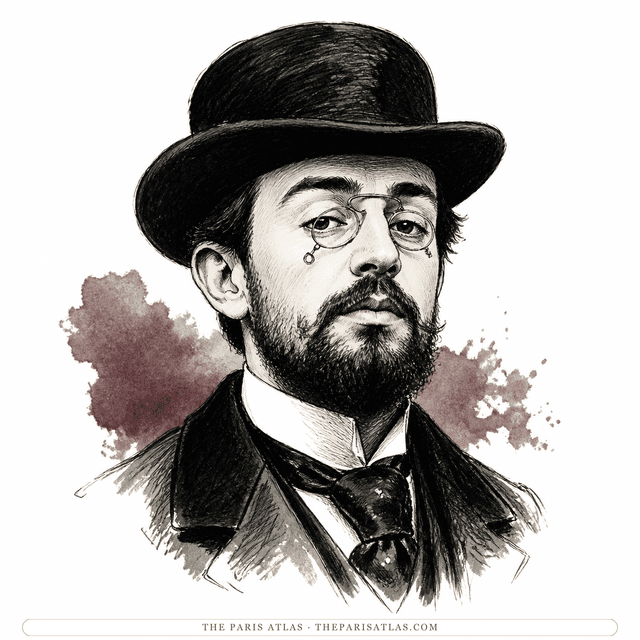
Henri de Toulouse-Lautrec
Aristocrat, painter and printmaker who moved to Montmartre in the 1880s and made its nightlife his single subject. His 1891 Moulin Rouge poster of the dancer La Goulue changed what a poster could be; he died at thirty-six leaving more than five thousand drawings.
View artist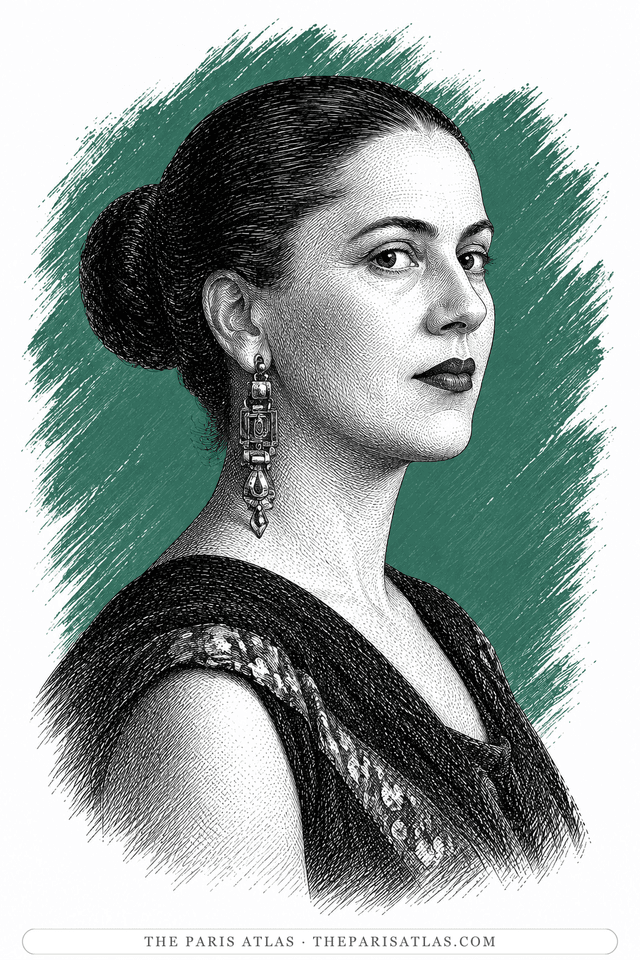
Tarsila do Amaral
Brazilian painter who spent the 1920s moving between São Paulo and Paris, studied Cubism under André Lhote, Albert Gleizes and Fernand Léger, and used what she learned to paint Brazilian towns, railways, plants and bodies. Her 1928 painting Abaporu prompted the manifesto that gave the Anthropophagic movement its name.
View artist
Pierre Bonnard
French painter, printmaker and illustrator whose intimate rooms, Paris streets, gardens and bathing figures transformed everyday life into complex fields of color, memory and perception.
View artist
References
The sources below include collection records, catalogues, scholarly research, and primary materials that informed this page. They document Zodiac, its making, and its place in cultural history.


1Alphonse Mucha, Zodiaque (La Plume), 1896-97
WebsiteArt Institute of ChicagoUsed forWeb source consulted for documented facts and historical context presented on the Zodiac page.
2Zodiac: the original calendar for Champenois
WebsiteMucha FoundationUsed forWeb source consulted for documented facts and historical context presented on the Zodiac page.
3Alphonse Mucha Timeline
WebsiteMucha FoundationUsed forWeb source consulted for documented facts and historical context presented on the Zodiac page.
4Art Posters
WebsiteMucha FoundationUsed forWeb source consulted for documented facts and historical context presented on the Zodiac page.
5Ferdinand Champenois: the printer’s full name
WebsitePrinceton University Art MuseumUsed forWeb source consulted for documented facts and historical context presented on the Zodiac page.

6Alphonse Mucha: The Complete Posters and Panels
NonfictionJack Rennert and Alain Weill, 1984Used forPublished analysis and historical context used in preparing the Zodiac page.
These references provide the documented foundation for this work's history and interpretation. Claim-level citations remain attached to the specific claims they support.
 Explore more resources