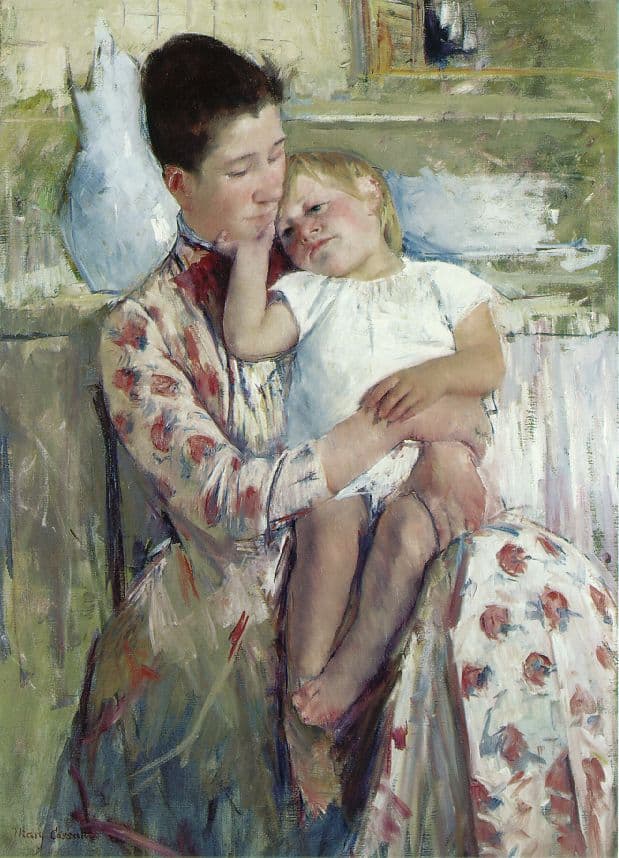
Mother and Child
by Mary Cassatt
A woman in a printed cotton dress holds a sleepy toddler on her lap, the room behind them left in a few quick strokes. Mary Cassatt painted it about 1890, in the years when mothers and children were becoming the subject she is known for, and it hangs at the Wichita Art Museum in Kansas as part of the Roland P. Murdock Collection.
- c. 1890
- Oil on canvas
About Mary Cassatt
A plain dress and a sleepy child
The woman is not idealized. The museum's own description calls her plain-featured, in a simple cotton print dress, embracing a drowsy toddler. Behind them Cassatt gave the room only the barest interior detail in quick, sketchy brushwork, including the cropped back of a straight chair. The two bodies lean into each other, and the museum reads that locked-together pose as the point of the picture: woman and child form a single unit.
Centuries of religious painting had used the same arrangement for the Madonna and Child, and Cassatt's handling of it was deliberate. She set her mother and child in ordinary contemporary life, without halos and without sweetness. The Wichita Art Museum's text says she avoided conventional sentimentality by giving the embrace solemnity and stability instead.
The subject that became her signature
Cassatt painted her first treatments of a mother caring for a child around 1880, and through the late 1880s she drew and etched the mothers and children of her own family. By the 1890s the theme dominated her work. The National Gallery of Art's account of her career states it directly: the mother-and-child pictures came to dominate her later years and are now her most popular images.
This canvas sits at the start of that decade, and it is loosely painted — so loosely that, as the museum's 2011 essay on the picture notes, it is often thought to be unfinished, even though it carries her signature.
How it reached Kansas
The painting belongs to the Roland P. Murdock Collection, which exists because of a will. Louise Caldwell Murdock, a Wichita interior designer, died in 1915 and left her estate in trust to buy American art for the city of Wichita, in memory of her husband Roland P. Murdock, business manager of the family's newspaper, the Wichita Eagle. From 1939 to 1962 her friend and associate Elizabeth Stubblefield Navas chose the pictures, advised by the New York dealer Edith Halpert and by Lloyd Goodrich of the Whitney Museum of American Art.
The Cassatt became one of the collection's best-known purchases. In 2011 the museum's director, Charles K. Steiner, called it perhaps the most sought-after work in the Wichita Art Museum's collection, requested for loan by museums worldwide. Its accession number is M109.53.
Close reading
Reading the work, detail by detail
Cassatt makes affection visible through contact: cheek against cheek, a hand at the face, and arms supporting a small body. Pattern and household objects surround this compact arrangement.
1.Faces together
The two heads incline toward each other and occupy a shared patch of light. Their proximity makes the relationship visible without an outward gesture toward the viewer.
2.A hand at the cheek
The small hand turns affection into a specific action. The bent arm also closes the space between the two bodies.
3.Supporting arms
The overlapping forearms form a secure horizontal support. Their arrangement balances the child's leaning head and loose posture.
4.Dangling feet
The relaxed legs show how fully the adult carries the child's weight. Their smooth pale surfaces stand apart from the broken floral marks beneath them.
5.The flowered dress
The pattern gives the large skirt visual activity without demanding a separate subject. Its scattered marks contrast with the more continuous modeling of faces and limbs.
6.Objects behind them
These objects are abbreviated and softened compared with the figures. They establish an inhabited interior while allowing the intimate contact to remain the clearest event.
Timeline
c. 1890
Painted in France, at the start of the decade in which mothers and children became Cassatt's principal subject.
1915
Louise Caldwell Murdock dies in Wichita, leaving her estate in trust to buy American art for the city in memory of her husband Roland P. Murdock.
1939–62
Elizabeth Stubblefield Navas assembles the Roland P. Murdock Collection under the will, and the Cassatt enters it during these years.
1997–98
Tours in Toward an American Identity: Selections from the Wichita Art Museum, an American Federation of Arts exhibition of seventy-six paintings.
2011
Centerpiece of the museum's Cassatt exhibition for the 150th anniversary of Kansas statehood.
Where to see it
Wichita Art Museum
1400 West Museum Boulevard, Wichita, KS 67203, United States
General admission is free. The museum is closed on Mondays and Tuesdays; check its current display information before travelling.
Plan your visit on the museum’s official website (opens in a new tab)Frequently asked questions
Where is Mary Cassatt's Mother and Child?
At the Wichita Art Museum in Wichita, Kansas, in the Roland P. Murdock Collection — accession number M109.53.
Is Mother and Child finished?
It is signed, so Cassatt considered it ready to leave the studio, but the paint handling is loose enough that the museum's own essay says the picture is often thought to be unfinished. The background especially is little more than sketched.
Who are the woman and child in the painting?
The museum does not identify them. Its description presents the woman as a type from contemporary life — plain-featured, in a simple cotton print dress — rather than a named sitter.
When did Cassatt paint Mother and Child?
About 1890. The museum's collection record says about 1890, and its 2011 essay on the picture dates it around 1889 — either way, the start of the decade in which the mother-and-child subject took over her work.
Did Cassatt paint other pictures called Mother and Child?
Yes. She returned to the subject for the rest of her career, in oil, pastel and print, and several museums hold works with this title. Other painters used it too — Pablo Picasso's Mother and Child of 1921 hangs at the Art Institute of Chicago.
What is the Roland P. Murdock Collection?
A collection of American art bought for the city of Wichita under the will of Louise Caldwell Murdock, who died in 1915 and named it for her late husband. Elizabeth Stubblefield Navas selected the works from 1939 to 1962, and the collection remains the core of the Wichita Art Museum.
More by Mary Cassatt
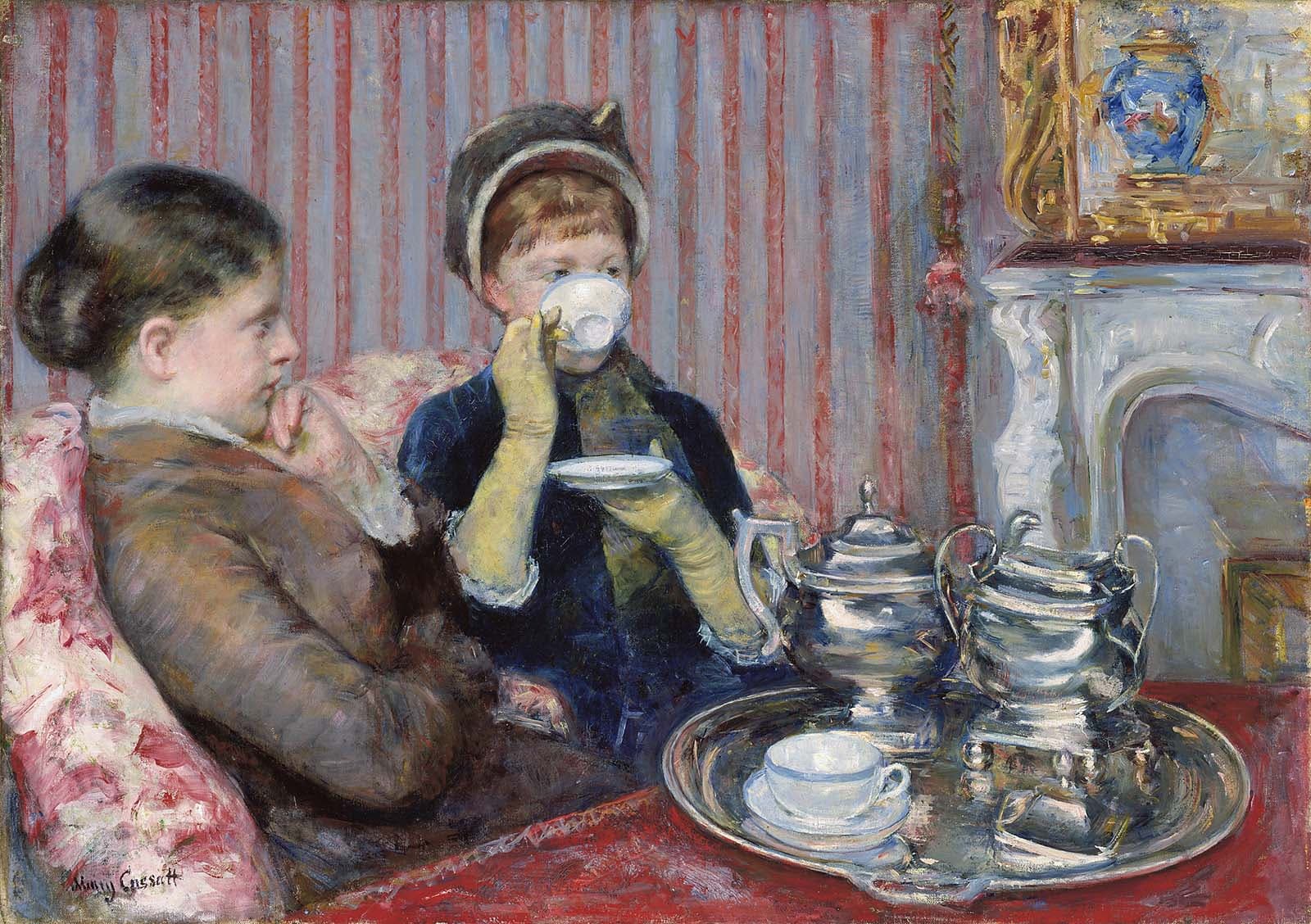
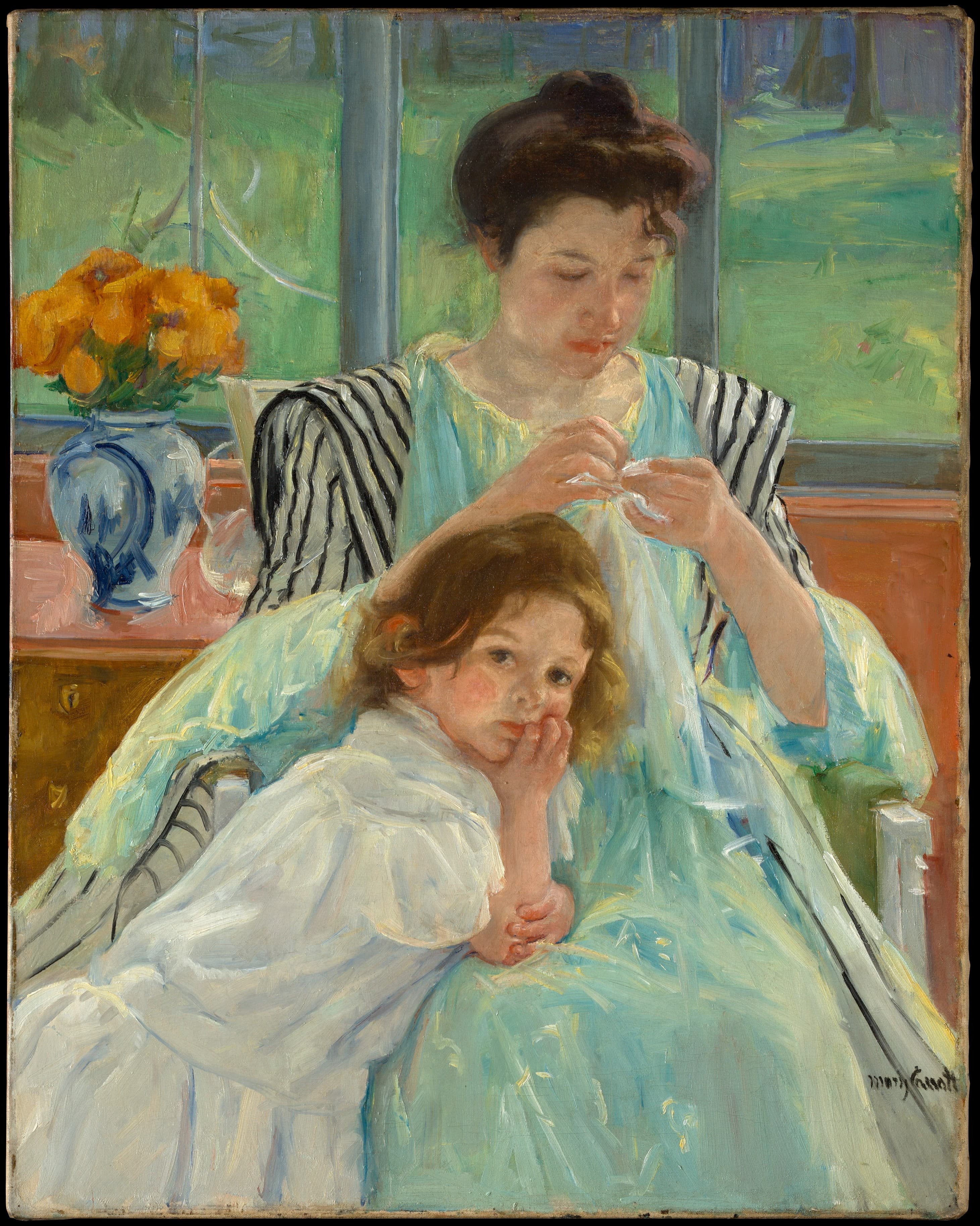
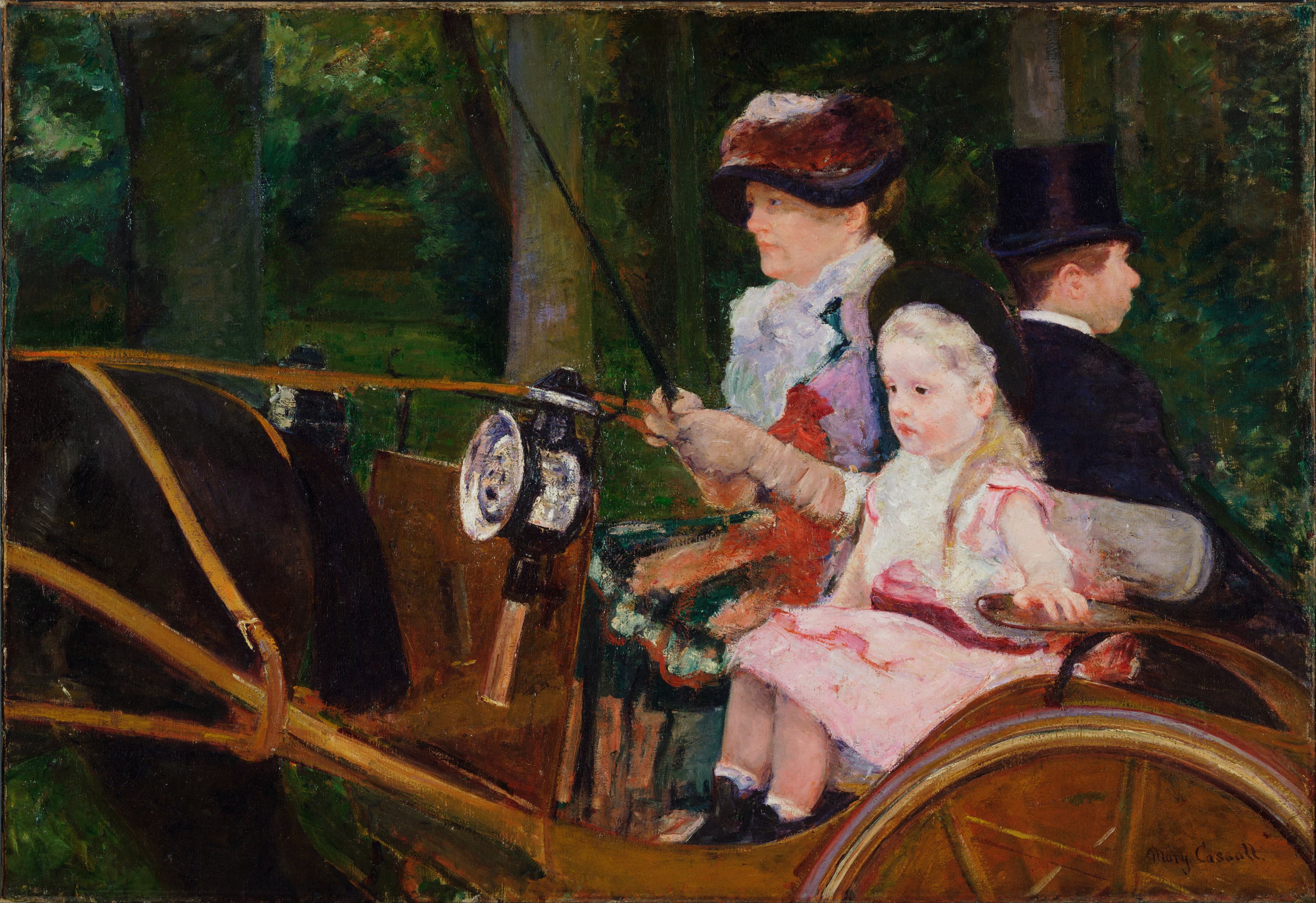
If you like Mary Cassatt
Explore painters from the same movements and circles.
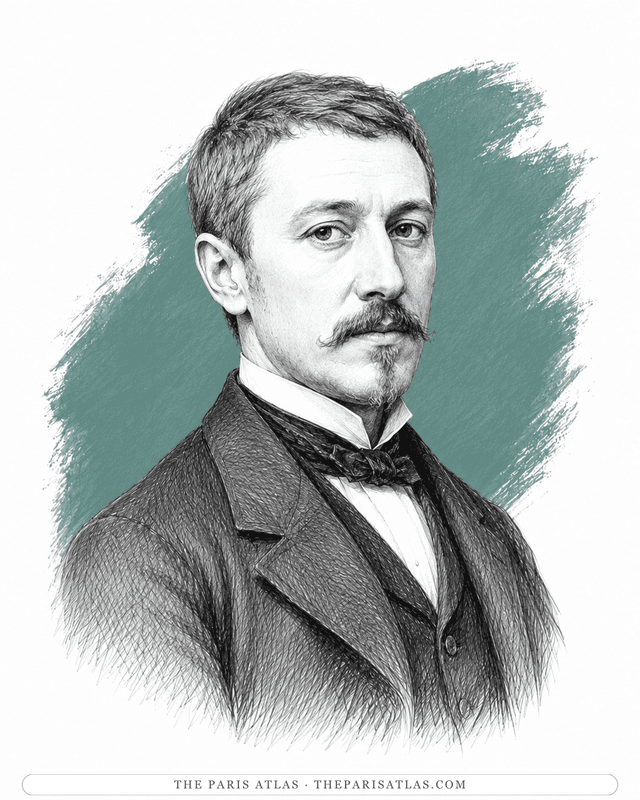
Gustave Caillebotte
Painter of Haussmann's geometry and the group's organizer-financier; his bequest of Impressionist paintings forced the French state to take the movement in.
View artist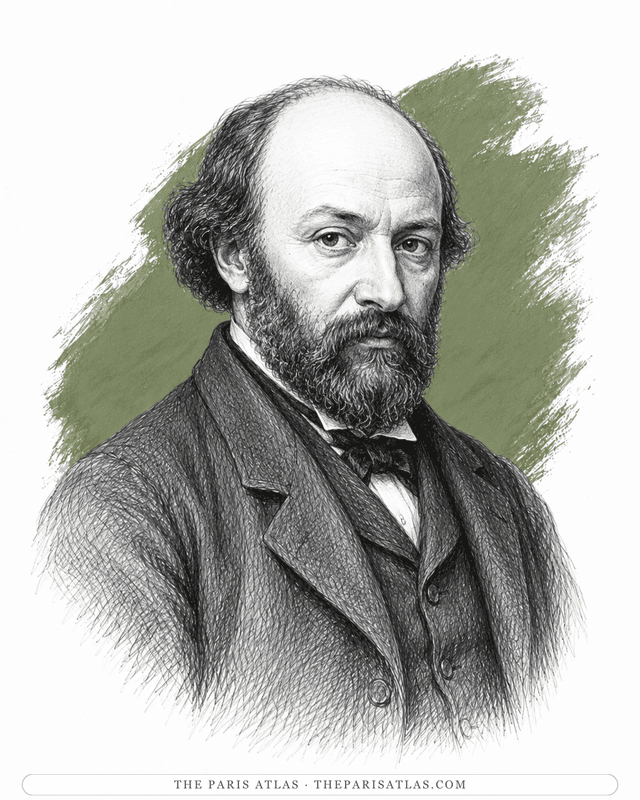
Paul Cézanne
Painter between Impressionism and everything after — shown in the independents' exhibitions, emulated by the Cubists, and present at the Orangerie through 15 works in the Walter-Guillaume collection.
View artist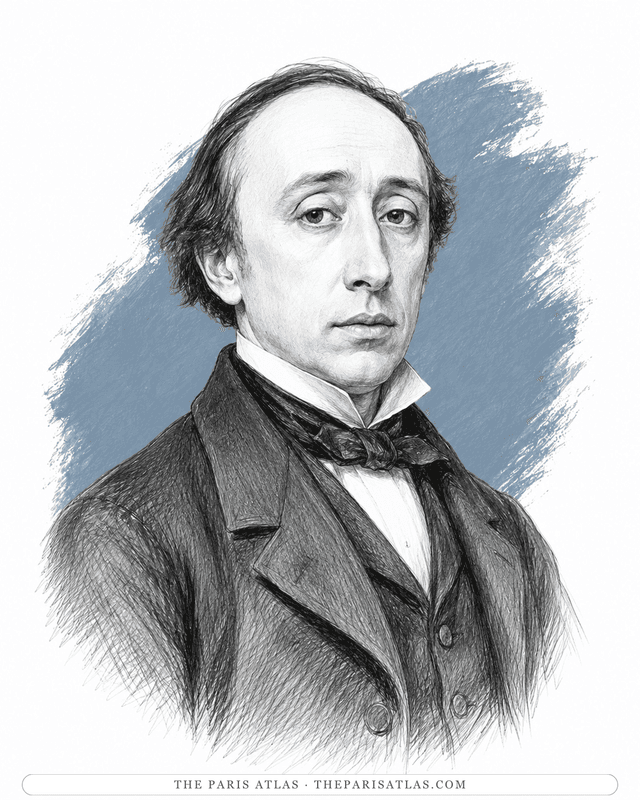
Edgar Degas
Painter of dancers, racecourses, and café interiors — among the founders of the independent exhibitions that became Impressionism, though he preferred the word 'independent' himself.
View artist
References
The sources below include collection records, catalogues, scholarly research, and primary materials that informed this page. They document Mother and Child, its making, and its place in cultural history.


1Mother and Child (Mary Cassatt, c. 1890) — Wichita Art Museum
WebsiteWichita Art MuseumUsed forWeb source consulted for documented facts and historical context presented on the Mother and Child page.
2A Kansas Treasure in Context: Mary Cassatt — Wichita Art Museum essay, 2011
WebsiteTraditional Fine Arts Organization, 2011Used forThe museum's 2011 essay supplies the often-thought-unfinished observation and the director's statement about loan requests.
3Museum History — Wichita Art Museum
WebsiteWichita Art MuseumUsed forThe museum's own history page documents Louise Caldwell Murdock's bequest and Elizabeth Navas's role.

4Degas/Cassatt exhibition brochure — National Gallery of Art
Exhibition catalogueNational Gallery of Art, 2014Used forStates that mother-and-child pictures came to dominate the later part of Cassatt's career.
5Mary Cassatt — National Museum of Women in the Arts
WebsiteNational Museum of Women in the ArtsUsed forDocuments the family etchings of the late 1880s and the 1890 Japanese print exhibition.
These references provide the documented foundation for this work's history and interpretation. Claim-level citations remain attached to the specific claims they support.
 Explore more resources