Madonna
by Edvard Munch
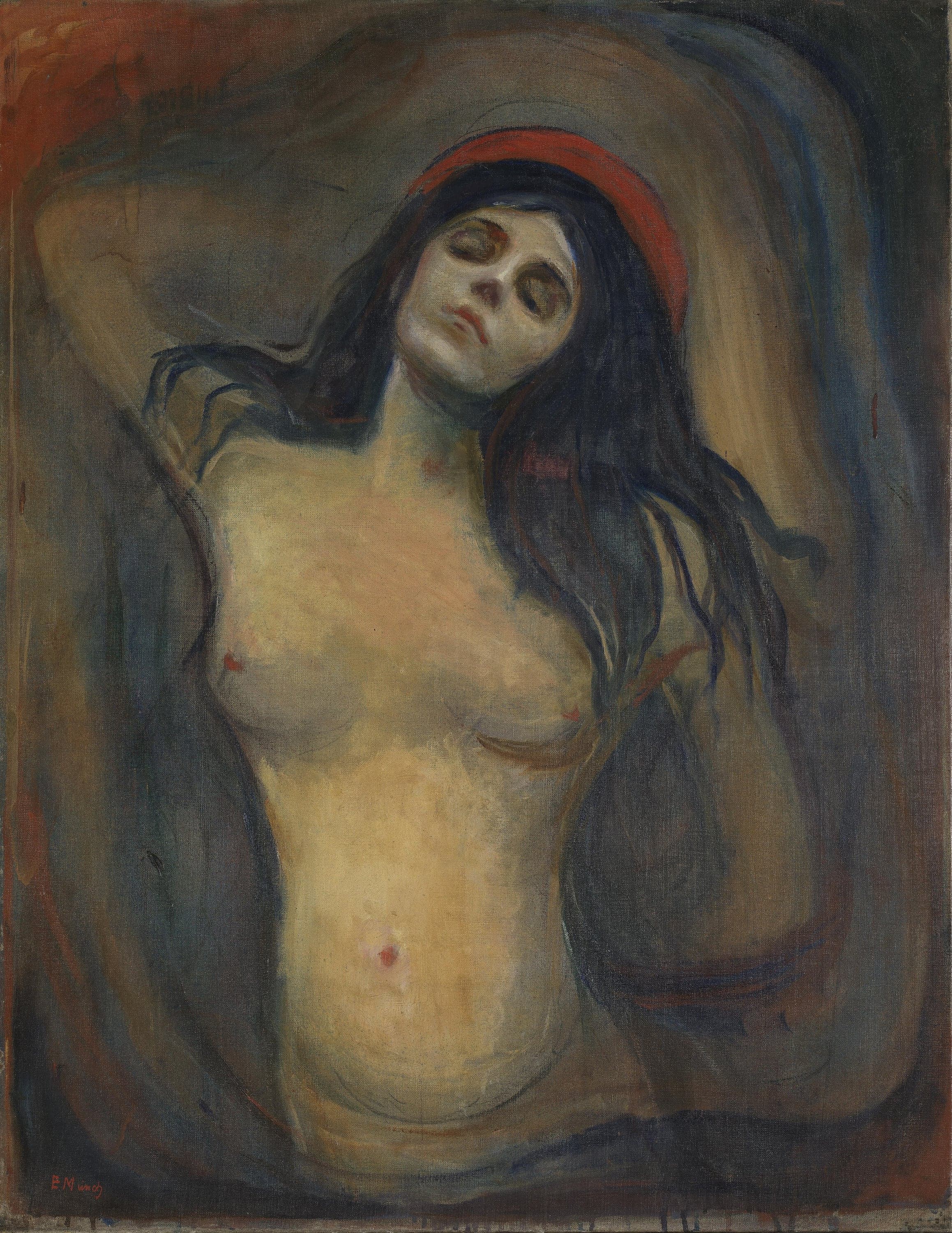
A woman leans back with her eyes closed and her arms behind her head, a red halo arcing over her head and down its right side. Edvard Munch painted five versions of the motif between 1894 and 1897 and this is the first. The National Museum in Oslo describes it as combining erotic and religious associations — the halo is red rather than the gold a saint would be given.
- 1894
- Oil on canvas
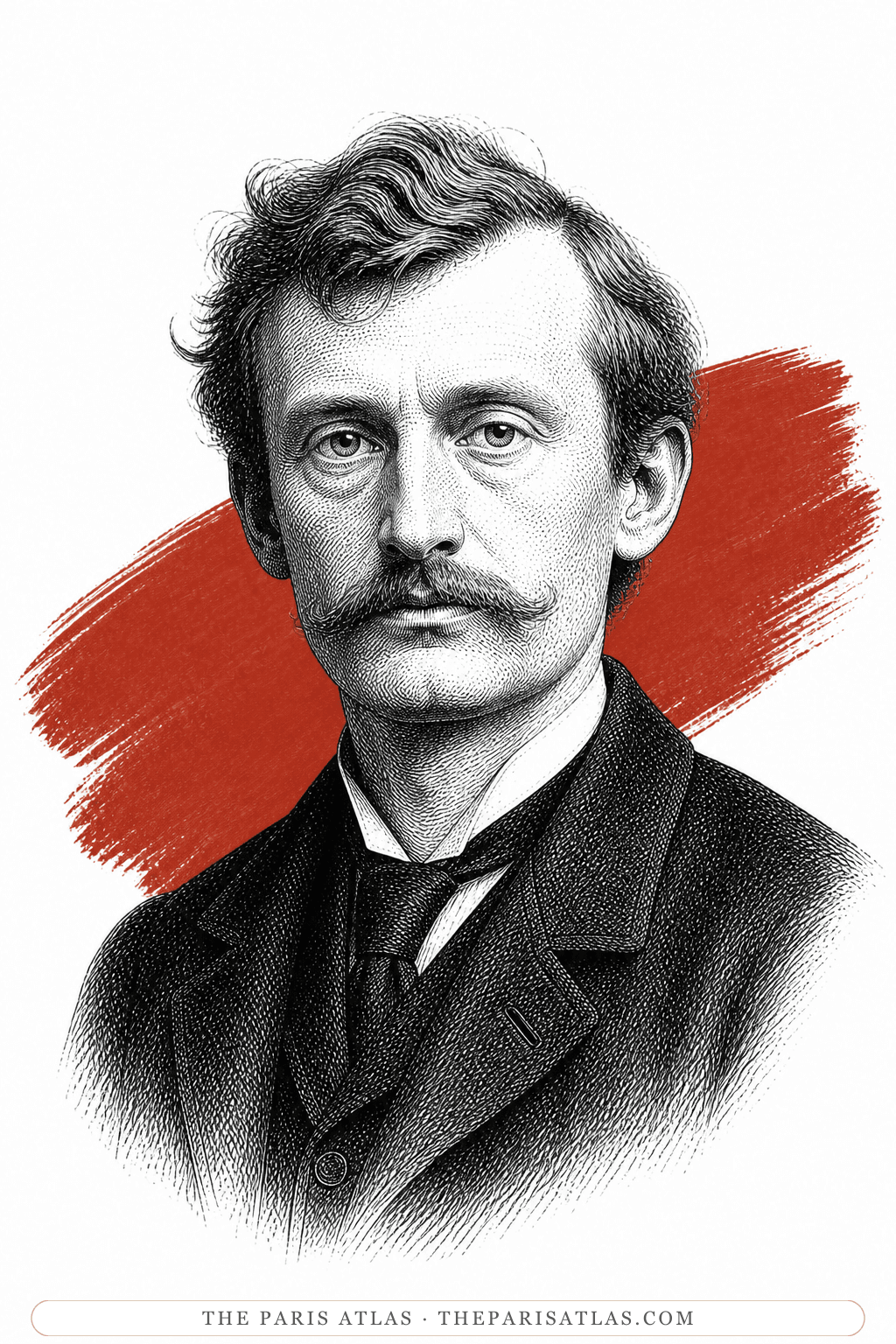
About Edvard Munch
What the painting shows
A woman is shown from the hips up against a dark ground. Her head is tipped back, her eyes are closed, and both arms are bent behind her head and back, which lifts her chest forward. Her hair falls black around her shoulders. A red band arcs over her head and continues down the right side, broadening as it falls.
The background is not a room. It is built from long wavering bands of blue, red and dark brown that curve around the figure and seem to move. Her body is modelled fairly solidly; everything around it is not.
The National Museum's account is direct about the combination at work: the picture puts erotic and religious associations together, so the woman reads at once as a lover and as a sanctified figure. The red halo is the hinge. It is the attribute of a saint, in the wrong colour.
Five versions, and a print
Munch returned to the motif five times between 1894 and 1897. The National Museum identifies its canvas as the first of the series. He also made a lithograph of the subject, which surrounds the figure with a border of sperm and places a foetus in the lower left corner — an addition the paintings do not carry.
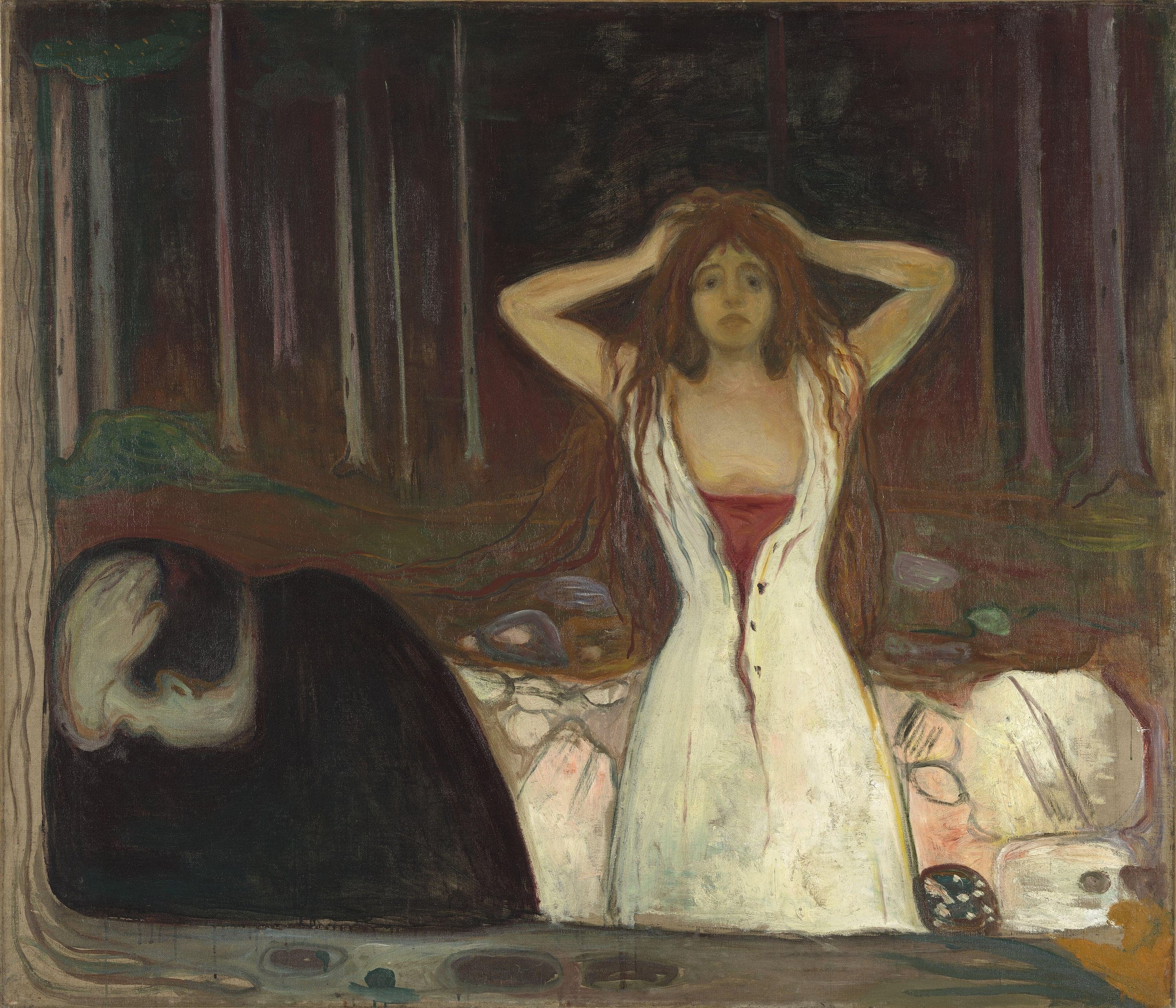
The painting hung in Munch's 1903 exhibition in Leipzig, where he showed the Frieze of Life as a connected sequence rather than as separate pictures. Ashes hung alongside it.
Part of the Frieze of Life
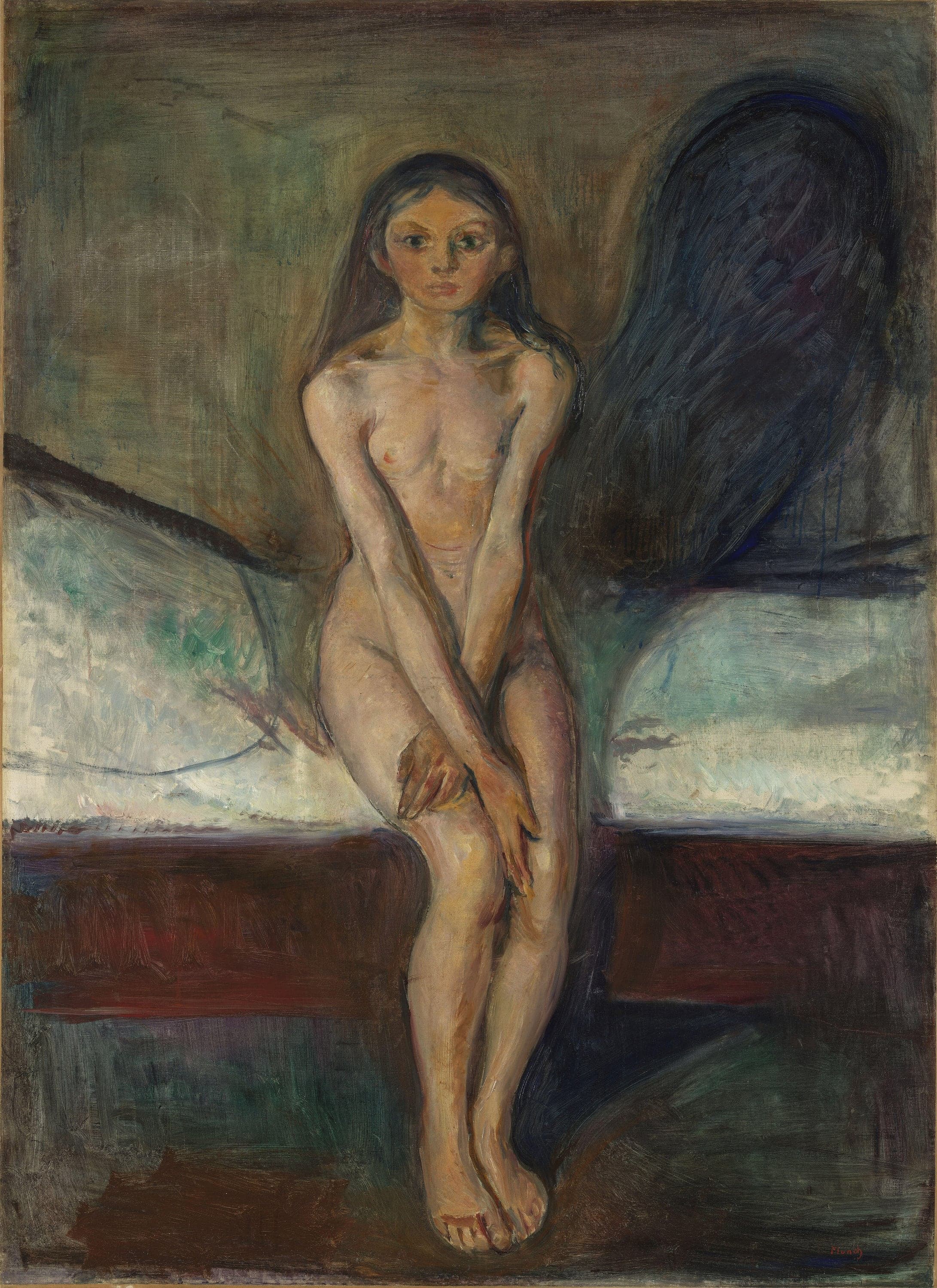
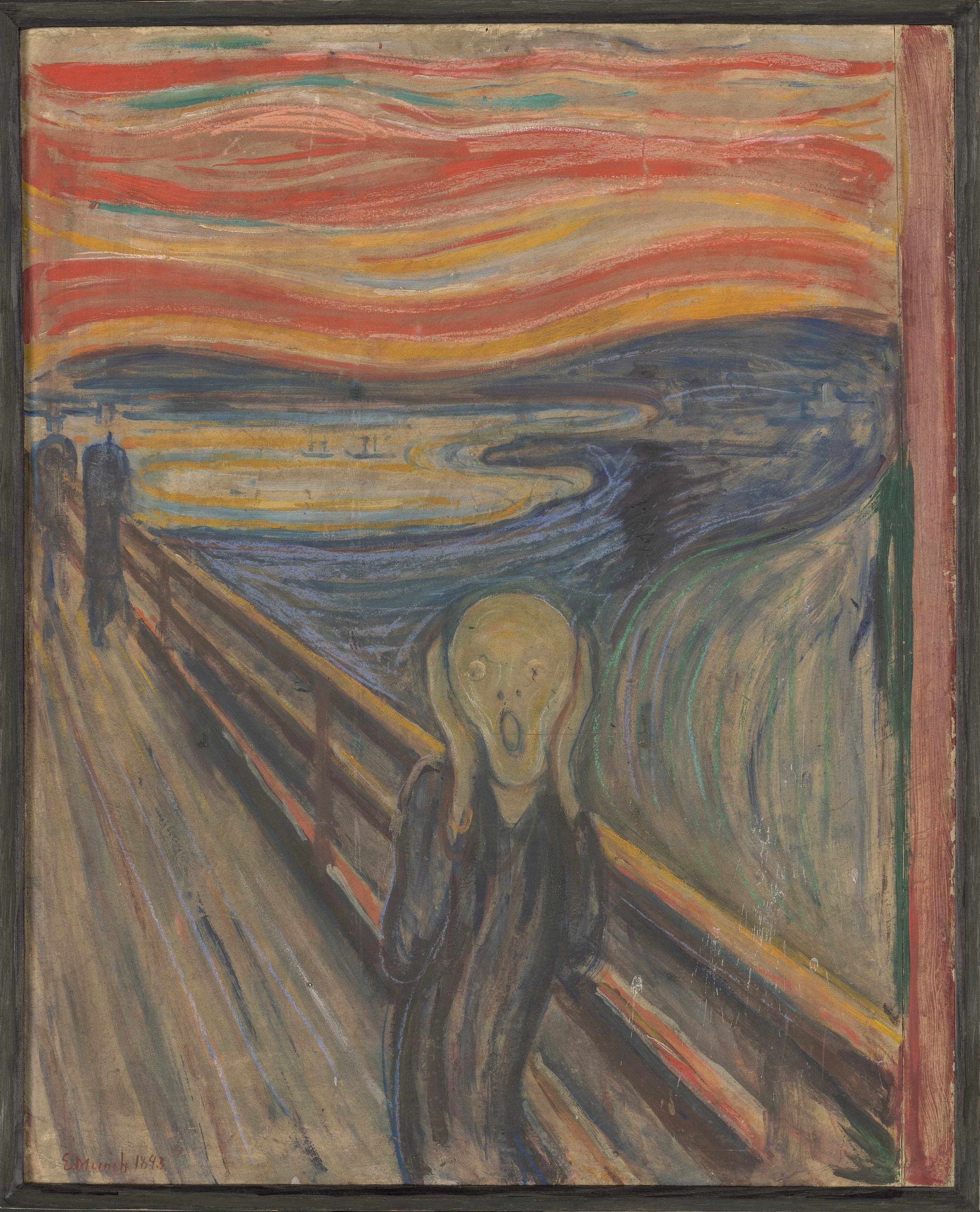
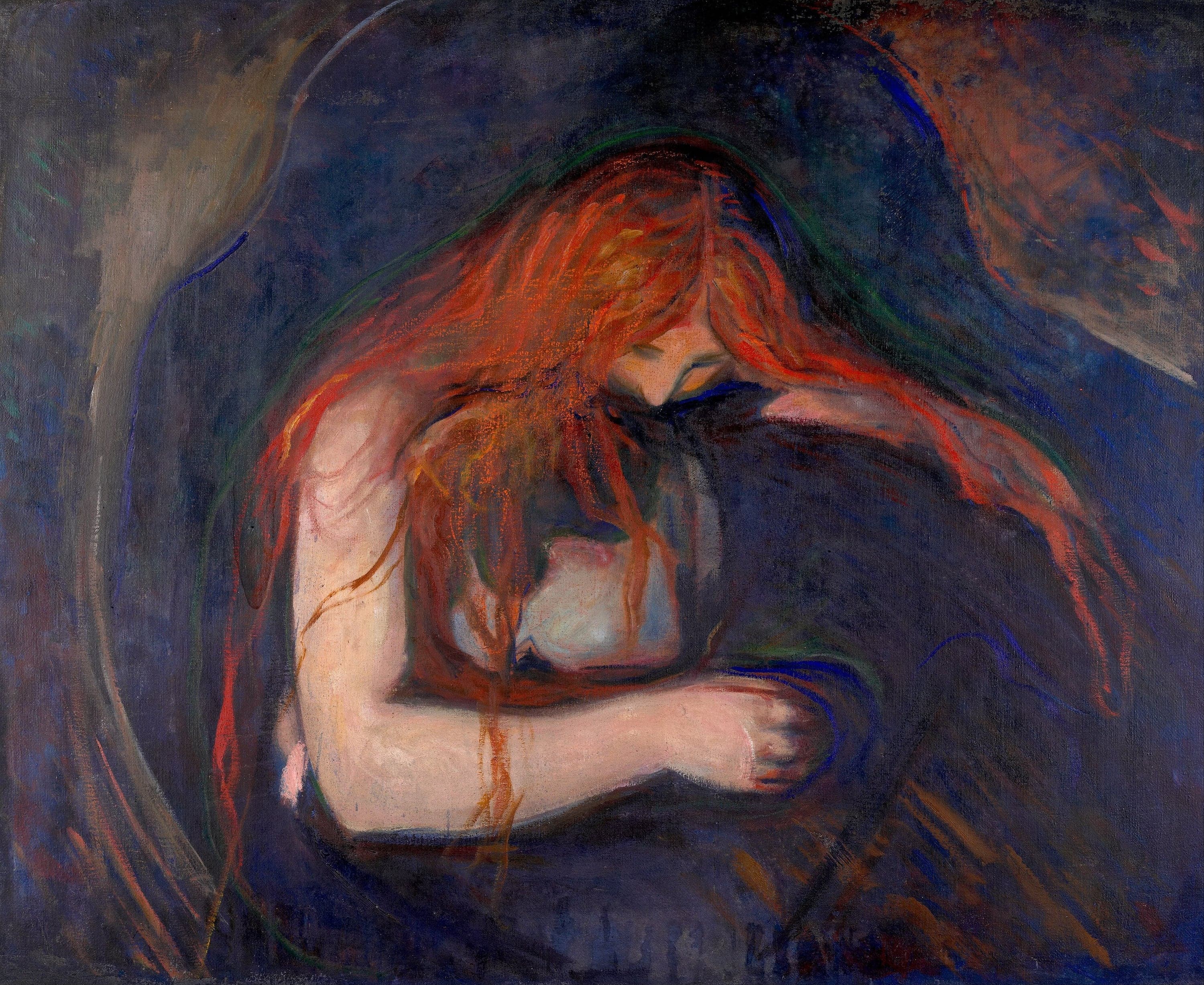
The Frieze of Life was Munch's name for a group of paintings about love, anxiety and death that he showed together and rearranged over decades. Madonna, Ashes, Vampire and The Scream all belong to it.
The pictures were meant to be read against each other. That is why the same few subjects recur across them in different arrangements: a woman with loose hair, a figure alone at a rail, a couple in a dark wood.
How Oslo got it
The collector Olaf Schou gave the painting to the Norwegian national collection in 1909, the year before he gave it The Scream. Its accession number is NG.M.00841.
Close reading
Reading the work, detail by detail
The body is modelled solidly and everything around it is not. Close views show where the paint is worked up into flesh, where it thins to a stained wash that lets the canvas weave through, and where red interrupts both.
1.A saint's attribute in the wrong colour
The red arcs across the top of the head and continues down the right side, broadening as it descends. Strands of black hair cross in front of it. It is not a closed ring, and a saint's halo would be gold.
2.The head is tipped back and the eyes are shut
The head is tipped back and turned slightly, so the chin leads and both eye sockets fall into shadow. The lids are two brown smudges. The mouth is small and dark red, and the whole face reads several tones lighter than the neck under it.
3.On the left the hair ends in drawn points
Here the hair leaves the head as separate strands, each one finishing in a fine point made with a loaded brush. The strands sit on top of the background wash rather than in it. Their edges stay hard where the rest of the paint is soft.
4.On the right it falls as heavy ropes
This side is a fall of blue-black ropes reaching below the waist, thinning until the olive ground and the canvas weave read straight through. A red-brown stroke crosses it about midway down. The two sides of the head are not treated alike.
5.The navel is a single red mark
The abdomen is the most worked passage of flesh in the picture, built up in yellow-cream over a warmer layer. At the navel one red-pink mark sits on the surface. The same red returns at both nipples and at the mouth.
6.The ground is bands of paint, not a room
Soft olive and blue-grey bands curve around the body, closed off by a blue-black contour line. The paint is thin enough that the weave of the canvas counts as texture. No floor, wall or horizon is given anywhere.
Timeline
1894
Painted, the first of five versions of the motif.
1895
Makes a lithograph of the subject, adding a border of sperm and a foetus that the paintings do not have.
1903
Shown at Munch's Leipzig exhibition, where the Frieze of Life hangs as a connected sequence, next to Ashes.
1909
Given to the Norwegian national collection by Olaf Schou, as NG.M.00841.
Where to see it
Nasjonalmuseet for kunst, arkitektur og design, Oslo
A public viewing address has not yet been confirmed for this holding.
Frequently asked questions
Where is Munch's Madonna?
The National Museum in Oslo holds this version, accession number NG.M.00841. It is the first of five painted versions Munch made between 1894 and 1897; others are at the Munch Museum in Oslo and the Hamburger Kunsthalle.
Why is the halo red in Munch's Madonna?
A saint's halo is gold. Munch's is red, which is the point: the National Museum describes the painting as putting erotic and religious associations together, so the figure reads as a lover and a sanctified woman at the same time.
How many versions of Madonna did Munch paint?
Five, between 1894 and 1897, plus a lithograph. The National Museum's canvas is the first of the painted series.
How is the Madonna lithograph different from the painting?
The print adds a border of sperm around the figure and a foetus in the lower left corner. Neither appears in the painted versions.
How big is Munch's Madonna?
90.5 by 70.5 centimetres, oil on canvas — about three feet by two and a third.
What is the Frieze of Life?
Munch's own name for a group of paintings about love, anxiety and death that he exhibited together and rearranged over several decades. Madonna belongs to it, along with The Scream, Ashes and Vampire. He presented it as a connected sequence at Leipzig in 1903.
More by Edvard Munch
If you like Edvard Munch
Explore painters from the same movements and circles.
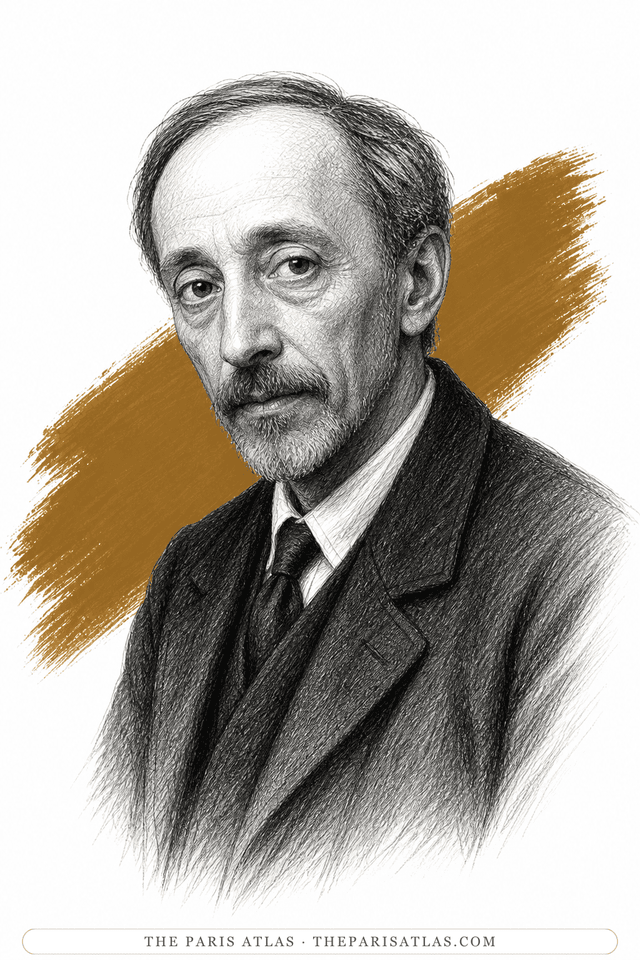
Pierre Bonnard
French painter, printmaker and illustrator whose intimate rooms, Paris streets, gardens and bathing figures transformed everyday life into complex fields of color, memory and perception.
View artist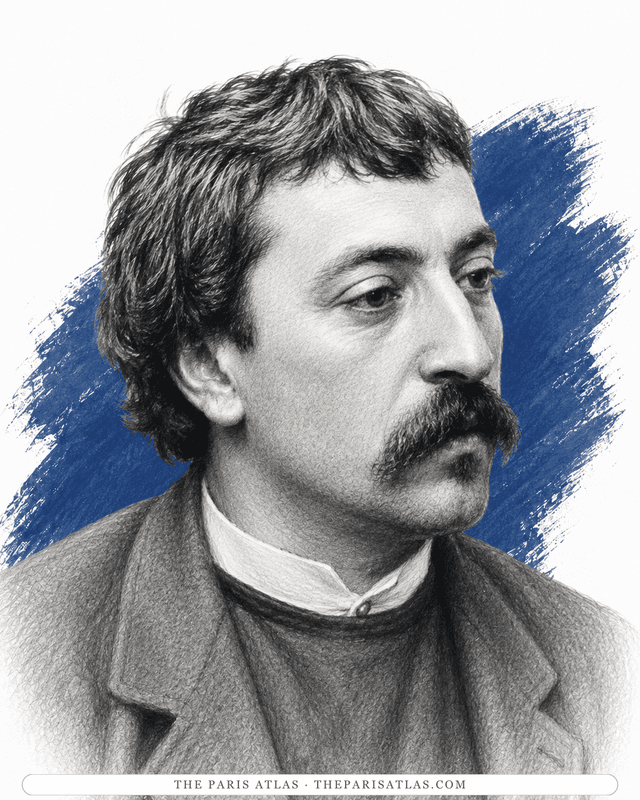
Paul Gauguin
Stockbroker turned painter who came into art through Camille Pissarro, showed with the Impressionists, and left Europe for Polynesia.
View artist
Gustave Moreau
Painter of jewelled myths — Salome, Oedipus, floating severed heads — who lived nearly his whole life in one Paris house, taught Henri Matisse and Georges Rouault at the Beaux-Arts, and turned the house into a museum before he died so the state would have to keep everything.
View artist
References
The sources below include collection records, catalogues, scholarly research, and primary materials that informed this page. They document Madonna, its making, and its place in cultural history.


1Madonna, Edvard Munch (NG.M.00841)
Official recordNasjonalmuseet for kunst, arkitektur og design, OsloUsed forOfficial record used to verify names, dates, institutional details, or other factual information on this page.

2Edvard Munch in the collection
WebsiteNasjonalmuseet, OsloUsed forWeb source consulted for documented facts and historical context presented on the Madonna page.
3The collection
WebsiteMUNCH, OsloUsed forWeb source consulted for documented facts and historical context presented on the Madonna page.
4Edvard Munch: Behind the Scream
BiographyYale University Press, 2005Used forBiographical evidence used to verify chronology, relationships, and historical context connected to Madonna.
These references provide the documented foundation for this work's history and interpretation. Claim-level citations remain attached to the specific claims they support.
 Explore more resources