Puberty
by Edvard Munch
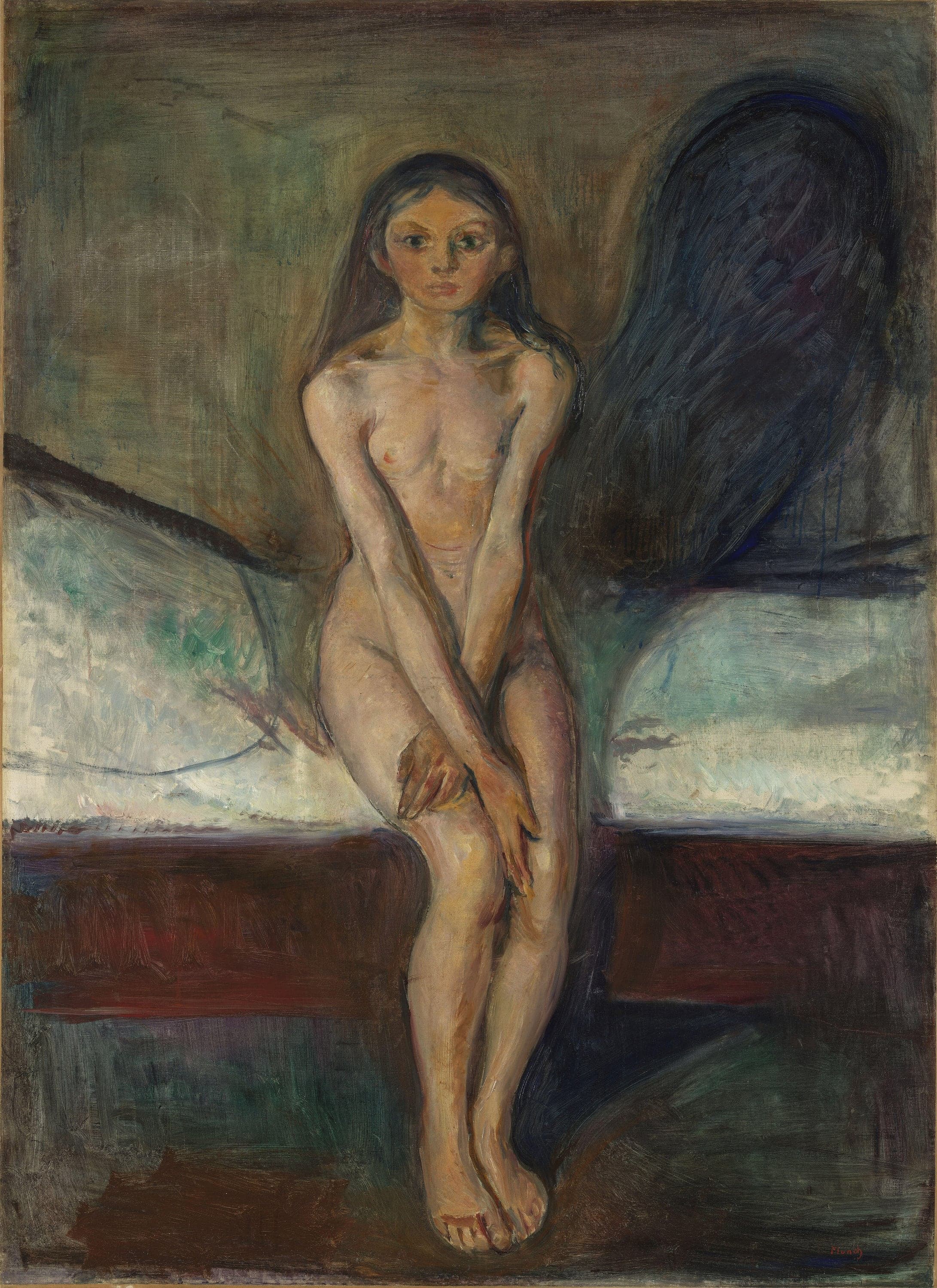
A naked girl sits on the edge of a bed with her arms crossed over her lap and a large dark shadow on the wall behind her. Edvard Munch painted this version in Berlin over the winter of 1894 and 1895. The National Museum in Oslo, which owns it, reads the shadow as a projection of what the girl is feeling rather than as a trick of the light.
- 1894
- Oil on canvas
About Edvard Munch
What the painting shows
A young girl sits upright on the edge of a bed, facing the viewer. Her hair hangs loose. Her arms are crossed in front of her lap, covering herself, and her shoulders are pulled in. Her eyes are wide and she does not look away.
Behind her and to one side, on a wall of dull olive-brown, a shadow rises. Its top clears her head and it is broader than her body. It is much darker than anything else in the picture, and it does not have the shape a body would cast. The bed runs horizontally across the canvas; the girl and the shadow are the vertical elements, and the contrast between those directions is what holds the composition.
The National Museum describes the shadow as a projection of the girl's inner state of mind, and the picture as addressing approaching sexual maturity in a direct and unflinching way. The body is painted realistically. Everything around it is not.
Painted in Berlin
Munch made this version in Berlin during the winter of 1894–95, in the years he spent moving between Berlin and Paris rather than living in Norway. He was in his early thirties.
An earlier version of the subject, painted in 1886, was destroyed by fire. He also made the image as a lithograph in 1894 and as an etching in 1902.
How Oslo got it
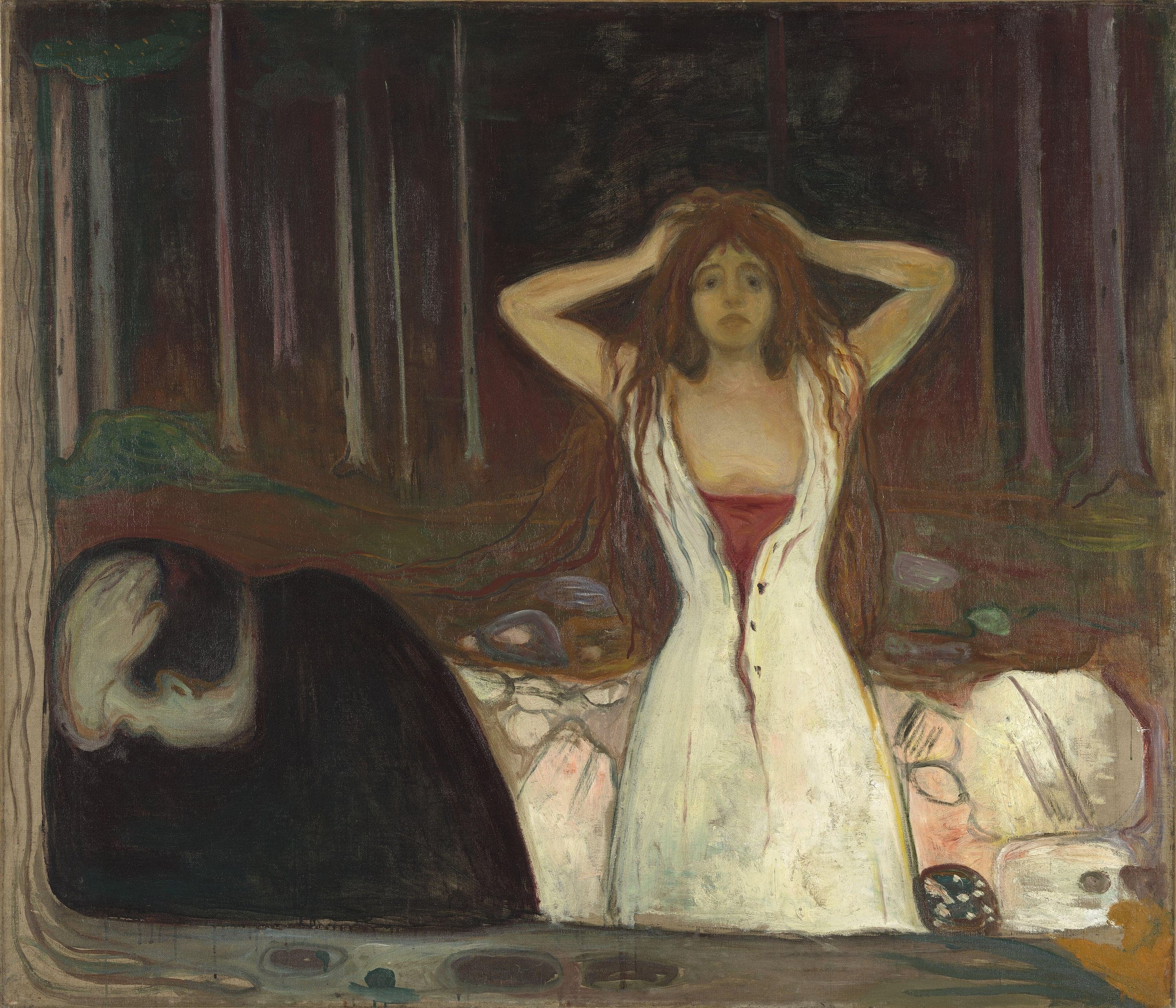
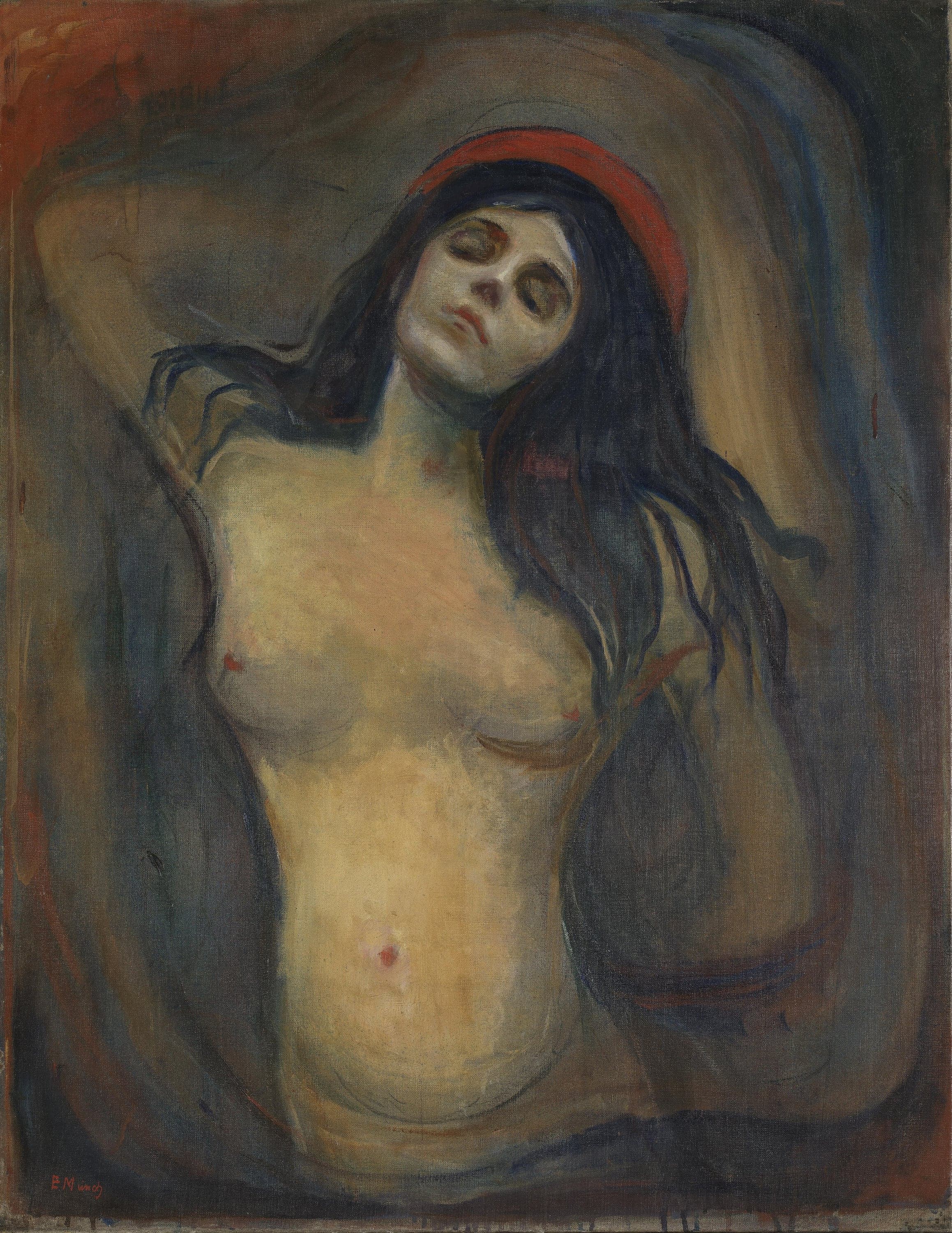
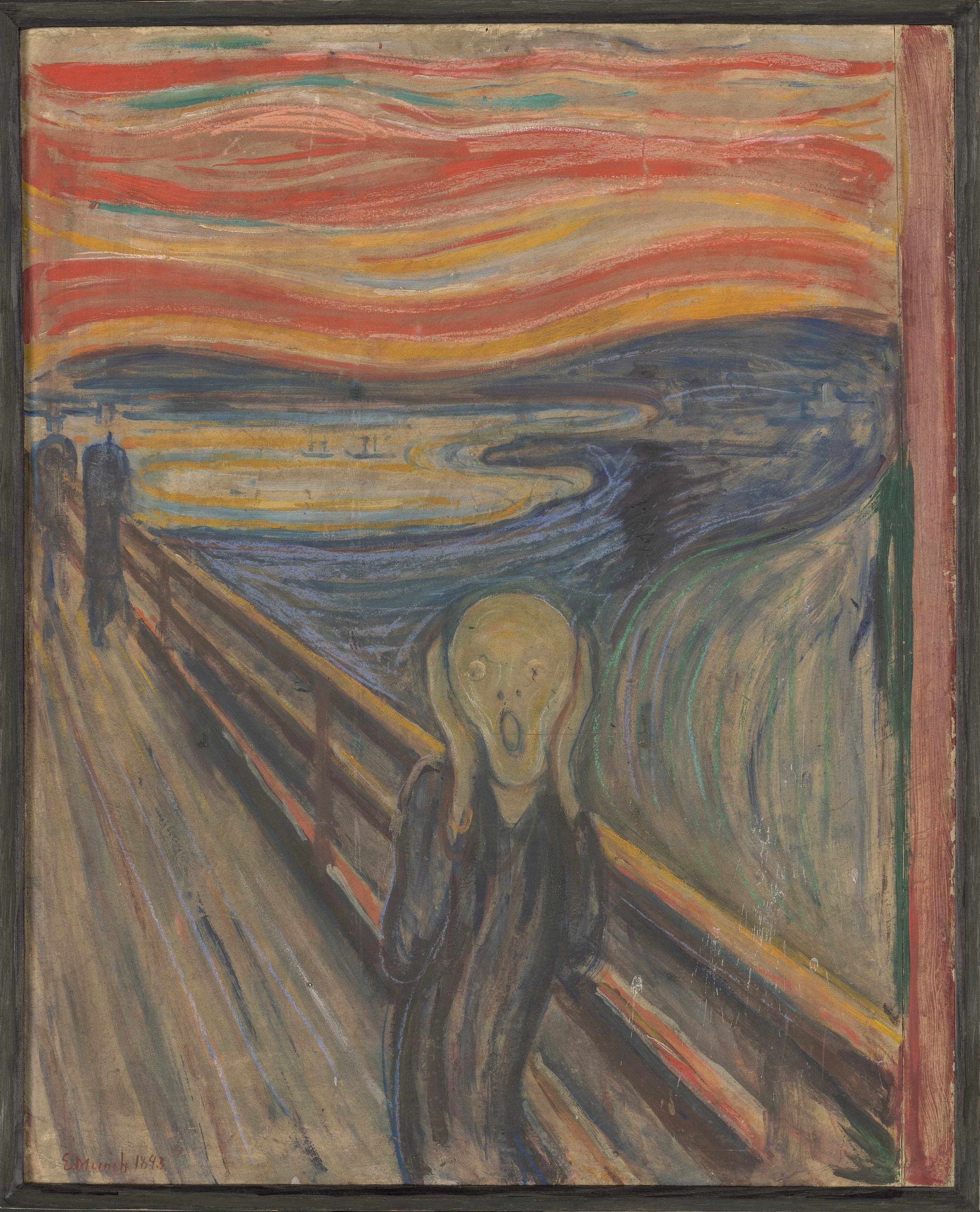
The Norwegian national collection bought the painting in 1909 with money from the A.C. Houen Endowment — a purchase rather than a gift, unlike The Scream and Madonna, which Olaf Schou gave the museum in 1910 and 1909. Its accession number is NG.M.00807.
Close reading
Reading the work, detail by detail
The girl is painted with care and the room is not. Close views show a firmly modelled body set against thin scrubbed paint, and a shadow whose brush marks stay separate and visible.
1.She holds the look out of the picture
The eyes are large, set well apart and turned straight out at the viewer. The whites are grey-green and each lid is drawn with a thin dark line. The mouth is closed and level, and the brows are barely marked.
2.The shoulders are drawn forward and up
Pulling the shoulders forward narrows the chest and lifts the collarbones into two hard ridges. The upper arms stay pressed close to the body. Warm ochre is worked into the shadow under the jaw and along the near arm.
3.The hands cross low and cover her
Both forearms come down and cross low over the thighs, the hands meeting there. The fingers are the most finished drawing in the picture, each separated and shaded. The gesture covers her and it also locks her arms across the body.
4.The shadow is a mass of separate strokes
The shadow is dark blue-violet, rounded at the top and rimmed with a line of stronger blue. Inside it the brush marks stay separate and run in several directions. Its top rises above her head and it is broader than her body.
5.A band of white over a band of dark red
The linen is scrubbed in white, pale blue and green over a visible weave, and stops at a straight horizontal edge. Below it runs a band of dark red-brown. The two bands cross the whole canvas and set her upright against them.
6.Both feet are flat and close together
The feet are set flat on the floor and kept close together, the near one seen from above with its toes drawn separately. Red-brown lines mark the divisions between the toes and run along the instep. The floor behind them is a dull green-brown.
Timeline
1886
Paints a first version of the subject, later destroyed by fire.
1894
Makes a lithograph of the motif.
1894–95
Paints this version in Berlin over the winter.
1902
Makes an etching of the subject.
1909
Bought for the Norwegian national collection with funds from the A.C. Houen Endowment, as NG.M.00807.
Where to see it
Nasjonalmuseet for kunst, arkitektur og design, Oslo
A public viewing address has not yet been confirmed for this holding.
Frequently asked questions
Where is Munch's Puberty?
The National Museum in Oslo, accession number NG.M.00807. The museum bought it in 1909 with money from the A.C. Houen Endowment.
What does Puberty show?
A naked young girl sitting upright on the edge of a bed, arms crossed over her lap, looking straight out at the viewer, with a large dark shadow rising on the wall behind her.
What does the shadow mean in Puberty?
The National Museum reads it as a projection of the girl's state of mind rather than as an ordinary cast shadow. It is broader and much darker than her body, its top clears her head, and its outline does not match hers.
When did Munch paint Puberty?
This version was painted in Berlin over the winter of 1894–95. An earlier version of 1886 was destroyed by fire, and he also made the subject as a lithograph in 1894 and an etching in 1902.
How big is Puberty?
151.5 by 110 centimetres — about five feet by three and a half — so the girl is close to life size.
More by Edvard Munch
If you like Edvard Munch
Explore painters from the same movements and circles.
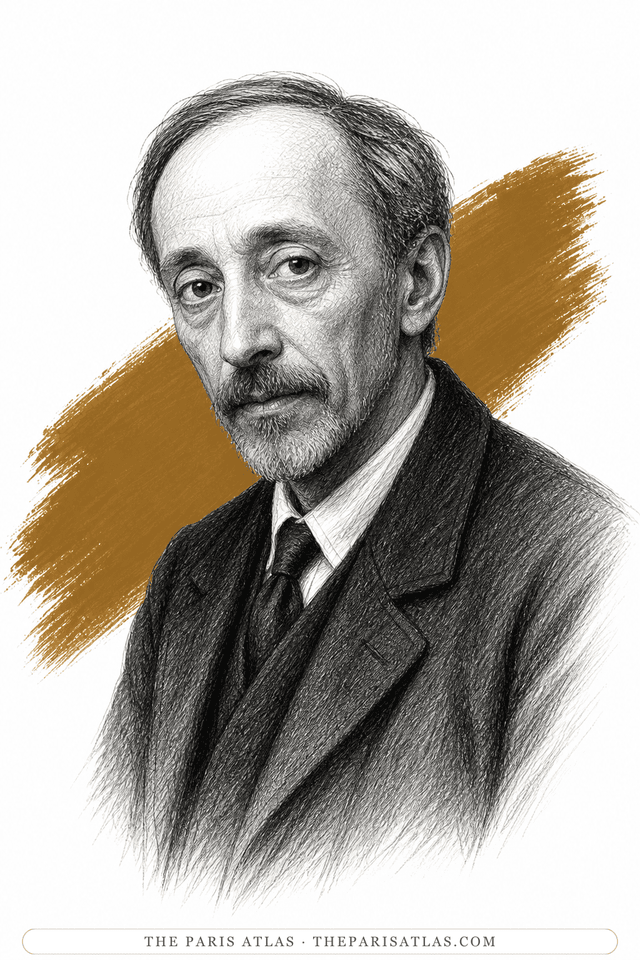
Pierre Bonnard
French painter, printmaker and illustrator whose intimate rooms, Paris streets, gardens and bathing figures transformed everyday life into complex fields of color, memory and perception.
View artist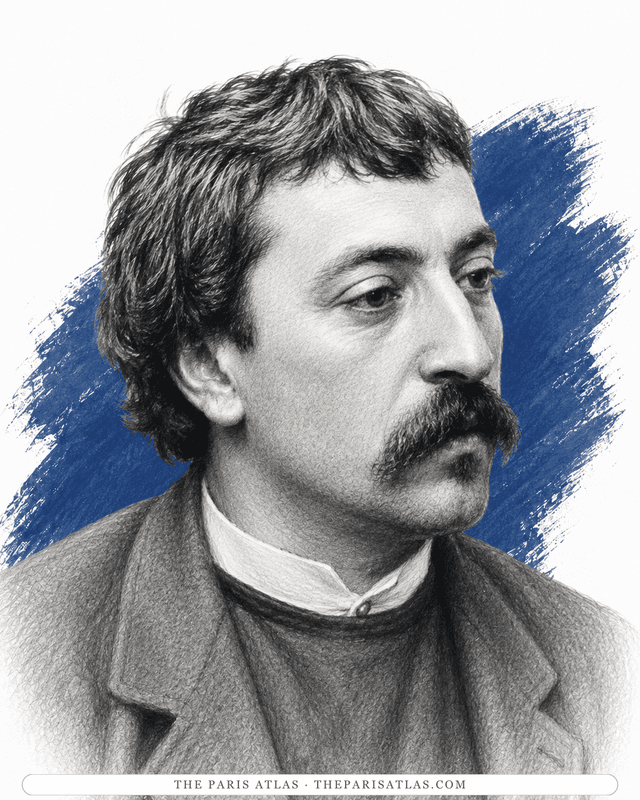
Paul Gauguin
Stockbroker turned painter who came into art through Camille Pissarro, showed with the Impressionists, and left Europe for Polynesia.
View artist
Gustave Moreau
Painter of jewelled myths — Salome, Oedipus, floating severed heads — who lived nearly his whole life in one Paris house, taught Henri Matisse and Georges Rouault at the Beaux-Arts, and turned the house into a museum before he died so the state would have to keep everything.
View artist
References
The sources below include collection records, catalogues, scholarly research, and primary materials that informed this page. They document Puberty, its making, and its place in cultural history.


1Puberty, Edvard Munch (NG.M.00807)
Official recordNasjonalmuseet for kunst, arkitektur og design, OsloUsed forOfficial record used to verify names, dates, institutional details, or other factual information on this page.

2Edvard Munch in the collection
WebsiteNasjonalmuseet, OsloUsed forWeb source consulted for documented facts and historical context presented on the Puberty page.
3Edvard Munch's life 1863–1944 — MUNCH, Oslo
WebsiteMunchmuseet (MUNCH), OsloUsed forWeb source consulted for documented facts and historical context presented on the Puberty page.
4Edvard Munch: Behind the Scream
BiographyYale University Press, 2005Used forBiographical evidence used to verify chronology, relationships, and historical context connected to Puberty.
These references provide the documented foundation for this work's history and interpretation. Claim-level citations remain attached to the specific claims they support.
 Explore more resources