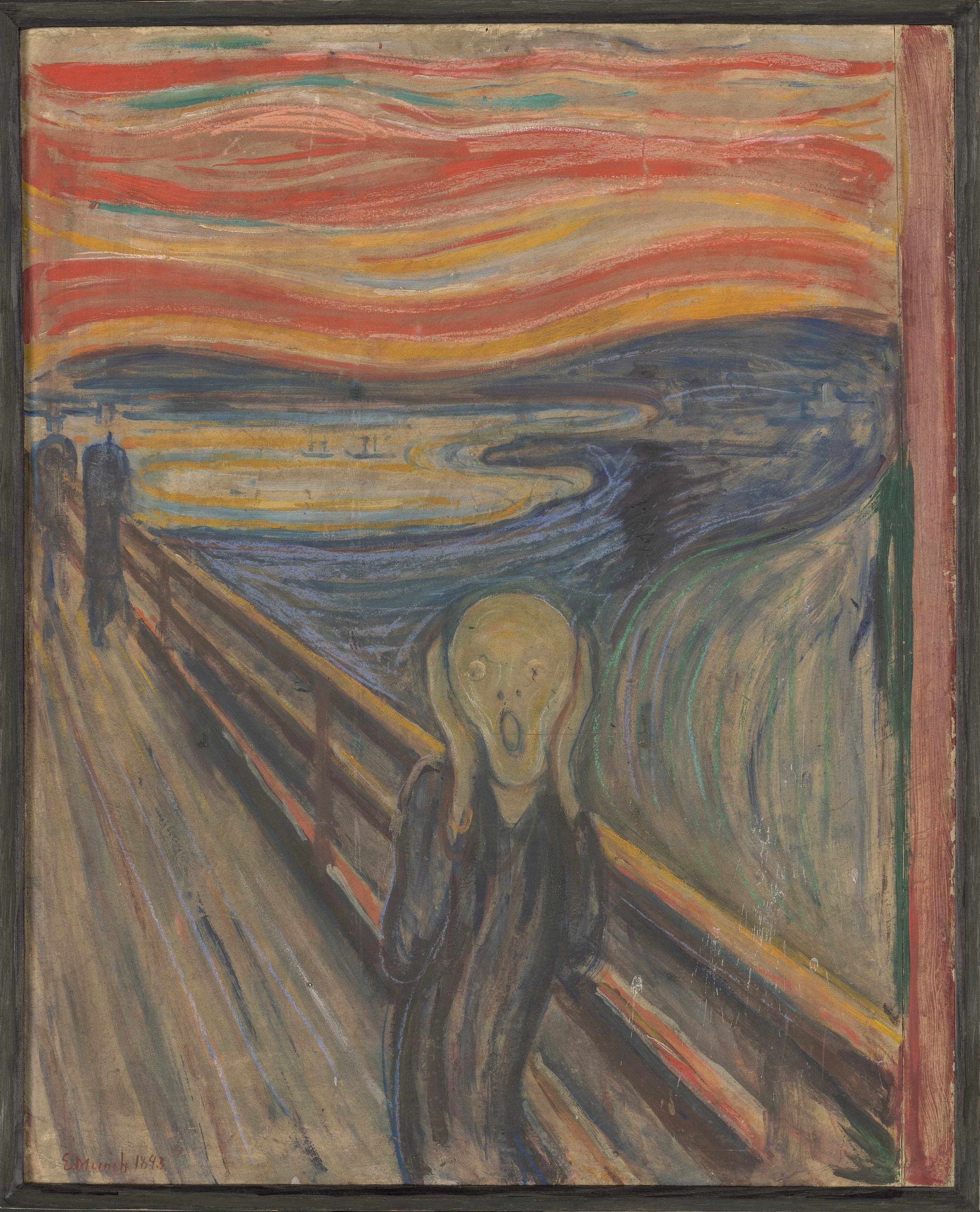
The Scream
by Edvard Munch
A figure stands on a bridge with its hands against its head and its mouth open, under a sky of red and orange bands. Edvard Munch painted this version in 1893 in tempera and oil pastel on cardboard, and it belongs to the National Museum in Oslo. He made four versions of the image in all. Munch's own note explains it: walking with two friends at sunset, he felt a scream pass through nature.
- 1893
- Tempera and oil pastel on cardboard
About Edvard Munch
What the painting shows
A figure stands at the front of a bridge or boardwalk that runs steeply away to the upper left. Its hands are pressed to the sides of its head, its eyes and mouth are open, and its head is a bare skull-like oval with no hair and no clear sex. The body is a wavy vertical shape that dissolves into the same curves as the landscape.
Behind it two other figures walk away up the bridge, upright and in hats, paying no attention. Beyond the railing a blue-black fjord curls under a sky laid in thick bands of orange and red. The National Museum points out that this figure changed from an earlier related painting, where it had been a clearly defined man, into what the museum calls a presence that is difficult to define.
The support is cardboard, not canvas, and the medium is tempera with oil pastel. It measures 91 by 73.5 centimetres. There is a signature in the lower left, and evidence that signatures were added at different times.
The walk Munch described
Munch wrote down the experience the picture came from more than once. He was walking along a road at sunset with two friends, felt tired, and stopped at a railing. The sky turned blood red, he saw the fjord and the town below, and he felt a great scream pass through nature while his friends walked on.
That account gives the painting its structure: the two companions receding, the figure stopped at the rail, and the scream located in the landscape rather than in the mouth of the person. The figure's hands are over its ears.
Four versions
Munch made the image four times between 1893 and 1910: two paintings and two works in pastel. The National Museum in Oslo holds this 1893 painting and a 1893 pastel. The Munch Museum in Oslo holds a 1910 painting. A pastel of 1895 is in private hands, and in 2012 it sold at auction in New York.
He also made a lithograph of the motif in 1895, which is how the image travelled: prints could be reproduced in magazines and books while the paintings stayed in Oslo.
How Oslo got it
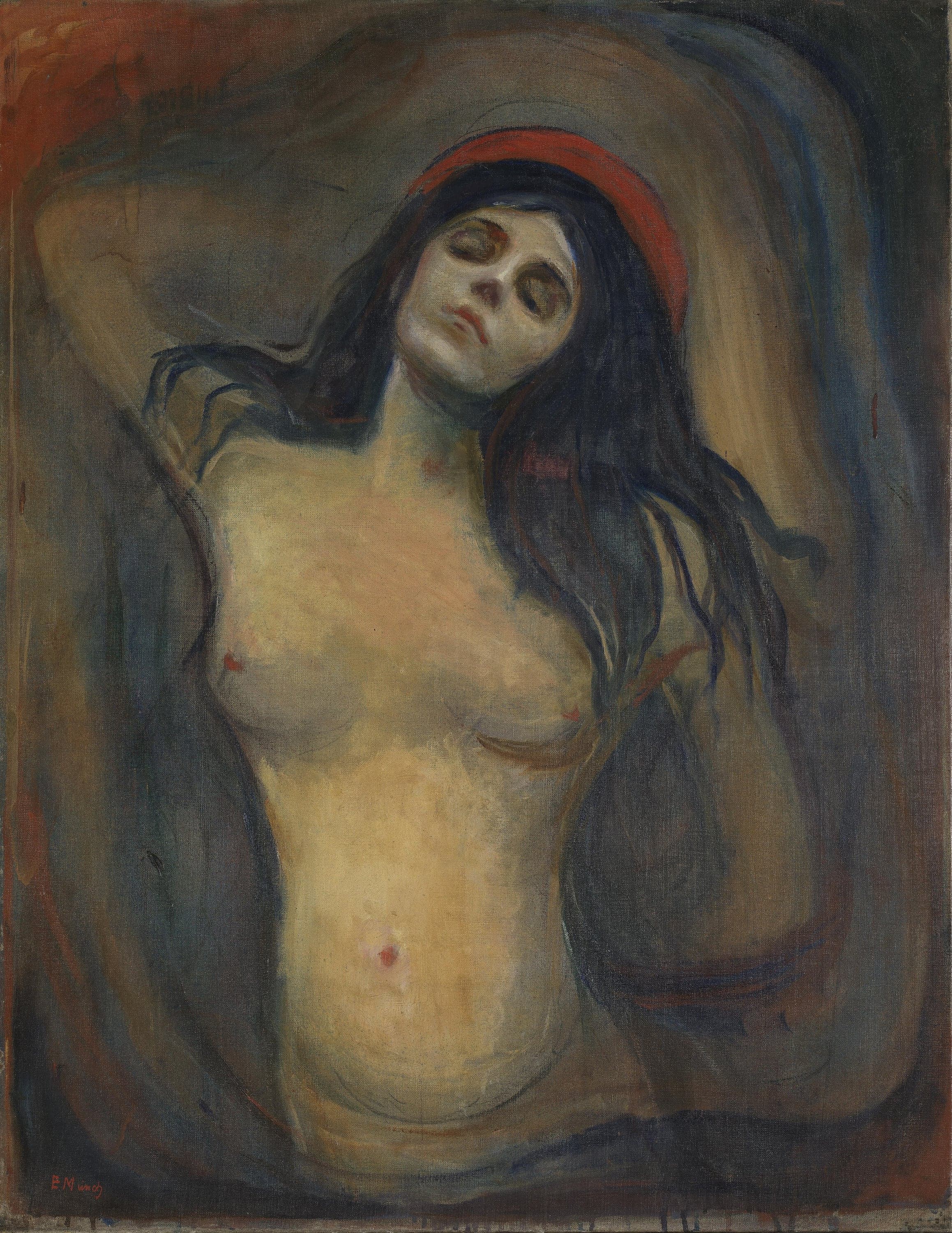
The collector Olaf Schou gave the painting to the Norwegian national collection in 1910. Its accession number is NG.M.00939. Schou also gave the museum Munch's Madonna the previous year.
The National Museum treats the picture as a turning point where, in its words, form and content became closely interrelated, and places it at the passage from Symbolism into the Expressionism of the twentieth century.
Close reading
Reading the work, detail by detail
The support is cardboard and the medium is tempera with oil pastel, so the surface stays dry and matt. Close views show one wavering line used for sky, water and figure, and ruled straight lines kept for the bridge alone.
1.The head is a bare oval with the mouth pulled open
The head carries no hair and no ears, and the mouth is a dark oval stretched long. The eyes are two pale rings with small dark centres. Features are put in with a few strokes over flat yellow-green, and the cardboard shows through between them.
2.The hand covers the ear, not the mouth
The hand is a long tapering shape laid flat against the side of the head, level with where an ear would be. Edvard Munch's written account places the scream in the landscape, not in the figure. The pose matches it: this is someone shutting a sound out.
3.Two figures in hats keep walking
The nearer figure is a blue-black column under a tall hat, with two thin legs below the coat. The further one is smaller and its crown is rounded. Neither has a face, and neither turns.
4.The only straight lines in the picture
Rail and boards are ruled straight and run to a point past the upper left corner. Every other contour in the picture wavers. The two systems meet along the rail, which is where the figure has stopped.
5.The sky is laid in strokes that never blend
Red, orange, yellow and blue-green go on in long horizontal strokes, each one separate. Bare cardboard stays visible in the gaps. The bands sag towards the middle and repeat the curve of the water below them.
6.Two boats sit out on the water
Two vessels are put in with a handful of dark marks: low hulls and thin masts on a band of yellow and grey-blue. They set the middle distance at the scale of the two walkers rather than of the figure at the front.
Timeline
1892
Munch notes the walk at sunset when he felt a scream pass through nature, the experience the picture works from.
1893
Paints this version in tempera and oil pastel on cardboard, and makes a pastel of the same motif.
1895
Makes a lithograph of the image, which carries it into print and out of Norway. A pastel version of this year is now in private hands.
1910
Olaf Schou gives the painting to the Norwegian national collection, as NG.M.00939. Munch paints a further version, now at the Munch Museum.
2012
The 1895 pastel sells at auction in New York.
Where to see it
Nasjonalmuseet for kunst, arkitektur og design, Oslo
A public viewing address has not yet been confirmed for this holding.
Frequently asked questions
Where is The Scream?
There are four versions. This 1893 painting is at the National Museum in Oslo, accession number NG.M.00939, along with an 1893 pastel. The Munch Museum in Oslo holds the 1910 painting, and an 1895 pastel is privately owned.
What does The Scream show?
A figure on a bridge above a fjord with its hands pressed to its head and its mouth open, under a sky of red and orange bands. Two other figures walk away up the bridge without looking back.
Is the figure in The Scream screaming?
Munch's own account says no. He described stopping at a railing at sunset and feeling a scream pass through nature while his friends walked on. The figure has its hands over its ears, so the sound is in the landscape and the figure is reacting to it.
What is The Scream painted on?
Cardboard, in tempera with oil pastel, not oil on canvas. It measures 91 by 73.5 centimetres. The unusual support is part of why the surface looks dry and matt rather than glossy.
How many versions of The Scream are there?
Four, made between 1893 and 1910 — two paintings and two pastels — plus a lithograph of 1895. The print is what spread the image internationally while the paintings stayed in Oslo.
How did the National Museum get The Scream?
The collector Olaf Schou gave it to the Norwegian national collection in 1910. He had given the museum Munch's Madonna the year before.
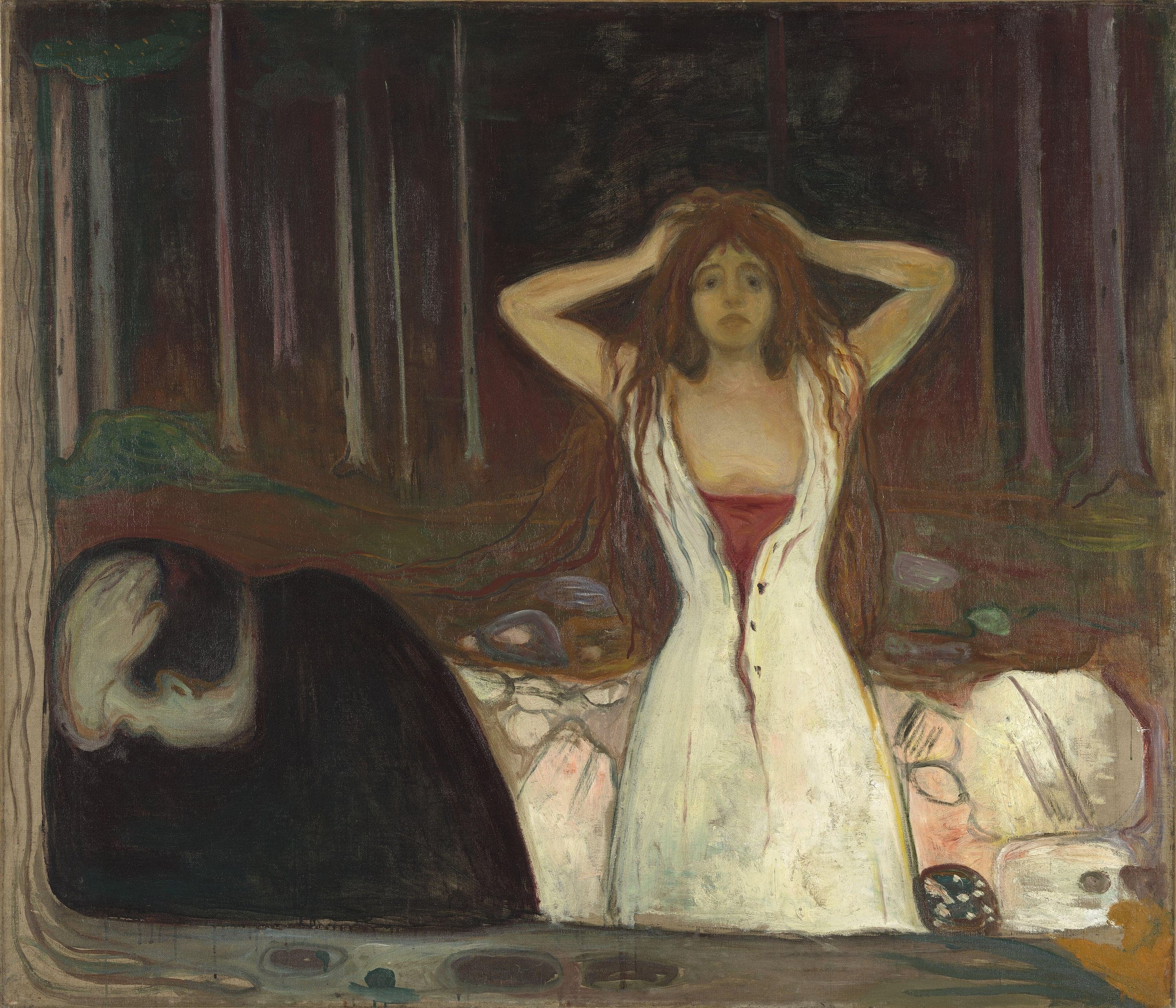
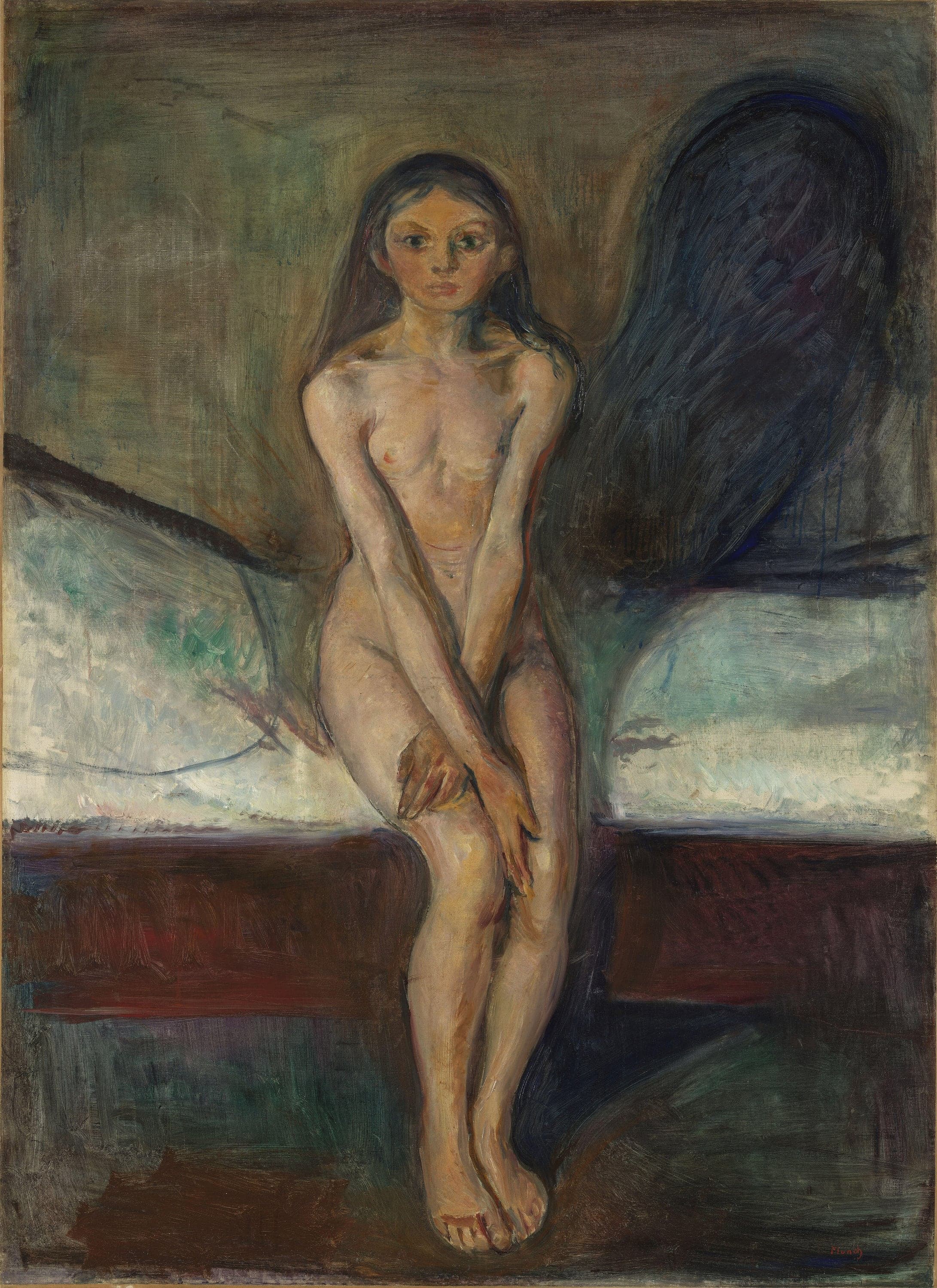
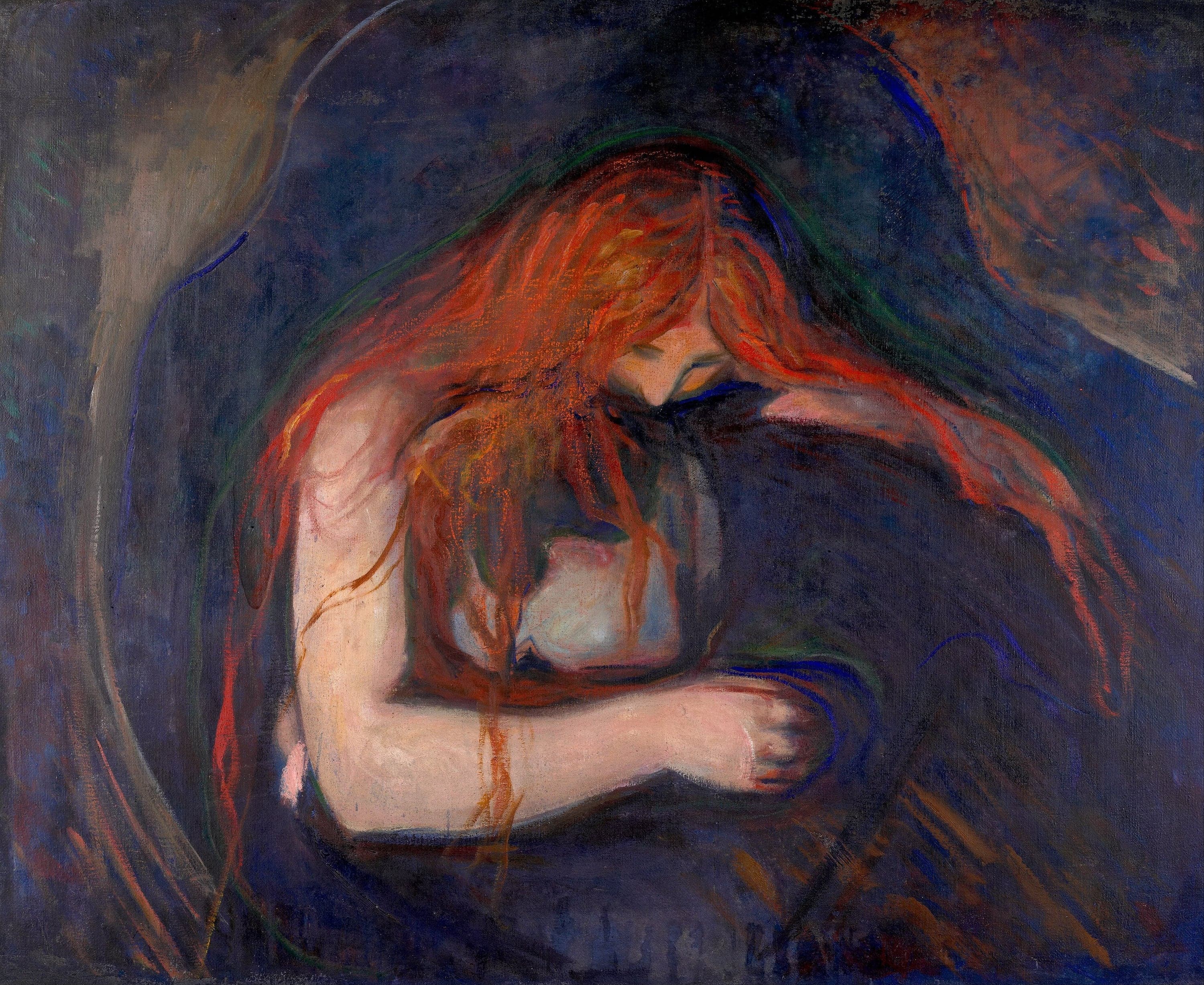
More by Edvard Munch
If you like Edvard Munch
Explore painters from the same movements and circles.
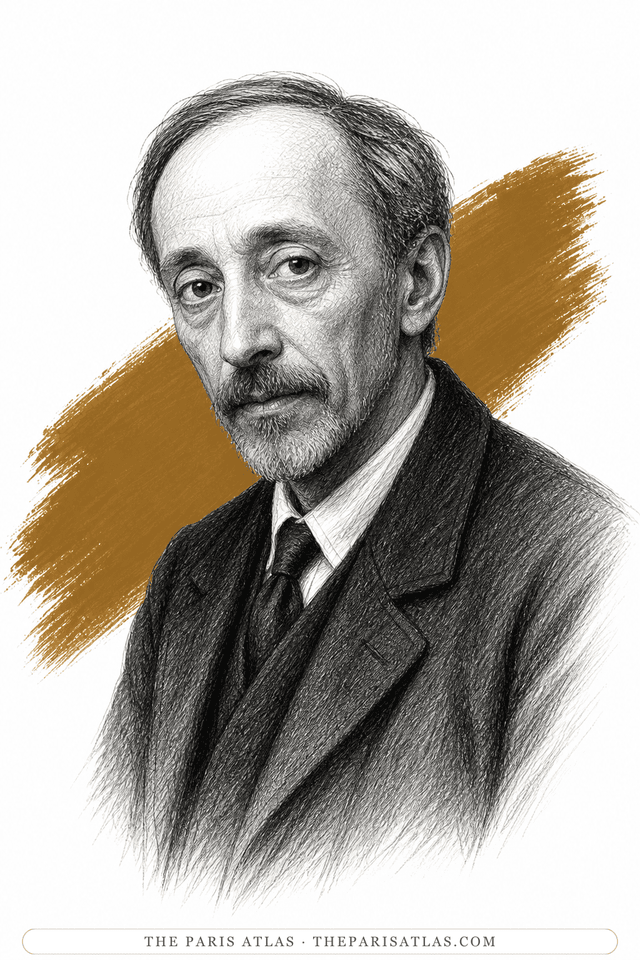
Pierre Bonnard
French painter, printmaker and illustrator whose intimate rooms, Paris streets, gardens and bathing figures transformed everyday life into complex fields of color, memory and perception.
View artist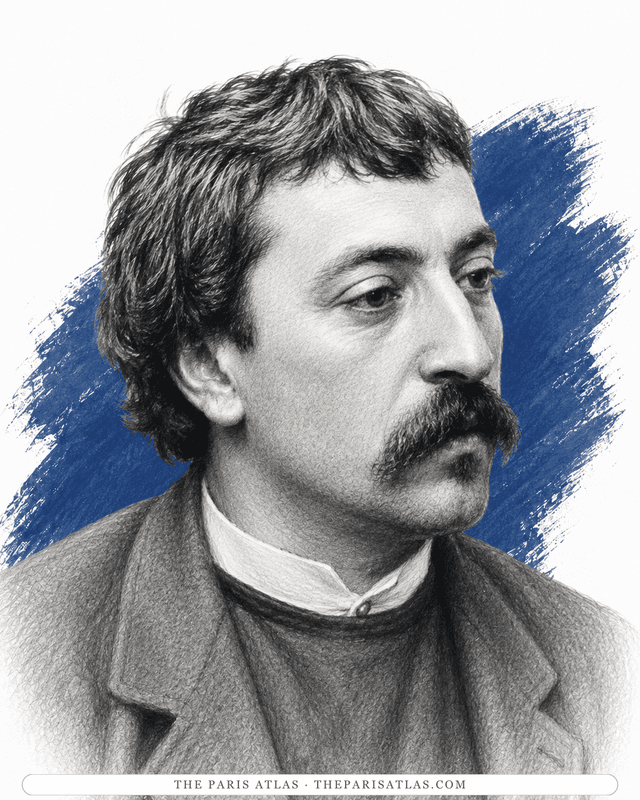
Paul Gauguin
Stockbroker turned painter who came into art through Camille Pissarro, showed with the Impressionists, and left Europe for Polynesia.
View artist
Gustave Moreau
Painter of jewelled myths — Salome, Oedipus, floating severed heads — who lived nearly his whole life in one Paris house, taught Henri Matisse and Georges Rouault at the Beaux-Arts, and turned the house into a museum before he died so the state would have to keep everything.
View artist
References
The sources below include collection records, catalogues, scholarly research, and primary materials that informed this page. They document The Scream, its making, and its place in cultural history.

1Edvard Munch, The Scream (1893), NG.M.00939 — Nasjonalmuseet collection record
WebsiteNasjonalmuseet, OsloUsed forWeb source consulted for documented facts and historical context presented on the The Scream page.
2Edvard Munch in the collection
WebsiteNasjonalmuseet, OsloUsed forWeb source consulted for documented facts and historical context presented on the The Scream page.

3eMunch — Edvard Munch's writings, digital archive
ArchiveMunchmuseet (MUNCH), OsloUsed forArchival evidence used to document the historical record connected to The Scream.
4Edvard Munch: Behind the Scream
BiographyYale University Press, 2005Used forBiographical evidence used to verify chronology, relationships, and historical context connected to The Scream.
These references provide the documented foundation for this work's history and interpretation. Claim-level citations remain attached to the specific claims they support.
 Explore more resources