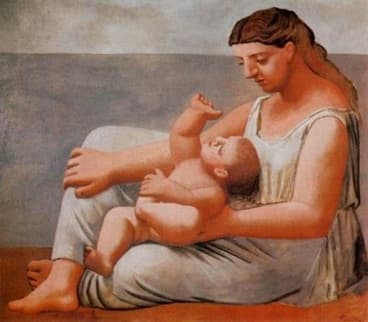
A woman sits on brown ground in a white tunic, one knee drawn up, her long hair falling loose over her shoulder. She looks down. A naked infant lies across her lap and reaches a hand toward her face. Behind them, a band of grey water and a paler sky, painted almost without incident.
The picture is nearly six feet wide, and the scale is the argument. Her hands and feet are enormous, her head small on heavy shoulders, the folds of the tunic cut like stone rather than cloth. Two people at rest, given the proportions of architecture.
Signed and dated at the lower right, Picasso / 21.
Rome, and where the classicism came from
In 1917 Picasso went to Rome to design sets and costumes for Sergei Diaghilev's Ballets Russes. The Art Institute's account puts the change there: the ancient and Renaissance art he saw in that city sent him toward monumental figures drawn from antiquity, filtered through the finely modelled odalisques of Ingres and the heavy late nudes of Renoir.
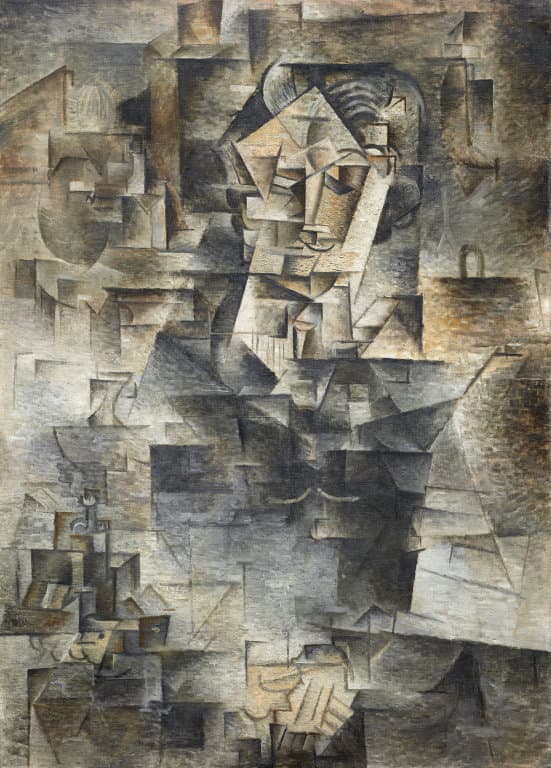
It is worth being precise about what this was not. Picasso did not stop being a Cubist in 1917 and become a classicist. Through these same years he was producing flat, bright, cut-paper Synthetic Cubism, sometimes in the same weeks. The classical language was a language he added, not one that replaced anything.
Olga and Paulo
The subject was also domestic fact. Picasso had married the Russian dancer Olga Khokhlova in 1918, and their son Paulo was born in February 1921. Between 1921 and 1923 he made at least twelve pictures of mothers and children.
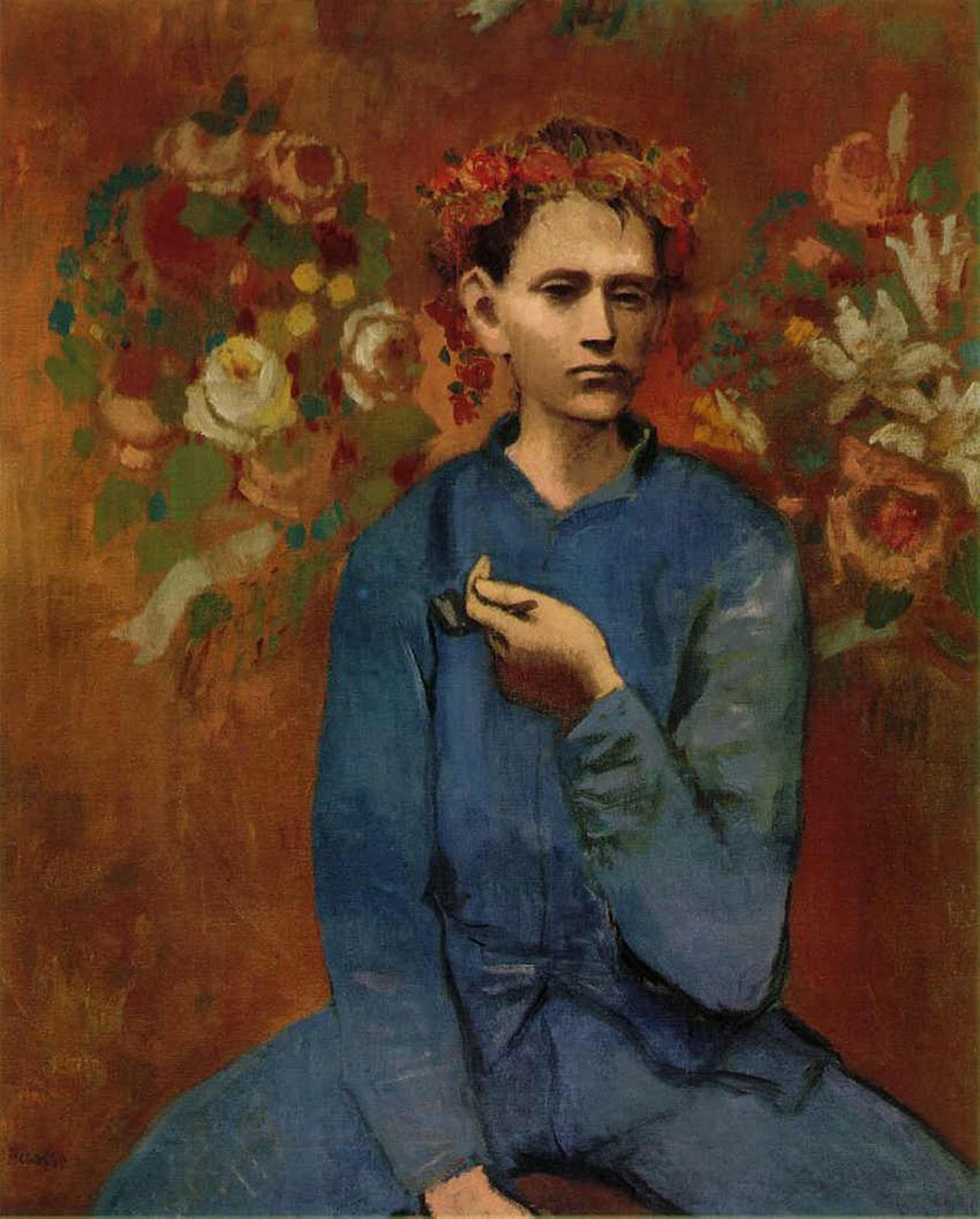
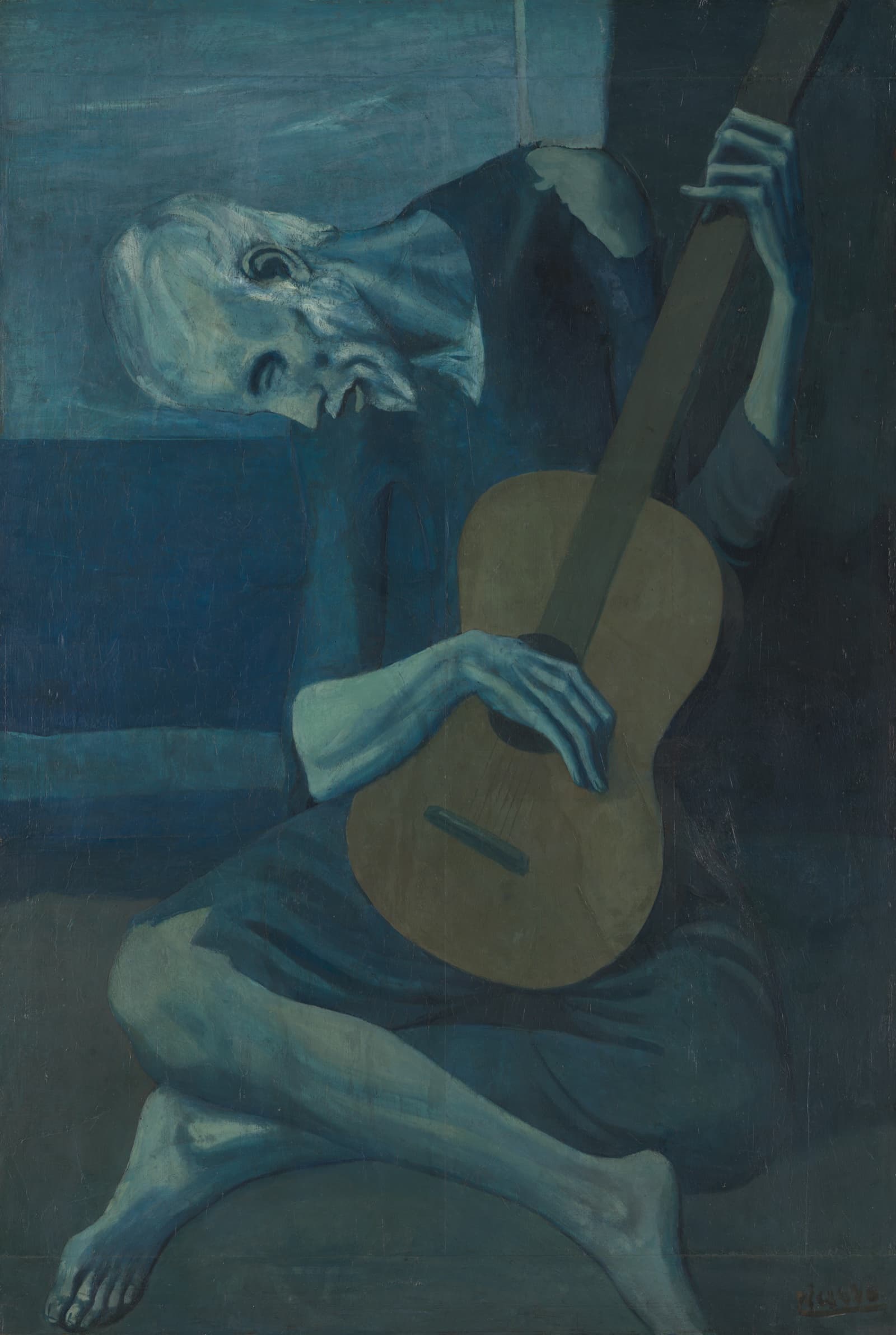
He had painted the subject before, in the Blue Period, where the figures are thin and stricken. The Art Institute draws the comparison itself: these later figures are solid, sculpturally modelled, and calm. The same theme, taken up by a man on the other side of poverty and in the first year of his own fatherhood.
The same year as Three Women at the Spring
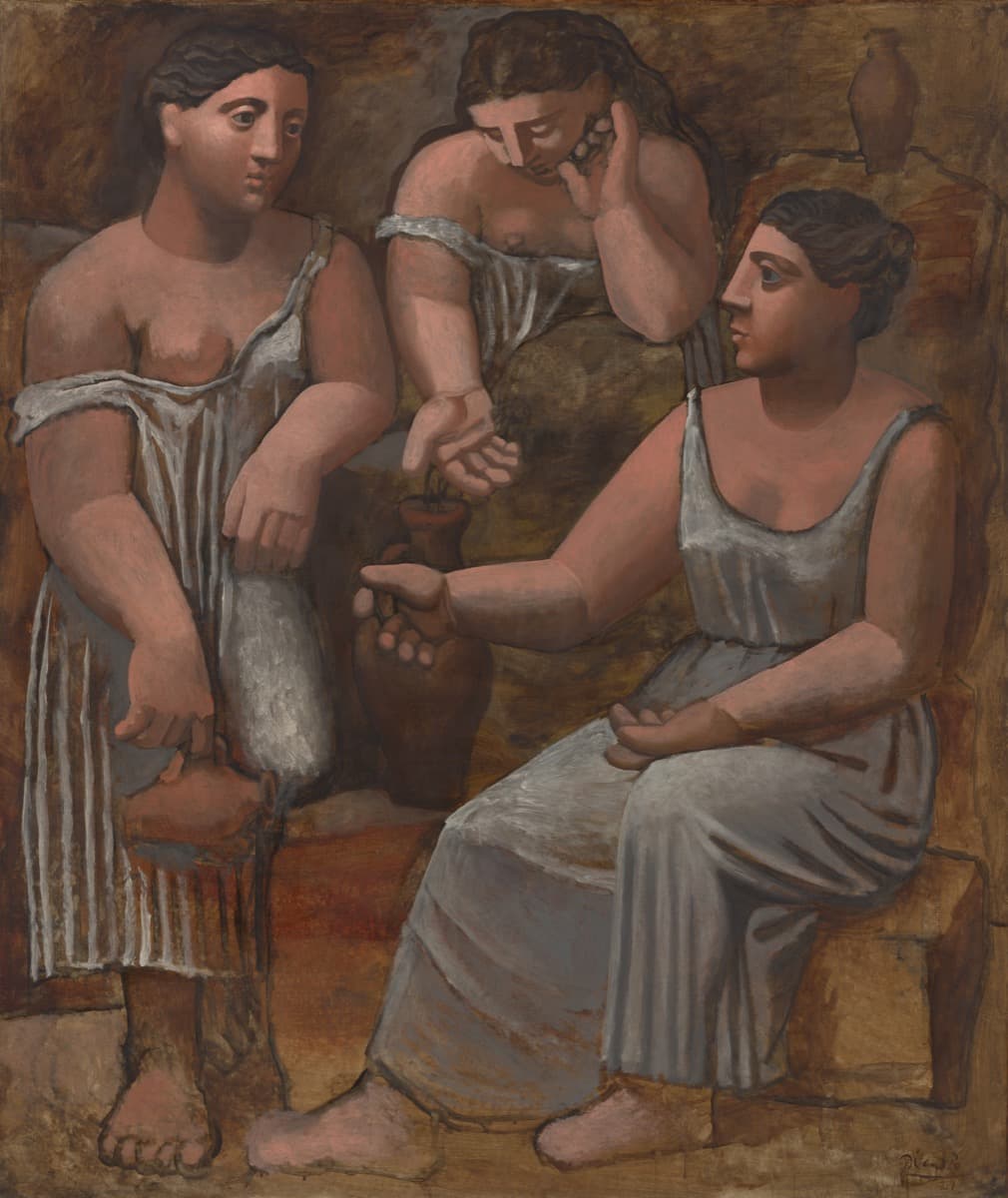
Three Women at the Spring, at the Museum of Modern Art, comes out of the same campaign — the same monumental bodies, the same stone-cut drapery, the same year. Set beside each other, the two pictures show the range of what Picasso wanted the classical mode to do. One is a family at rest. The other is a ritual that has stalled, three women at a spring that gives no water.
Cocteau printed it first
The painting's first appearance in print was in Jean Cocteau's book Picasso, published by Librairie Stock in Paris in 1923, where it is captioned Maternité. It ran again the same year in L'Esprit Nouveau and in the American magazine The Dial. That 1923 publication is also why the image on this page is in the public domain in the United States.
Paul Rosenberg had the canvas by 1922 and sold it that June to John Quinn, the New York lawyer whose collecting underwrote a great deal of modernism on both sides of the Atlantic. Quinn died in 1924; the painting went back to Rosenberg in 1926, on to Gottlieb Friedrich von Reber in Lausanne, and returned to Rosenberg in New York in 1953. The Art Institute bought it in 1954, and it hangs in Gallery 394.
Close reading
Reading the work, detail by detail
This Return to Order painting adopts one of art's oldest subjects without returning to delicate naturalism. Its close views show tenderness carried by monumental, deliberately oversized bodies.
1.The exchange is concentrated in two profiles
The heads incline toward one another and close the emotional circuit of the painting. Expression is restrained; angle and proximity do more than facial detail to establish intimacy.
2.Oversized hands turn care into structure
The hands are emphatically large, enclosing and stabilizing the smaller body. They are not anatomical mistakes but compositional tools: protection made visible as weight and span.
3.Drapery gives the pair the mass of sculpture
Large folds suppress the separate contours of legs and torso, gathering two bodies into one pyramidal volume. Picasso borrows classical stability while keeping the surface blunt and modern.
4.The mother's lowered face directs attention toward her lap
The mother lowers her face, bringing the eyes and nose into a clear diagonal toward her lap. Warm color across the cheek stands against the gray background. Dark hair defines the upper edge of the head, while the softer shading below keeps the expression restrained.
5.The bare foot extends beyond the folded dress
A bare foot extends leftward from beneath the pale dress. A dark band of folds gathers around the ankle before the fabric turns across the lap. The change from folded cloth to the smoother foot makes the seated mother's position easier to follow.
6.Long folds descend beside the mother's arm
Long folds gather along the right side of the pale dress. Dark lines sharpen where the fabric passes beneath the arm, then continue toward the lower edge. These mostly vertical marks give the clothing a clear direction beside the broad horizontal forearm supporting the child.
Timeline
1921
Picasso painted it in the monumental, neoclassical manner of his postwar years.
1922
Acquired by the dealer Paul Rosenberg and sold on to the New York collector John Quinn.
Where to see it
Art Institute of Chicago
111 South Michigan Avenue, Chicago, IL 60603, United States
Displays and loans can change. Check whether this work is on view before making a special trip.
A woman seated by grey water with an infant across her lap, painted at nearly six feet wide in the monumental classical style Picasso adopted after 1917. It is one of at least twelve mother-and-child pictures he made between 1921 and 1923, in the years around the birth of his son.
Why did Picasso start painting like this after Cubism?
The Art Institute traces it to his 1917 trip to Rome to work for Diaghilev's Ballets Russes, and the ancient and Renaissance art he saw there, with Ingres and late Renoir behind it. He did not abandon Cubism to do it — he was producing flat Synthetic Cubist work in the same period.
Who are the mother and child?
The painting does not name them. Picasso had married Olga Khokhlova in 1918 and their son Paulo was born in February 1921, and the museum connects the subject to his own life, but the figures are types drawn from antiquity rather than portraits.
How is it different from his Blue Period mothers?
The Blue Period figures on this theme are frail and anguished. These are solid, sculpturally modelled and majestic in proportion — the Art Institute's own comparison. Same subject, twenty years and a change of circumstances apart.
How big is it?
142.9 by 172.7 centimetres, a little under five feet tall and nearly six feet wide.
Where is it now?
The Art Institute of Chicago, object 1954.270, on view in Gallery 394 at the last check of the museum's record.
In the atlas
What the graph records about this work — every claim carries its citation.
The Art Institute traces the monumental classical figures to Picasso's 1917 trip to Rome for Diaghilev, with Ingres and late Renoir behind them. He kept painting Synthetic Cubism through the same years, so the classicism was an addition rather than a repudiation.
— Art Institute of Chicago — collection records, object 109275
Explore painters from the same movements and circles.
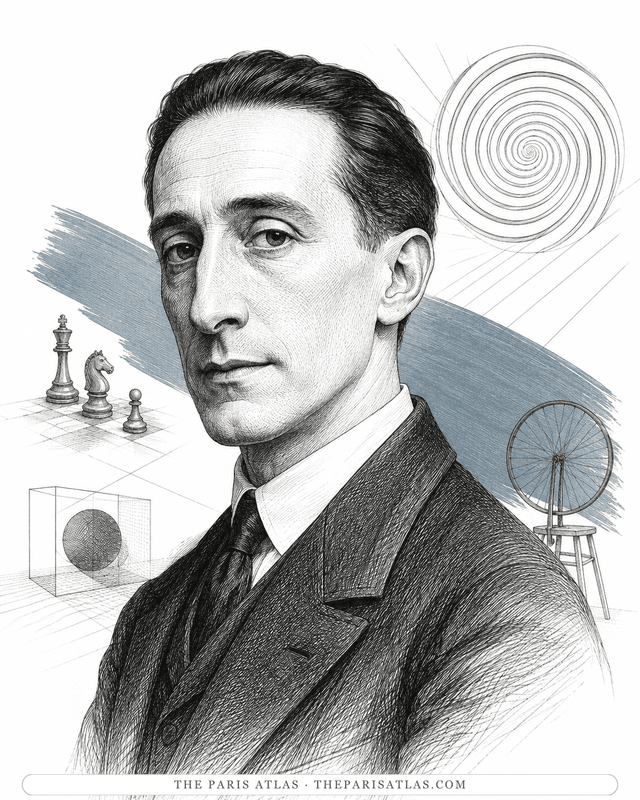
Marcel Duchamp
The century's quietest revolutionary — readymades, the abandonment of painting, chess on a Paris rooftop in Entr'acte, and one anemic film of spinning puns signed Rrose Sélavy.
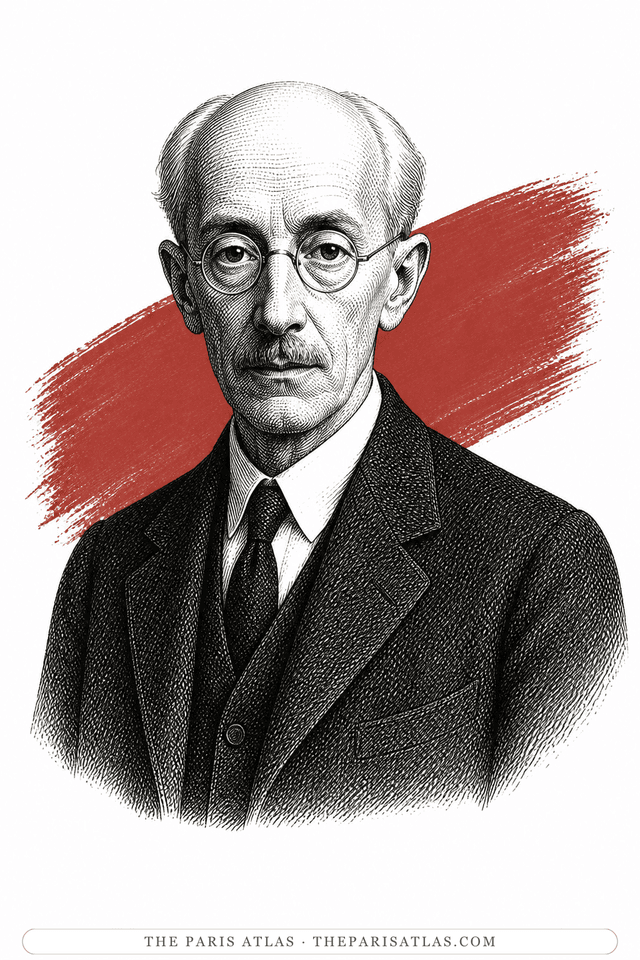
Dutch painter of the primary-colour grids, made mostly in a studio beside the Gare Montparnasse where he lived on and off from 1912 to 1938. He dropped an 'a' from Mondriaan on arriving in Paris, painted his studio walls in movable rectangles, and danced the Charleston.
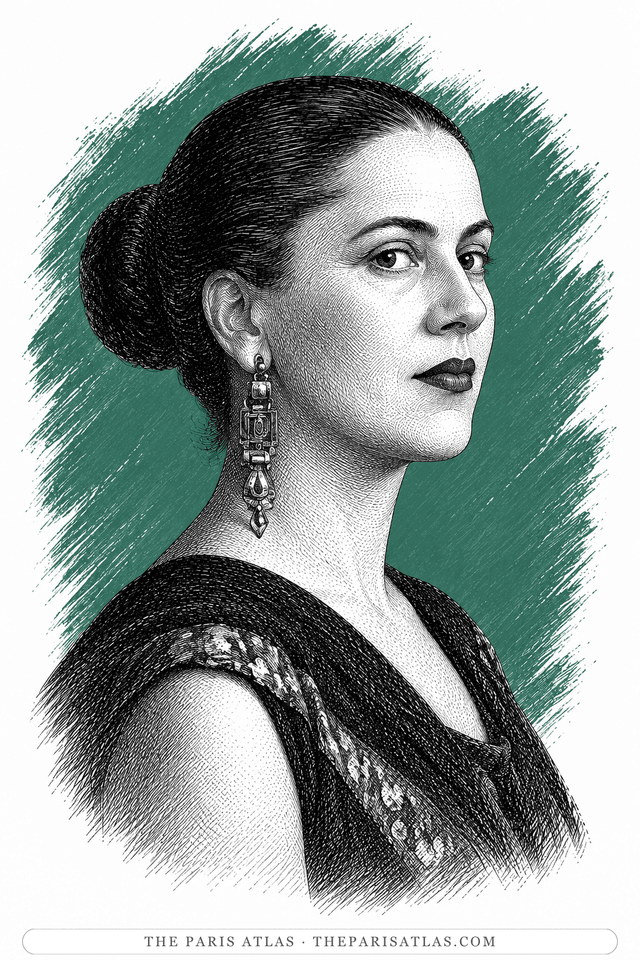
Brazilian painter who spent the 1920s moving between São Paulo and Paris, studied Cubism under André Lhote, Albert Gleizes and Fernand Léger, and used what she learned to paint Brazilian towns, railways, plants and bodies. Her 1928 painting Abaporu prompted the manifesto that gave the Anthropophagic movement its name.
The sources below include collection records, catalogues, scholarly research, and primary materials that informed this page. They document Mother and Child, its making, and its place in cultural history.
1Art Institute of Chicago — collection records
Website
Used for
Web source consulted for documented facts and historical context presented on the Mother and Child page.
These references provide the documented foundation for this work's history and interpretation. Claim-level citations remain attached to the specific claims they support.



 View source