The selection includes precursors, core Cubist works, and a later continuation. Collection names identify the institutions that hold the works, not a promise that they are currently on view.
Artwork reproduction
painting · Rose Period · toward Cubism
Pablo Picasso · 1905–6 · Oil on canvas
Collection: The Metropolitan Museum of Art
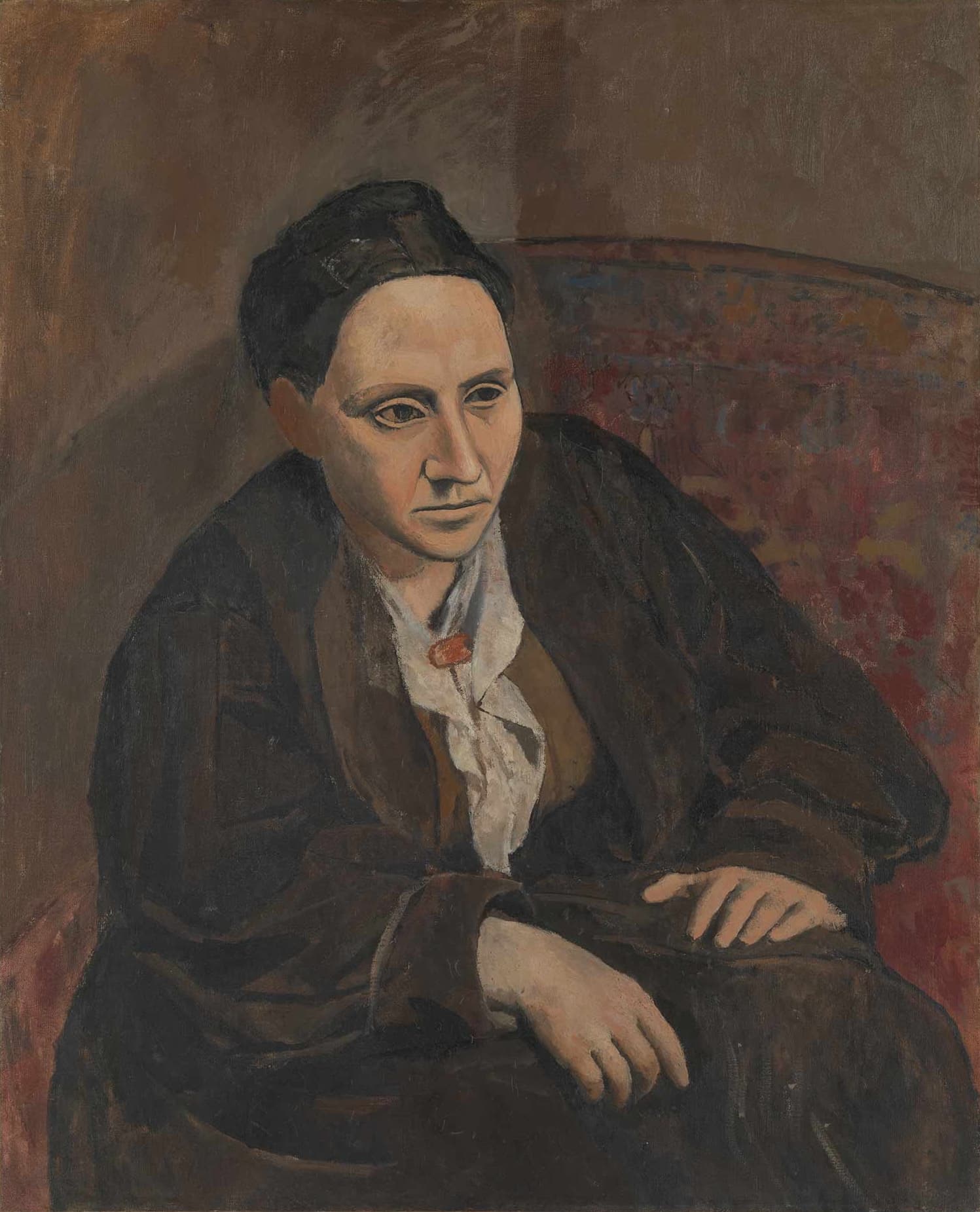
Painted through eighty or ninety sittings at Picasso's Bateau-Lavoir studio, the portrait joins Stein's massive, calmly seated body to a face radically reinvented in 1906. She hung it above the fireplace at 27 rue de Fleurus, where it became both her public image and a threshold on Picasso's road to Cubism.[47]
A pre-Cubist portrait whose reworked face helps explain Pablo Picasso’s changing treatment of form.[47]
Pablo Picasso’s portrait of Gertrude Stein, painted in 1905–1906, precedes mature Cubism but belongs to the story of its emergence. Gertrude Stein later recalled eighty or ninety sittings—an extraordinary number that the Met’s curator Dita Amory considers probably exaggerated. The count is best understood as part of Gertrude Stein’s recollection of the experience. [44]
Pablo Picasso, Gertrude Stein, 1905–6. The Metropolitan Museum of Art. Image: public domain (US).
Artwork reproduction
painting · Modern Art
Pablo Picasso · 1907 · Oil on canvas
Collection: Museum of Modern Art · New York, United States
Acquired by the Museum of Modern Art in 1939. Gallery displays change, so check the museum's own object record before making a special visit.
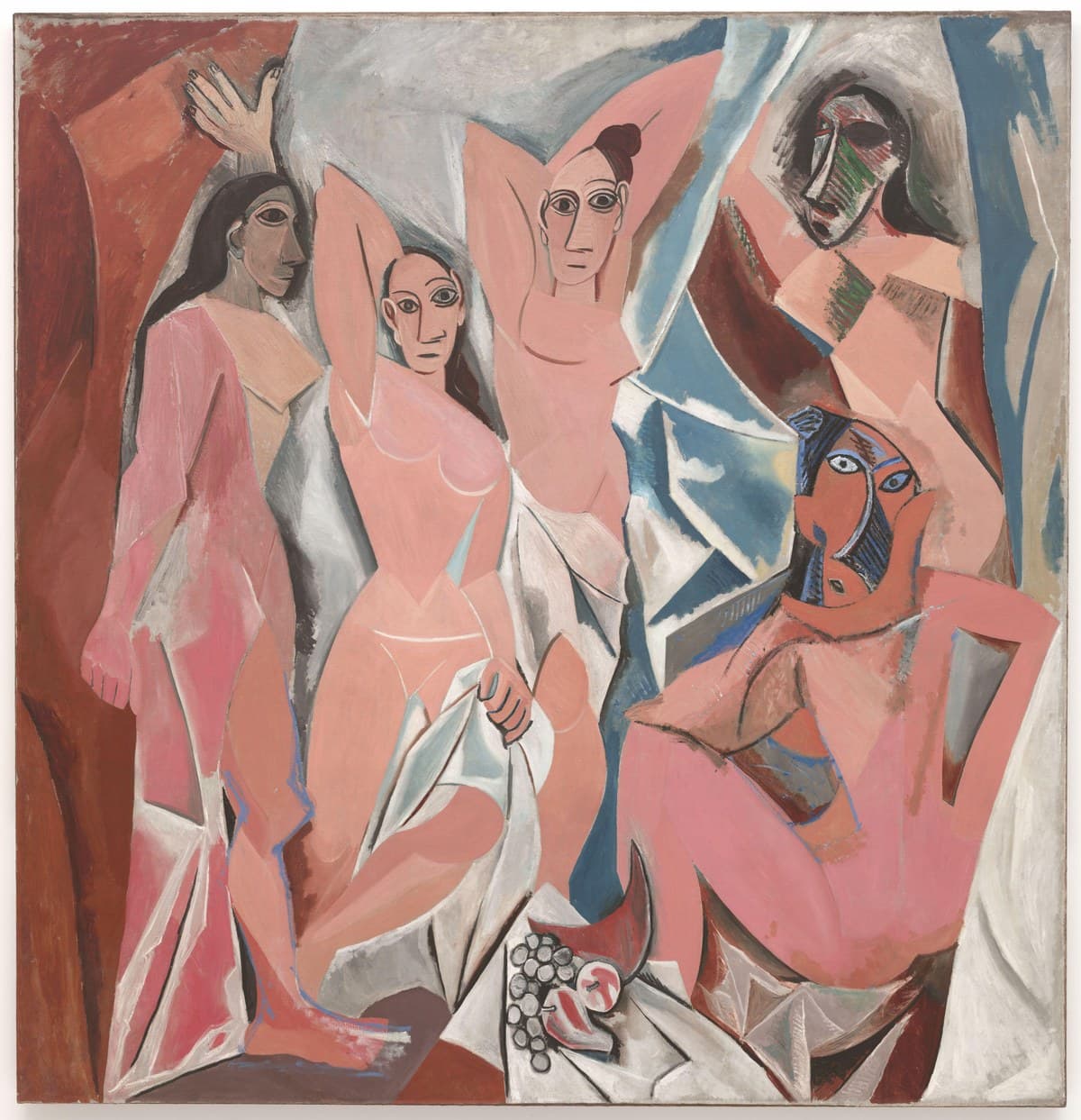
Pablo Picasso developed Les Demoiselles d’Avignon through numerous studies, bringing the canvas to its decisive state in summer 1907. Five women occupy an aggressively compressed space; bodies and curtains form angular areas, while the faces draw on different sculptural traditions. Its title refers to a street associated with prostitution in Barcelona, not the French city of Avignon. [11]
A pivotal precursor, combining angular bodies, compressed space, and diverse sculptural references.[11]
Pablo Picasso, Les Demoiselles d'Avignon, 1907. Museum of Modern Art. Image © the rights holder, shown under fair use.
Artwork reproduction
Georges Braque · 1908 · Oil on canvas
Collection: Centre Pompidou, Musée national d’art moderne
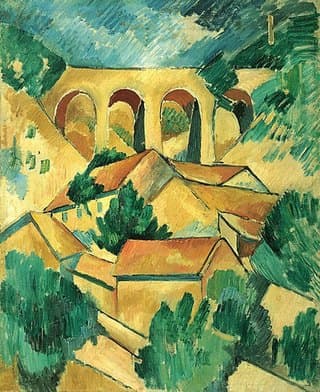
The major retrospective of Paul Cézanne’s work at the 1907 Salon d’Automne was particularly important for Georges Braque. Returning to L’Estaque, near Marseille, in 1908, he painted houses, trees, and hills as closely interlocking masses. In The Viaduct at L’Estaque, the landscape becomes a tightly constructed arrangement rather than an expansive view into the distance. This early phase is sometimes called Cézannian or early Cubism: forms are simplified and space compressed, but objects generally retain more solidity than in the densely fragmented paintings that followed. [3]
The translation of Paul Cézanne’s example into a more tightly organized landscape.[3]
Georges Braque, The Viaduct at L’Estaque, 1908. Centre Pompidou, Musée national d’art moderne. © Adagp, Paris 2007. Image shown under fair use.
Artwork reproduction
sculpture · Cubism
Pablo Picasso · 1909 · Bronze
Collection: Art Institute of Chicago
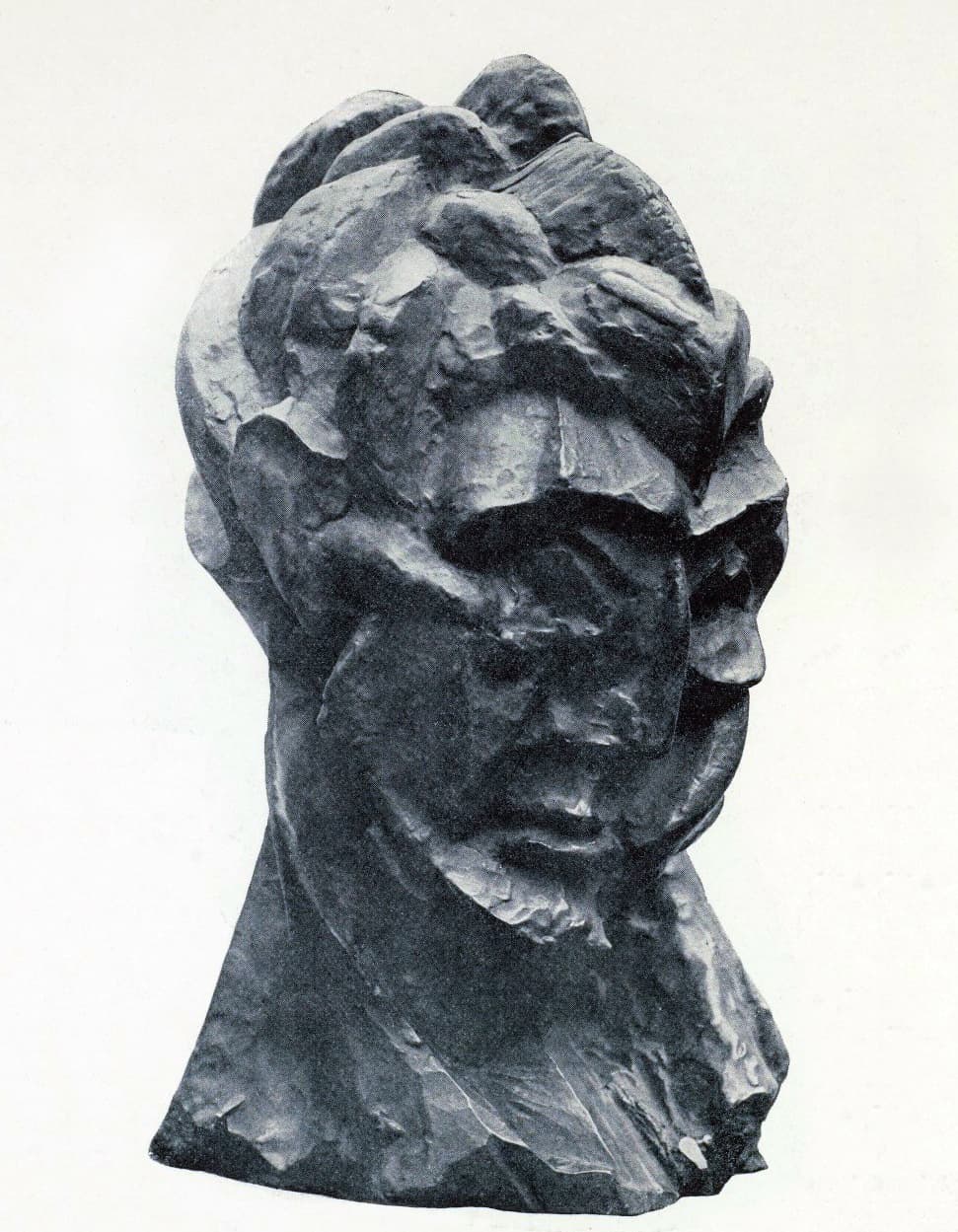
Picasso's 1909 portrait of Fernande Olivier, modeled in clay as interlocking ridges, hollows, and facets. Often identified as his first fully Cubist sculpture, it tests how several implied viewpoints can occupy one solid head.[38]
The treatment of a head through ridges and facets; the collection holds a bronze example.[38]
Pablo Picasso, Head of a Woman (Fernande), 1909. Art Institute of Chicago. Image: public domain (US).
Artwork reproduction
painting · Analytic Cubism
Pablo Picasso · autumn 1910 · Oil on canvas
Collection: Art Institute of Chicago
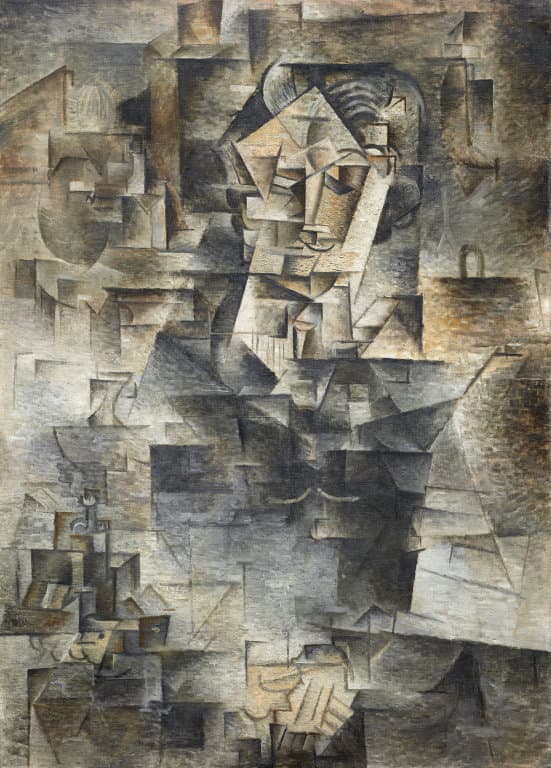
The dealer who kept Cubism solvent, dissolved into its planes — painted in Paris at the movement's most austere moment.[16]
A portrait that preserves identifying details within a dense structure of planes.[16]
His hair, clasped hands, and watch chain provide clues within a network of shifting brown and grey planes. These details are sufficiently specific to retain something of the sitter’s identity even though his head and body never detach cleanly from their surroundings. The watch chain is particularly revealing: an accessory can be easier to identify than the person wearing it. [17]
Pablo Picasso, Daniel-Henry Kahnweiler, autumn 1910. Art Institute of Chicago. Image: public domain (US).
Artwork reproduction
Pablo Picasso · Winter 1911–1912 · Oil on canvas
Collection: Museum of Modern Art, New York
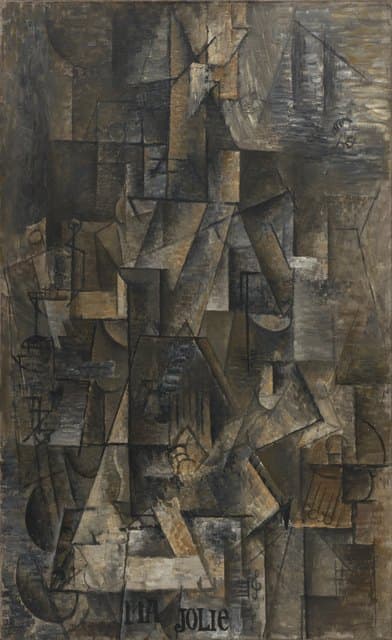
In Ma Jolie, made in winter 1911–1912, recognition becomes harder. Lines suggest an instrument’s strings, a treble clef points towards music, and the words refer both to a popular song and to Pablo Picasso’s affectionate name for his companion. Lettering can be read without establishing depth. The painting sets this kind of recognition beside the more uncertain task of identifying a figure in the facets. [7]
A near-abstract figure held in relation to music, language, and personal association.[7]
Pablo Picasso, Ma Jolie, Winter 1911–1912. Museum of Modern Art, New York. © 2026 Estate of Pablo Picasso / Artists Rights Society (ARS), New York. Image shown under fair use.
Artwork reproduction
Juan Gris · January–February 1912 · Oil on canvas
Collection: Art Institute of Chicago
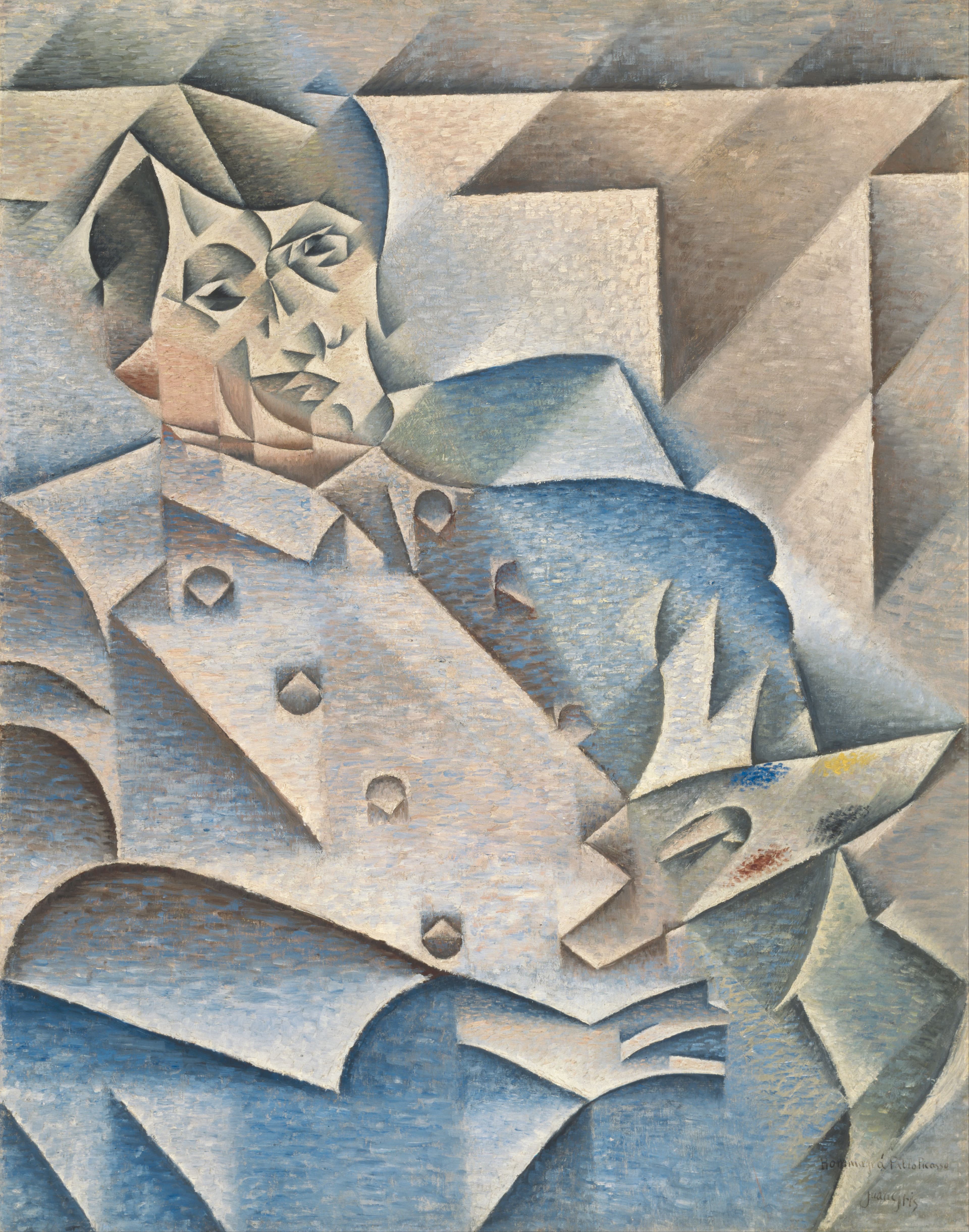
Juan Gris’s Portrait of Pablo Picasso, painted in January–February 1912, makes his allegiance explicit. Pablo Picasso appears with a painter’s palette, and the inscription offers an homage to him. Yet Juan Gris was also announcing an identity of his own. The portrait gives its faceted forms a more regular organization and clearer colour contrasts than many contemporary paintings by Pablo Picasso and Georges Braque. Its public exhibition helped establish Juan Gris as a participant in the movement, not merely an admirer looking in from outside. [27]
An homage that also announces Juan Gris’s distinct place in the movement.[27]
Juan Gris, Portrait of Pablo Picasso, January–February 1912. Art Institute of Chicago. Image: public domain.
Artwork reproduction
Pablo Picasso · Spring 1912 · Oil and printed oilcloth on canvas, framed with rope
Collection: Musée national Picasso-Paris
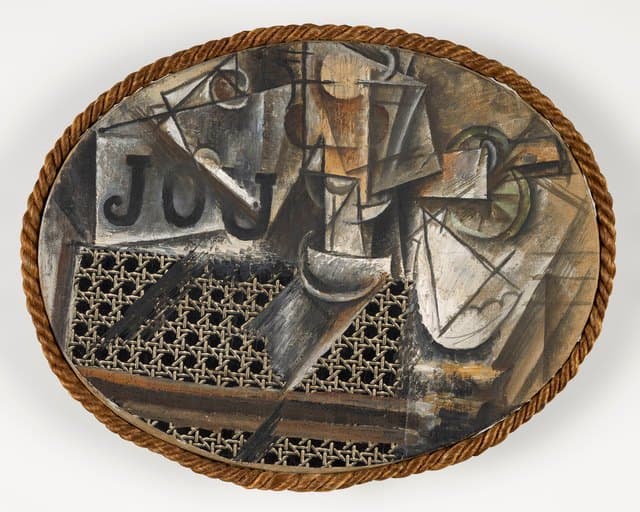
In the spring of 1912, Pablo Picasso made Still Life with Chair Caning, a small oval work now in the Musée national Picasso-Paris. Its lower area contains commercially printed oilcloth imitating woven chair caning, while a real rope forms the frame. The distinction matters: Pablo Picasso did not paste an actual piece of woven cane into the painting. He introduced a manufactured illusion of cane and placed it beside painted forms and real rope. [22]
Printed oilcloth and rope complicate the relationship between material and imitation.[22]
Pablo Picasso, Still Life with Chair Caning, Spring 1912. Musée national Picasso-Paris. © Succession Picasso. Image shown under fair use.
Artwork reproduction
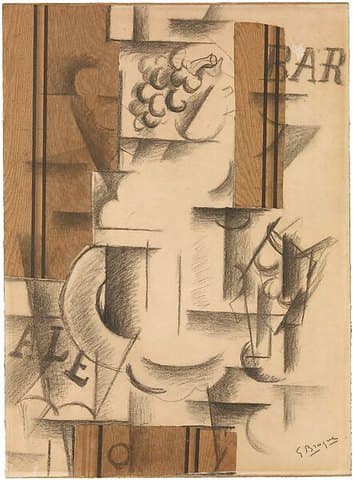
Georges Braque · Autumn 1912 · Charcoal, printed wallpaper, and gouache on paper, mounted on paperboard
Collection: Metropolitan Museum of Art, New York
Georges Braque’s Fruit Dish and Glass, made at Sorgues in the autumn of 1912, is generally identified as his first papier collé. According to Georges Braque’s later account, he bought imitation wood-grain wallpaper in Avignon and waited until Pablo Picasso had left before incorporating it into his work. The story adds rivalry to the familiar picture of perfect collaboration: the painters shared an investigation, but each still wanted to surprise the other. [24]
An early landmark of papier collé, using imitation wood-grain wallpaper.[24]
Georges Braque, Fruit Dish and Glass, Autumn 1912. Metropolitan Museum of Art, New York. © 2026 Artists Rights Society (ARS), New York. Image shown under fair use.
Artwork reproduction
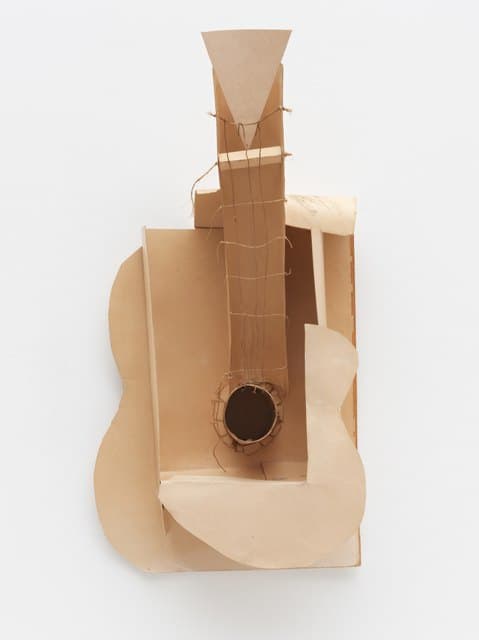
Pablo Picasso · October–December 1912 · Paperboard, paper, thread, string, twine, and coated wire
Collection: Museum of Modern Art, New York
Pablo Picasso’s Guitar construction of 1912 proposes something different. Cut and folded paperboard, paper, string, and wire are assembled rather than carved from a block or modelled as a continuous mass. The construction makes the difference between an instrument’s outside and inside unusually conspicuous. It is not a playable guitar and does not need to disguise the humble materials from which it was made. [39]
A construction of paperboard and other ordinary materials, assembled rather than carved.[39]
Pablo Picasso, Guitar, October–December 1912. Museum of Modern Art, New York. © 2026 Estate of Pablo Picasso / Artists Rights Society (ARS), New York. Image shown under fair use.
Artwork reproduction
painting · Cubism
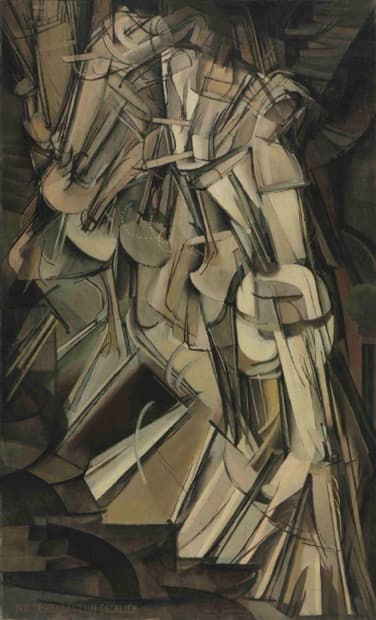
Marcel Duchamp · 1912 · Oil on canvas
Collection: Philadelphia Museum of Art (The Louise and Walter Arensberg Collection)
A descending body translated into overlapping ochre planes and repeated stages of motion. Its withdrawal from a Paris exhibition in 1912 and hostile reception at New York's 1913 Armory Show made it an early test of where Cubism ended and a new mechanized image began.[37]
A contentious meeting of fragmented form and successive movement.[37]
Marcel Duchamp, Nude Descending a Staircase (No. 2), 1912. Philadelphia Museum of Art (The Louise and Walter Arensberg Collection). Image © the rights holder, shown under fair use.
Artwork reproduction
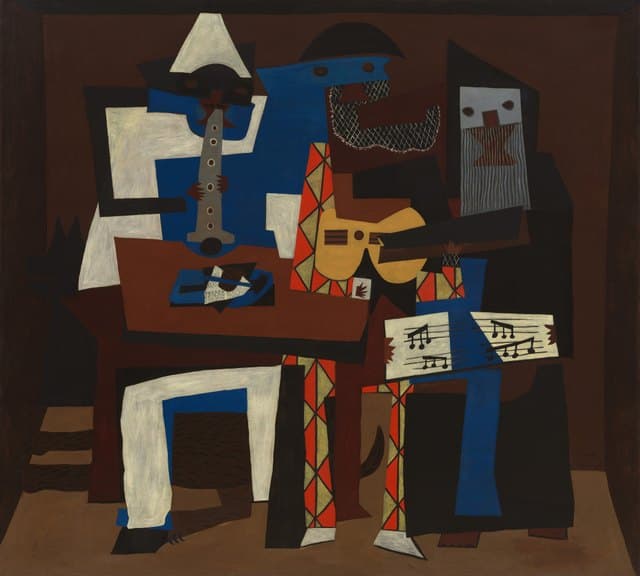
Pablo Picasso · Summer 1921 · Oil on canvas
Collection: Museum of Modern Art, New York
Pablo Picasso’s Three Musicians, painted at Fontainebleau in summer 1921, demonstrates that continuation on a monumental scale. Its interlocking shapes recall collage, although it is painted in oil. Pierrot, Harlequin, and a monk form the central group, with a dog partly concealed beneath them. Synthetic Cubist construction remained a productive resource nearly a decade after the first experiments with pasted paper. [5]
Synthetic Cubist construction continued on a large scale after the war.[5]
Pablo Picasso, Three Musicians, Summer 1921. Museum of Modern Art, New York. © 2026 Estate of Pablo Picasso / Artists Rights Society (ARS), New York. Image shown under fair use.








 View source