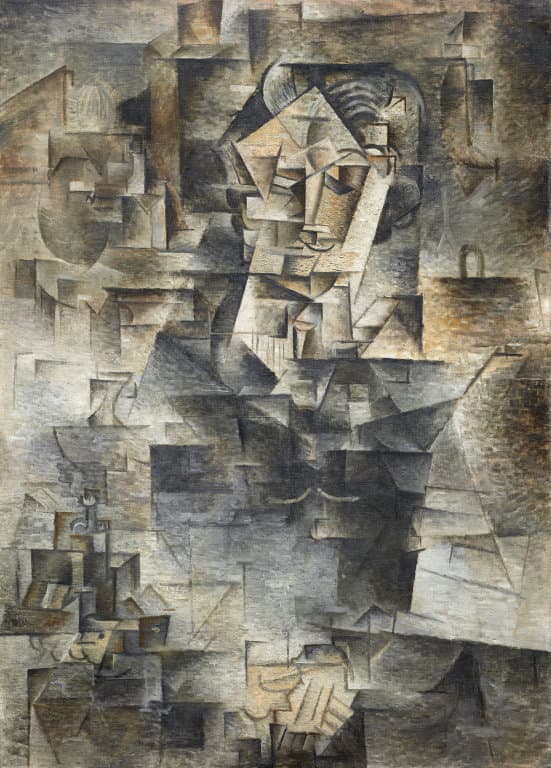
Painting · Analytic Cubism
Daniel-Henry Kahnweiler
The dealer who kept Cubism solvent, dissolved into its planes — painted in Paris at the movement's most austere moment.
The dealer who made Cubism a business. He opened a small Paris gallery in 1907, put Picasso, Braque, Gris and Léger under exclusive contract, bought most of what they painted for a decade, and wrote the movement's first theory. Picasso painted his portrait in 1910.
Kahnweiler was born in Mannheim in 1884 and sent to Paris to train for finance. In February 1907, aged twenty-three, he used a small inheritance to open a gallery four metres square on the rue Vignon, and chose to sell the least sellable art in the city. Within two years he was buying the whole output of Picasso, Georges Braque, Juan Gris and Fernand Léger under exclusive contract — the arrangement that let four painters take the figure apart without waiting for a market to approve of it. He introduced Picasso to Braque, and between 1908 and 1915 he bought most of what the pair made.
The First World War nearly ended him. As a German citizen in France he was declared an enemy alien, his stock was seized as a war trophy on 12 December 1914, and after the war the French state auctioned roughly three thousand works at the Hôtel Drouot in four sales between 1921 and 1923 — Cubism's first decade sold off cheap by the government, its own dealer barred from the room. He had spent the war in neutral Switzerland writing Der Weg zum Kubismus (The Rise of Cubism, 1920), the movement's first book-length account. He came back to Paris in 1920 and opened again under a partner's name, the Galerie Simon, publishing more than forty illustrated books pairing living painters with living writers. In 1941, to keep the Nazi occupation from expropriating a Jewish firm, the gallery was renamed for his sister-in-law Louise Leiris. He died in Paris in 1979, having represented Picasso, on and off, for most of sixty years.
Painting · Analytic Cubism
The dealer who kept Cubism solvent, dissolved into its planes — painted in Paris at the movement's most austere moment.
Patron of · 1908–1914
When the Salon d'Automne refused Braque's L'Estaque landscapes, Kahnweiler showed them at his rue Vignon gallery in November 1908 — the exhibition the Centre Pompidou calls the official beginnings of Cubism — with a catalogue preface by Guillaume Apollinaire. A contract of 30 November 1912 fixed the terms on which the dealer took his output. Kahnweiler had also introduced Braque to Picasso.
Art movement · 1907–1914
He put Picasso, Braque, Gris and Léger under exclusive contract and bought most of what they painted between 1908 and 1915, then wrote the movement's first book-length account, Der Weg zum Kubismus (1920). Cubism had a dealer before it had a public.
Associated with · 1907–1915
He put Picasso, Braque, Gris and Léger under exclusive contract and bought most of what they painted between 1908 and 1915, then wrote the movement's first book-length account, Der Weg zum Kubismus (1920). Cubism had a dealer before it had a public.
Patron of · 1908–1914
When the Salon d'Automne refused Braque's L'Estaque landscapes, Kahnweiler showed them at his rue Vignon gallery in November 1908 — the exhibition the Centre Pompidou calls the official beginnings of Cubism — with a catalogue preface by Guillaume Apollinaire. A contract of 30 November 1912 fixed the terms on which the dealer took his output. Kahnweiler had also introduced Braque to Picasso.

Depicts · 1910
Picasso's Analytic Cubist portrait, painted over as many as thirty sittings in the autumn of 1910. The dealer who bought most of Cubism, dissolved into its planes; the hair parting, the brows, the moustache and the folded hands are all that stay legible.
The sources below include biographies, scholarly essays, interviews, and primary materials that informed this page. They reflect both the historical record and ongoing critical conversations about Daniel-Henry Kahnweiler and their work.


Web source consulted for documented facts and historical context presented on the Daniel-Henry Kahnweiler page.
Web source consulted for documented facts and historical context presented on the Daniel-Henry Kahnweiler page.
Web source consulted for documented facts and historical context presented on the Daniel-Henry Kahnweiler page.
Web source consulted for documented facts and historical context presented on the Daniel-Henry Kahnweiler page.
Web source consulted for documented facts and historical context presented on the Daniel-Henry Kahnweiler page.
These references anchor the page in the documented record and in the scholarly conversations around Daniel-Henry Kahnweiler. Every claim on this page traces back to one or more of the works listed here.
 Explore more resources