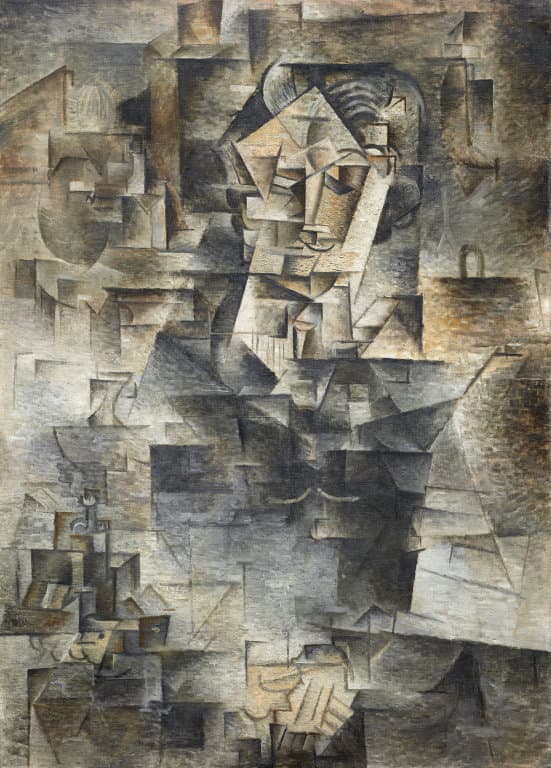
The canvas is grey and brown almost throughout, built from small overlapping planes that tilt against each other and catch light at different angles. There is no background behind the man, because there is no line where he stops.
Enough survives to identify a person. A parting in the hair with a wave to the left of it. Eyebrows, and beneath them the suggestion of closed or lowered eyes. A moustache. Two hands folded together at the bottom of the picture, drawn more legibly than anything above them. In the upper corners, forms that read as objects on a wall or a shelf, and at the lower left a bottle and glass. The Art Institute describes Picasso as no longer seeking the illusion of true appearances, breaking down and recombining what he saw into semitransparent surfaces that merge with the air around the sitter.
It is a portrait that withholds the one thing portraits exist to supply. Told who this is, you can find him. Not told, you would not.
As many as thirty sittings
The museum records that Kahnweiler sat for this portrait as many as thirty times. The least legible likeness in the room took the most looking, which is worth holding onto when Analytic Cubism is described as a theory about representation. It was also a dealer, in a chair, over and over, through the autumn of 1910.
The man who kept Cubism solvent
Daniel-Henry Kahnweiler was born in Mannheim in 1884 and opened a gallery in Paris in 1907, at twenty-three. He began representing Picasso in 1908 and introduced him to Georges Braque, and between 1908 and 1915 he bought the majority of what the two of them painted. In 1920 he published The Rise of Cubism, which gave the movement its first theoretical account. He died in 1979.
For most of the years these pages cover, he is the reason Cubist paintings could be made at all: the person who took the inventory risk while the market decided whether the work was anything. He appears here as a picture before he appears as a person.
How the dealer lost his own portrait
Kahnweiler was a German citizen living in Paris. When war came, the French state seized his gallery stock as enemy property, and after the war it was sold off at auction rather than returned. The first of the sequestration sales was held at the Hôtel Drouot on 13 and 14 June 1921.
This portrait was lot 84, catalogued simply as Portrait, and it went to the Swedish painter Isaac Grünewald. The man who had bought nearly every Cubist canvas of the movement's first decade watched his own likeness sold by the government, under a title that did not name him.
Printed before it was accepted
The painting was reproduced almost immediately, and by the people who were arguing for Cubism in public. Marius de Zayas ran it in the Mexican magazine América in May 1911. Gertrude Stein's word portrait "Pablo Picasso" carried it in Camera Work in August 1912. Guillaume Apollinaire used it in Les Peintres cubistes in 1913.
Three countries and three of the movement's earliest explainers, within three years of the paint drying.
Chicago
Grünewald still had it in 1925. By about 1929 it belonged to the Philadelphia collector and illustrator Earl Horter, who sold it in 1934 to Elizabeth Fuller Goodspeed of Chicago. She gave it to the Art Institute of Chicago on 14 December 1948, in memory of her first husband. It hangs in Gallery 391.
Close reading
Reading the work, detail by detail
Picasso takes apart the likeness of the dealer who helped sustain Cubism, yet preserves enough signs for a portrait to remain. Close views show identity distributed across planes, objects, and repeated directional marks.
1.The face survives as a cluster of cues
Forehead, nose, hair, and shadow appear from several angles at once. No single contour encloses the head, but a likeness accumulates from repeated darks and directional planes. Recognition becomes an active assembly.
2.Clasped hands provide the portrait's anchor
The hands are more compact and readable than the torso around them. Their interlocking shape holds the lower picture together and gives the sitter a calm, seated presence despite the visual fragmentation.
3.Objects and body share one visual grammar
Bottle, paper, chair, and clothing are reduced to the same facets as the person. The portrait refuses to rank human figure above surroundings; dealer and room are reconstructed by one continuous Cubist method.
4.A compact collar fixes the center of the torso
Two pale angled shapes flank a small dark vertical below the head. Their compact arrangement suggests a collar and tie amid the surrounding broken planes. This familiar clothing detail helps locate the upper torso even where no continuous jacket outline survives.
5.The background repeats the portrait's angled planes
Rectangular and sloping patches overlap at the upper left, with dark edges that stop before enclosing complete shapes. The same gray-brown range appears in the figure. This shared handling makes the surrounding space feel connected to the sitter rather than placed behind a clean silhouette.
6.Small upright objects survive among the fragments
A narrow upright form with a lighter neck emerges among the small blocks at the lower left. Short dark outlines distinguish it from neighboring planes without describing every edge. Such recognizable fragments offer the eye local points of orientation inside the larger network of angles.
Timeline
autumn 1910
Picasso painted his dealer, Daniel-Henry Kahnweiler, at the most austere moment of Analytic Cubism.
1921
Kahnweiler being a German national, the portrait had been sequestered as enemy property during the war; it was sold at the first Kahnweiler sale at the Hôtel Drouot in Paris.
Where to see it
Art Institute of Chicago
111 South Michigan Avenue, Chicago, IL 60603, United States
Displays and loans can change. Check whether this work is on view before making a special trip.
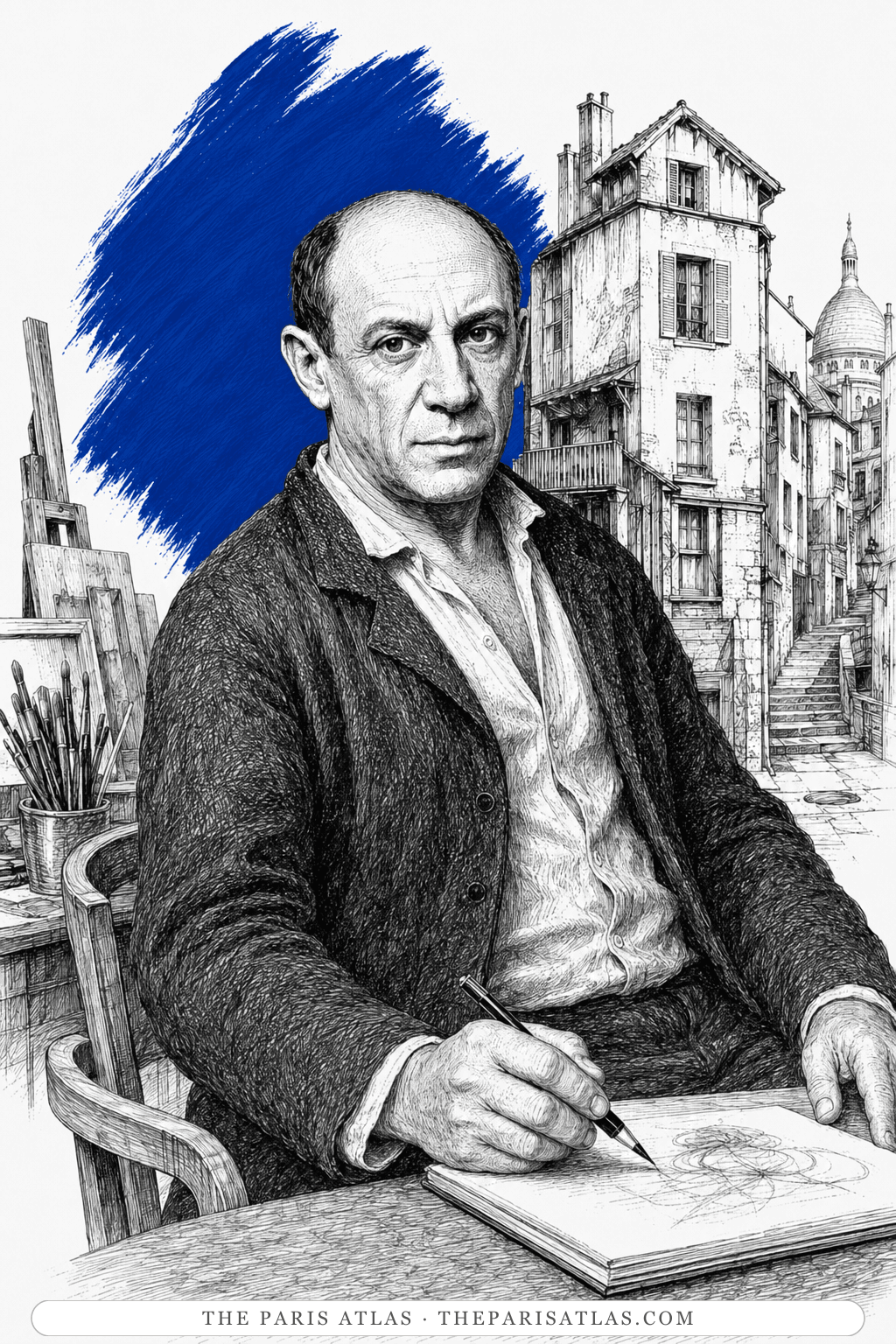
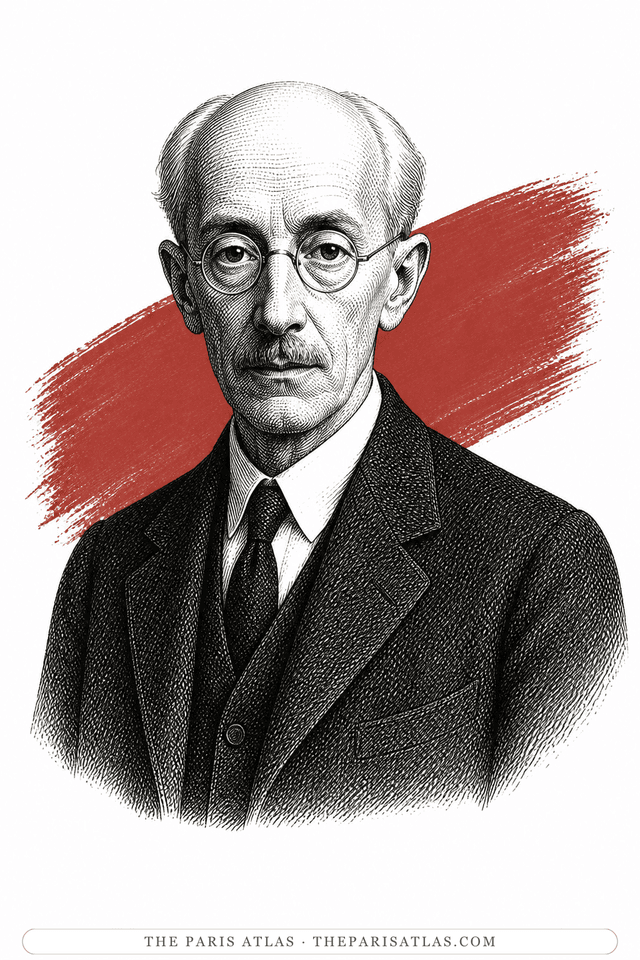
The dealer who made Cubism a business. German-born, he opened a Paris gallery in 1907, started representing Picasso in 1908, introduced him to Georges Braque, and bought most of what the pair produced between 1908 and 1915. His 1920 book The Rise of Cubism was the movement's first theoretical account.
Why is the sitter so hard to make out?
Because Picasso had stopped trying to produce a likeness in the ordinary sense. The Art Institute describes him breaking down and recombining what he saw into faceted, semitransparent planes shown from several viewpoints at once. What remains identifiable is deliberate and minimal: the hair parting, the brows, the moustache, the folded hands.
How long did the portrait take?
The Art Institute records as many as thirty sittings, through the autumn of 1910.
How did Picasso's own dealer lose the painting?
Kahnweiler was a German national in Paris, so the French state sequestered his gallery stock during the First World War as enemy property and auctioned it afterwards. The portrait was lot 84 in the first sequestration sale at the Hôtel Drouot on 13–14 June 1921, sold as Portrait, to the Swedish painter Isaac Grünewald.
Is this Analytic or Synthetic Cubism?
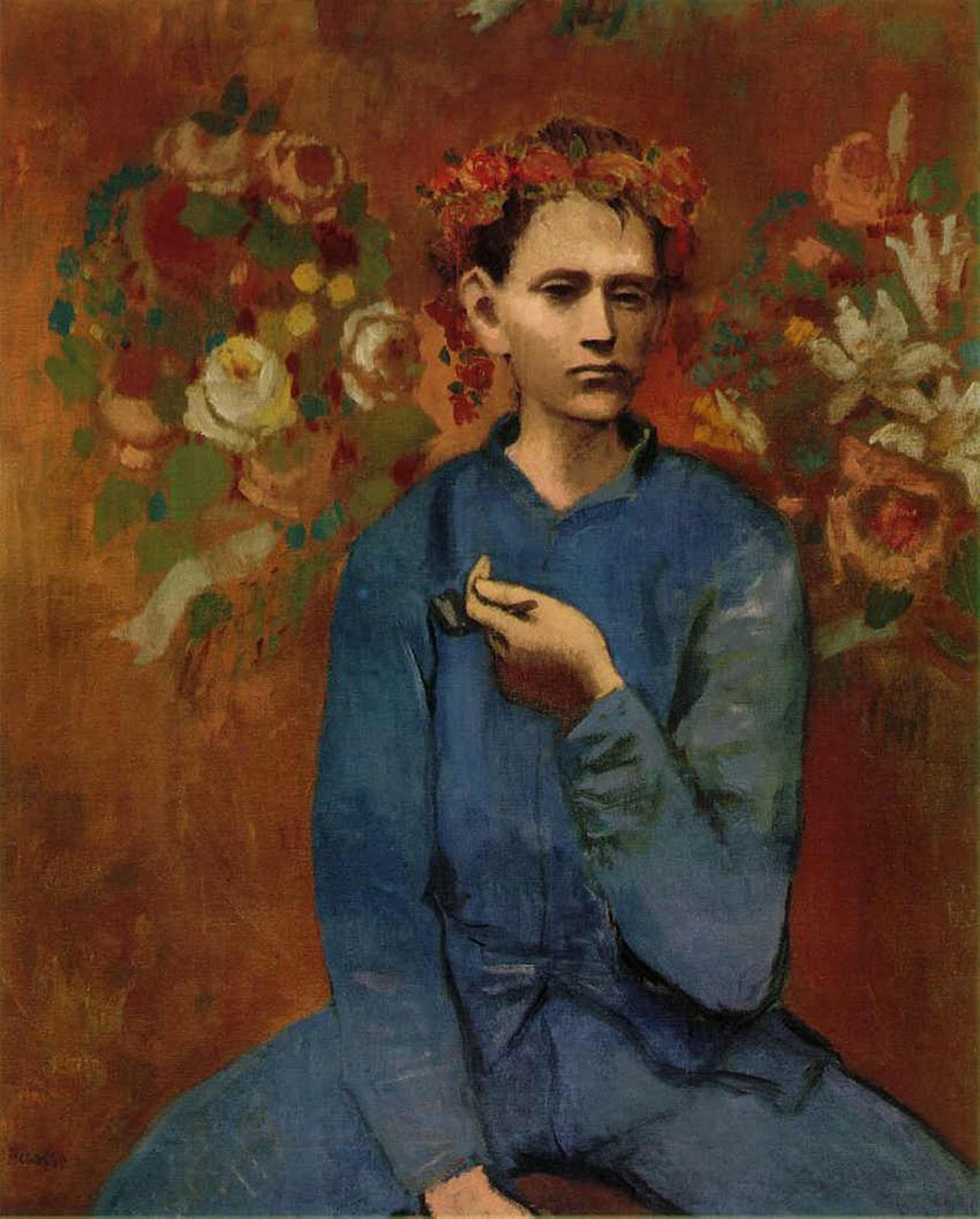
Analytic, and close to its limit. The palette is nearly monochrome, the forms are dissolved rather than assembled, and the picture predates the papiers collés and flat bright planes that define the synthetic phase from about 1912 onwards. Compare Man with a Pipe, painted five years later.
Where is it now?
The Art Institute of Chicago, object 1948.561, on view in Gallery 391 at the last check of the museum's record.
In the atlas
What the graph records about this work — every claim carries its citation.
The Art Institute describes the portrait as Picasso breaking down and recombining the forms he saw into faceted, semitransparent planes shown from several viewpoints. It is Analytic Cubism at its most austere, and its sitter bought most of the movement's output.
— Art Institute of Chicago — collection records, object 111060
Picasso's Analytic Cubist portrait, painted over as many as thirty sittings in the autumn of 1910. The dealer who bought most of Cubism, dissolved into its planes; the hair parting, the brows, the moustache and the folded hands are all that stay legible.
— Art Institute of Chicago — collection records, object 111060
Explore painters from the same movements and circles.
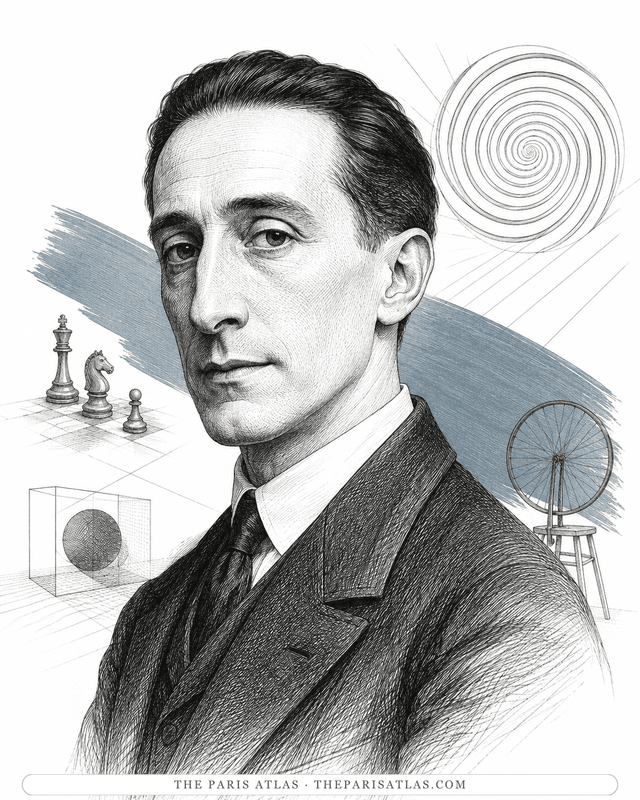
Marcel Duchamp
The century's quietest revolutionary — readymades, the abandonment of painting, chess on a Paris rooftop in Entr'acte, and one anemic film of spinning puns signed Rrose Sélavy.
Dutch painter of the primary-colour grids, made mostly in a studio beside the Gare Montparnasse where he lived on and off from 1912 to 1938. He dropped an 'a' from Mondriaan on arriving in Paris, painted his studio walls in movable rectangles, and danced the Charleston.
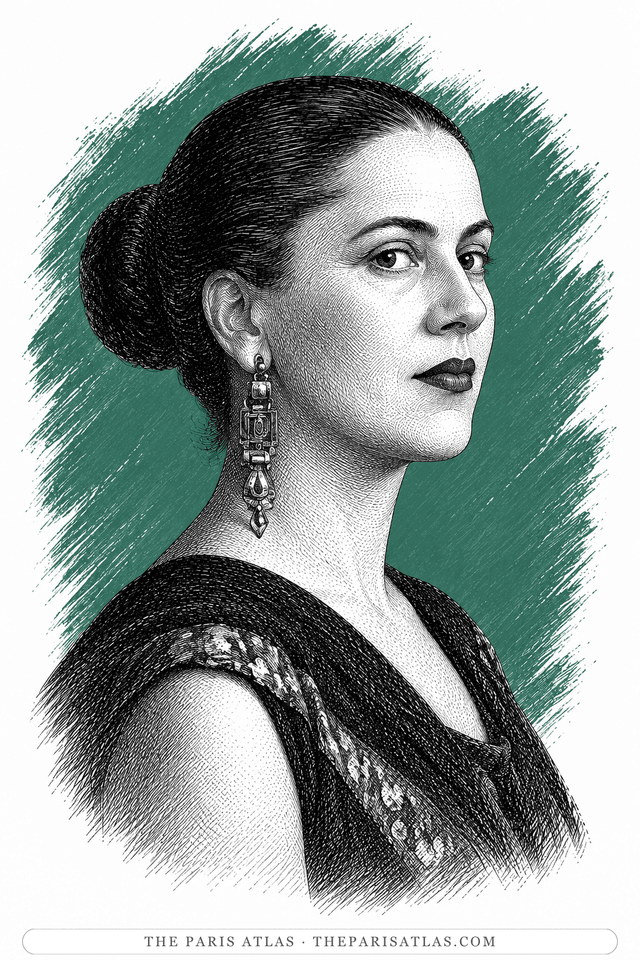
Brazilian painter who spent the 1920s moving between São Paulo and Paris, studied Cubism under André Lhote, Albert Gleizes and Fernand Léger, and used what she learned to paint Brazilian towns, railways, plants and bodies. Her 1928 painting Abaporu prompted the manifesto that gave the Anthropophagic movement its name.
The sources below include collection records, catalogues, scholarly research, and primary materials that informed this page. They document Daniel-Henry Kahnweiler, its making, and its place in cultural history.
1Art Institute of Chicago — collection records
Website
Used for
Web source consulted for documented facts and historical context presented on the Daniel-Henry Kahnweiler page.
These references provide the documented foundation for this work's history and interpretation. Claim-level citations remain attached to the specific claims they support.



 View source