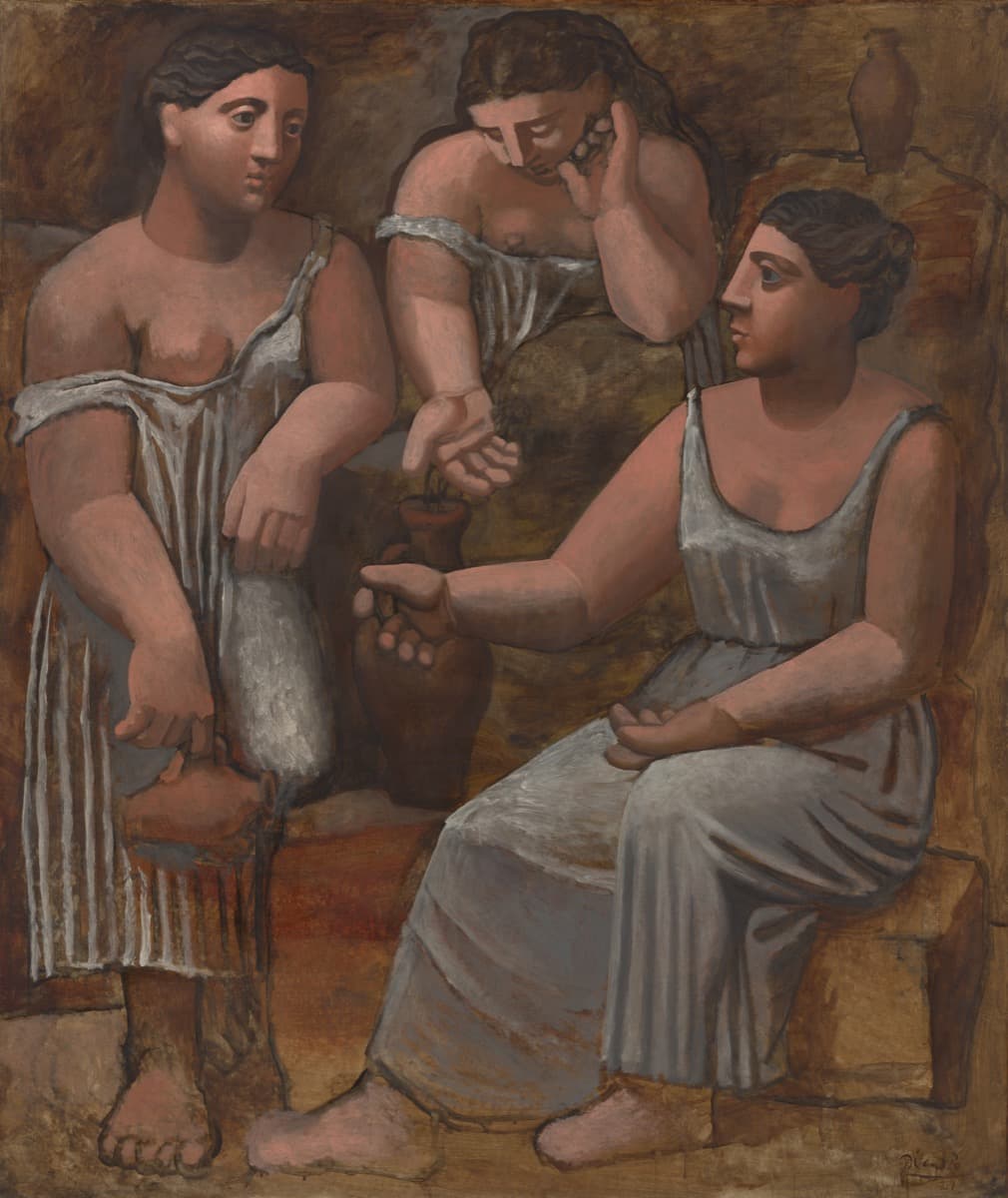
Three Women at the Spring
At Fontainebleau in 1921, Picasso enlarged an ancient scene of women gathering water into a nearly seven-foot meditation on classical order. Yet the ritual has stalled: the bodies are disjointed, the faces masklike, and no water reaches the waiting hand.
- Fontainebleau, summer 1921
- Oil on canvas
About Pablo Picasso
An ancient ritual, suspended
Three monumental women gather around a rocky spring. One stands at the left with a jug held low at her side. Behind her a second leans forward, head against her hand, the other arm reaching toward the source with an open palm. The third sits at the right in profile, turned back toward the group, her arm extended across the center. Everything about the gestures says communal ritual: drawing water, resting, talking at a place generations have used.
Except the ritual has stalled. The eyes never meet. The movements have slowed nearly to stillness. And beneath the spring, a hand waits into which no water falls.
The palette holds the suspension in place. Browns, grays, and earthen reds bind flesh, cloth, and rock into one substance; the pale garments remember the Greek chiton but hang with the weight of the bodies under them. At more than six and a half feet tall, with enlarged hands and feet and small heads on immense shoulders, the women carry the gravity of sculpture, and the stiffness of something assembled from parts.
Fontainebleau and the double practice
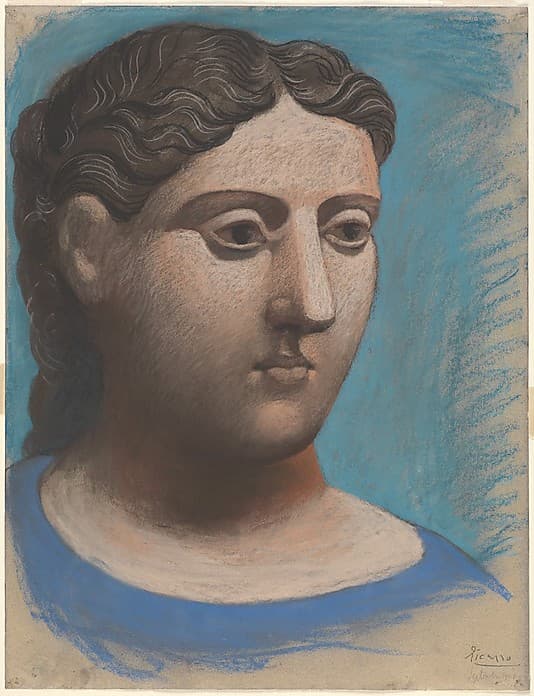
Picasso painted the canvas in the summer of 1921 at Fontainebleau, in an improvised garage studio, living there with Olga Khokhlova and their infant son Paulo. The subject would not let him go. He returned to the three women all season, in drawings, in pastels, in a monumental red chalk version, and MoMA's record calls the oil the culmination of the series. The colossal pastel Head of a Woman comes out of the same campaign, a preparatory head whose heavy-lidded features are usually traced to Olga. A living face, folded into a scene built to look timeless.
In the same garage, in the same months, he was finishing the two enormous versions of Three Musicians. Flat, bright, cut-paper Synthetic Cubism. A different language altogether.
Not phases, then. Parallel work from one studio, sometimes one week, and that is the key to the painting: Picasso had not traded Cubism for the antique. Classicism had become one more language available to a painter who no longer believed art moved in a single direction.
Classical form made deliberately strange
The subject has a long pedigree. Nymphs at the water, the Three Graces, the monumental women of the academies; the chitons and vessels invite every one of those associations and confirm none. No attributes name these women. And the picture keeps refusing to behave like a proper revival: the anatomy is too disjointed, the faces too masklike, the glances unreturned. The simplified features remember ancient sculpture, but they also remember the Iberian and African masks that had preoccupied Picasso before Cubism. Classical profile and modern mask, sharing the same faces.
Even the solidity is uneasy. Permanent, but not quite alive. Together, but without intimacy. Gesturing toward listening, offering, receiving, and completing none of it. This is not antiquity restored; it is antiquity as raw material, enlarged, rearranged, left open.
The missing water
The absent stream is the painting's quietest decision and its strangest. With water, this is a pastoral: women at a source, the timeless cycle of work and renewal. Without it, the questions start. Has the source run dry? Has time stopped? Has the ritual outlived its meaning? The painting answers none of this, and the refusal is the content. Picasso goes back to the classical world without pretending it can be restored. The forms survive. The animating source is uncertain.
What the return actually was
Three Women at the Spring is one of the defining canvases of the Return to Order, and the clearest demonstration of why the name misleads. The postwar appetite for stability is all here: recognizable figures, disciplined drawing, classical scale. But no ancient or academic painter would assemble bodies this way. Picasso enlarges, distorts, breaks the anatomy into masses, interrupts the story, and subjects the past to the same freedom of reconstruction Cubism had applied to guitars and newspapers.
The women wait beside a spring that gives no water. It is hard to think of a better image for the act of returning itself. The forms of the past remain available; their old meanings do not come back without interruption.
Close reading
Reading the work, detail by detail
Picasso turns three bathers into a dense classical monument. The close views show how heads, arms, drapery, and stone are locked together until the group feels carved rather than casually gathered.
1.Three heads make a closed circuit
Each head turns differently, but their gazes and profiles remain inside the group. No one addresses the viewer. The triangular exchange makes the scene self-contained and ritual-like.
2.Arms link the figures into one mechanism
Oversized limbs overlap and redirect the eye from one body to the next. The vessel is less a narrative prop than a joint in the composition, the object around which the human architecture closes.
3.Cloth, flesh, and stone share the same weight
Broad folds and pale bodies are modeled with similar solidity, while the setting offers no airy distance. Everything belongs to one compressed sculptural mass—the Return to Order as material pressure.
4.Narrow folds lengthen the left figure's dress
Narrow pale folds run down the left figure's dress toward her feet. Their repeated verticals differ from the larger diagonal folds across the seated woman at the right. This change in direction helps distinguish the figures even though their clothing shares the same restrained gray palette.
5.A bent arm frames the lowered head
The upper woman's head leans toward a bent arm, making a compact group of curved forms. Dark hair sits against the brown setting, while the forearm is much lighter. The contrast separates the gesture from the rock and concentrates attention on the lowered face.
6.A small vessel interrupts the long folds
A rounded ochre vessel appears directly beneath the left woman's hand. Its warm body contrasts with the gray vertical folds beside it, and a dark outline separates their edges. The small, enclosed vessel separates the area beneath the hand from the larger forms of the arm and dress.
Timeline
summer 1921
Picasso painted the canvas at Fontainebleau, in a rented garage studio, alongside the two big Three Musicians in flat Synthetic Cubism.
1926
Bought by the dealer Paul Rosenberg at the John Quinn estate sale.
1952
Given to the Museum of Modern Art by Mr. and Mrs. Allan D. Emil.
Where to see it
The Museum of Modern Art
11 West 53 Street, New York, NY 10019, United States
Displays and loans can change. Check whether this work is on view before making a special trip.
Plan your visit on the museum’s official website (opens in a new tab)Frequently asked questions
What does the painting show?
Three monumental women gathered around a rocky spring, in Picasso's classical manner. But the ritual is suspended: their eyes never meet, the movements have slowed nearly to stillness, and a hand waits beneath the spring into which no water falls.
When and where did Picasso paint it?
At Fontainebleau in the summer of 1921, in a rented garage studio where he was living with Olga Khokhlova and their infant son Paulo.
Had Picasso given up Cubism by 1921?
No. In the same garage that summer he was finishing the two enormous Three Musicians in flat, bright Synthetic Cubism. Classicism was a parallel language he had added, not a replacement.
Why is there no water?
It is the painting's quietest and strangest decision. With water it would be a pastoral of work and renewal; without it the ritual stalls, and the classical forms are present while their old meaning is withheld.
What is the “Return to Order”?
The postwar swing back toward classical calm and stability across European art. This canvas is one of its defining works — and shows why the name misleads, since Picasso kept Cubism running right beside it.
Where is the painting now?
The Museum of Modern Art in New York, the gift of Mr. and Mrs. Allan D. Emil.
More by Pablo Picasso
If you like Pablo Picasso
Explore painters from the same movements and circles.
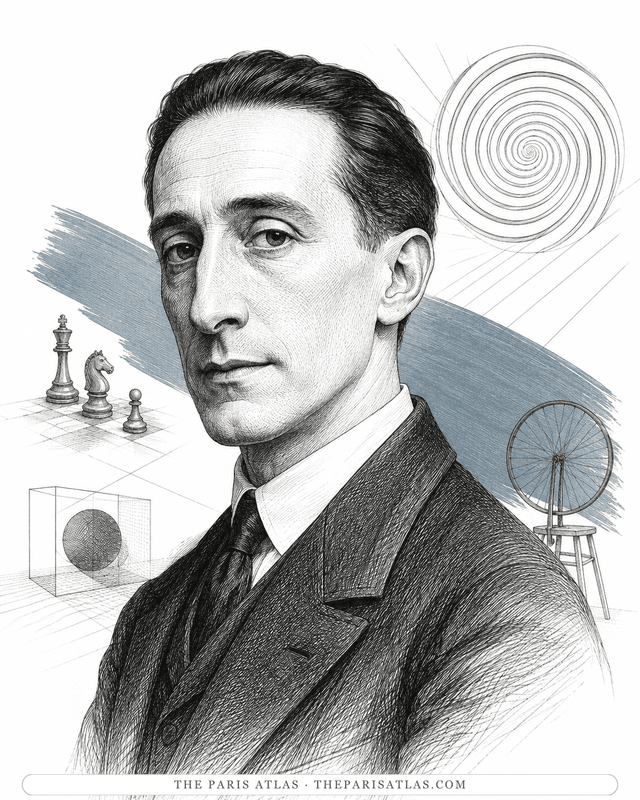
Marcel Duchamp
The century's quietest revolutionary — readymades, the abandonment of painting, chess on a Paris rooftop in Entr'acte, and one anemic film of spinning puns signed Rrose Sélavy.
View artist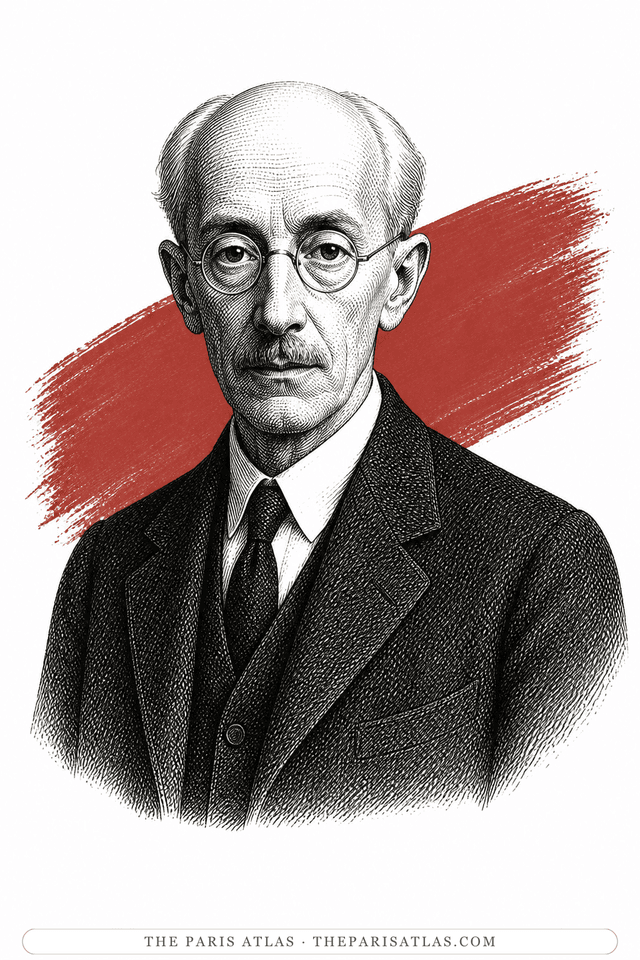
Piet Mondrian
Dutch painter of the primary-colour grids, made mostly in a studio beside the Gare Montparnasse where he lived on and off from 1912 to 1938. He dropped an 'a' from Mondriaan on arriving in Paris, painted his studio walls in movable rectangles, and danced the Charleston.
View artist
Tarsila do Amaral
Brazilian painter who spent the 1920s moving between São Paulo and Paris, studied Cubism under André Lhote, Albert Gleizes and Fernand Léger, and used what she learned to paint Brazilian towns, railways, plants and bodies. Her 1928 painting Abaporu prompted the manifesto that gave the Anthropophagic movement its name.
View artist
References
The sources below include collection records, catalogues, scholarly research, and primary materials that informed this page. They document Three Women at the Spring, its making, and its place in cultural history.


1The Museum of Modern Art — collection records
WebsiteUsed forWeb source consulted for documented facts and historical context presented on the Three Women at the Spring page.
2The Picasso Collection and Creative Archive
WebsiteMusée National Picasso-ParisUsed forUsed to place Three Women at the Spring within Pablo Picasso's documented oeuvre and verify its period, medium, or institutional context.
3Pablo Picasso — Artist and Collection Record
WebsiteThe Museum of Modern ArtUsed forUsed to cross-check artist chronology and the work's relationship to Pablo Picasso's wider practice.
4Picasso Timeline
WebsiteMusée National Picasso-ParisUsed forUsed for an additional museum or scholarly perspective on Three Women at the Spring's history and interpretation.
5MoMA — Three Women at the Spring, 1921
WebsiteThe Museum of Modern ArtUsed forWeb source consulted for documented facts and historical context presented on the Three Women at the Spring page.

6Picasso and Rivera: Conversations Across Time — Educator Resource
Official recordLos Angeles County Museum of ArtUsed forOfficial record used to verify names, dates, institutional details, or other factual information on this page.
These references provide the documented foundation for this work's history and interpretation. Claim-level citations remain attached to the specific claims they support.
 Explore more resources