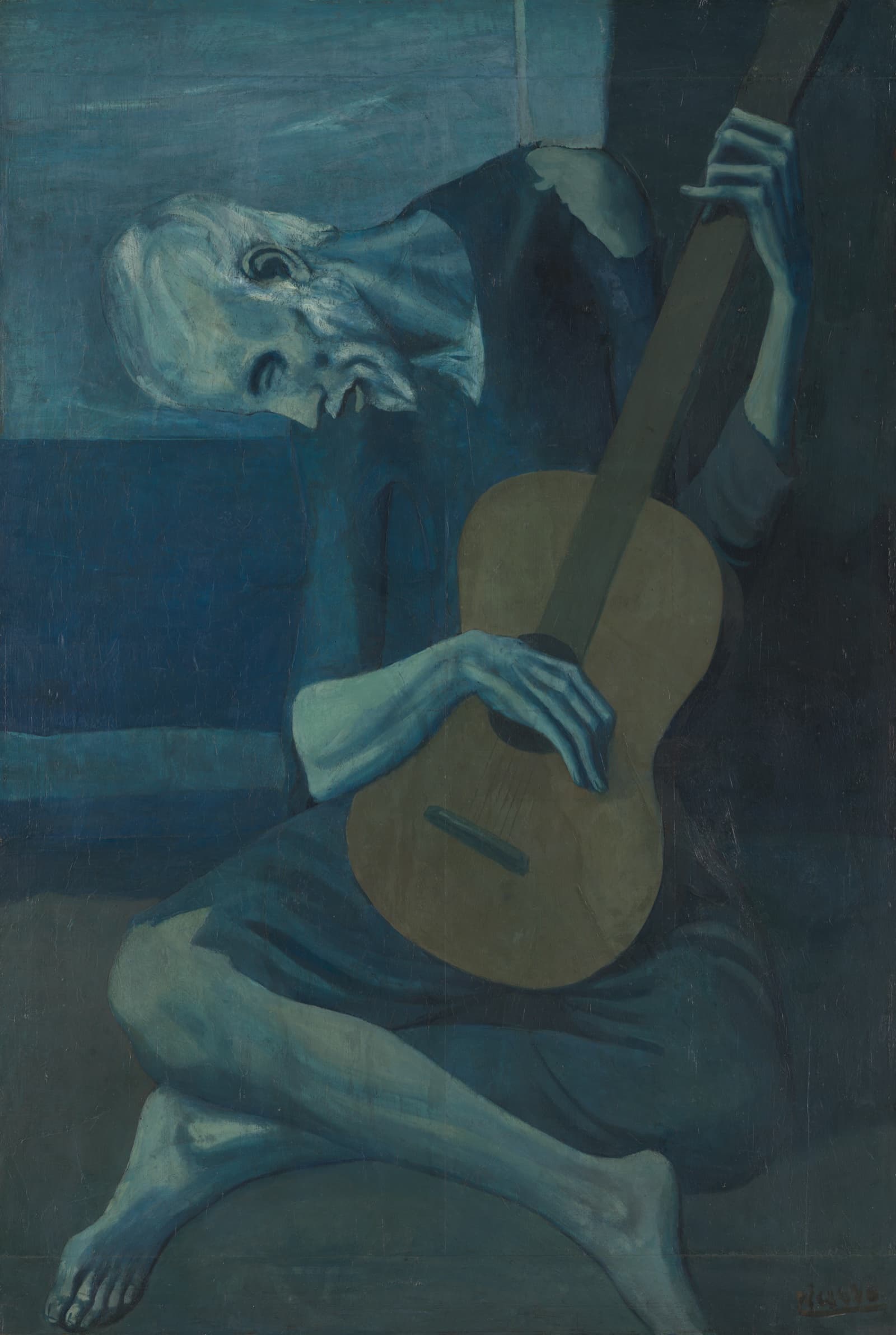
Painted in Barcelona when Picasso was twenty-two, a blind musician folds himself around the only warm object in a nearly monochrome world. Beneath him lie abandoned figures — a woman, a child, animals — making this Blue Period icon literally a painting built over other lives.
An elderly blind musician sits cross-legged on the ground, holding a guitar upright against his body. His head bends toward his shoulder, further than a neck should go. Closed eyes, hollow cheeks, white hair. Thin clothing shows a body reduced to bone and tendon, and the narrow panel barely contains him: his back runs along the left edge, the guitar's neck climbs toward the upper right, and his crossed legs fill whatever room is left.
Almost everything here has been submerged in blue. Skin, cloth, floor, and wall share one cold register of blue-gray and green, and the boundaries between the man and his surroundings start to dissolve. The guitar refuses. Warm, brown, structurally sound, it is the one thing in the picture that keeps its shape while the body around it bends.
There is no audience, no street, no coins. Just the two of them.
Barcelona and the Blue Period
Picasso painted The Old Guitarist in Barcelona between late 1903 and early 1904. He was twenty-two, still moving between Spain and Paris, months away from settling in the French capital for good.
The painting closes the Blue Period, which had begun around 1901: years of a restricted palette and of people at society's margins, beggars, prisoners, blind men, impoverished mothers. The suicide of his friend Carles Casagemas in Paris in 1901 fed the period's grief, though it explains less than the legend wants it to. Picasso was also looking at the poverty around him in both cities, at the Symbolist painting of the moment, and at his own empty pockets. The Art Institute notes he had been nearly penniless through all of 1902. He knew something about the people he was painting.
By this panel, blue was no longer a mood. It was a system. One restricted palette flattens the differences between skin, cloth, and wall, and the subject is sealed inside a single climate of cold.
The guitar as livelihood and counterweight
For a blind street performer the guitar was survival, companion and income at once, and Picasso makes it inseparable from its player: one long hand on the neck, the other across the body, the torso curved to repeat the instrument's curve. It is tempting to read the guitar as hope, since it is warmer and more whole than anything else in the picture. The painting is stingier than that. Music has not rescued this man from poverty. It may only be what lets him keep going, consolation and obligation in the same object, the thing he has to play whether or not anyone is listening.
That withheld promise is why the picture outruns the sentimental version of itself, the one where art redeems suffering.
Blindness and inward vision
Blind figures recur across the Blue Period. The Blind Man's Meal, from the same year, reaches just as uncertainly toward its bread and pitcher. Behind both stands a long inheritance, the blind musician or prophet denied ordinary sight and granted some other kind, and The Old Guitarist borrows that gravity without committing to the allegory.
What it commits to is inwardness. The bowed head and closed eyes pull the man out of the visible world; what is left of him is concentrated in touch and sound, one hand finding the strings, the other the frets. He cannot see us, so the usual exchange of portraiture is off. We watch an enclosed, private act, and the music stays where Picasso had to leave it, in the imagination.
El Greco and the spiritual body
The stretched proportions come out of Spanish painting, above all out of El Greco, whose saints carry elongated bodies and angular poses that seem to pull them away from physical reality. The Art Institute draws the connection directly. But nothing in this picture ascends. The guitarist's long limbs fold back into the cramped panel; age and need hold him to the ground.
That inversion is the Blue Period's signature move: the formal gravity of sacred art, spent on people respectable society had agreed not to see.
So the distortion is expressive rather than observed. The neck bends too far. The fingers lengthen, because touch is everything to a blind musician. Every departure from anatomy is doing emotional work.
The paintings underneath the guitarist
The panel holds more figures than its surface admits. Faint shapes disturb the blue even for the naked eye, and X-radiography and infrared imaging confirmed what they hint at: Picasso reused the support and painted the guitarist over earlier, abandoned compositions. Researchers have made out a young seated woman extending an arm, a child, at least one animal, and a second bowed female head that seems to belong to a different attempt entirely. The Art Institute counts two buried paintings beneath the final one. One of them matches a scene Picasso sketched in a 1903 letter to the poet Max Jacob, a mother and child with a cow and calf.
He never scraped the panel down or sealed the old work under a fresh ground. He simply painted over it, and as the surface aged, the ghosts started coming back.
The reuse was partly economics; panels cost money he did not have. But it is hard to miss what ended up underneath. The era's definitive image of solitude sits on top of an abandoned scene of connection, a family and its animals, painted out.
From Picasso to Stevens to Hockney
The painting's afterlife runs through literature and back into art. Wallace Stevens published The Man with the Blue Guitar in 1937, thirty-three cantos of argument about whether art should play things as they are, and readers have set the poem beside the painting ever since. Stevens pushed back, insisting no single Picasso stood behind it. The bent guitarist, the color, and the title keep the two works in conversation anyway.
Then David Hockney closed the loop. His 1976–77 portfolio of twenty etchings names the whole chain on its title page: The Blue Guitar, etchings by David Hockney, who was inspired by Wallace Stevens, who was inspired by Pablo Picasso. Painting to poem to print, across three-quarters of a century, and the blind musician from Barcelona still generating art.
Close reading
Reading the work, detail by detail
The Blue Period's restricted palette makes small deviations unusually powerful. In detail, the bent body, warm guitar, and ghosts under the paint all pull against the canvas's cold enclosure.
1.The body folds around grief
The neck drops, shoulder rises, and face turns inward until the upper body becomes a closed curve. Elongation does not lift the figure in El Greco's manner; it folds him more tightly into need.
2.The guitar is the one warm body
Brown wood interrupts the blue field with the picture's only sustained warmth. The instrument is broader and more intact than the man holding it. Music appears as the physical form that still has coherence.
3.Long limbs cannot escape the narrow panel
Knees and feet extend unnaturally yet remain trapped by the tall, tight format. Picasso uses distortion to increase confinement: the more the body lengthens, the more completely it fills its prison.
4.The raised hand follows the narrow guitar neck
Long pale fingers bend around the narrow brown neck of the guitar. Small dark gaps separate them from one another and from the instrument. Their repeated angles make the grasp readable even though the hand shares the surrounding body's restricted blue palette.
5.Pale streaks lighten the blue background
Pale streaks run across the blue background above the bowed head. Some are almost horizontal, while others rise slightly. Their shallow angles give this otherwise quiet area a visible direction, distinct from the sharper changes of angle in the man's shoulder and neck.
6.The foot ends in a row of separate toes
At the lower left, the long foot narrows into a row of individually marked toes. Pale ridges meet dark gaps along its edge. This small sequence of marks makes the foot more specific than the broad blue shapes of the folded legs above it.
Timeline
1901
Picasso's Blue Period began — a restricted palette and subjects drawn from society's margins, following the suicide of his friend Carles Casagemas.
1903–4
He painted The Old Guitarist in Barcelona, aged twenty-two and nearly penniless, reusing a panel that already held earlier abandoned figures.
1926
Entered the Art Institute of Chicago with the Helen Birch Bartlett Memorial Collection, where it remains.
1937
Wallace Stevens published “The Man with the Blue Guitar,” a long poem readers have set beside the painting ever since.
1976–7
David Hockney made “The Blue Guitar,” a portfolio of etchings that names the Picasso–Stevens chain on its title page.
Where to see it
Art Institute of Chicago
111 South Michigan Avenue, Chicago, IL 60603, United States
Displays and loans can change. Check whether this work is on view before making a special trip.
At least two earlier, abandoned paintings. X-radiography and infrared imaging reveal a young seated woman with an outstretched arm, a child and animals; the Art Institute counts two buried compositions, one matching a mother-and-child scene Picasso sketched in a 1903 letter. He painted the guitarist straight over them, and the ghosts have surfaced as the panel aged.
Why is the painting almost entirely blue?
It comes from Picasso's Blue Period, roughly 1901 to 1904, when he worked in a near-monochrome blue palette and painted the poor and the outcast. Here the single cold register flattens the man into his surroundings, and only the warm brown guitar keeps its shape.
When and where did Picasso paint it?
In Barcelona between late 1903 and early 1904, when he was twenty-two and, by the Art Institute's account, had been nearly penniless throughout the previous year.
Why are the guitarist's proportions so distorted?
The elongated, folded body comes out of Spanish painting, above all El Greco. The distortion is expressive rather than observed: the neck bends too far and the fingers lengthen because touch is everything to a blind musician.
How is it connected to Wallace Stevens and David Hockney?
Wallace Stevens's 1937 poem “The Man with the Blue Guitar” has long been paired with the painting, though Stevens denied any single Picasso lay behind it. David Hockney's 1976–77 etching portfolio “The Blue Guitar” names the Picasso-to-Stevens chain directly.
Where is The Old Guitarist now?
The Art Institute of Chicago, in the Helen Birch Bartlett Memorial Collection.
In the atlas
What the graph records about this work — every claim carries its citation.
Read alongside the painting since publication — the bent blue guitarist, the color, the title — but Stevens resisted naming any single Picasso as the source and later discouraged pairing the book with a Picasso reproduction. Probable, productive, contested at the edges.
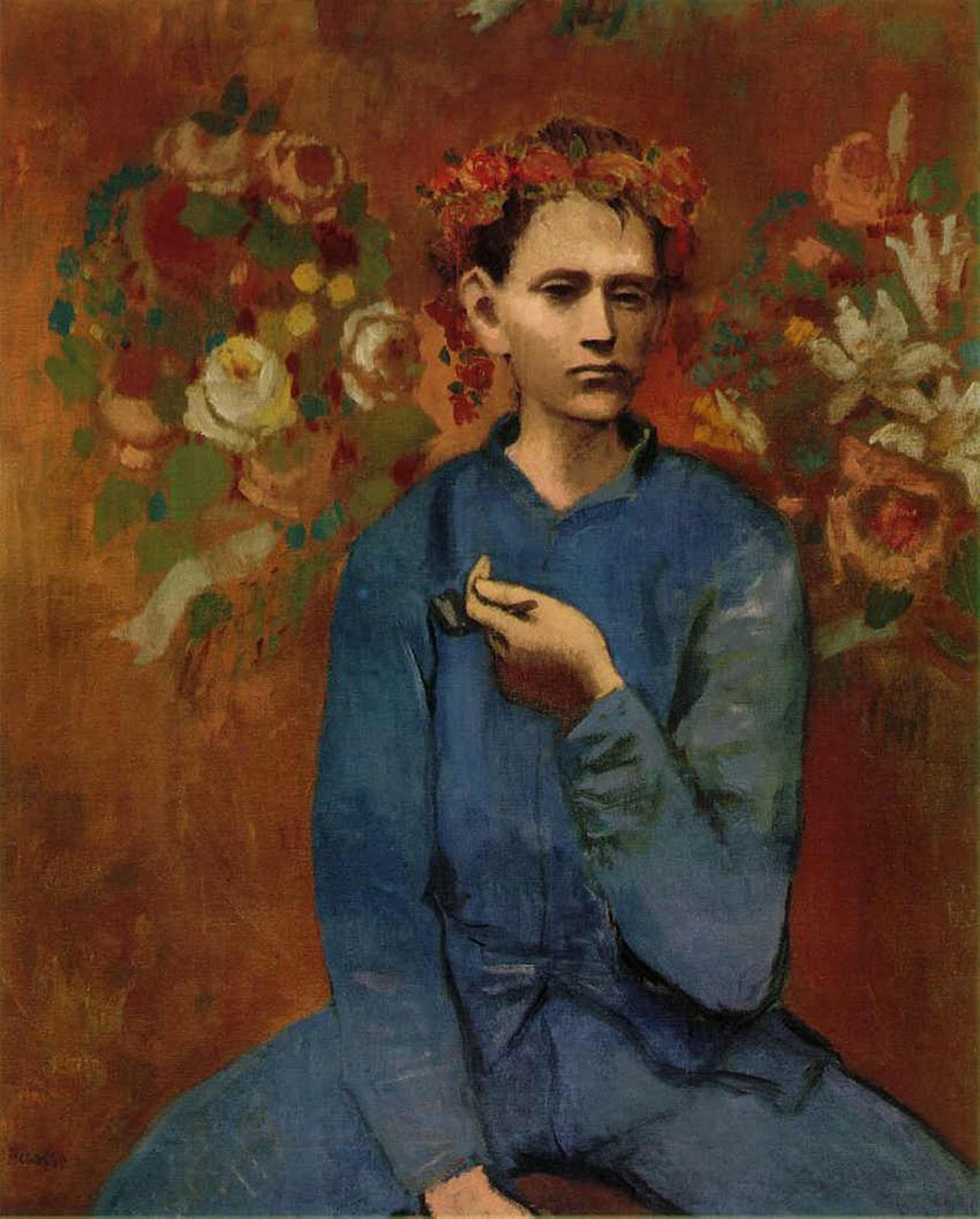
Explore painters from the same movements and circles.
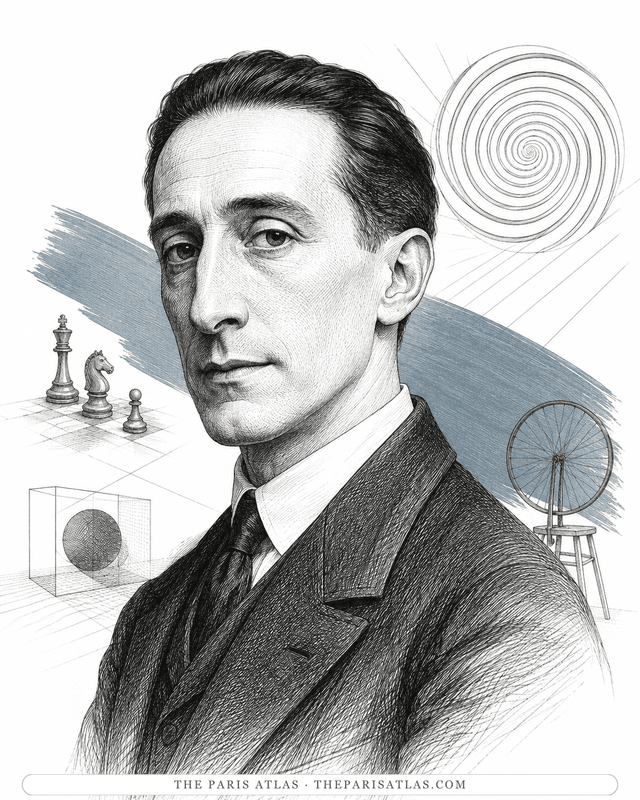
Marcel Duchamp
The century's quietest revolutionary — readymades, the abandonment of painting, chess on a Paris rooftop in Entr'acte, and one anemic film of spinning puns signed Rrose Sélavy.
Dutch painter of the primary-colour grids, made mostly in a studio beside the Gare Montparnasse where he lived on and off from 1912 to 1938. He dropped an 'a' from Mondriaan on arriving in Paris, painted his studio walls in movable rectangles, and danced the Charleston.
Brazilian painter who spent the 1920s moving between São Paulo and Paris, studied Cubism under André Lhote, Albert Gleizes and Fernand Léger, and used what she learned to paint Brazilian towns, railways, plants and bodies. Her 1928 painting Abaporu prompted the manifesto that gave the Anthropophagic movement its name.
The sources below include collection records, catalogues, scholarly research, and primary materials that informed this page. They document The Old Guitarist, its making, and its place in cultural history.
1Art Institute of Chicago — collection records
Website
Used for
Web source consulted for documented facts and historical context presented on the The Old Guitarist page.
These references provide the documented foundation for this work's history and interpretation. Claim-level citations remain attached to the specific claims they support.



 View source