
Animal Farm
Both books show a collective ideal becoming an argument for centralized control and the destruction of dissent.
Read our take
by Yevgeny Zamyatin
A numbered citizen in a glass city begins to discover the dangerous appeal of privacy and individual thought.
In a future state built around schedules, surveillance, and perfect order, individuality is treated as an illness. One citizen's awakening unsettles the system and his place inside it.
D-503 is the chief engineer of the Integral, a spacecraft the One State plans to send beyond Earth. He lives in a city of glass, wears a number instead of a name, follows a schedule that organizes nearly every hour, and believes that perfect happiness has finally been achieved by replacing freedom with mathematical order. He begins a written record so that distant civilizations will understand the logic of his society.
Then he meets I-330. She smokes, drinks alcohol, wears forbidden old clothes, and seems to know passages through the city that should not exist. D-503 is attracted to her and terrified by the feelings she produces. He begins dreaming, lying, missing scheduled hours, and developing what a doctor calls a soul—a diagnosis he experiences almost as a physical illness.
Zamyatin writes the novel as D-503’s increasingly unstable diary. The orderly report becomes a record of jealousy, political rebellion, and mental fracture. The One State promises to remove imagination surgically, and D-503 must decide whether the painful self awakening inside him is a disease or the only part of him that has ever been alive.
D-503 addresses his first entries to unknown readers who may one day receive the Integral. He explains the One State’s logic with pride. Citizens live behind transparent walls, march in rows, wear identical uniforms, and follow the Table of Hours. Sexual access is regulated by pink tickets. The Benefactor governs through public execution, while Guardians observe citizens for signs of imagination or private thought.
D-503’s regular partner is O-90, a gentle woman whose body does not meet the state’s ideal proportions and whose deepest forbidden wish is to have a child. Their relationship is scheduled and familiar. D-503’s friend R-13, a poet employed to write official verse, also has access to O. D-503 accepts this arrangement until I-330 enters his life and introduces emotions the social mathematics cannot explain.
I-330 takes D-503 to the Ancient House, an opaque building preserved from the world before the One State. She changes into a yellow dress, drinks alcohol, and encourages him to break scheduled rules. D-503 should report her, yet repeatedly delays. He begins to dream, and a state doctor tells him he has developed a soul. His prose becomes more fragmented as he experiences jealousy, fantasy, and the humiliating awareness that he cannot predict his own behavior.
I-330 reveals connections with the Mephi, a revolutionary group that lives beyond the Green Wall enclosing the city. Through passages in the Ancient House, D-503 reaches the wild land outside, where unregulated people live among trees and animals. The Mephi plan to use the Integral in a revolt. D-503 cannot determine whether I loves him or needs him only because he controls the spacecraft.
The One State announces the Great Operation, a surgical procedure that destroys imagination by treating part of the brain with X-rays. Citizens are told the operation will produce final happiness. D-503 initially recoils. At the same time, O-90 becomes pregnant by him. Pregnancy without state authorization means death, so D-503 and I arrange for O to escape beyond the Green Wall. O leaves carrying D-503’s child, and her fate remains unknown.
During the Integral’s first flight, the Mephi attempt to seize the ship. D-503 has allowed them access, but the plan fails when Guardians regain control. He suspects several possible informers, including the maternal building supervisor U, and becomes unable to trust his own account. Disorder spreads through the city as rebels damage the Green Wall and citizens resist the compulsory operation.
D-503 is captured and subjected to the Great Operation. Afterward, his emotional turmoil disappears. He calmly reports I-330 and other rebels to the authorities. He watches while I is tortured beneath the Gas Bell and refuses to provide the information the state demands. D-503 feels no compassion and describes the proceedings as rational.
In the final entries, the operated D-503 has returned to complete loyalty. He treats his earlier diary as evidence of an illness and helps the Guardians locate I-330. The man who once believed he loved her can now watch her torture without experiencing recognizable grief.
I is placed under the Gas Bell, a device that removes air while keeping the prisoner conscious. She refuses to confess. The novel does not narrate a formal execution after the torture, so her death should be described as expected or strongly implied rather than shown as a completed event on the page.
Outside the city, resistance continues. The Green Wall has been breached, birds enter the urban space, and sections of the population remain beyond state control. The One State has recovered D-503 but has not clearly defeated the Mephi.
D-503 ends with confidence that reason must win. The statement is chilling because readers have watched the state define reason as the removal of imagination, attachment, and independent judgment. His personal story has closed through surgery, while the political struggle remains unresolved.
The One State defines happiness as perfect predictability. Freedom is dangerous because it introduces unknown outcomes. D-503 initially accepts this equation without irony, which lets Zamyatin show how oppression can be defended as efficient problem-solving rather than openly celebrated cruelty.
D-503 begins as a number who experiences himself as one component in a social machine. Desire, jealousy, dreams, and contradiction create the first-person self he had never needed. The soul is painful because individuality arrives not as calm enlightenment but as illness, embarrassment, and loss of control.
The city’s transparent architecture makes visibility appear virtuous. Blinds may be lowered only for authorized sexual hours. The Ancient House matters because its opaque walls permit secrets, imagination, and historical memory. Zamyatin links privacy not only to concealment but to the possibility of a self that is not continuously performed for the state.
The Great Operation identifies imagination as the biological source of unhappiness. Art, dreams, fantasy, and political alternatives all require the ability to picture what does not yet exist. Destroying imagination creates stable citizens because it removes both desire and the language of possibility.
I-330’s attraction is inseparable from danger. D-503 first breaks rules because he wants her, not because he has developed a coherent political program. The novel does not reduce revolution to romance, but it shows how the body can discover a conflict before the intellect knows how to name it.
The One State associates straight lines, glass, and regulated time with civilization. Beyond the Green Wall are plants, animals, weather, hair, and bodies that have not been standardized. Zamyatin does not offer the outside world as a fully developed utopia; it functions as proof that the state’s order is not the only possible reality.
I tells D-503 that there can be no final revolution, just as there is no final number. The One State claims to have solved history. The Mephi insist that life remains unfinished. The novel’s unresolved political ending keeps that argument open even after D-503 himself has been closed down.
The book is composed of numbered diary entries, and the style changes as D-503 changes. Early entries are full of equations, geometric shapes, engineering metaphors, and confident proofs. He describes people as curves, angles, and irrational quantities. As I-330 unsettles him, the sentences fracture. Dashes, exclamations, unfinished images, and sudden repetitions show a mind losing the ability to organize experience according to the state’s mathematics.
Zamyatin also writes with expressionist intensity. Colors recur sharply: I’s yellow dress, blue shadows, pink tickets, the green wall. The physical world often seems distorted by D-503’s emotional state. English translations can sound quite different because they must decide how much strangeness to preserve in his syntax and how to render the One State’s technical vocabulary. Comparing translations is unusually rewarding here.
The publication history is central to the book. It was written in Russian but first reached readers as a 1924 English translation by Gregory Zilboorg. A complete Russian book edition appeared abroad decades later, and Soviet readers did not receive a legal domestic edition until 1988.
Major English versions include Mirra Ginsburg’s translation, Clarence Brown’s 1993 Penguin translation, and Natasha Randall’s 2006 translation. Brown provides extensive notes and historical framing; Randall often preserves a sharper, more eccentric rhythm. Names, mathematical language, punctuation, and even the texture of D-503’s breakdown vary. The translator should always be listed prominently.
A 1982 West German television film, commonly titled Wir, is the clearest completed screen adaptation to identify. It transforms D-503’s diary into visual narration and necessarily makes choices about a world the novel presents through unstable perception.
Later film projects have been announced in Russia and elsewhere, but release dates and completion claims have changed repeatedly. Projects without confirmation from a distributor or film archive remain announced or in development rather than completed adaptations.
Its glass state and numbered citizens helped define the form Orwell later used.
A citizen’s perspective makes the state’s schedules and surveillance part of daily experience.
The emergence of individuality threatens both the narrator’s security and the order he has accepted.

D-503 is a mathematician, engineer, and builder of the Integral.

I-330 is a charismatic woman connected to the Mephi rebellion.

O-90 is D-503’s registered sexual partner and R-13’s partner as well.

R-13 is D-503’s friend and an official poet.

S-4711 is a Guardian assigned to observe citizens and investigate disobedience.

U is the older woman who supervises D-503’s building and behaves toward him with possessive, maternal concern.

The Benefactor is the public ruler of the One State.

The First Doctor examines D-503 after his dreams and tells him that he has developed a soul.

A second medical figure is connected with I-330 and the underground movement.

The unnamed caretaker receives visitors at the museum-like Ancient House.

The Mephi are a network rather than one character, but they function as a collective force in the story.
1920–1921
Zamyatin writes We in Russian.
1924
E. P. Dutton publishes Gregory Zilboorg’s English translation in New York, the novel’s first complete book publication.
1927
A Russian text appears in an émigré journal in Prague without full authorization, intensifying official pressure on Zamyatin.
1931
Zamyatin is permitted to leave the Soviet Union and later settles in Paris.
1952
A complete Russian-language book edition is published in New York.
1970s
New English translations make the novel more widely available beyond the Zilboorg version.
1982
A West German television film adaptation is released.
1988
The novel is finally published legally in the Soviet Union during glasnost.
1993
Clarence Brown’s influential Penguin translation appears.
2006
Natasha Randall publishes a new English translation.
Both books show a collective ideal becoming an argument for centralized control and the destruction of dissent.
Read our take
Orwell drew on Zamyatin’s numbered, surveilled society and the use of a private record as rebellion.
Read our take
Huxley also imagines engineered happiness, regulated sexuality, and citizens conditioned to accept a social role.
Read our take
Kafka’s inaccessible bureaucracy produces a similar feeling that logic has become an instrument for making resistance impossible.
Read our take
Rand uses a first-person record and the rediscovery of the word “I” to dramatize rebellion against enforced collectivism.
Read our take
Le Guin offers a more patient examination of how collective ideals can protect freedom and also harden into social pressure.
Read our takeYes. Zamyatin wrote it in 1920–1921, and the first complete book edition appeared in English in 1924. It is one of the foundational modern dystopian novels and influenced later debates about Huxley and Orwell.
The One State assigns alphanumeric designations because citizens are treated as interchangeable units within a system. The letters and numbers still acquire personality for readers, which quietly defeats the state’s claim that individuality has vanished.
It is the spacecraft D-503 is building. The One State intends to send it to other planets and impose mathematical happiness on their inhabitants. The Mephi hope to seize it, turning an instrument of expansion into a revolutionary weapon.
It is the barrier separating the glass city from the natural world outside. The wall keeps plants, animals, weather, and unregulated people out of the One State. Its breach near the ending proves that the state’s closed system can be physically and intellectually penetrated.
The novel leaves that uncertain. She is attracted to him and shares dangerous intimacy with him, but she also needs his access to the Integral. D-503’s desire for a simple answer is part of his emotional inexperience.
It is brain surgery designed to remove imagination. Citizens who undergo it lose dreams, emotional conflict, and the capacity to picture alternatives. The state presents this destruction as a medical cure for unhappiness.
She is shown being tortured under the Gas Bell and refusing to confess. Her execution appears inevitable, but the novel does not present a separate scene confirming the moment of death. A careful summary should distinguish implication from what is directly narrated.
O escapes beyond the Green Wall while pregnant with D-503’s child. Their later fate is not given. Her escape preserves one fragile possibility that D-503’s former life continues outside state control.
D-503 begins the record as propaganda for the One State. The form then captures changes he cannot control. Readers watch official language break down from inside as private consciousness enters the document.
There is no universally agreed answer. Clarence Brown is useful for notes and context; Mirra Ginsburg is direct and widely read; Natasha Randall emphasizes verbal energy and strangeness. The best edition is one that names the translator and matches the reader’s tolerance for experimental syntax.
Explore authors with a similar voice, perspective, and influence.
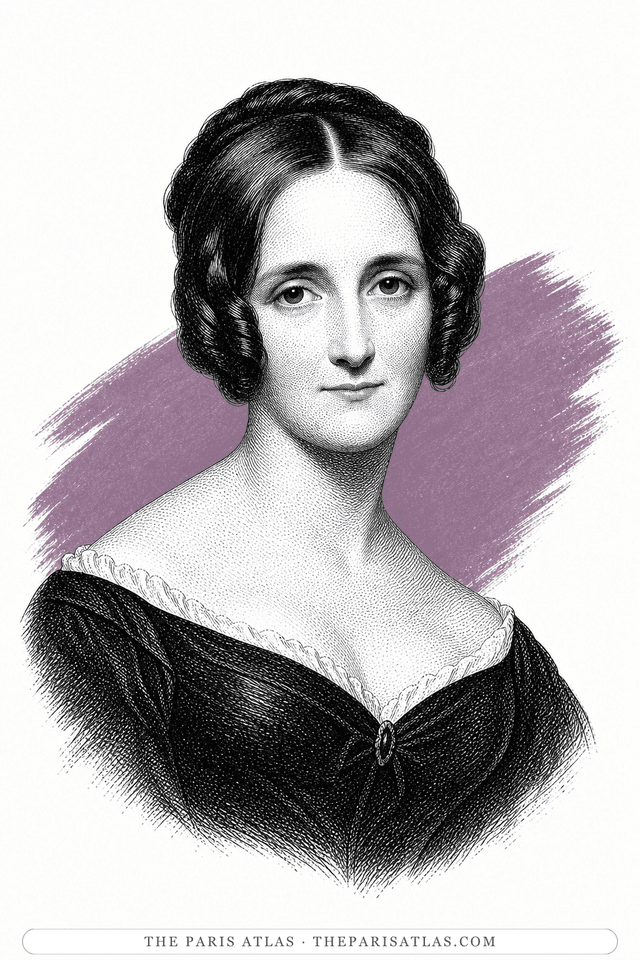
The author of Frankenstein, who first saw Paris at sixteen as a runaway. In the summer of 1814 she crossed from England to Calais with the poet Percy Bysshe Shelley and her stepsister Claire Clairmont, spent a week trapped in an expensive Paris hotel with no money, then bought a donkey and walked south-east across a France still wrecked by the Napoleonic wars. That journey became her first published book. Two years later, on a lake in Switzerland, she began her second.
View author
English novelist of Brave New World, which he wrote not in Paris but on the Mediterranean coast at Sanary-sur-Mer. His French years ran from a rented house at Suresnes on the western edge of Paris, where he pushed the dying D. H. Lawrence towards the city's presses, to seven years on the Riviera; he then left for California, wrote the best-known modern account of taking mescaline, the hallucinogenic drug made from the peyote cactus, and died on the day President Kennedy was shot.
View author
Hungarian-British novelist and essayist whose fiction examined revolution, ideology, imprisonment, and political disillusionment.
View authorThe sources below include the primary text, editions, scholarship, archival materials, and other records that informed this page. They document We, its publication, and its place in literary history.


Open Library ISBN catalogue used to verify the title, ISBN, and publication metadata.
Google Books catalogue record used to cross-check the title and edition metadata.
Internet Archive ISBN catalogue used to cross-check the edition and its availability in library holdings.
Library of Congress books catalogue used to cross-check the bibliographic record by ISBN.

Penguin edition; verifies Clarence Brown’s translation and publication context.
Modern Library edition; verifies Natasha Randall’s translation and modern bibliographic information.
Publisher author page; verifies Zamyatin bibliography and biographical context.
Institutional overview; verifies censorship and publication history.
Detailed publication and translation cross-check; use alongside the publisher sources.
Identifies the completed 1982 adaptation; adaptation details should be checked against film databases when expanded.
Secondary plot and character cross-check; useful for sequence and symbols.
The primary text is the baseline reference for every book page. Additional references document publication history, interpretation, and historical context where that evidence is available.
 Explore more resources