Point Counter Point
Philip Quarles is invented, drawn from Aldous: A novelist who thinks about life instead of living it. His notebook explains how the novel itself is built. Partly a self-portrait of Huxley.
Read the character guideEnglish novelist of Brave New World, which he wrote not in Paris but on the Mediterranean coast at Sanary-sur-Mer. His French years ran from a rented house at Suresnes on the western edge of Paris, where he pushed the dying D. H. Lawrence towards the city's presses, to seven years on the Riviera; he then left for California, wrote the best-known modern account of taking mescaline, the hallucinogenic drug made from the peyote cactus, and died on the day President Kennedy was shot.
Aldous Huxley's France was the south. He lived in it for eight and a half unbroken years, from October 1928 to February 1937, and only the first eighteen months of that were spent near Paris — at 3 rue du Bac in Suresnes, a suburb on the Seine west of the Bois de Boulogne, the big park on the western edge of the city, with the wooded hill of Mont Valérien rising above the town. In April 1930 he moved to a house at La Gorguette in Sanary-sur-Mer, a fishing village on the Var coast between Toulon and Bandol, and stayed until he sailed for America. Brave New World, the book he is known for, was written there between May and August 1931 and published in January 1932. If you are looking for Huxley in Paris, the honest answer is that he never lived in it: he lived eighteen months on its western edge and nearly seven years on the Riviera, the Mediterranean coast of south-eastern France.
The Suresnes years earned their place all the same, because of who came to stay. Huxley and his wife Maria were the closest friends of the novelist D. H. Lawrence at the end of his life; it was the Huxleys who told him to take Lady Chatterley's Lover to Paris. That novel, with its explicit sex and its four-letter words, could not be published openly in Britain or the United States, where it fell foul of the obscenity laws; in France the law took no interest, and a handful of small English-language presses in Paris existed to print exactly such books for the export trade. Lawrence came in March 1929, spent a week out at 3 rue du Bac, pronounced the suburb sleepy and dull, and was taken by the Huxleys to their doctor. He had almost exactly a year to live.
Huxley was born at Godalming in Surrey on 26 July 1894 into the English intellectual aristocracy: his grandfather was Thomas Henry Huxley, the biologist who argued Charles Darwin's theory of evolution in public on Darwin's behalf and was nicknamed Darwin's bulldog for it, and his great-uncle was the poet and critic Matthew Arnold. He went to Eton, the most prestigious of England's boarding schools, in 1908, the year his mother Julia died. In 1910 and 1911 he was struck by keratitis punctata, an inflammation of the cornea that left him effectively blind for a period and permanently damaged his sight. It ended any thought of medicine, and it is the reason nearly everything he wrote about perception has a personal edge.[1]
He took a First in English at Oxford in 1916 — a first-class degree, the top result — and went back to Eton for the school year 1917–18, this time as a master, teaching English and French. Eton's own record names two of his pupils from that period: Harold Acton, later a writer and connoisseur and one of the models for the aesthetes of Evelyn Waugh's Oxford novels, and Eric Blair, who would publish Nineteen Eighty-Four thirty-one years later under the pen name George Orwell. Huxley married Maria Nys, a Belgian refugee, on 10 July 1919; their son Matthew was born in April 1920. Crome Yellow (1921) and Antic Hay (1923) made him the wittiest English novelist of the decade, and Point Counter Point (1928) the most ambitious — its character Mark Rampion is drawn from Lawrence, who read it and disliked it.[2]
In October 1928 the Huxleys took a house at 3 rue du Bac in Suresnes, on the Seine immediately west of the Bois de Boulogne. It was twenty minutes from the centre of Paris and a world away from Montparnasse, the quarter on the Left Bank where the foreign writers and painters of the 1920s drank and worked: Suresnes was a working town, with factories along the river and villas up the slope behind them. They kept the house until April 1930, which means it was their address for the whole of the year D. H. Lawrence spent dying.[1]
Lady Chatterley's Lover had been printed privately in Florence in 1928 and was immediately pirated — copied and sold by publishers who paid Lawrence nothing — and he wanted a cheap authorised Paris edition to undercut them. The Huxleys told him where to go. He came in March 1929, spent a week with them at Suresnes in the middle of his month in Paris, found the suburb sleepy and dull, and let them take him to their doctor. That last detail is the one that tells you how far gone he was: Lawrence was in the last stage of tuberculosis, refused to say the word, and did not readily let anyone examine him. He settled the contract on 5 April, left for the Mediterranean two days later, and died at Vence, a hill town above Nice, on 2 March 1930. Maria had typed part of the book; both Huxleys were there at the end; and it was Aldous who edited the first published collection of Lawrence's letters in 1932.
In April 1930 the Huxleys gave up the Suresnes house and went south, to La Gorguette at Sanary-sur-Mer in the Var. They stayed nearly seven years, until February 1937. Brave New World was written there in four months, from May to August 1931, and published in January 1932. Whatever Paris gave other English writers of the period — cafés, publishers, an expatriate audience — Huxley took from a Mediterranean village instead, and the record of his French decade is a record of the coast.[3]
From 1933 the village filled up around him. When Adolf Hitler took power in Germany in January 1933, German and Austrian writers and artists — many of them Jewish, most of them on the left — fled to France, and between 1933 and 1940 a remarkable number of them settled in Sanary: Thomas Mann, the German novelist who had won the Nobel Prize in 1929, the novelist Lion Feuchtwanger, the painter Moïse Kisling, and the philosopher Ludwig Marcuse, who called the place the world capital of artistic and literary exile. The town has marked their houses with plaques since 1987. Huxley, an Englishman with a house there since before any of them arrived, watched the totalitarian century assemble itself in his own village a year after publishing a novel about a state that had abolished the family, history and unhappiness.[4]
Brave New World is set six hundred years in the future, in a single World State where human beings are manufactured in bottles and graded before birth into five castes, from Alpha down to the stunted Epsilons who do the menial work. Children are conditioned in their sleep to want what their caste is for. Families, mothers and lasting attachments have been abolished as sources of pain; unhappiness is treated on the spot with a drug called soma; and everyone is genuinely, permanently content.
The plot brings in a young man raised outside the system, on a reservation in New Mexico, who has read Shakespeare and therefore has words for grief, love and God — none of which the World State can accommodate. His collision with a society that has bought stability by giving up art, religion, science and suffering is the argument of the book. It is the opposite prediction from Orwell's. Nineteen Eighty-Four imagines tyranny as permanent pain — its own image for the future is a boot stamping on a human face for ever — while Brave New World imagines tyranny as pleasure, administered steadily until nobody objects to anything. That both books came out of the same small English literary world, and that Huxley had taught Orwell French at school, is one of the odder facts of the twentieth century.
In the spring of 1937 Huxley sailed for New York with his friend the writer Gerald Heard, toured the American Southwest, and by January 1938 had settled in California. He wrote for Hollywood — the studios paid well and his eyes were failing — published the novel After Many a Summer in 1939 and, in 1941, the historical study Grey Eminence — a life of Father Joseph, the French friar who served as Cardinal Richelieu's confidant and political fixer, and whose nickname gave English the phrase for a power behind the throne — bought a cottage in the Mojave desert at Llano del Rio in 1942, and in 1945 brought out The Perennial Philosophy, an anthology-with-commentary arguing that the world's mystical traditions describe the same thing.[1]
In May 1953, at fifty-eight, he took mescaline — a hallucinogen derived from the peyote cactus — under the supervision of the psychiatrist Humphry Osmond, and wrote up what happened. The Doors of Perception (1954) is that account: careful, unembarrassed, and written by a half-blind man describing the folds of his own trousers as though they were a cathedral. It made him, against his own temperament, the intellectual grandfather of the 1960s counterculture — the generation that took psychedelic drugs as a route to insight and quoted him as its authority. Maria died on 12 February 1955; he married the Italian-born musician and therapist Laura Archera on 19 March 1956, and in 1962 published Island, a last novel that turns Brave New World inside out: an island society that uses everything the World State had banned — attachment, religion, an honest relation to suffering — to make its people good rather than merely content.
On 12 May 1961 the Bel Air fire — a wildfire that burned through a wealthy district of Los Angeles — took their house with most of his manuscripts and his library inside it; what survived went eventually to UCLA, the University of California, Los Angeles, where the Aldous and Laura Huxley papers now run to fifty linear feet, the way archives measure a collection by the shelf space its boxes occupy. He died at home in Los Angeles on 22 November 1963 and was cremated the following day. Laura Huxley gave the account of his last hours in her 1968 memoir This Timeless Moment: too ill to speak, he wrote out a request for LSD, the hallucinogenic drug then still legal in California, and she administered it. The death went almost unreported. President John F. Kennedy had been shot in Dallas that morning.[5]
Born at Godalming, Surrey, on 26 July, grandson of the biologist Thomas Henry Huxley.
Keratitis punctata leaves him effectively blind for a period and permanently damages his sight.
Teaches English and French at Eton; Eric Blair, later George Orwell, and Harold Acton are among his pupils.
Marries Maria Nys in Belgium on 10 July; their son Matthew is born in April 1920.
Publishes Point Counter Point and, in October, takes the house at 3 rue du Bac in Suresnes, west of Paris.
The Huxleys send D. H. Lawrence to Paris to arrange a cheap edition of Lady Chatterley's Lover, put him up at Suresnes for a week in March, and take him to their doctor.
Gives up the Suresnes house in April and moves to La Gorguette at Sanary-sur-Mer on the Var coast, where he will stay until February 1937.
Writes Brave New World at Sanary between May and August; it is published in January 1932.
German and Austrian exiles settle around him at Sanary — Thomas Mann, Lion Feuchtwanger, Moïse Kisling, Ludwig Marcuse, who calls the village the world capital of artistic and literary exile.
Sails for New York in the spring with Gerald Heard, tours the American Southwest, and is settled in California by January 1938.
Takes mescaline in May under the supervision of the psychiatrist Humphry Osmond; The Doors of Perception follows in 1954.
Maria Huxley dies on 12 February; he marries Laura Archera on 19 March 1956.
The Bel Air fire of 12 May destroys the Huxleys' house with most of his manuscripts and his library.
Dies at home in Los Angeles on 22 November, hours after the assassination of President Kennedy; cremated the next day.
Philip Quarles is invented, drawn from Aldous: A novelist who thinks about life instead of living it. His notebook explains how the novel itself is built. Partly a self-portrait of Huxley.
Read the character guide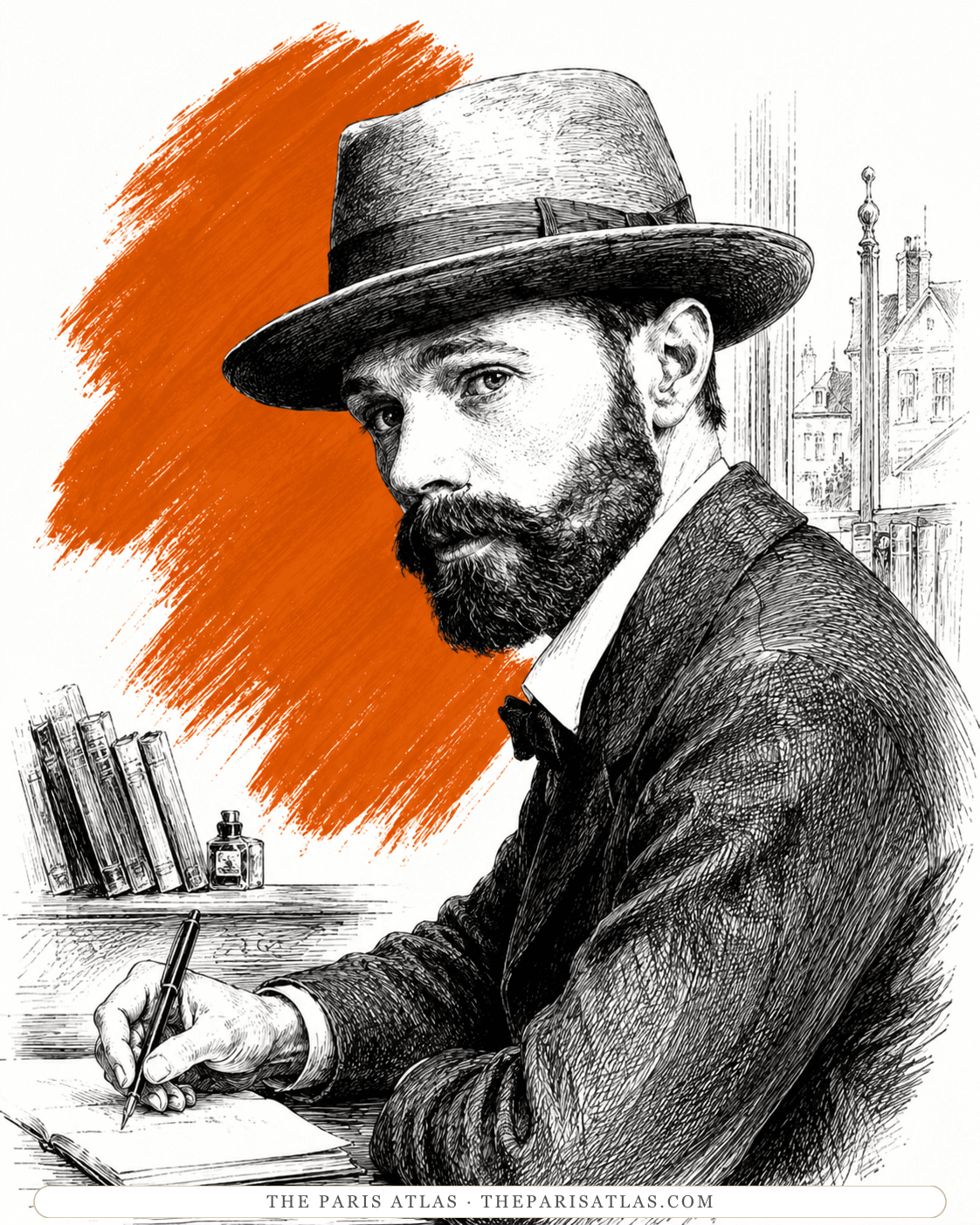
Met · 1915–1930
Huxley met Lawrence in 1915 and stayed in his orbit for the rest of Lawrence's life, despite having almost nothing in common with him as a writer — Eton and Balliol against a Nottinghamshire mining village, irony against prophecy. Huxley put a version of him into Point Counter Point (1928) as Mark Rampion, which Lawrence read and disliked. Maria Huxley typed part of Lady Chatterley's Lover; from their house at Suresnes the couple sent Lawrence to the Paris presses in March 1929 and to their own doctor; both were at Vence when he died on 2 March 1930; and Huxley edited the first published collection of Lawrence's letters in 1932.
Taught · 1917–1918
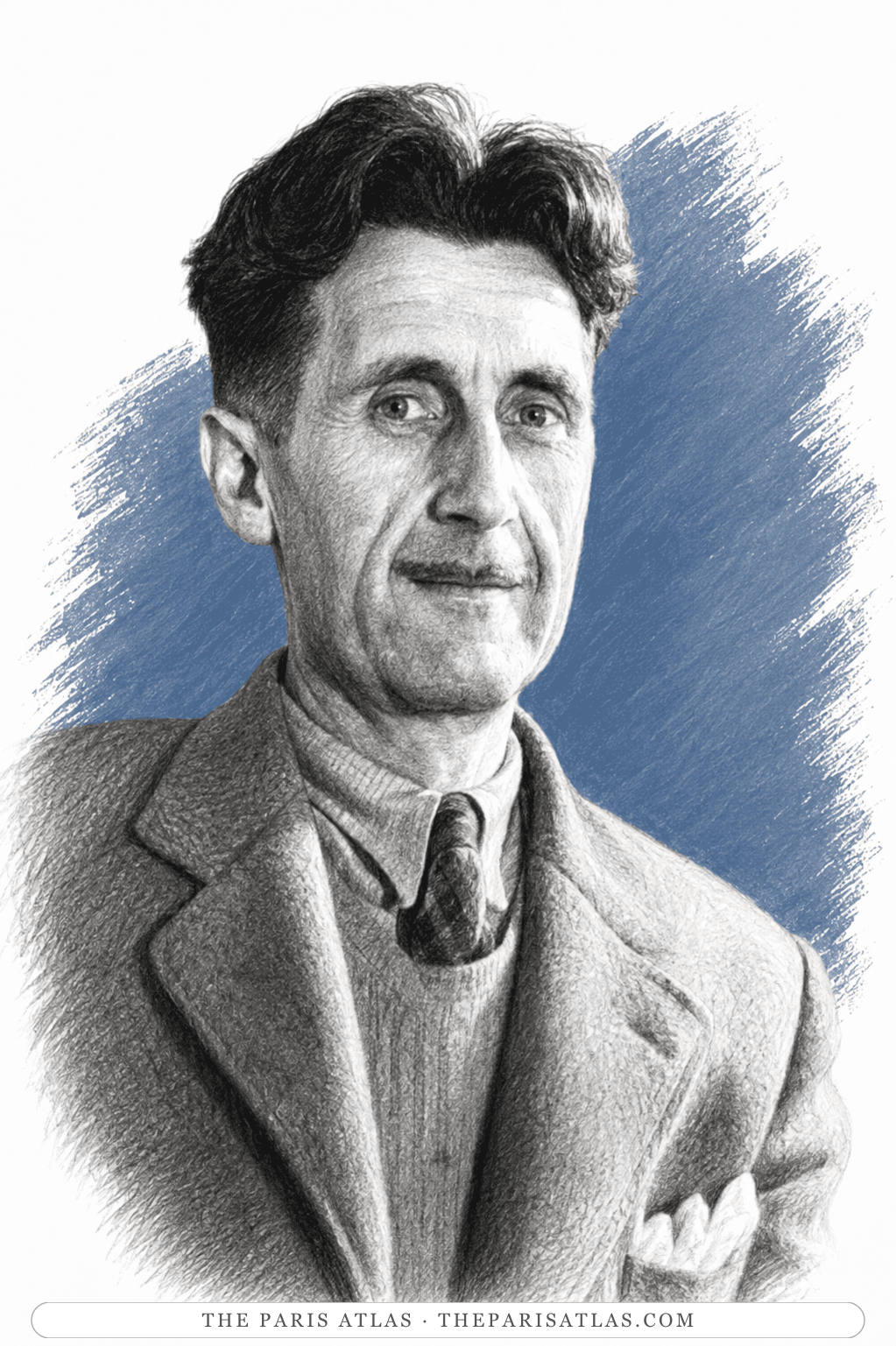
Huxley, himself an Eton pupil from 1908 to 1911, returned to the school as a master for the year 1917–18 to teach English and French. Eton's own record of him names Eric Blair — who would publish Nineteen Eighty-Four in 1949 as George Orwell — and Harold Acton among his pupils in that period. The teaching was brief and there is no evidence of a later relationship; the two great English dystopias of the century, Brave New World (1932) and Nineteen Eighty-Four, were nevertheless written by a schoolmaster and his pupil.
A crowded London novel of the late 1920s, built like a piece of music, with D. H. Lawrence at its moral centre and a murder near the end.

A society gives up freedom willingly because comfort, entertainment, and chemical happiness feel easier.

Aldous Huxley gathers the saints and sages of East and West into one book, and argues that they were all describing the same thing.

Aldous Huxley takes mescaline in May 1953 and writes down what happens to the world when he looks at it.

Aldous Huxley's last novel imagines a good society on the island of Pala, and sends a cynical journalist to help oil men take it over.
Not in Paris itself. From October 1928 to April 1930 he and his wife Maria rented a house at 3 rue du Bac in Suresnes, a suburb on the Seine immediately west of the Bois de Boulogne — close enough to be in the city in twenty minutes, far enough that D. H. Lawrence, who stayed a week there in March 1929, called it sleepy and dull. The rest of his French years, from April 1930 to February 1937, were spent on the Mediterranean at Sanary-sur-Mer.
Two addresses, eight and a half years. First 3 rue du Bac in Suresnes, west of Paris, from October 1928 to April 1930. Then a house at La Gorguette in Sanary-sur-Mer, a fishing village on the Var coast between Toulon and Bandol, from April 1930 until February 1937, when he left for the United States.
At Sanary-sur-Mer on the French Riviera, between May and August 1931 — four months of work. It was published in January 1932. Huxley had been living on the coast for a year by then, having given up the house near Paris the previous April.
A World State six hundred years in the future where people are manufactured in bottles, graded before birth into five castes, and conditioned in their sleep to want exactly what their caste is for. Families and lasting attachments have been abolished because they cause pain, and unhappiness is treated with a drug called soma. A young man raised outside the system, who has read Shakespeare and so has words for grief and love, is brought in, and cannot survive the collision. It is a warning about a society that buys permanent contentment by giving up art, religion, science and suffering.
Yes, briefly. Huxley returned to Eton as a master for the school year 1917–18 to teach English and French, and Eton's own record of him names Eric Blair — the future George Orwell — and Harold Acton among his pupils. Thirty-one years later Orwell published Nineteen Eighty-Four, the other great English dystopia of the century.
He took mescaline, a hallucinogen derived from the peyote cactus, for the first time in May 1953, under the supervision of the psychiatrist Humphry Osmond, and wrote the experience up as The Doors of Perception (1954), followed by Heaven and Hell (1956). The essays are sober, precise and philosophical rather than celebratory, but they made him a founding text of the 1960s counterculture, and gave the band The Doors their name.
At home in Los Angeles on 22 November 1963, aged sixty-nine; he was cremated the following day. His wife Laura Archera Huxley described the last hours in her 1968 memoir This Timeless Moment: too ill to speak, he wrote out a request for LSD, which she administered. His death was barely noticed at the time, because President Kennedy had been assassinated in Dallas that morning.
Most of them burned. The Bel Air fire of 12 May 1961 destroyed the Huxleys' Los Angeles house along with the bulk of his manuscripts and his library. What survived, together with Laura Huxley's papers, is at UCLA Library Special Collections as the Aldous and Laura Huxley papers, 1925–2007 — some fifty linear feet. The Centre for Aldous Huxley Studies at the University of Münster maintains the scholarly bibliography and publishes the Aldous Huxley Annual.
Lived at · 1928–1930
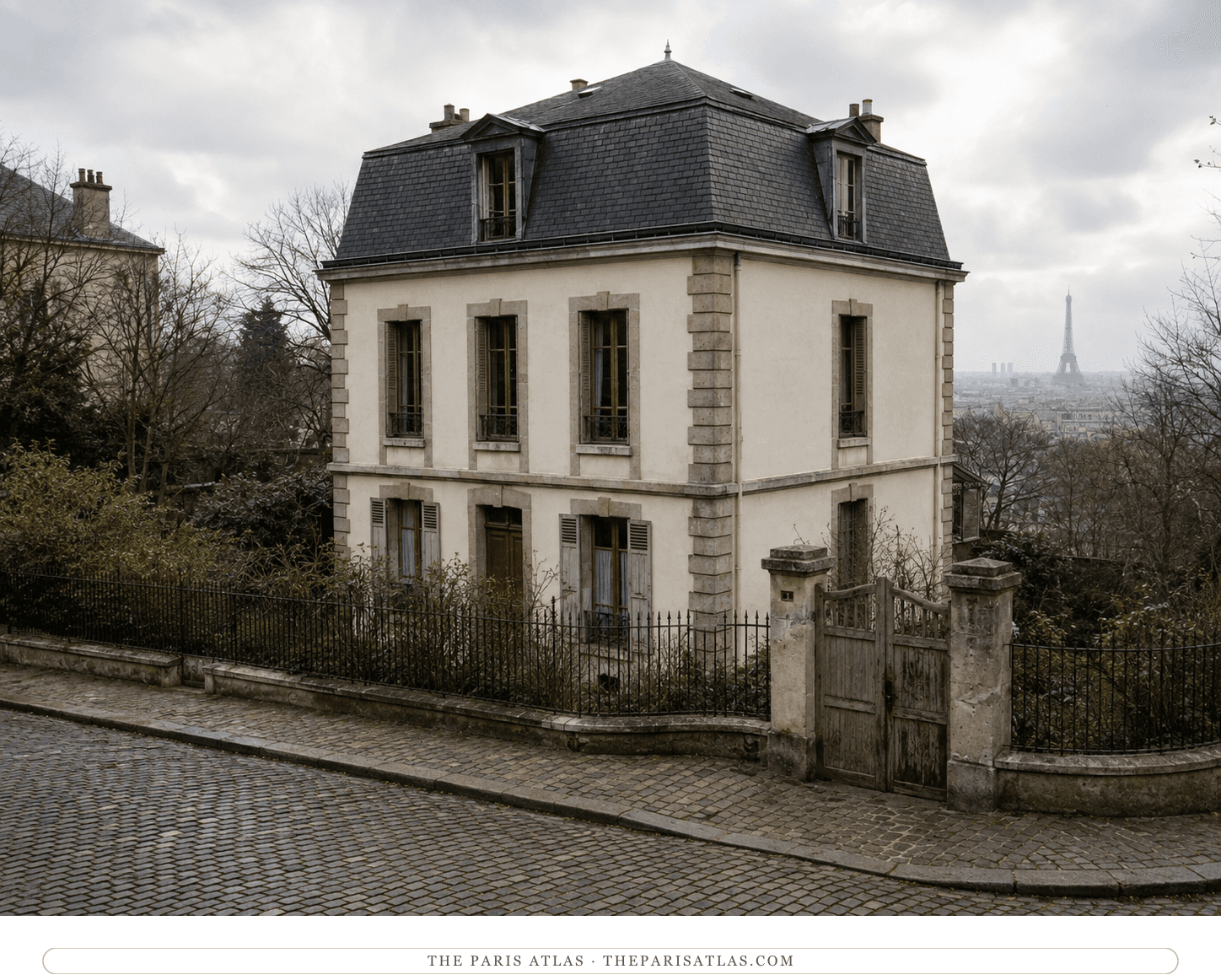
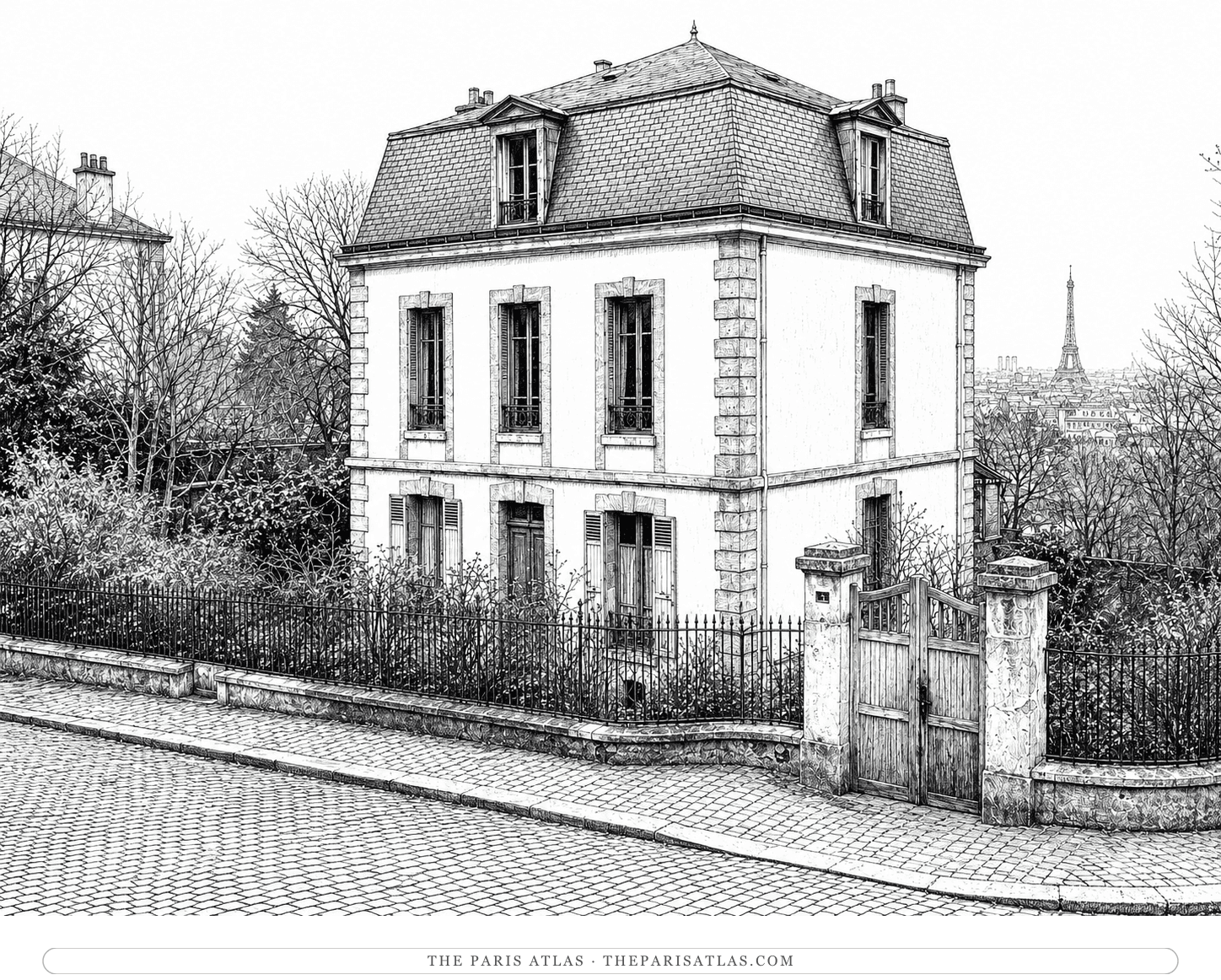
Aldous and Maria Huxley rented the house at 3 rue du Bac in Suresnes, the river suburb west of the Bois de Boulogne, from October 1928 until April 1930, with their son Matthew. It is the only address Huxley held in the Paris region; from there they advised the dying D. H. Lawrence to bring Lady Chatterley's Lover to the Paris presses, put him up for a week in March 1929 and took him to their doctor. In April 1930 they gave the house up and moved south to Sanary-sur-Mer, where Brave New World was written the following year.
Met · 1915–1930
Huxley met Lawrence in 1915 and stayed in his orbit for the rest of Lawrence's life, despite having almost nothing in common with him as a writer — Eton and Balliol against a Nottinghamshire mining village, irony against prophecy. Huxley put a version of him into Point Counter Point (1928) as Mark Rampion, which Lawrence read and disliked. Maria Huxley typed part of Lady Chatterley's Lover; from their house at Suresnes the couple sent Lawrence to the Paris presses in March 1929 and to their own doctor; both were at Vence when he died on 2 March 1930; and Huxley edited the first published collection of Lawrence's letters in 1932.
Taught · 1917–1918
Huxley, himself an Eton pupil from 1908 to 1911, returned to the school as a master for the year 1917–18 to teach English and French. Eton's own record of him names Eric Blair — who would publish Nineteen Eighty-Four in 1949 as George Orwell — and Harold Acton among his pupils in that period. The teaching was brief and there is no evidence of a later relationship; the two great English dystopias of the century, Brave New World (1932) and Nineteen Eighty-Four, were nevertheless written by a schoolmaster and his pupil.
The sources below include biographies, scholarly essays, interviews, and primary materials that informed this page. They reflect both the historical record and ongoing critical conversations about Aldous Huxley and their work.
Eton College's own record of Huxley as pupil and as master.
The standard biography, by a friend who knew the Huxleys at Sanary.
Sanary's tourist office on the German and Austrian exile colony of 1933–1940.
UCLA's finding aid for the surviving papers, and the record of the 1961 fire.
The Münster research centre that publishes the Aldous Huxley Annual.
Web source consulted for documented facts and historical context presented on the Aldous Huxley page.
First-person evidence and historical context used in preparing the Aldous Huxley page.
Web source consulted for documented facts and historical context presented on the Aldous Huxley page.
These references anchor the page in the documented record and in the scholarly conversations around Aldous Huxley. Every claim on this page traces back to one or more of the works listed here.
 Explore more resources