English novelist, essayist and journalist, born Eric Arthur Blair, who wrote Animal Farm and Nineteen Eighty-Four. He was an imperial policeman in Burma, a plongeur in Paris kitchens off the rue Mouffetard, and a militiaman shot through the neck in Spain before any of it.
George Orwell spent only forty-six years alive, but somehow managed to become an imperial policeman, dishwasher, tramp, schoolteacher, bookseller, soldier, war correspondent, BBC broadcaster, political journalist, critic, novelist and one of the most influential writers of the twentieth century.
The author the world remembers as George Orwell was actually born Eric Arthur Blair on June 25, 1903, in Motihari, Bengal, then part of British India. His father, Richard Walmesley Blair, worked in the Opium Department of the Indian Civil Service. Orwell later described his family's social position with his characteristically precise class-consciousness as belonging to the “lower-upper-middle class.” He was brought back to England as a small child and grew up largely apart from his father.[1]
Today Orwell is overwhelmingly associated with two books: Animal Farm and Nineteen Eighty-Four, usually published as 1984. But concentrating only on those novels misses much of what made him extraordinary. Orwell's fiction emerged from an unusually physical life. He deliberately placed himself in situations most literary intellectuals observed from a distance: colonial Burma, cheap lodging houses, Parisian restaurant kitchens, English coal-mining towns and the trenches of the Spanish Civil War.
His writing repeatedly returned to the same fundamental question: what happens when powerful institutions are allowed to decide what ordinary people are permitted to see, say and believe?
That question explains why terms Orwell invented or popularized—Big Brother, the Ministry of Truth, Newspeak, doublethink, Thought Police and Room 101—remain part of everyday political language more than seventy years after his death.
At work, with Westminster outside the window. (Illustration — The Paris Atlas)
Eric Blair Before He Became George Orwell
Orwell's childhood already contained many of the contradictions that would later preoccupy his writing.
He was connected to the British establishment but never especially wealthy. He received an elite education partly because of scholarships, yet developed an intense awareness of class divisions. He was British but had been born inside the British Empire. And before becoming one of imperialism's most memorable critics, he personally worked for the imperial system.
As a boy, Eric Blair attended St Cyprian's School in Eastbourne, where another future literary figure, Cyril Connolly, was a fellow pupil. He won a King's Scholarship to Eton College, arriving there in 1917. At Eton, however, he was far from the model student his scholarship might suggest. Orwell's biographer D. J. Taylor describes him as having largely “slacked” during his later school years. He left Eton in 1921 rather than continuing to university.
There is one particularly interesting literary connection from his education: Aldous Huxley, the future author of Brave New World, briefly taught Orwell at Eton during the First World War. Huxley taught English and French there in 1917–1918, and Eton's own historical archive identifies Eric Blair among his pupils.[2]
Orwell knew very early that he wanted to write. In his later essay Why I Write, he recalled realizing around the age of five or six that he wanted to become a writer. His earliest surviving work was far removed from the anti-authoritarian Orwell people know today: at eleven he published a patriotic poem during the First World War.[3]
The political Orwell had not yet been created.
Burma would help create him.
Reading outdoors, a dog at his side. (Illustration — The Paris Atlas)
Burma: The Imperial Policeman Who Turned Against Empire
Instead of university, Eric Blair joined the Indian Imperial Police. In 1922, at nineteen, he sailed for Burma, now Myanmar.[1]
He stayed roughly five years.
This period became crucial to understanding George Orwell's political views. He was not observing colonialism from a university seminar or newspaper office; he was participating in its enforcement.
His experiences later supplied material for his first novel, Burmese Days, and two of his most famous essays, A Hanging and Shooting an Elephant. The Orwell Foundation describes his time in Burma as formative in turning him against imperialism.
Shooting an Elephant became particularly famous because Orwell turned an apparently straightforward incident involving a colonial police officer into something much larger: an examination of how power can trap the person exercising it as well as the person subjected to it.
This became a recurring Orwell idea. Systems of domination deform almost everyone inside them.
He returned to England on medical leave in 1927 and resigned from the police.
It was an extraordinary decision. He was abandoning a secure career in the British Empire without having established himself as a writer.
For several years, failure seemed considerably more likely than fame.
Poverty, Paris and the Creation of “George Orwell”
After Burma, Blair tried to understand poverty by getting extremely close to it.
He lived cheaply in Paris, worked in restaurant kitchens as a plongeur—essentially a dishwasher and kitchen laborer—and later spent time among tramps and inhabitants of lodging houses in England. Those experiences became the basis of Down and Out in Paris and London, published in 1933.[4]
It was his first full-length published book.
It was also the book that introduced readers to George Orwell.
Eric Blair adopted the pseudonym shortly before publication. According to D. J. Taylor's biography for the Orwell Foundation, the name combined the name of the reigning monarch, George V, with a local English river—the River Orwell in Suffolk.[1]
The transformation was useful psychologically as well as professionally. “Eric Blair” could remain the private individual; “George Orwell” became the writer.
Down and Out in Paris and London also established something essential about George Orwell's writing style: he preferred experience to abstraction.
Rather than simply writing that poverty was degrading, he described what poverty did to someone's meals, clothes, sleep, conversations, dignity and sense of time. That commitment to concrete observation would stay with him throughout his career.
A café table in Paris, notebook open. (Illustration — The Paris Atlas)
The Bookseller, Eileen O'Shaughnessy and the Road to Wigan
Orwell spent periods teaching and, after another bout of illness, eventually found work in a secondhand bookshop in Hampstead.
This period helped inspire his novel Keep the Aspidistra Flying, but something more important happened personally: Orwell met Eileen O'Shaughnessy.
Eileen was intelligent, highly educated and independently minded. She had studied English at Oxford and later educational psychology at University College London. She and Orwell met in 1935 and married in 1936.[5]
Modern scholarship has increasingly emphasized that Eileen should not be treated merely as “George Orwell's wife.” Her surviving correspondence demonstrates her wit, political awareness and involvement in Orwell's working life, and recent Orwell Foundation scholarship describes her influence on his work as more extensive than was once acknowledged.[6]
Around the same time, publisher Victor Gollancz commissioned Orwell to investigate unemployment and working conditions in northern England.[7]
Orwell spent the early months of 1936 traveling through Lancashire and Yorkshire, visiting homes and industrial communities and descending into coal mines.
The result was The Road to Wigan Pier, published in 1937.[7]
The first half is social reportage; the second is an argument about socialism, class and the political failures Orwell believed prevented socialism from attracting ordinary English people. The book is important because it shows Orwell developing politically in public rather than presenting himself as a man who had always possessed a finished ideology.
Then Spain changed him permanently.
Among the shelves. (Illustration — The Paris Atlas)
George Orwell and the Spanish Civil War
At the end of 1936 Orwell went to Spain, originally intending to write about the Spanish Civil War.
Instead, he joined the fighting.
He served with the militia associated with the POUM, an anti-Stalinist Marxist organization fighting against Francisco Franco's Nationalist forces.[8]
Orwell was physically hard to miss—he stood well over six feet tall—and in May 1937 he was struck by a bullet through the neck.[8]
He survived.
But the bullet was not the only thing that transformed him.
While Orwell was fighting against fascism, conflict erupted within the Republican side itself. Soviet-aligned communists moved against rival leftist organizations including the POUM. Orwell and Eileen eventually had to escape Spain after the POUM was suppressed.
That experience was decisive.
Orwell remained a man of the political left, but he became fiercely hostile to Stalinism and totalitarianism. In Why I Write, he later explained that after the events of 1936–37, his serious writing was directed against totalitarianism and in favor of what he understood as democratic socialism.[3]
So, was George Orwell a socialist?
Yes.
One of the greatest misconceptions about Orwell is that because Animal Farm attacked Stalin's Soviet Union, Orwell must have rejected socialism altogether. He did not. His politics were better characterized as democratic socialist, anti-fascist, anti-imperialist and intensely anti-authoritarian.
What Spain destroyed was not his belief in social equality but his willingness to excuse dictatorship when it came from the political left.
He recorded the experience in Homage to Catalonia, published in 1938. His regular publisher, Victor Gollancz, declined to publish it, and Secker & Warburg eventually did.[8]
Orwell's Relationships Were More Complicated Than the Legend
Eileen was the central relationship of Orwell's adult life, but surviving correspondence reveals a considerably messier romantic history than older biographies sometimes suggested.
In 2021, Orwell's adopted son Richard Blair donated fifty letters to the Orwell Archive at University College London. They documented Orwell's relationships with Brenda Salkeld and Eleanor Jaques, two women he had known in Southwold.[9]
Orwell proposed marriage to both women at different points, both declined, and both remained significant friends. The letters also reveal overlapping romantic attachments during the years in which Orwell was struggling to establish himself as a writer.
That makes Orwell more complicated—and more human—than the austere public photograph with the cigarette and moustache sometimes suggests.
With Eileen, he eventually created something resembling a family life. In 1944, George and Eileen adopted a baby boy, Richard Horatio Blair.
Less than a year later their lives were shattered.
Eileen underwent an operation in March 1945 and unexpectedly died during it. Surviving letters in the UCL Orwell Archive include messages she wrote to Orwell immediately before the operation.[10]
Orwell became a single father.
On a bench, with a robin for company. (Illustration — The Paris Atlas)
George Orwell at the BBC
The Second World War gave Orwell another uncomfortable encounter with institutional power.
He wanted to contribute to the war effort but was rejected for regular military service on health grounds. He served in the Home Guard and in 1941 began working for the BBC Eastern Service.[11]
His job involved producing cultural and political broadcasts for audiences in India and elsewhere in the region.
In other words, one of history's most famous critics of propaganda spent part of the war producing wartime propaganda.
The contradiction was not lost on him.
Orwell increasingly disliked the bureaucracy and limitations of BBC work and left in 1943. He subsequently became literary editor of the socialist weekly Tribune, where his regular “As I Please” column gave him freedom to write about politics, books, language, popular culture and ordinary English life.[11]
These years produced some of Orwell's finest essays.
At the microphone. (Illustration — The Paris Atlas)
George Orwell's Writing Style
Orwell's reputation rests almost as much on his prose style as on his political ideas.
His goal was not merely to make sentences simpler. He believed bad language could make bad thinking easier.
In Politics and the English Language, published in 1946, Orwell attacked stale metaphors, unnecessary jargon, inflated vocabulary, vague abstractions and political euphemisms. His basic principle was that writers should determine exactly what they mean and then choose language capable of expressing it clearly.
That principle explains many characteristics of George Orwell's writing style:
straightforward sentences without unnecessary ornament;
concrete images rather than abstract generalities;
close observation of physical details;
distrust of clichés and euphemisms;
dry humor and irony;
willingness to include uncomfortable facts that weakened his own side of an argument;
political arguments expressed through stories, characters and tangible objects.
Orwell was not actually an advocate of boring prose. He cared enormously about rhythm, imagery and beauty.
In Why I Write, he explained that writing came from several motives at once: personal ambition, aesthetic pleasure, the desire to record reality and the desire to affect politics. His ambition was ultimately to make political writing into an art rather than force readers to choose between politics and literature.
That combination explains why Orwell remains unusually readable. His essays frequently begin with something specific—a hanging, an elephant, a cup of tea, a bookshop, a coal mine—and slowly reveal the larger political question hiding inside it.
At the typewriter. (Illustration — The Paris Atlas)
The Writers Who Influenced George Orwell
Orwell had an unusually broad reading life, and several writers repeatedly shaped his thinking.
Jonathan Swift was enormously important. Orwell admired Gulliver's Travels, and Swift's ability to use apparently simple fantasy as devastating political satire has an obvious connection to Animal Farm.
Charles Dickens was another major influence. Orwell wrote extensively about him and admired his moral imagination, memorable characters and instinctive hatred of cruelty, even while criticizing the limits of Dickens's politics.
H. G. Wells fascinated the young Orwell. Wells's speculative fiction and visions of future societies helped create the intellectual environment from which dystopian literature eventually emerged, although the older Orwell increasingly argued with Wells's faith in rational planning and scientific progress.
Jack London offered another model: the writer as participant-observer who entered uncomfortable environments and reported what he discovered. Scholars have specifically compared Orwell's social investigations to London's approach.
Orwell also read Lewis Carroll, Mark Twain, Rudyard Kipling and a remarkably varied assortment of popular fiction.
One delightful detail from studies of Orwell's personal library is that he remembered Beatrix Potter's The Tale of Pigling Bland as having exerted a peculiar influence on what eventually became Animal Farm.
Orwell's influences therefore did not form a single political tradition. He absorbed children's literature, Victorian novels, science fiction, journalism, satire and popular entertainment and turned them into something recognizably his own.
Animal Farm: The Book Publishers Were Afraid to Touch
Orwell conceived the central idea behind Animal Farm years before he actually wrote it. The novel itself was composed principally during 1943 and 1944.
Its target was the corruption of the Russian Revolution under Stalin.
That created a serious publishing problem.
Britain and the Soviet Union were allies against Nazi Germany, and a satire portraying Stalinism as a betrayal of revolutionary ideals was politically awkward. Orwell's manuscript was rejected by several publishers. One famous rejection came from T. S. Eliot at Faber & Faber.
Eventually Secker & Warburg accepted it.
Animal Farm was published on August 17, 1945.
The timing transformed Orwell's career. The war in Europe had ended, attitudes toward the Soviet Union were shifting, and the short fable could be read both as a story about farm animals and as an extraordinarily compact account of how revolutions can reproduce the oppression they were created to destroy.
Characters including Napoleon, Snowball, Boxer and Squealer entered literary culture, and Animal Farm became one of the books most closely associated with Orwell's name.
Its success finally gave Orwell something he had lacked for most of his career: financial security.
His health, however, was deteriorating.
1984: The Last Book
After Eileen's death, Orwell increasingly sought somewhere isolated where he could write.
With help from his friend David Astor, he found a house called Barnhill on the remote Scottish island of Jura.
There, while raising Richard with help from his sister Avril and while becoming increasingly ill with tuberculosis, Orwell worked on the novel that would make his name synonymous with modern authoritarianism.
The book was Nineteen Eighty-Four, usually written as 1984.
Orwell completed the final manuscript near the end of 1948. The process severely strained his already fragile health, and he subsequently required lengthy hospitalization. The novel was published in June 1949.
The 1984 book tells the story of Winston Smith, a minor Party employee whose job involves altering historical records at the Ministry of Truth so that the past continually agrees with whatever the government currently claims.
Around that premise Orwell created an extraordinary political vocabulary.
There is Big Brother, the supposedly all-seeing leader.
There is Newspeak, a language engineered to reduce the range of possible thought.
There is doublethink, the ability to accept mutually contradictory ideas when the Party demands it.
There are the Thought Police, who pursue forbidden thinking.
And there is Room 101, associated with the state's ultimate ability to break individual resistance.
These ideas explain the modern meaning of the word Orwellian.
Something is generally described as Orwellian when it involves authoritarian control, pervasive surveillance, propaganda, political manipulation of language or attempts to rewrite reality itself.
Ironically, the word has become so popular that it is frequently used to describe things Orwell never would have recognized as Orwellian.
By the fire. (Illustration — The Paris Atlas)
George Orwell's Final Marriage and Death
By the time 1984 appeared, Orwell was seriously ill.
While being treated for tuberculosis at University College Hospital in London, he married Sonia Brownell on October 13, 1949.
Sonia was connected to the London literary world and had worked at the influential magazine Horizon. Their marriage lasted only a little more than three months.
George Orwell died on January 21, 1950, aged forty-six.
The cause was tuberculosis.
He died just as 1984 was becoming an international sensation.
Richard was only five. After Orwell's death he was largely raised by Orwell's sister Avril. Sonia subsequently played a major role in preserving Orwell's manuscripts and literary estate; material from his papers eventually helped establish the George Orwell Archive at University College London, now one of the world's most important collections relating to his life.
On the seafront, notebook in hand. (Illustration — The Paris Atlas)
Why George Orwell Still Matters
Orwell's lasting importance comes from something larger than his ability to predict surveillance technology.
He did not really write 1984 as a fortune-teller predicting exactly what the year 1984 would look like.
He wrote warnings.
His life had given him direct experience of empire, poverty, class divisions, war, propaganda, revolutionary politics, ideological persecution and bureaucratic institutions. Again and again he saw how easily abstract political ideals could obscure what was happening to actual human beings.
That is why Orwell constantly returned to concrete reality.
Who has enough food?
Who controls the newspaper?
Who changes yesterday's statement?
Who is allowed to criticize the people supposedly acting on their behalf?
What happens when a political movement begins changing the meaning of words?
And what happens when loyalty to a cause becomes more important than acknowledging that something is true?
Those questions have outlived nearly every government and political controversy Orwell originally wrote about.
That may be the most remarkable thing about George Orwell.
He died in 1950.
But we are still using his vocabulary to explain the world.
A London street after dark. (Illustration — The Paris Atlas)
Major Books by George Orwell
For readers looking for the principal George Orwell books in order, his major book-length works are:
Orwell also produced an enormous body of journalism, reviews and essays, including Shooting an Elephant, A Hanging, Politics and the English Language, Why I Write, The Prevention of Literature, Notes on Nationalism, and many others. The Orwell Foundation's bibliography separates his six novels from his principal nonfiction books and extensive essay writing.
Life events
1903
Eric Arthur Blair is born on 25 June at Motihari, in Bengal, British India.
1917
Wins a King's Scholarship to Eton, where Aldous Huxley briefly teaches him.
1922
Joins the Indian Imperial Police and sails for Burma at nineteen.
1927
Returns to England on medical leave and resigns from the police.
1928
Takes a room at 6 rue du Pot de Fer in the Latin Quarter and works as a plongeur in Paris hotel kitchens.
1933
Down and Out in Paris and London is published, under the name George Orwell for the first time.
1936
Marries Eileen O'Shaughnessy, travels through Lancashire and Yorkshire for The Road to Wigan Pier, and goes to Spain at the end of the year.
1937
Shot through the neck in May while serving with the POUM militia; escapes Spain after the POUM is suppressed.
1941
Begins work at the BBC Eastern Service, producing broadcasts for audiences in India.
1945
Animal Farm is published on 17 August. Eileen dies during an operation in March.
1949
Nineteen Eighty-Four is published in June. Orwell marries Sonia Brownell in October, in hospital.
1950
Dies of tuberculosis on 21 January, aged forty-six.
George Orwell quotes
Verbatim, as recorded by the witnesses of the era — sources on every quotation.
“
Political language – and with variations this is true of all political parties, from Conservatives to Anarchists – is designed to make lies sound truthful and murder respectable, and to give an appearance of solidity to pure wind.
— George Orwell, “Politics and the English Language,” Horizon, April 1946
“
If liberty means anything at all it means the right to tell people what they do not want to hear.
— George Orwell, “The Freedom of the Press,” written 1945, first published 1972
“
In our age there is no such thing as ‘keeping out of politics’. All issues are political issues, and politics itself is a mass of lies, evasions, folly, hatred and schizophrenia.
— George Orwell, “Politics and the English Language,” Horizon, April 1946
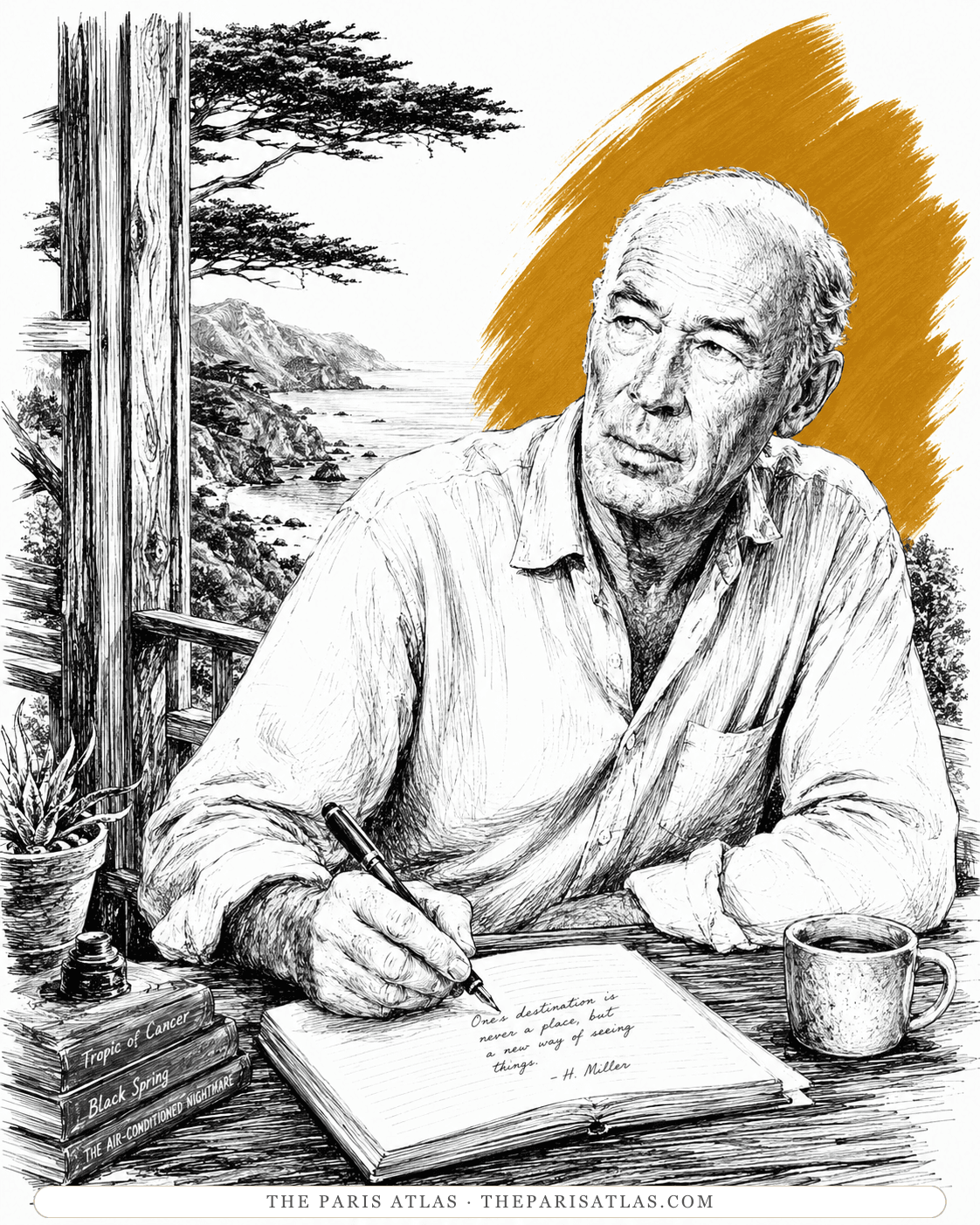
They met in Paris on 23 December 1936, as Orwell broke his journey to the Spanish Civil War. Miller gave him a corduroy jacket for the front. Alfred Perlès, who was there, recorded the meeting in My Friend Henry Miller (1955). Orwell went on to write Inside the Whale (1940) largely about Miller's Paris work.
— Strange Meeting — Orwell and Henry Miller, Paris 1936; Bernard Crick, George Orwell: A Life (1980)
Huxley, himself an Eton pupil from 1908 to 1911, returned to the school as a master for the year 1917–18 to teach English and French. Eton's own record of him names Eric Blair — who would publish Nineteen Eighty-Four in 1949 as George Orwell — and Harold Acton among his pupils in that period. The teaching was brief and there is no evidence of a later relationship; the two great English dystopias of the century, Brave New World (1932) and Nineteen Eighty-Four, were nevertheless written by a schoolmaster and his pupil.
— Aldous Huxley; Aldous Huxley: A Chronology of His Life
The two chief anti-totalitarian novelists of the 1940s were close friends. Orwell reviewed Darkness at Noon in 1941 and wrote a long essay on Koestler in 1944; from 1945, with Koestler living at a farmhouse in the Vale of Ffestiniog in Wales, the friendship deepened, and the two discussed founding a league for the rights of man. It lasted until Orwell's death in 1950.
— Arthur Koestler
Who George Orwell Inspired
People who found inspiration in George Orwell’s work.
Vonnegut called George Orwell his favourite writer and said he tried to emulate him: "I like his concern for the poor, I like his socialism, I like his simplicity." He named Nineteen Eighty-Four as a direct influence on his first novel, Player Piano, whose automated America is a corporate cousin of Orwell's surveillance state.
Atwood laid out the debt herself in the centenary essay "Orwell and me": she read Animal Farm at nine, without knowing what it was about, and cried her eyes out. She named Nineteen Eighty-Four as a direct model for The Handmaid's Tale, which she framed as the same totalitarian machinery seen from the point of view of the regime's women.
George Orwell went to Spain to write newspaper articles and joined a militia instead: a winter in the Aragón trenches, street fighting in Barcelona, a bullet through the throat.
Ten wartime essays on Dickens, Kipling, boys' comics and seaside postcards, including the piece on Salvador Dalí that a publisher cut out of a printed book.
George Orwell was an English novelist, essayist, journalist and political critic best known for Animal Farm and Nineteen Eighty-Four. Much of his writing examined totalitarianism, propaganda, imperialism, poverty, class and the political manipulation of language.
What was George Orwell's real name?
George Orwell's real name was Eric Arthur Blair. He began publishing under the name George Orwell early in his professional writing career.
Where was George Orwell born?
George Orwell was born on June 25, 1903, in Motihari, Bengal Presidency, British India, in an area that is now part of Bihar, India.
Where did George Orwell go to school?
Orwell attended St Cyprian's School in Eastbourne before winning a King's Scholarship to Eton College. He did not attend university.
Did Aldous Huxley teach George Orwell?
Yes. Future Brave New World author Aldous Huxley briefly taught Eric Blair at Eton while Huxley worked there as a teacher in 1917–1918.
Why did Eric Blair call himself George Orwell?
The pseudonym combined George, associated with the reigning king George V, with the River Orwell in Suffolk. He began using it around the publication of Down and Out in Paris and London.
What are George Orwell's most famous books?
The two most famous books by George Orwell are Animal Farm, published in 1945, and Nineteen Eighty-Four (1984), published in 1949. His other important books include Down and Out in Paris and London, Burmese Days, The Road to Wigan Pier and Homage to Catalonia.
When was Animal Farm written?
George Orwell principally wrote Animal Farm in 1943–1944, although he said the central idea had occurred to him years earlier.
When was Animal Farm published?
Animal Farm was first published on August 17, 1945, by Secker & Warburg.
Why did George Orwell write Animal Farm?
Orwell used Animal Farm as a political fable about the corruption of revolutionary ideals, particularly the transformation of the Russian Revolution into Stalin's authoritarian Soviet regime. Orwell opposed Stalinism while continuing to identify with democratic socialism.
When was 1984 written?
Orwell worked on Nineteen Eighty-Four during the late 1940s and completed the final draft near the end of 1948, much of the work taking place while he lived on Jura and suffered from serious illness.
When was 1984 published?
Nineteen Eighty-Four was published in June 1949, approximately seven months before Orwell's death.
Why did George Orwell write 1984?
Orwell wrote 1984 as a warning about the possibilities of totalitarian power: surveillance, propaganda, censorship, historical manipulation, political control of language and the destruction of independent thought. The book reflected his experiences with imperialism, fascism, Stalinism, wartime propaganda and twentieth-century bureaucracy.
What does Orwellian mean?
Orwellian generally describes a society or practice involving oppressive government control, surveillance, propaganda, censorship, manipulation of language or distortion of objective reality. The term derives from the political world Orwell created most famously in 1984.
What is the Ministry of Truth in 1984?
The Ministry of Truth is the government department where Winston Smith works altering historical records so that the past always matches the Party's current claims. It is one of Orwell's clearest examples of political language deliberately meaning the opposite of reality.
Was George Orwell a socialist?
Yes. Orwell explicitly identified with democratic socialism. He strongly opposed Stalinism and other forms of totalitarianism, but his criticism of the Soviet Union did not mean that he had rejected socialism itself.
Did George Orwell fight in the Spanish Civil War?
Yes. Orwell fought for the Republican side with a militia connected to the anti-Stalinist POUM beginning in late 1936. His experiences became the basis for Homage to Catalonia.
Was George Orwell shot?
Yes. Orwell was shot through the neck while fighting in Spain in 1937. He survived and later fled Spain after the POUM was outlawed.
What is Shooting an Elephant about?
Shooting an Elephant is Orwell's 1936 essay about his experiences as a colonial police officer in Burma. Using one disturbing incident, Orwell examines imperialism, social pressure and the way political power can imprison the person supposedly possessing it.
What is Politics and the English Language about?
In Politics and the English Language, Orwell argues that vague, clichéd and inflated language can hide confused thinking and political dishonesty. He advocates precise language in which writers determine their meaning first and choose the clearest words capable of expressing it.
Who were George Orwell's wives, and how did he die?
Orwell married Eileen O'Shaughnessy in 1936. She died unexpectedly during an operation in 1945. In October 1949, while hospitalized, Orwell married Sonia Brownell. George Orwell died from tuberculosis on January 21, 1950, at the age of forty-six.
Connections and Sources
George Orwell’s connections to people, places, and works, with the sources behind each one.
Orwell took a room at 6 rue du Pot de Fer, off the rue Mouffetard, in the spring of 1928 and stayed about eighteen months. Down and Out in Paris and London renames the street the rue du Coq d'Or.
— George Orwell, Down and Out in Paris and London (1933); Down and Out in Paris
Orwell lodged at the Hôtel des Bons Amis for most of his eighteen months in Paris, from a few weeks after arriving in June 1928. A letter he sent to the editor Max Plowman on 22 September 1929 carries the return address 6 Rue du Pot de Fer, Paris 5. He disguised the street as the rue du Coq d'Or and the hotel as the Hôtel des Trois Moineaux in Down and Out in Paris and London.
— Bernard Crick, George Orwell: A Life (1980); Darcy Moore, Orwell in Paris
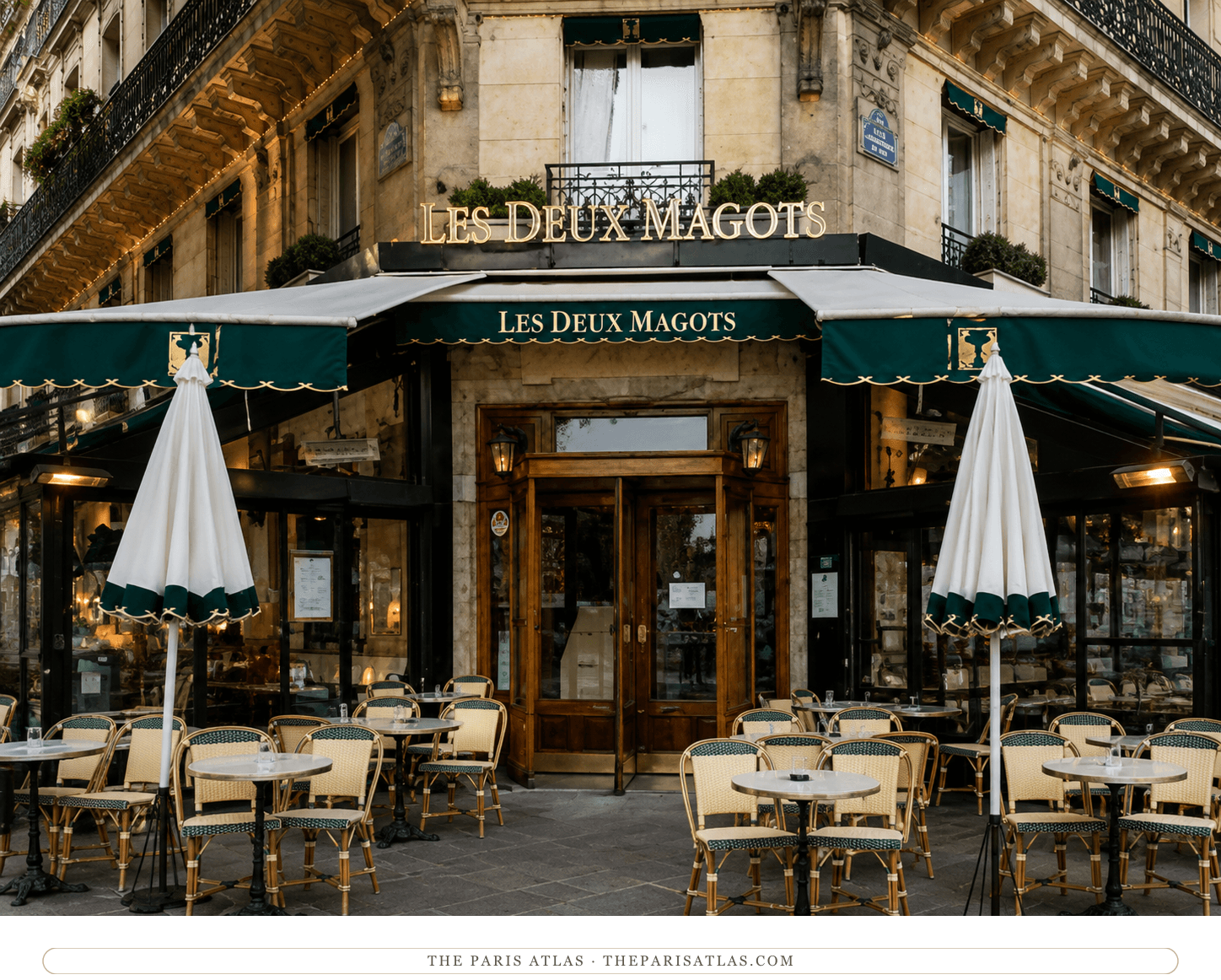
Orwell is reported to have seen James Joyce eating here and not approached him. Returning to Paris as a war correspondent in 1945 he arranged to meet Albert Camus at the café — an appointment Camus was too ill to keep, so the two writers never met.
Orwell's first Paris address — the flat of his aunt Nellie Limouzin and her partner Eugène Adam, where he stayed on arriving in 1928 before moving to the rented room on the rue du Pot de Fer. Down and Out begins after this, with him already poor.
As Down and Out has it, Orwell walked here to pawn the overcoats — in his own name, since Boris had stopped renewing his identity papers to avoid the tax — and found the pawnshop shut until four in the afternoon.
— George Orwell, Down and Out in Paris and London (1933); Richard Erickson, Down and Out in Paris: Orwell's Fact or Fiction?
Orwell pawned clothing with the municipal pawnbroker to buy food during the events of Down and Out in Paris and London. Pawning is the engine of the book's Paris economy, and he describes the queueing and the valuations from inside the queue.
— Qui donc était « Boris » ? (2024); George Orwell, Down and Out in Paris and London (1933)
Orwell was admitted with pneumonia in 1929 and spent several weeks in a public ward of about sixty beds, leaving before he was discharged. He wrote it up as "How the Poor Die", disguising the hospital as the "Hôpital X" in the fifteenth arrondissement — Cochin is in the fourteenth.
— George Orwell, How the Poor Die (1946); Richard Erickson, Down and Out in Paris: Orwell's Fact or Fiction?
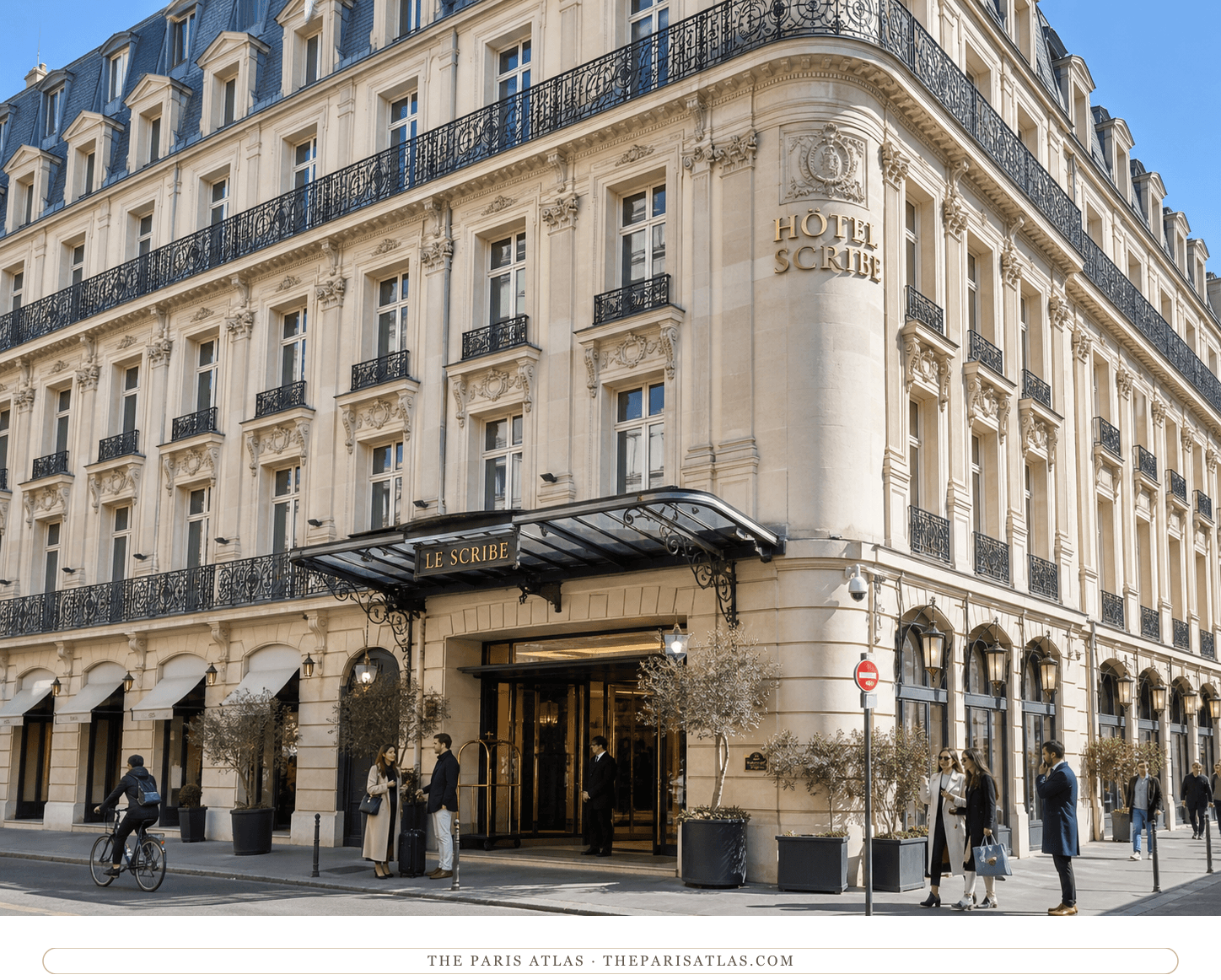
"We went to the Hôtel Scribe and waited an hour on the pavement, hoping that the manager would come out, but he never did." Orwell returned to the hotel as a war correspondent in 1945.
— George Orwell, Down and Out in Paris and London (1933)
As Down and Out in Paris and London has it, Orwell and Boris reached the end of their money, bought half a pound of bread and a piece of garlic to rub on it, and spent the day here: "We sat most of that day in the Jardin des Plantes... we wrote dinner menus on the backs of envelopes. We were too hungry even to try and think of anything except food."
— George Orwell, Down and Out in Paris and London (1933); Richard Erickson, Down and Out in Paris: Orwell's Fact or Fiction?
As Down and Out has it, Orwell was walking home along the rue Broca after finding the pawnshop shut — twelve kilometres walked and sixty hours without food — when he saw a five-sou piece glittering on the cobbles. It bought a pound of potatoes, eaten half-raw for want of stove alcohol and salt.
— George Orwell, Down and Out in Paris and London (1933); Richard Erickson, Down and Out in Paris: Orwell's Fact or Fiction?
Orwell's second Paris kitchen job, as a plongeur at the Auberge de la Ferme — the restaurant he renamed the "Auberge de Jehan Cottard" and relocated to the rue du Commerce in Down and Out in Paris and London. Identified at this address by Duncan Roberts's archival research, 2017-2021.
— Qui donc était « Boris » ? (2024); George Orwell, Down and Out in Paris and London (1933)
The strongest identification of the "Hotel X" where Orwell worked as a plongeur, up to seventeen hours a day in the basement kitchen. Orwell withheld the name, as he did for the hospital and the restaurant, so this is an identification rather than a confirmation.
— George Orwell, Down and Out in Paris and London (1933)
They met in Paris on 23 December 1936, as Orwell broke his journey to the Spanish Civil War. Miller gave him a corduroy jacket for the front. Alfred Perlès, who was there, recorded the meeting in My Friend Henry Miller (1955). Orwell went on to write Inside the Whale (1940) largely about Miller's Paris work.
— Strange Meeting — Orwell and Henry Miller, Paris 1936; Bernard Crick, George Orwell: A Life (1980)
Vonnegut called George Orwell his favourite writer and said he tried to emulate him: "I like his concern for the poor, I like his socialism, I like his simplicity." He named Nineteen Eighty-Four as a direct influence on his first novel, Player Piano, whose automated America is a corporate cousin of Orwell's surveillance state.
Atwood laid out the debt herself in the centenary essay "Orwell and me": she read Animal Farm at nine, without knowing what it was about, and cried her eyes out. She named Nineteen Eighty-Four as a direct model for The Handmaid's Tale, which she framed as the same totalitarian machinery seen from the point of view of the regime's women.
Huxley, himself an Eton pupil from 1908 to 1911, returned to the school as a master for the year 1917–18 to teach English and French. Eton's own record of him names Eric Blair — who would publish Nineteen Eighty-Four in 1949 as George Orwell — and Harold Acton among his pupils in that period. The teaching was brief and there is no evidence of a later relationship; the two great English dystopias of the century, Brave New World (1932) and Nineteen Eighty-Four, were nevertheless written by a schoolmaster and his pupil.
— Aldous Huxley; Aldous Huxley: A Chronology of His Life
The two chief anti-totalitarian novelists of the 1940s were close friends. Orwell reviewed Darkness at Noon in 1941 and wrote a long essay on Koestler in 1944; from 1945, with Koestler living at a farmhouse in the Vale of Ffestiniog in Wales, the friendship deepened, and the two discussed founding a league for the rights of man. It lasted until Orwell's death in 1950.
— Arthur Koestler
References
References
The sources below include biographies, scholarly essays, interviews, and primary materials that informed this page. They reflect both the historical record and ongoing critical conversations about George Orwell and their work.
These references anchor the page in the documented record and in the scholarly conversations around George Orwell. Every claim on this page traces back to one or more of the works listed here.











 View source