The Paris AtlasCharting the artists, works, and places worth returning to.

Hotel · Latin Quarter (Mouffetard) · 5e arrondissement

6 rue du Pot de Fer (Hotel des Bons Amis)

Permanently closed

The building stands and is in ordinary use, with commerce on the ground floor. The Hotel des Bons Amis is gone. A commemorative plaque was approved by the City of Paris in June 2026.

The cheap Latin Quarter lodging house where Eric Blair lived for eighteen months before he was George Orwell, and the raw material for the Paris half of Down and Out in Paris and London.

Address
6 Rue du Pot de Fer, 75005 Paris
Years
Orwell lodged here 1928-1929
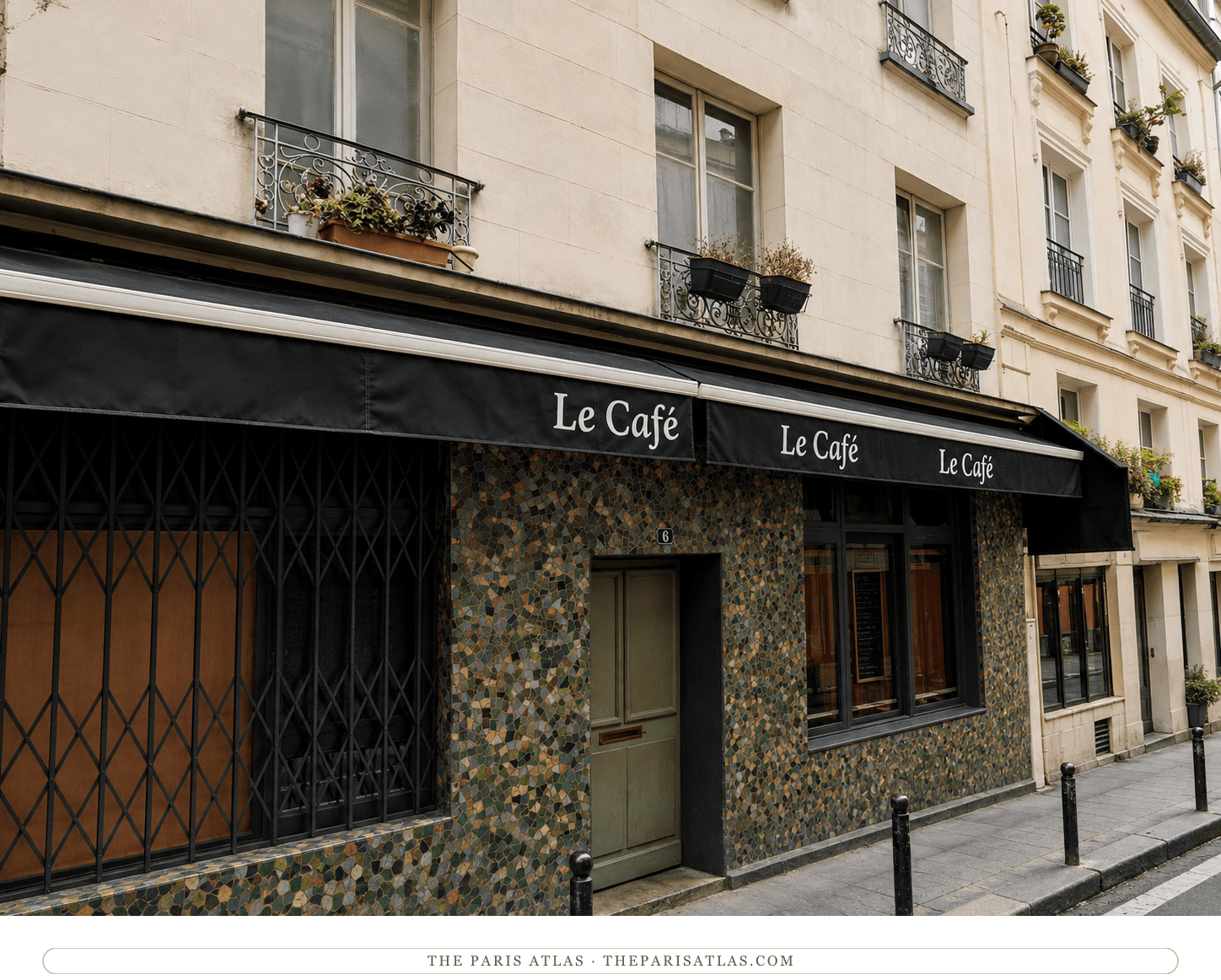
IllustrationThe front of 6 rue du Pot de Fer today in colour — green and ochre mosaic tiling around a pale green door, black awnings, geraniums on the ironwork balconies above

The mosaic tiling and the balconies above are the parts of the front Orwell would still recognise.

Editorial illustration

The story

Why Orwell came to Paris

Orwell had spent five years, from 1922 to 1927, serving as a colonial policeman in Burma. The experience left him deeply uncomfortable with British imperialism, and after returning to England he resigned from the service and decided that he wanted to write instead. Paris offered two major advantages to an aspiring writer with little money: living costs were comparatively low, and Orwell already had family there. His aunt, Nellie Limouzin, lived in Paris and was able to give him occasional meals, financial help and introductions.

He arrived in France in June 1928 and initially stayed with his aunt before finding inexpensive furnished accommodation in the Latin Quarter. Archival research places his move to the Hôtel des Bons Amis only a few weeks after his arrival. He remained based at 6 Rue du Pot de Fer for most of his eighteen-month Paris stay.

Unlike the prosperous expatriate Paris associated with cafés, publishers and literary salons, Orwell was deliberately living cheaply. He wanted to become a writer, but he had virtually no reputation, little income and no guarantee that anyone would publish what he produced.

What was the Hôtel des Bons Amis like?

It was emphatically not a glamorous Left Bank hotel.

Orwell's fictionalized description in Down and Out in Paris and London presents a five-storey lodging house divided into around forty tiny rooms by thin wooden partitions. There was little cleaning, the wallpaper was worn, and bedbugs were a persistent problem. Rents varied according to the room, and the residents were an unstable mixture of poor workers, immigrants and people passing through Paris. Despite all this, Orwell remembered the establishment as “dirty … but homelike.”

Modern archival work gives the hotel considerably more reality than Orwell allowed in the book. Researchers have identified the people running the Hôtel des Bons Amis as Carlos and Clothilde Ferrari, Italian immigrants who leased the establishment from property owners Henri-Antoine and Marie-Antoinette Mons. The Ferraris appear to correspond to the friendly proprietors whom Orwell disguised in his account.

This is one reason 6 Rue du Pot de Fer is unusually valuable as an Orwell site: Down and Out can sound like a collection of exaggerated characters invented for comic effect, but archival records increasingly show that there was a very real social world behind Orwell's pseudonyms.

The neighborhood Orwell knew

The Mouffetard quarter of the late 1920s was very different from the restaurant-filled destination visitors encounter today. It was a densely populated, relatively inexpensive and cosmopolitan part of the Left Bank, filled with small shops, inexpensive lodgings and working people rather than the fashionable literary cafés associated with Saint-Germain-des-Prés or Montparnasse. Recent research describes the neighborhood Orwell entered in 1928 as both popular and cosmopolitan.

The physical setting itself was already old. Rue du Pot de Fer is a narrow historic street running away from Rue Mouffetard, and images preserved by the Musée Carnavalet show how strongly commerce shaped the area. Historical photographs record groceries, wine merchants and barrels standing directly in the street, while a Musée Carnavalet drawing made in 1926—only two years before Orwell arrived—depicts the junction of Rue Mouffetard and Rue du Pot de Fer much as he would have encountered it.

At the corner stands the old Fontaine du Pot-de-Fer, another surviving link to the earlier neighborhood. The Musée Carnavalet preserves photographs of the fountain from before Orwell's arrival.

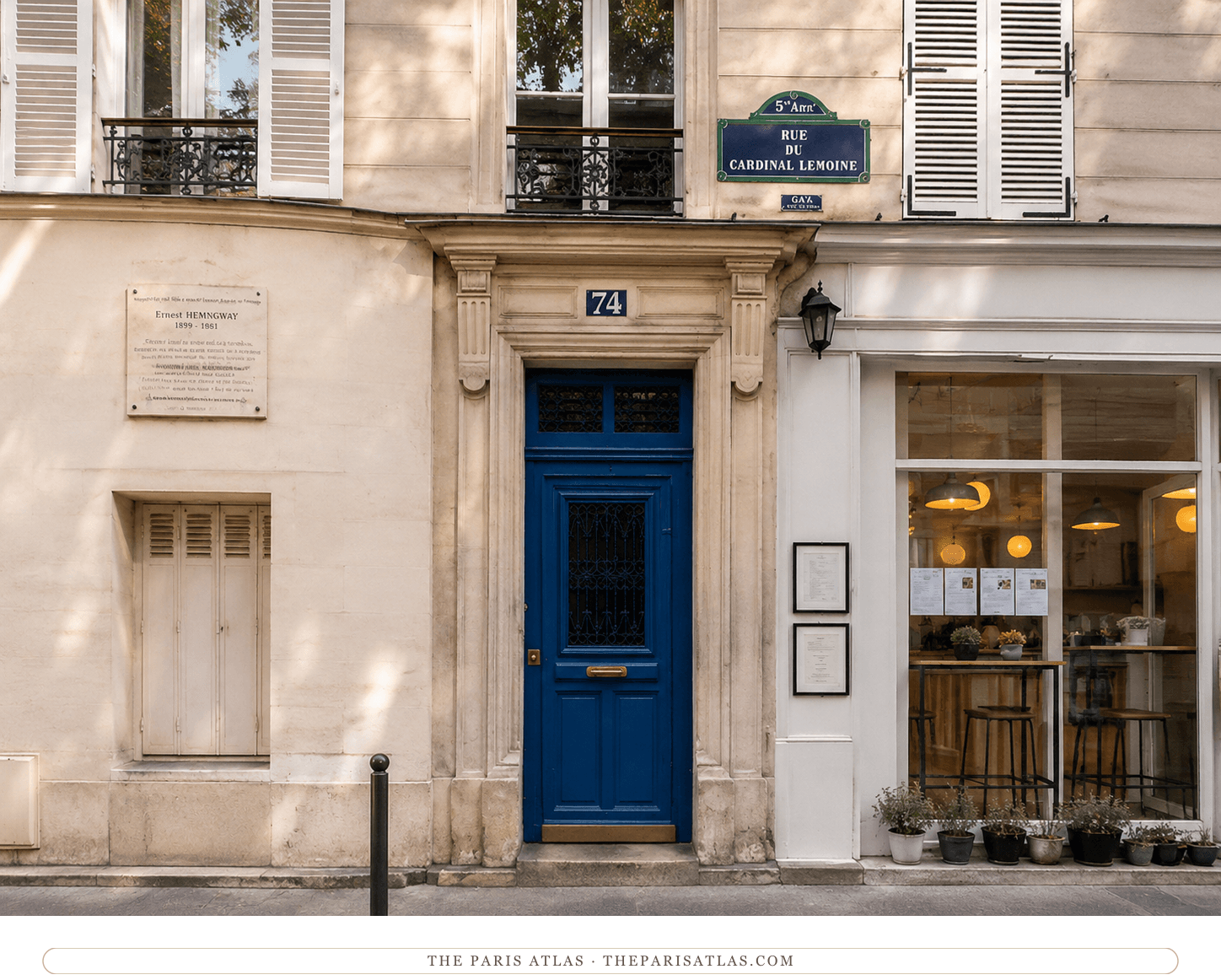
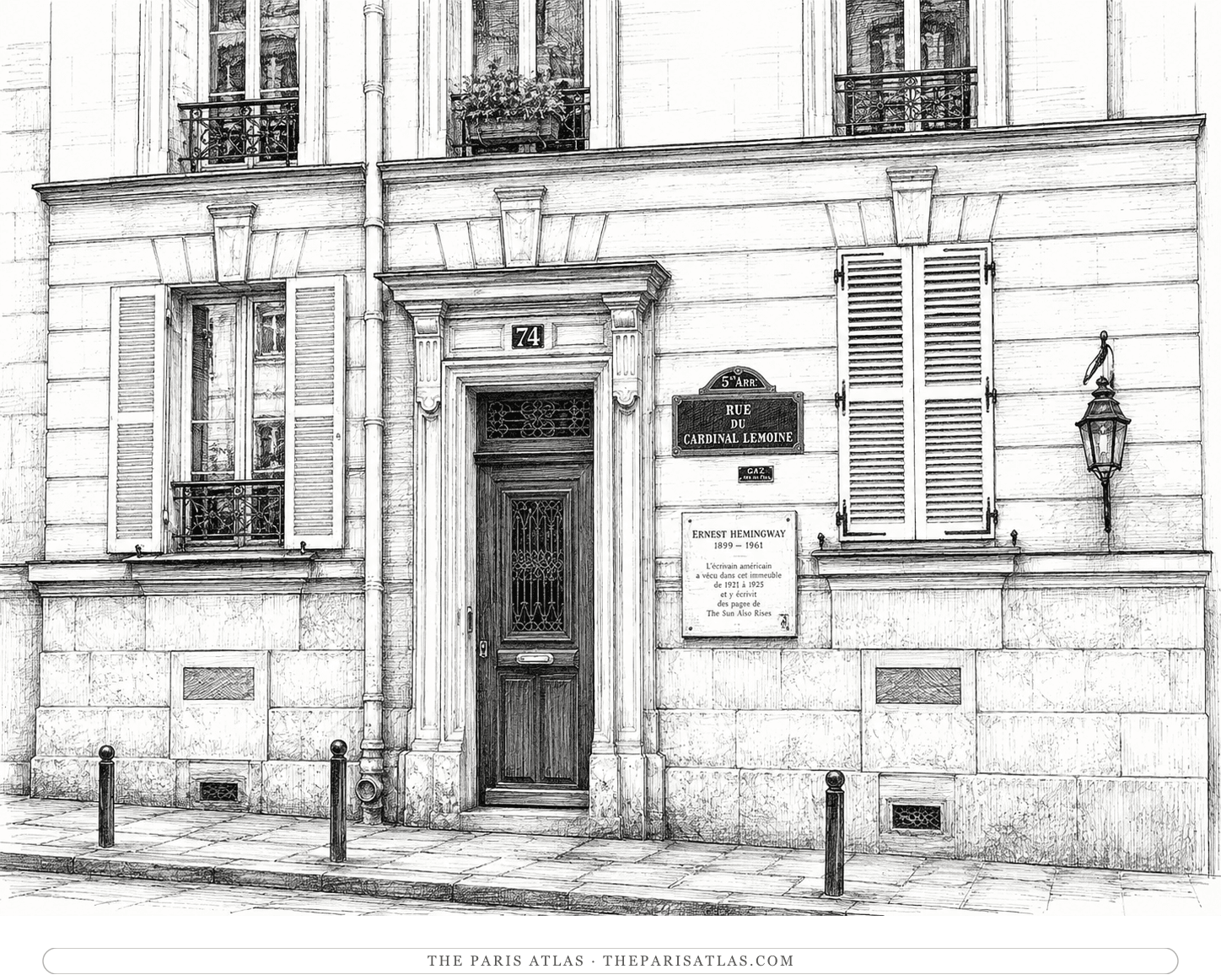
There is also an intriguing contrast with another writer who knew almost exactly the same patch of Paris. Ernest Hemingway had lived only a few minutes away at 74 Rue du Cardinal Lemoine earlier in the decade. Hemingway remembered the area as inexpensive but appealing; Orwell, arriving without literary success and eventually falling into real financial distress, depicted it much more harshly. The difference says as much about the writers' circumstances as it does about the neighborhood itself.

Did Orwell actually write at 6 Rue du Pot de Fer?

Yes—constantly.

Before becoming George Orwell, Eric Blair spent much of his Paris period trying unsuccessfully to become a fiction writer. Accounts of the period indicate that he produced two novels and several short stories, submitted work to publishers and agents, received rejections and eventually destroyed much of the material. None of those novels survives in its completed form.

There is a possible connection to Burmese Days as well. Preliminary manuscripts for what eventually became Orwell's first novel may date from his Paris period, although Orwell scholar Peter Davison cautions that the surviving pages cannot be dated precisely enough to prove that they were written at Rue du Pot de Fer. It is safer to say that Orwell was developing material that would eventually lead toward Burmese Days, rather than claiming that the finished novel was written here.

What can be documented much more securely is his journalism. Paris was where Orwell first began to appear in print as a professional writer. His article “La Censure en Angleterre” appeared in Henri Barbusse's journal Monde in October 1928. In December, “A Farthing Newspaper” appeared in England in G. K.'s Weekly. He also wrote articles for the French publication Le Progrès Civique about poverty, unemployment, tramps and British rule in Burma—the subjects that would continue to occupy him throughout his career.

There is even unusually direct documentary evidence linking his writing life to this exact address. A surviving letter Orwell sent to editor Max Plowman on 22 September 1929 carries the return address 6 Rue du Pot de Fer, Paris 5. Orwell was chasing a response to an article he had submitted and explained that he wanted it back if the magazine did not intend to use it. It is a small but wonderfully concrete glimpse of the future author of 1984 sitting at this address, still worrying about unanswered submissions.

Poverty changed the nature of his Paris stay

Orwell did not arrive in Paris completely destitute. For much of his first year he was principally a struggling writer living very cheaply. The extreme poverty described in Down and Out developed later.

By 1929 his finances had deteriorated badly. According to the reconstructed chronology, the loss of his remaining money pushed him into a period of hunger and unsuccessful job hunting. Eventually he found exhausting work as a plongeur, essentially a dishwasher and kitchen laborer, in Paris restaurants.

Those experiences fundamentally changed his writing. Instead of merely observing poverty from outside, Orwell now knew the exhaustion produced by long shifts, inadequate food, cramped lodgings and the humiliations associated with having almost no money.

He took notes.

Those notes, memories and characters became much of the Paris half of Down and Out in Paris and London, published in January 1933. The book was the first work issued under the name George Orwell and effectively launched his literary career.

That makes Rue du Pot de Fer more than simply a former address. This is one of the places where Eric Blair began turning into George Orwell.

How literal is Down and Out in Paris and London?

Down and Out is rooted in Orwell's real experiences, but it should not be treated as a diary in which every event happened exactly where and when he says it did. Names were changed, locations were disguised and incidents were arranged for narrative effect. Scholars have debated for decades how much of the book is autobiography, reportage and literary reconstruction.

New archival work by researcher Duncan Roberts, published in France in 2024 as Orwell à Paris, has nevertheless strengthened the factual foundations of the Paris chapters by identifying real hotels, restaurants and people behind Orwell's pseudonyms. Among its most useful discoveries is the restoration of the name Hôtel des Bons Amis to 6 Rue du Pot de Fer.

  • Historical name: Hôtel des Bons Amis
  • Name in Orwell's book: Hôtel des Trois Moineaux
  • Real street: Rue du Pot de Fer
  • Name in the book: Rue du Coq d'Or

Is Orwell's residence still there?

The address and building survive, but the Hôtel des Bons Amis does not.

Property records place the construction period of the building at approximately 1800, and recent planning records document work to the roof and courtyard façades, indicating that the structure at No. 6 remains in use. The ground floor is now commercial rather than functioning as Orwell's old lodging house.

So a visitor can still stand at 6 Rue du Pot de Fer and look at the actual building associated with Orwell, although the interiors, street-level use and surrounding neighborhood have changed dramatically.

A commemorative plaque was approved by the City of Paris in June 2026. The proposed inscription states that Orwell lived at the address between 1928 and 1929 and that the experience inspired Down and Out in Paris and London. The approval and its funding are on the record; there is no reliable evidence yet that the plaque has been physically installed.

Why the address matters

No. 6 Rue du Pot de Fer captures a stage of Orwell's life that is easy to overlook because it came before the famous books. When he arrived here, he was Eric Blair, an ex-colonial policeman trying unsuccessfully to write fiction. He left Paris having experienced unemployment, hunger, hard manual work and the social world of people who lived permanently close to destitution.

Those subjects did not disappear when his circumstances improved. Poverty, hierarchy, exploitation, power and the gulf between comfortable people and those whose labor supports them became recurring concerns in Orwell's journalism and fiction.

The most famous Orwell landmarks are inevitably associated with Animal Farm and Nineteen Eighty-Four. But 6 Rue du Pot de Fer belongs to the period in which the writer who would produce those books was being formed. It gave him unsuccessful novels, rejected stories, his first professional journalism and, eventually, much of the raw material for the book that introduced “George Orwell” to the world.

Key facts

Who lived here
George Orwell, then Eric Arthur Blair, aged twenty-five
When
June 1928 to late 1929, about eighteen months
Historical name
Hotel des Bons Amis
Name in Orwell's book
Hotel des Trois Moineaux, on the fictional rue du Coq d'Or
What came out of it
The Paris half of Down and Out in Paris and London, published January 1933
Today
The building stands, the hotel does not. A commemorative plaque was approved by the City of Paris in June 2026
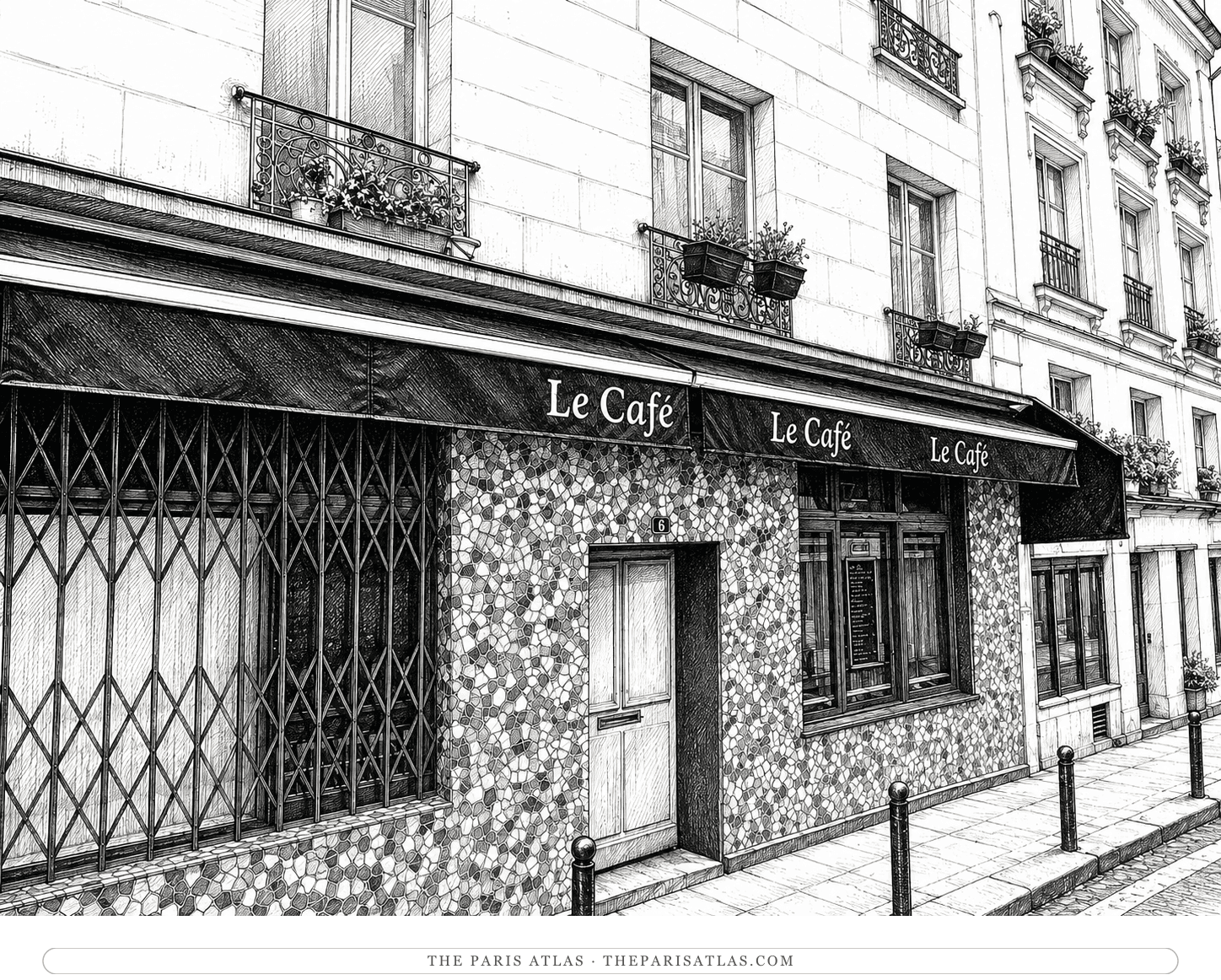
Number 6 today. A cafe holds the ground floor; the doorway beside it leads to the flats above.Editorial illustration
The mosaic tiling and the balconies above are the parts of the front Orwell would still recognise.Editorial illustration
The Hotel des Bons Amis as it would have looked when Eric Blair lodged here. Reconstructed for the Atlas; no photograph of the front is known.Artistic reconstruction
Gilt lettering, lace half-curtains and a room lit at the back. The building stands; the hotel does not.Artistic reconstruction

Timeline

  1. June 1928

    Orwell arrives in France and stays with his aunt Nellie Limouzin before finding a room in the Latin Quarter.

  2. 1928

    Moves into the Hotel des Bons Amis at 6 rue du Pot de Fer, a few weeks after arriving.

  3. October 1928

    "La Censure en Angleterre" appears in Henri Barbusse's journal Monde - his first professional journalism.

  4. 1929

    His money runs out. After hunger and unsuccessful job hunting he works as a plongeur in Paris kitchens.

  5. 22 September 1929

    Writes to the editor Max Plowman from this address, chasing a submitted article.

  6. January 1933

    Down and Out in Paris and London is published, the first book under the name George Orwell.

  7. June 2026

    The Paris City Council approves a commemorative plaque for the address.

On the map

Related books

Cover of Down and Out in Paris and London by George Orwell

Setting of the story

Down and Out in Paris and London

George Orwell · 1933

The lodging house of the Paris chapters is the Hôtel des Bons Amis at 6 rue du Pot de Fer, where Orwell lived from 1928 to 1929. He renames the street the rue du Coq d'Or and the hotel the Hôtel des Trois Moineaux, and the book opens on it.

Writers who knew this place

Illustrated portrait of George Orwell

George Orwell

British · English novelist, essayist and journalist, born Eric Arthur Blair, who wrote Animal Farm and Nineteen Eighty-Four. He was an imperial policeman in Burma, a plongeur in Paris kitchens off the rue Mouffetard, and a militiaman shot through the neck in Spain before any of it.

Lived here

Orwell lodged at the Hôtel des Bons Amis for most of his eighteen months in Paris, from a few weeks after arriving in June 1928. A letter he sent to the editor Max Plowman on 22 September 1929 carries the return address 6 Rue du Pot de Fer, Paris 5. He disguised the street as the rue du Coq d'Or and the hotel as the Hôtel des Trois Moineaux in Down and Out in Paris and London.

Bernard Crick, George Orwell: A Life (1980); Darcy Moore, Orwell in Paris

Within walking distance

The Friday Letter

Paris, one address at a time.

The cafés, studios, and walk-up flats where the work was made — one story from the map in every letter.

One email a week. No spam, no selling your address. Unsubscribe anytime.