
The Paris AtlasCharting the artists, works, and places worth returning to.

School · Latin Quarter (Val-de-Grâce, behind the Panthéon) · 5e arrondissement

École normale supérieure

The buildingStill standing
Getting inOutside only
What's there nowStill the same

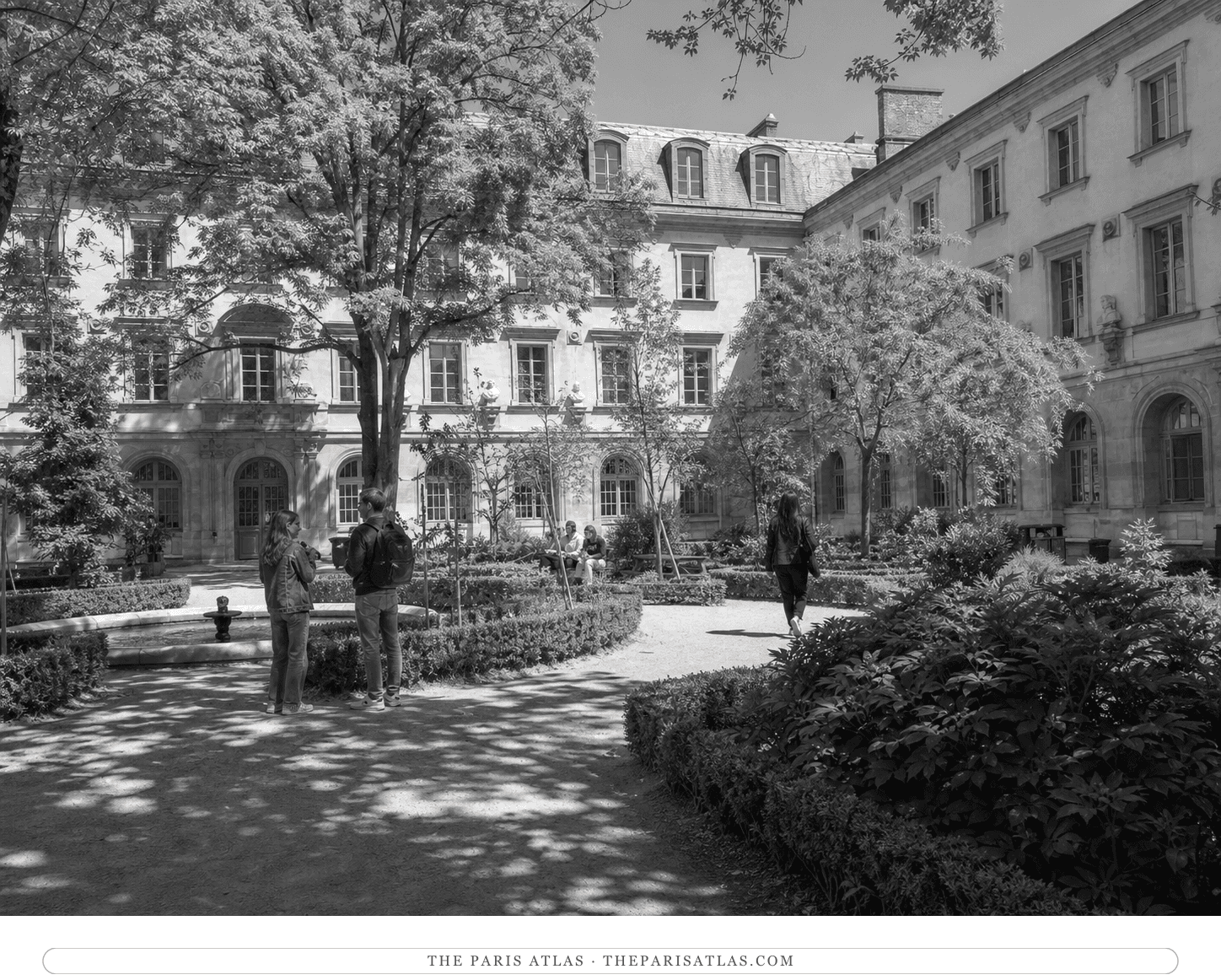
A working grande école, not a visitor site. The courtyard is sometimes accessible; the buildings are not. Exterior only in practice.

The grande école on the rue d'Ulm, behind the Panthéon — France's most selective humanities institution, and the building where Jean-Paul Sartre studied for the agrégation and Samuel Beckett arrived from Dublin in 1928 as a young English lecturer.

Address
45 rue d'Ulm, 75005 Paris
Years
Sartre a student in the 1920s; Beckett lecteur d'anglais from 1928

The place, briefly

The École normale supérieure sits at 45 rue d'Ulm, behind the Panthéon. It is not a university in the ordinary sense: it takes a very small number of students by competitive examination, pays them, and has produced a disproportionate share of France's philosophers, scientists and public intellectuals for two centuries.

Jean-Paul Sartre was a student here in the 1920s, and it is where he prepared for the agrégation in philosophy — which he failed at the first attempt and then took again in 1929, placing first. The candidate who placed second was Simone de Beauvoir, who was not at the ENS: it did not admit women to the same track. That asymmetry is worth stating rather than smoothing, because it is the shape of the world The Second Sex was written about.

Samuel Beckett arrived from Trinity College Dublin in 1928 as lecteur d'anglais — an exchange post teaching English. He was twenty-two, and the two years he spent on the rue d'Ulm are the ones that made him a Paris writer rather than an Irish one: it was here that he fell in with the circle around James Joyce.

There is a violent footnote to Beckett's Paris that belongs on this page because of what came of it. He was stabbed in the street, nearly fatally, by a man who accosted him at random. Joyce arranged and paid for a private hospital room during his recovery, and the incident renewed a friendship that had cooled. The Dublin Evening Herald ran it as "Irishman stabbed in Paris".

The school is a working institution and not a visitor attraction. What you can do is stand on the rue d'Ulm and note that two of the twentieth century's least similar writers passed through the same door within a few years of each other.

Key facts

What it is
France's most selective humanities grande école, founded in the Revolution's aftermath
Where
45 rue d'Ulm, behind the Panthéon, in the 5th
Sartre
A student here in the 1920s; failed the agrégation once, then placed first in 1929
Beauvoir
Placed second that year — but was not at the ENS, which did not admit women to the same track
Beckett
Arrived from Trinity College Dublin in 1928 as lecteur d'anglais, aged twenty-two
What it led to
Beckett's entry into the circle around James Joyce
Access
A working school — exterior only in practice

Timeline

  1. 1920s

    Sartre studies at the ENS and prepares for the agrégation in philosophy.

  2. 1928

    Beckett arrives from Trinity College Dublin as lecteur d'anglais, and falls in with the Joyce circle.

  3. 1929

    Sartre places first in the agrégation; Beauvoir, who was not at the ENS, places second.

On the map

Questions before you go

What is the École normale supérieure?

A grande école at 45 rue d'Ulm in the 5th arrondissement — France's most selective humanities institution. It admits a very small number of students by competitive examination and has produced a disproportionate share of the country's philosophers and public intellectuals.

Did Sartre go to the ENS?

Yes, in the 1920s, and it is where he prepared for the agrégation in philosophy. He failed it at the first attempt, sat it again in 1929, and placed first. Simone de Beauvoir placed second that year — but she was not at the ENS, which did not admit women to the same track.

What was Beckett doing there?

Teaching. He came from Trinity College Dublin in 1928 as lecteur d'anglais, an exchange post, aged twenty-two. The two years turned him into a Paris writer: it was on the rue d'Ulm that he fell in with the circle around James Joyce.

Can you visit the ENS?

Not really — it is a working school rather than a visitor site. The courtyard is sometimes accessible but the buildings are not. It is worth walking past on a Latin Quarter route, between the Panthéon and the Jardin du Luxembourg.

Writers who knew this place

Samuel Beckett

Irish · The Dublin-born writer who settled in Paris in 1937, was stabbed in the street by a stranger a few months later, translated and typed intelligence reports for a Resistance cell during the German occupation of the city, and then did the strangest thing of all — began writing in French, a language not his own, and produced Waiting for Godot, which opened at a small Left Bank theatre in January 1953 and changed what a play could be.

Worked here · 1928

Beckett arrived from Trinity College Dublin in 1928 as lecteur d'anglais, an exchange post teaching English, aged twenty-two. The two years on the rue d'Ulm are where he fell in with the circle around James Joyce and became a Paris writer.


Sam Slote, Samuel Beckett — Trinity Writers; Dans les pas de Simone de Beauvoir, rive gauche

Illustrated portrait of Jean-Paul Sartre

Jean-Paul Sartre

French · French philosopher, novelist and playwright, co-founder of Les Temps modernes, life partner of Simone de Beauvoir, and the central figure of French existentialism whose 1952 dispute with Albert Camus over The Rebel ended their friendship.

Studied here

Sartre studied at the École normale supérieure in the 1920s and prepared for the agrégation in philosophy there — failing at the first attempt, then placing first in 1929.

Sam Slote, Samuel Beckett — Trinity Writers; Dans les pas de Simone de Beauvoir, rive gauche

Within walking distance

The Friday Letter

Paris, one address at a time.

The cafés, studios, and walk-up flats where the work was made — one story from the map in every letter.

One email a week. No spam, no selling your address. Unsubscribe anytime.