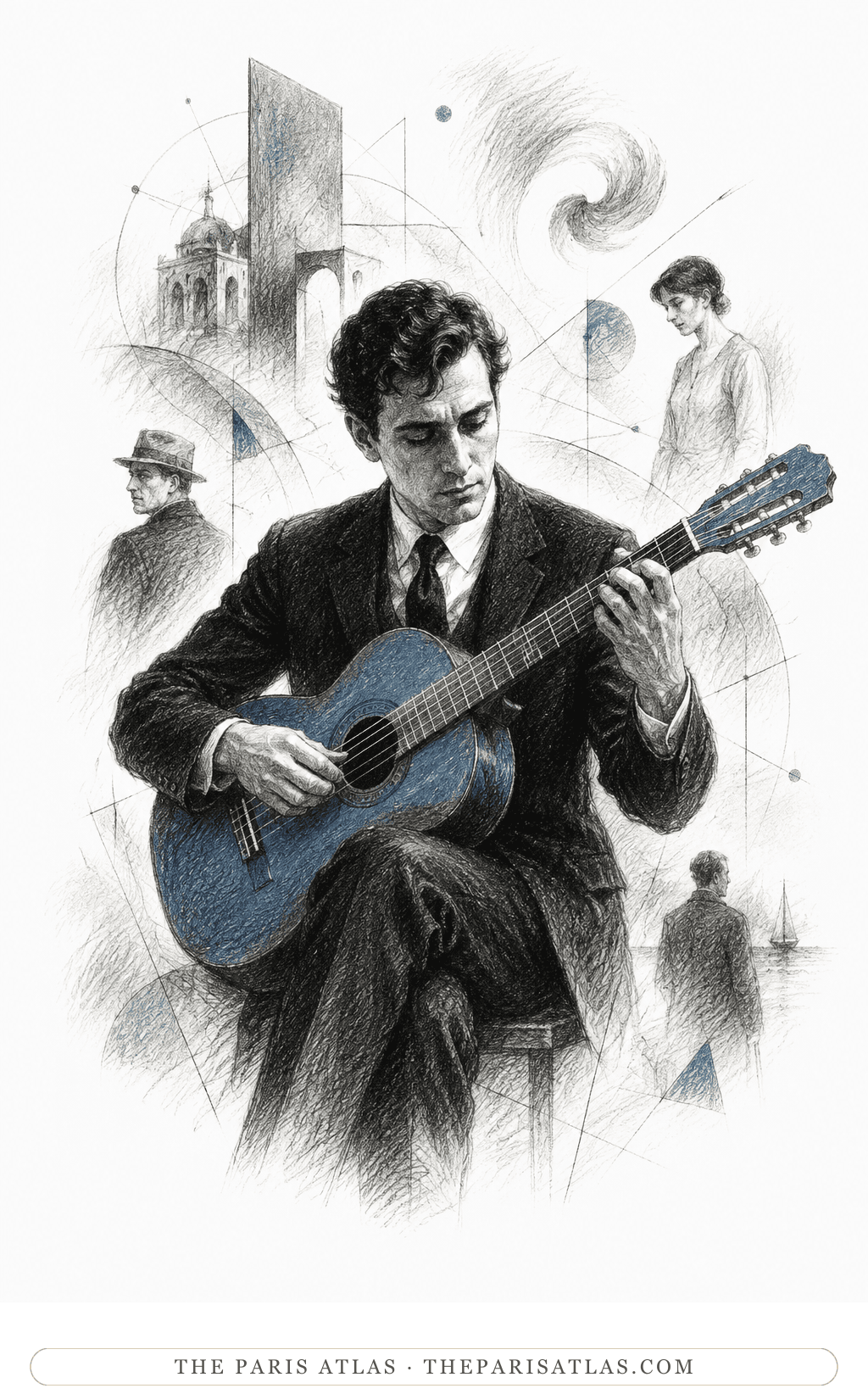
Responds to · 1976–1977
The Man with the Blue Guitar
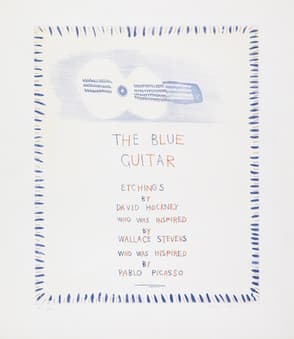
The portfolio's own title page states the lineage — etchings by David Hockney, who was inspired by Wallace Stevens, who was inspired by Pablo Picasso.
by David Hockney
Hockney's answer to Stevens answering Picasso — twenty etchings whose title page spells out the lineage: by David Hockney, who was inspired by Wallace Stevens, who was inspired by Pablo Picasso.
Hockney read The Man with the Blue Guitar in 1976 and spent the next year answering it in etching. Not illustration, by his own account. He took up the poem's theme, the transformations the imagination works on what it sees, and let the plates move between Picasso quotation, Stevens paraphrase, and his own vocabulary. The portfolio's full title spells out the genealogy: etchings by David Hockney, who was inspired by Wallace Stevens, who was inspired by Pablo Picasso.
Painting to poem to print, 1903 to 1937 to 1977. Each work answers the one before and remains entirely its own, which is the whole argument for a graph that lets influence travel across media. The blind musician from Barcelona kept generating art for three-quarters of a century.
Close reading
The page reproduces the portfolio's title sheet rather than Hockney's protected individual etchings. Its details show how words, the blue instrument, and a deliberately spare design announce the chain from Picasso to Stevens to Hockney.
1.The blue guitar is both object and quotation
The instrument condenses two earlier works into one sign: Picasso's painted musician and Stevens's poetic guitar. Hockney can invoke both without reproducing either literally.
2.The title states influence as a three-part sentence
The printed genealogy makes interpretation part of the object: Hockney inspired by Stevens, Stevens inspired by Picasso. Influence is declared as transmission across print, poem, and painting.
3.Empty paper gives the title room to perform
The sheet avoids illustrative scenery or a borrowed Picasso composition. Its restraint distinguishes the portfolio's premise from conventional book illustration and leaves transformation—not resemblance—as the announced method.
4.Blue handwriting turns a color into a voice
The word is not a neutral caption set outside the picture. Its drawn form and color make language part of the image, so reading and looking happen at the same time.
5.Picasso's name states the artistic conversation openly
Hockney does not hide the source of his dialogue behind resemblance alone. Naming Picasso makes influence a declared subject rather than a puzzle the viewer must solve before entering the work.
6.Broken outlines keep the guitar from becoming a fixed object
Edges stop, restart, and overlap with nearby marks. The instrument remains recognizable, but its unstable outline makes it behave like an image remembered or reworked rather than an object carefully copied.
1976–77
Hockney made the twenty etchings, working from Wallace Stevens's poem The Man with the Blue Guitar — itself long linked to Picasso.
1977
Published by Petersburg Press; the title page names the lineage — David Hockney, inspired by Wallace Stevens, inspired by Pablo Picasso.
A viewing location has not yet been listed for this work.
A portfolio of twenty etchings Hockney made in 1976–77, in response to Wallace Stevens's poem The Man with the Blue Guitar.
Its title page spells out the whole chain: by David Hockney, who was inspired by Wallace Stevens, who was inspired by Pablo Picasso.
Twenty etchings.
As etchings, several in colour, published by Petersburg Press in 1977.
Playful variations on guitars, still lifes and figures in Hockney's bright graphic style — riffing on Stevens's imagery rather than illustrating the poem line by line.
Responds to · 1976–1977
The portfolio's own title page states the lineage — etchings by David Hockney, who was inspired by Wallace Stevens, who was inspired by Pablo Picasso.
The sources below include collection records, catalogues, scholarly research, and primary materials that informed this page. They document The Blue Guitar, its making, and its place in cultural history.


Web source consulted for documented facts and historical context presented on the The Blue Guitar page.
Used to place The Blue Guitar within David Hockney's documented oeuvre and verify its period, medium, or institutional context.
Used to cross-check artist chronology and the work's relationship to David Hockney's wider practice.
Used for an additional museum or scholarly perspective on The Blue Guitar's history and interpretation.
These references provide the documented foundation for this work's history and interpretation. Claim-level citations remain attached to the specific claims they support.
 Explore more resources