The Paris AtlasCharting the artists, works, and places worth returning to.
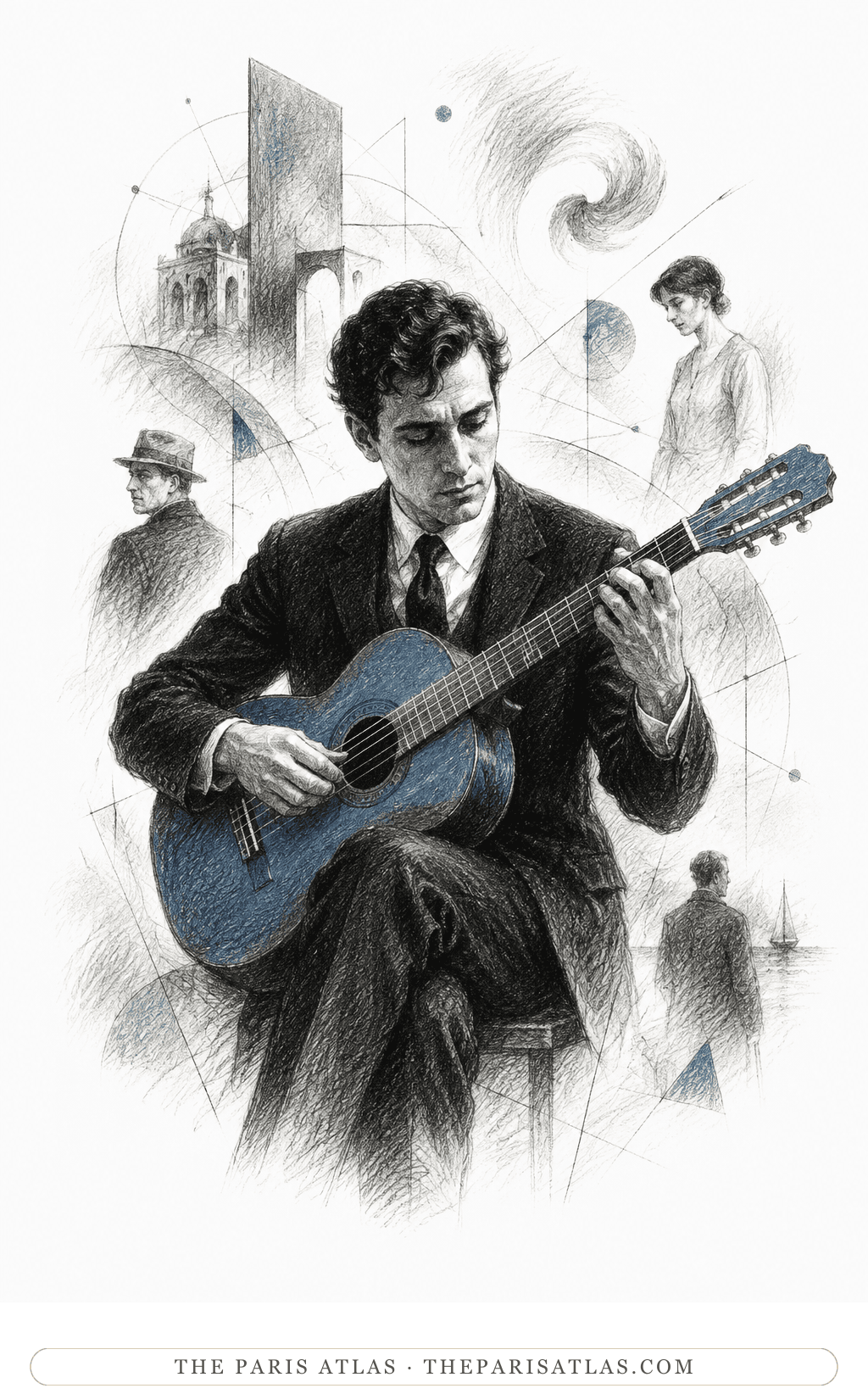
House illustration for The Man with the Blue Guitar: a suited man bent over a blue guitar in pen-and-ink, ringed by faint geometric lines, a domed city, a spiral, and half-drawn onlookers

Editorial illustration

Poem

The Man with the Blue Guitar

by Wallace Stevens

Stevens's long argument with a guitarist who will not play things as they are — the poem that carried Picasso's blue musician into American verse, whether or not Stevens meant any single painting.

Created
1937
Form
Poem in thirty-three cantos

Things as they are, changed upon the blue guitar

Across thirty-three short cantos, a crowd demands that a guitarist play things as they are, and the guitarist answers that things as they are, are changed when played. That exchange is the whole engine of the poem. Stevens turns it over and over, a figure practicing scales, and out of the repetition builds his most sustained case for the imagination: art does not copy the world, it remakes it, and the remaking is not a betrayal.

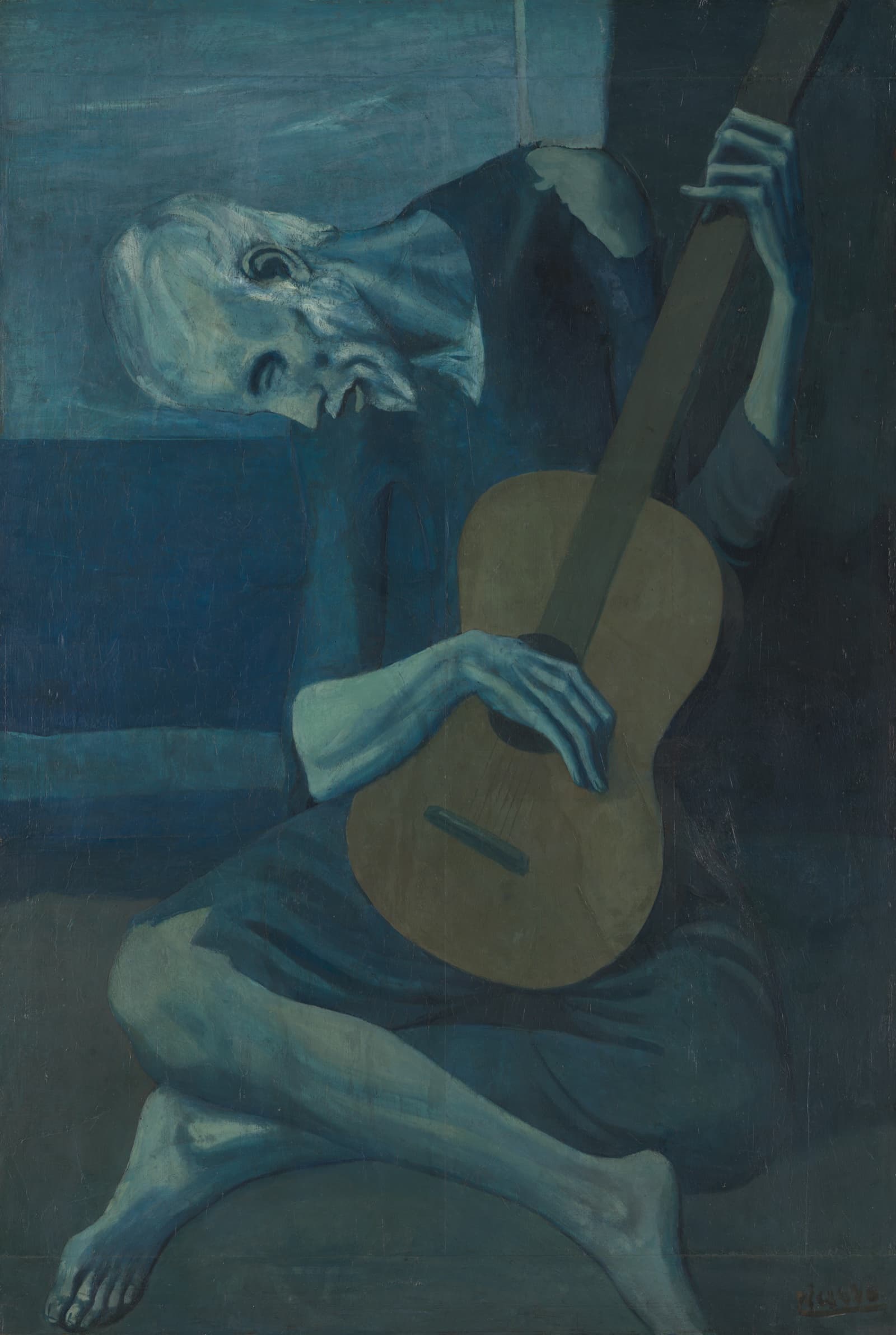
Readers have set the poem beside Picasso's Old Guitarist since 1937. Stevens resisted, insisting that no single painting stood behind it, and later discouraged pairing the book with a Picasso reproduction. We record the connection the way the scholarship holds it: probable, productive, contested at the edges.

What no one contests is the chain it started. Forty years on, David Hockney etched his answer to both.

Timeline

  1. 1937

    Wallace Stevens published the poem — thirty-three short cantos — in the collection The Man with the Blue Guitar (Alfred A. Knopf).

  2. 1976–77

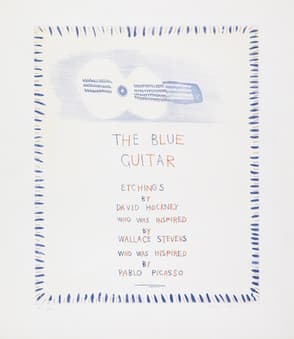
    David Hockney made his etching portfolio The Blue Guitar in response to the poem, naming the Picasso–Stevens chain on its title page.

Frequently asked questions

Who wrote The Man with the Blue Guitar?

The American poet Wallace Stevens, who published it in 1937.

What is the poem about?

A guitarist whose blue guitar changes “things as they are” — a long argument, in thirty-three short cantos, about whether art should reproduce reality or transform it.

Is it about Picasso's painting?

Readers connect it to Picasso's blue-period Old Guitarist, but Stevens denied that any single Picasso lay behind it. The colour, the guitar and the theme keep the two works in conversation anyway.

How is it structured?

As thirty-three numbered cantos, most in short rhyming couplets, circling the same argument rather than telling a story.

How is it connected to David Hockney?

Hockney's 1976–77 etching portfolio The Blue Guitar was made in response to the poem; its title page spells out the lineage from Picasso to Stevens to Hockney.

In the atlas

What the graph records about this work — every claim carries its citation.

Responds to · 1937

The Old Guitarist

Read alongside the painting since publication — the bent blue guitarist, the color, the title — but Stevens resisted naming any single Picasso as the source and later discouraged pairing the book with a Picasso reproduction. Probable, productive, contested at the edges.

Wallace Stevens — Poetry Foundation, poet page

Answered by · 1976–1977

The Blue Guitar

The portfolio's own title page states the lineage — etchings by David Hockney, who was inspired by Wallace Stevens, who was inspired by Pablo Picasso.

The Museum of Modern Art — collection records, object 437.1977 (portfolio plates)

