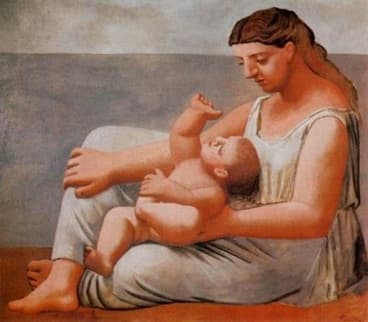
Associated with · 1921
Return to Order
A colossal antique-style head in pastel from Picasso's classical summer of 1921, the same campaign as Mother and Child and Three Women at the Spring.
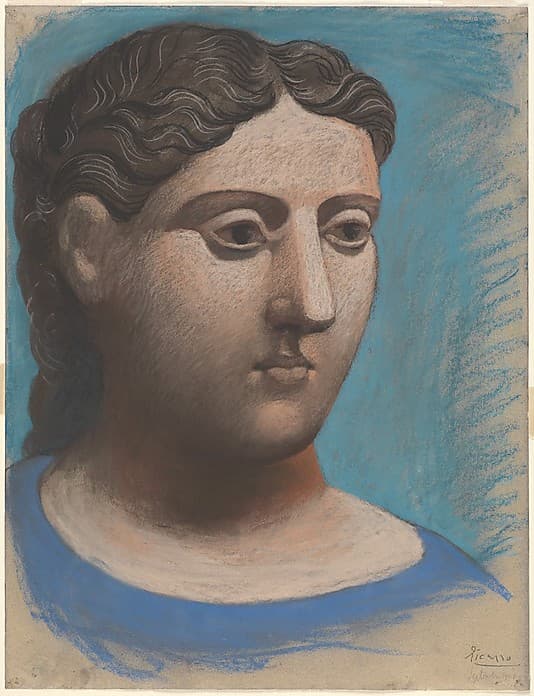
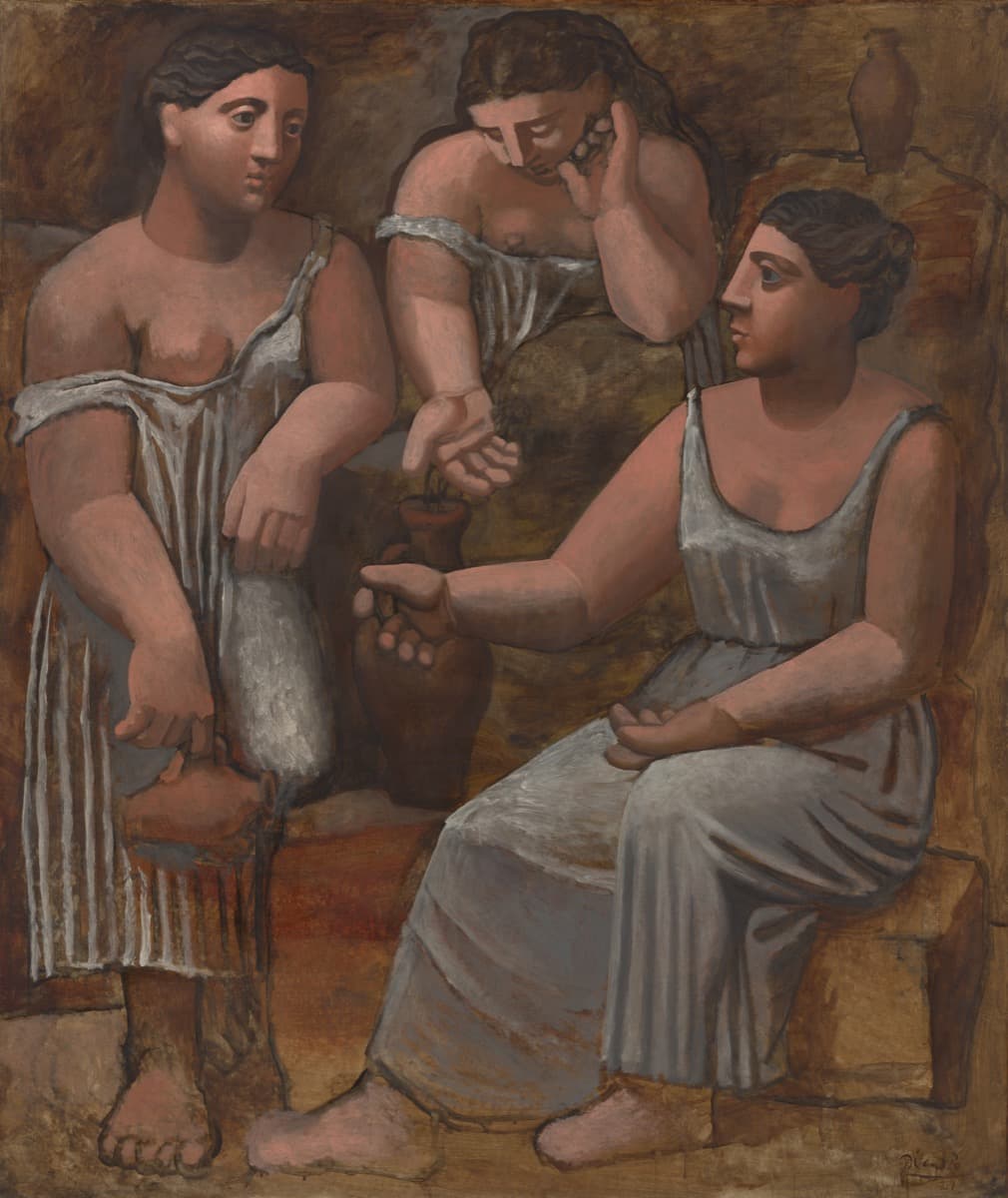
A monumental pastel study for Picasso's Three Women at the Spring, shaped by the features of Olga Khokhlova and by ancient Roman wall painting he studied in Italy. Its fragile medium is worked to suggest the mass and stillness of sculpture.
A woman's head and shoulders fill the sheet against a flat turquoise ground. Dark hair is parted in the center and waved back over the ears. Heavy lids, a long straight nose, and a small mouth are modeled in warm flesh tones and deep shadow. A blue-edged garment closes the composition at the bottom.[1]
The image is made with pastel, a dry and fragile medium, but the head carries the apparent weight of carved or frescoed form. Picasso used dense modeling and large scale to make a work on paper feel physically monumental.[1]
The Metropolitan Museum identifies the pastel as a study for Three Women at the Spring. The head tests the scale, lighting, and classical stillness that Picasso developed across the figures in the larger composition.[1]
Read as a study, it is complete without being independent of that project. The isolated head lets the viewer see how Picasso established volume and expression before placing a figure within the group.
The Met connects the woman's features to Olga Khokhlova, Picasso's wife, a dancer he met while working with the Ballets Russes. The sheet is not titled as a portrait of Olga, and the face has been generalized toward an antique type, but her features supplied a living point of departure.[1]
That distinction matters. Picasso's classical women can appear anonymous or timeless, yet they were made within a specific family and theatrical network. The transformation of Olga's features into a monumental study shows how personal observation and art-historical type could occupy the same image.
Picasso traveled to Rome and Naples in 1917 while working on Parade for Serge Diaghilev's Ballets Russes. The Met traces the scale and technique of this pastel to ancient wall paintings he saw on that trip.[1][2]
The influence is visible in the broad modeling, frontal calm, and relation between solid figure and flat colored ground. Picasso did not imitate one ancient image. He adapted the authority of Roman fresco and sculpture to a modern work on paper.
The drawing belongs to the postwar tendency often called the Return to Order, when many European artists turned toward classical bodies, clear contour, and historical precedent after the experiments and destruction of the 1910s. For Picasso, that turn did not cancel Cubism.[2]
In 1921 he continued making Synthetic Cubist works while producing monumental classical figures. The two approaches could coexist because he treated styles as available languages rather than as stages that had to replace one another.[3][2]
Pastel readily produces soft transitions and luminous color, but it also remains powder on the surface of paper. Picasso exploited that softness for skin while using dark contours and dense shadow to make the face appear solid.[1]
The mismatch is central to the work. A medium associated with touch and immediacy is made to suggest durable mass, while the turquoise ground continues to assert the flat sheet.
Head of a Woman shows that Picasso's classicism was an active process of translation rather than a retreat into academic copying. Olga's features, Roman wall painting, the needs of a larger composition, and the physical behavior of pastel all shaped the result.
It also makes a study worthy of sustained attention. The sheet reveals how the monumentality of Three Women at the Spring was constructed one head at a time.
The sheet came to the Metropolitan Museum of Art through Scofield Thayer, the American editor who ran the modernist magazine The Dial in the 1920s and used it to put European avant-garde art in front of American readers. Thayer assembled a substantial collection in those years and left it to the Met, which received it as the Bequest of Scofield Thayer in 1982. The drawing is object 1984.433.270.[1]
Close reading
The painting turns a head into a compact structure of planes. Its details show Picasso balancing severe simplification with small asymmetries that keep the face alert and human.
1.The eyes do not share one viewpoint
Each eye sits in its own tilted plane and seems to address a slightly different direction. The mismatch activates the face: frontal stability is interrupted by the memory of Cubist multiple viewpoints.
2.A few hard edges carry the likeness
The nose is a ridge, the mouth a compressed interval, the cheek a sloping field. Picasso removes descriptive softness and lets changes in direction do the work usually assigned to modeling.
3.The outer contour behaves like a cut edge
The head is sharply separated from the ground, almost like a carved or pasted form. That emphatic boundary gives the simplified face a sculptural weight greater than its small number of internal marks.
4.Fine lines follow the waves of the hair
Fine pale lines follow the dark hair in repeated waves. They change direction around each rounded lock rather than filling the hair with an even texture. This small-scale drawing contrasts with the broad, much smoother areas of the forehead and cheek below.
5.A curved blue band supports the neck
A broad blue band follows the base of the neck, with a thin dark boundary above it. The light chest forms a shallow curve inside that band. These nested curves widen the lower part of the portrait and give the upright head a clear supporting shape.
6.Blue strokes thin out near the paper edge
At the right edge, blue strokes become sparse enough for the pale support to show between them. Their diagonal ends remain visible beside the more solid blue near the face. The transition makes the background's application apparent instead of presenting an evenly filled field.
1921
Picasso made the monumental pastel as a study for Three Women at the Spring, drawing on Olga Khokhlova's features and ancient wall painting.
1982
Bequeathed to the Metropolitan Museum of Art by Scofield Thayer, the American editor who ran the modernist magazine The Dial in the 1920s.
The Metropolitan Museum of Art
1000 Fifth Avenue, New York, NY 10028, United States
Displays and loans can change. Check whether this work is on view before making a special trip.
Plan your visit on the museum’s official website (opens in a new tab)A pastel drawing by Picasso of a monumental, sculptural female head against a turquoise ground, made in his classical period. It is at the Metropolitan Museum of Art in New York.
Picasso used dense modeling, dark contours, and large scale so the head suggests carved or frescoed mass even though it is made from dry pastel on paper.
The Met identifies it as a study for Three Women at the Spring. It also belongs beside Mother and Child and other monumental classical works Picasso made in 1921 while continuing to work in Synthetic Cubism.
The Met says the features were inspired by Olga Khokhlova, Picasso's wife. The work is not titled as her portrait, and her face has been generalized toward a classical type.
After seeing ancient wall paintings in Rome and Naples in 1917, he adapted their monumental scale, broad modeling, frontal calm, and relation between solid figures and flat colored grounds.
It describes the postwar revival of classical figure, contour, and historical precedent. Picasso participated without abandoning Cubism, using both classical and Synthetic Cubist languages during the same period.
The American editor of the modernist magazine The Dial in the 1920s, which introduced European avant-garde art to American readers. He collected widely and bequeathed his collection, including this drawing, to the Metropolitan Museum of Art. It arrived in 1982.
Pastel on paper, 65.1 by 50.2 centimetres — roughly two feet tall.
The Metropolitan Museum of Art, New York, object 1984.433.270, the Bequest of Scofield Thayer.
Associated with · 1921
A colossal antique-style head in pastel from Picasso's classical summer of 1921, the same campaign as Mother and Child and Three Women at the Spring.
Explore painters from the same movements and circles.
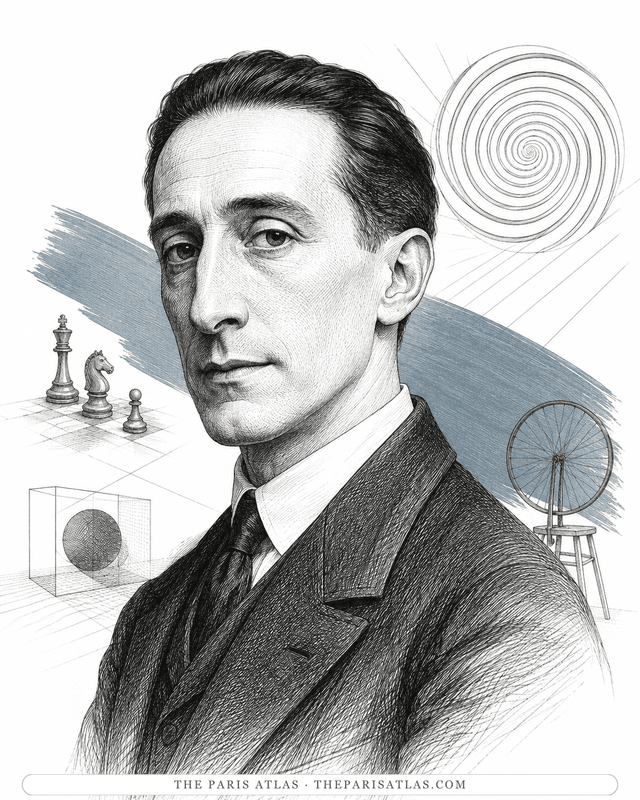
The century's quietest revolutionary — readymades, the abandonment of painting, chess on a Paris rooftop in Entr'acte, and one anemic film of spinning puns signed Rrose Sélavy.
View artist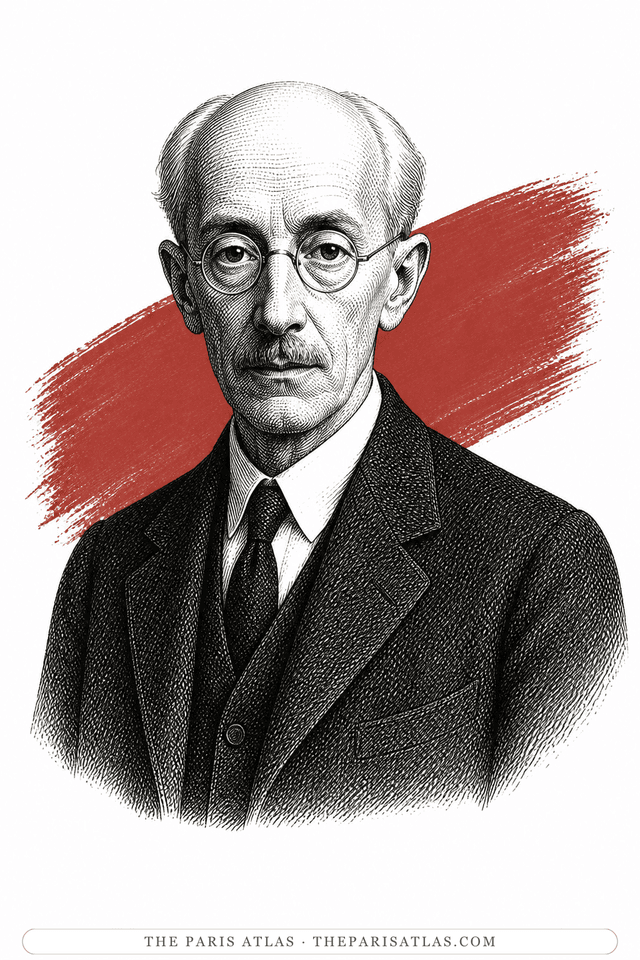
Dutch painter of the primary-colour grids, made mostly in a studio beside the Gare Montparnasse where he lived on and off from 1912 to 1938. He dropped an 'a' from Mondriaan on arriving in Paris, painted his studio walls in movable rectangles, and danced the Charleston.
View artist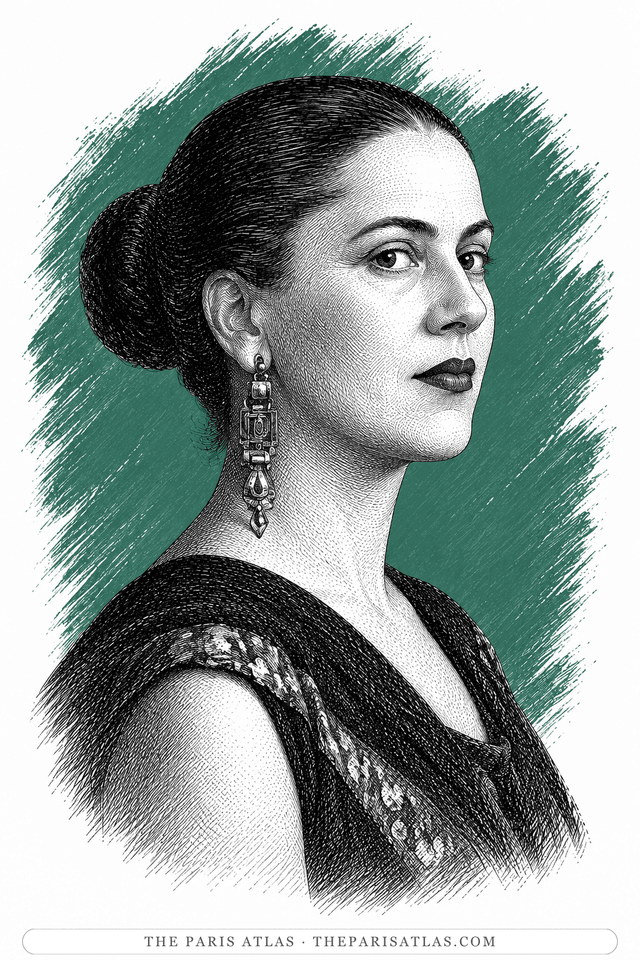
Brazilian painter who spent the 1920s moving between São Paulo and Paris, studied Cubism under André Lhote, Albert Gleizes and Fernand Léger, and used what she learned to paint Brazilian towns, railways, plants and bodies. Her 1928 painting Abaporu prompted the manifesto that gave the Anthropophagic movement its name.
View artistThe sources below include collection records, catalogues, scholarly research, and primary materials that informed this page. They document Head of a Woman, its making, and its place in cultural history.


Web source consulted for documented facts and historical context presented on the Head of a Woman page.
The Musée Picasso's collection and creative archive provide institutional context for Picasso's works on paper and painted studies.
These references provide the documented foundation for this work's history and interpretation. Claim-level citations remain attached to the specific claims they support.
 Explore more resources