
Depicts · 1909
Fernande Olivier
Picasso modelled the head from Fernande Olivier, his companion through the Bateau-Lavoir years. Her features stay legible under the Cubist faceting.
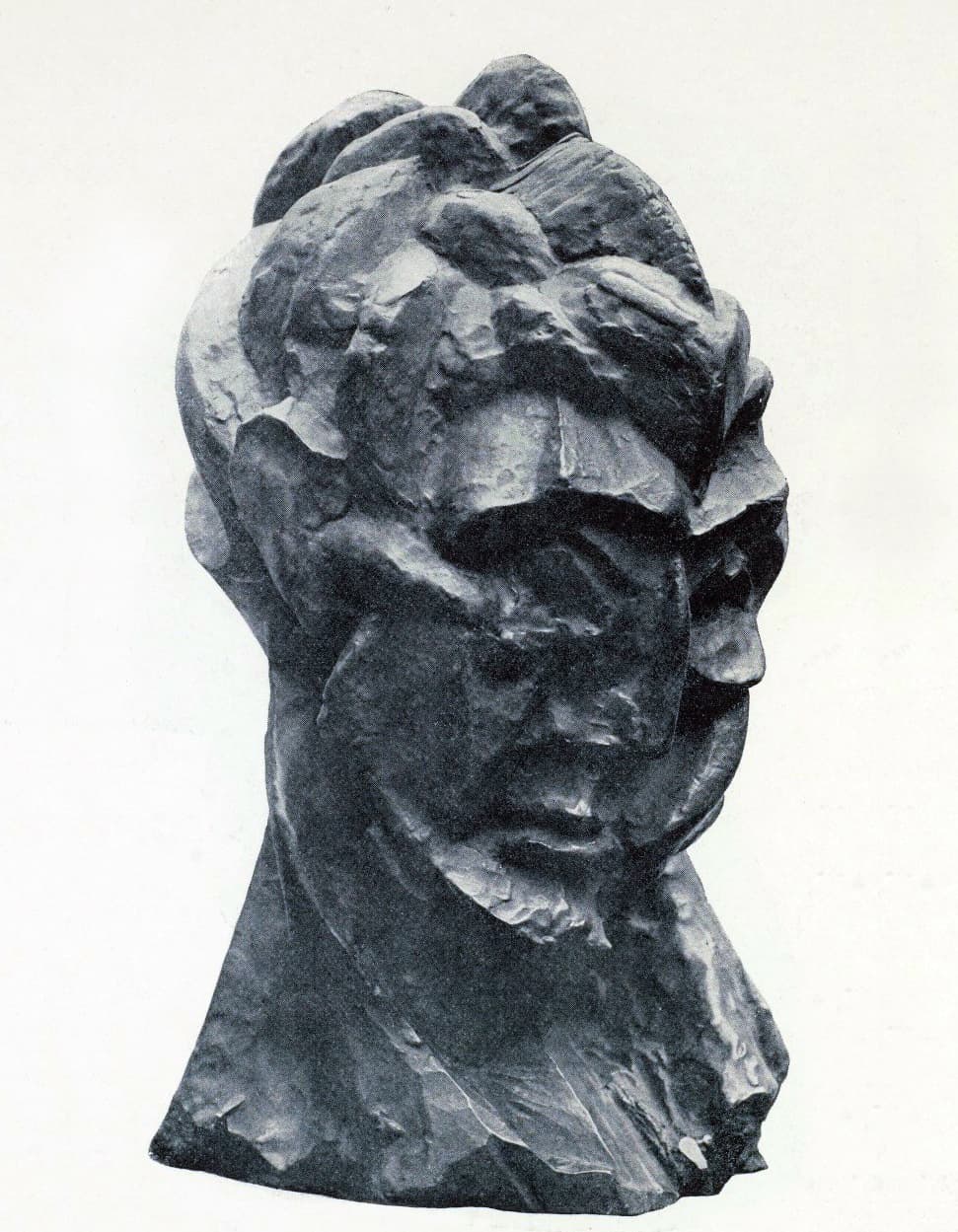
Picasso's 1909 portrait of Fernande Olivier, modeled in clay as interlocking ridges, hollows, and facets. Often identified as his first fully Cubist sculpture, it tests how several implied viewpoints can occupy one solid head.
A woman's head and neck rise to about forty centimetres, with the hair gathered into a high knot. Brow, cheeks, nose, and jaw have been built as projecting ridges and recessed hollows. Light breaks across these planes, making the face appear to shift as the viewer moves.[1][2]
Fernande Olivier remains recognizable through the mass of hair, strong nose, and tilt of the head, but the sculpture does not preserve one stable view. The facets suggest several positions within a single solid object.[3]
During the spring and summer of 1909 Picasso made a sustained group of paintings and drawings of Olivier, including works at Horta de Ebro in which her face and body hardened into angular planes. Soon after returning to Paris, he translated those experiments into a life-size clay bust.[1][3]
The sequence matters because the sculpture did not simply apply an existing Cubist formula to a new medium. Working in clay let Picasso build up and cut back physical mass, then see how actual light reorganized the planes he had been implying in paint.[1]
Picasso left finger marks and unsmoothed material in the original clay. When a plaster was cast from it, the clay was destroyed as part of the process. The Metropolitan Museum's study of the surviving plaster shows that Picasso continued revising the form at the foundry.[1]
While the plaster was still damp, he sharpened the brow and cut additional facets into the neck. The work therefore has no single untouched “original” surface: the clay was transformed through molding, and the plaster was edited before bronzes were cast.[1]
In an Analytic Cubist painting, adjacent planes can imply viewpoints that would be separated in ordinary vision. A sculpture already offers many views because the viewer can walk around it. Picasso's solution was not merely to make an angular head, but to multiply the directional pull of each feature.[4]
The brow projects, the cheeks recede, and the jaw turns at different rates. Those surfaces deny the smooth continuity expected of a modeled portrait. The object is often called Picasso's first Cubist sculpture because it makes the movement's problem of unstable viewpoint physically unavoidable.[3][4]
Fernande Olivier was Picasso's companion and a frequent model from 1905 to 1912, during his years at the Bateau-Lavoir in Montmartre. She is an identified participant in the development of his early work, not an anonymous type.[3]
Olivier later wrote memoirs of the period that remain important firsthand accounts of Picasso's circle before his international fame. The title keeps her identity attached to a sculpture whose formal history has often overshadowed the person represented.
In September 1910 the dealer Ambroise Vollard bought the clay so that an edition could be cast in bronze. The foundry process produced multiple objects at different dates rather than a single bronze made in 1909. Museum records therefore distinguish the date of the modeled clay, the plaster, and individual casts.[1][2]
That history changes how the sculpture traveled. The form could enter several collections and exhibitions, while each cast acquired its own provenance. The Art Institute's example is the one associated with Alfred Stieglitz.[2][5]
Alfred Stieglitz bought the Art Institute's cast directly from Vollard in 1912. The photographer and gallerist displayed and photographed modern European art for an American audience, making this particular bronze part of a larger program of advocacy.[2][5]
Stieglitz lent it to the 1913 International Exhibition of Modern Art, the Armory Show. The work received attention through that exhibition and through publication in Stieglitz's Camera Work. His collection came to the Art Institute in 1949.[2][5]
Head of a Woman (Fernande) matters because it made Cubism spatial without becoming a simple three-dimensional illustration of a painting. Its shifting planes depend on the viewer's movement and on real light, conditions unique to sculpture.
Its material history also anticipates later questions about versions and originals. Clay, revised plaster, bronze editions, photographs, and exhibition histories all carried the work. The sculpture's importance resides in that chain as well as in the head's faceted surface.
Close reading
The sculpture makes the Cubist problem literal: how can one head hold several views at once? Moving close reveals facets that behave as separate observations while remaining one continuous volume.
1.The brow and nose lock into an architectural ridge
Instead of modeling a soft transition, Picasso joins brow and nose as intersecting planes. Light catches their ridge differently from either cheek, making viewpoint something the surface physically contains.
2.Facets turn reflected light into drawing
Each plane receives a distinct band of light, so the bronze seems drawn by illumination. The sculpture changes as the viewer moves because its analysis of the head is built into the object, not painted onto it.
3.The broken silhouette still reads as a head
Edges step in and out rather than following an anatomical curve. Yet the total profile remains legible. Picasso tests how much continuity can be removed before recognition fails—and stops just short of that point.
4.Raised ridges break the crown into separate masses
Raised ridges gather across the crown, with deep dark grooves between them. Some projecting surfaces catch a pale highlight while adjacent hollows remain almost black. The top of the head therefore reads as a sequence of separate masses rather than one smoothly rounded cap.
5.A broad shadow turns the side of the head
A broad dark area runs down the side of the head, interrupted by smaller raised edges. Their narrow highlights distinguish one change of surface from the next. The shadow gives the head depth without requiring a continuous light outline around its side.
6.The neck broadens into an uneven base
Long diagonal planes spread outward from the neck toward the base. Pale highlights collect on their ridges, while the lower edge remains irregular. This broad support carries the head's weight visually and continues the broken surface treatment into the part beneath the face.
1909
Picasso modeled the faceted head of Fernande Olivier, working Cubism into three dimensions. It was later cast in bronze.
1912
Bought from the dealer Ambroise Vollard by Alfred Stieglitz, who carried it into his New York circle.
1913
Stieglitz lent his cast to the Armory Show, where the sculpture reached a broad American audience.
1949
Given to the Art Institute of Chicago with the Alfred Stieglitz Collection.
Art Institute of Chicago
111 South Michigan Avenue, Chicago, IL 60603, United States
Displays and loans can change. Check whether this work is on view before making a special trip.
Plan your visit on the museum’s official website (opens in a new tab)A 1909 bronze by Picasso, about forty centimetres tall, showing a woman's head with its features broken into faceted Cubist planes. It is often called the first Cubist sculpture, and is at the Art Institute of Chicago.
Fernande Olivier, Picasso's model and companion from 1905 to 1912 and the central figure of his Montmartre years at the Bateau-Lavoir. Her face is the one fragmented in the bronze. She later wrote two memoirs of that time.
Because it turns Cubism's unstable viewpoints and faceted planes into a physical object that changes under real light as viewers move around it. Museums commonly identify it as Picasso's first fully Cubist sculpture.
This cast was owned by Alfred Stieglitz, who lent it to the 1913 Armory Show — the exhibition that introduced European modern art to America. The show travelled to the Art Institute of Chicago, which now owns the bronze through the Stieglitz collection.
Yes. Picasso first modeled the work in clay, which was destroyed when a plaster was made. Vollard used the form for bronze casts at different dates. The Art Institute's example is the cast bought by Alfred Stieglitz.
It was destroyed during the process of making a plaster mold. Picasso then continued carving and sharpening the damp plaster, so the plaster records further changes beyond the clay stage.
Projecting and recessed planes catch light differently from each angle. Features that appear coherent from one position break into new ridges and shadows from another, making viewpoint part of the work.
The Art Institute of Chicago, object 1949.584, the Alfred Stieglitz Collection.
Depicts · 1909
Picasso modelled the head from Fernande Olivier, his companion through the Bateau-Lavoir years. Her features stay legible under the Cubist faceting.
Associated with · 1909
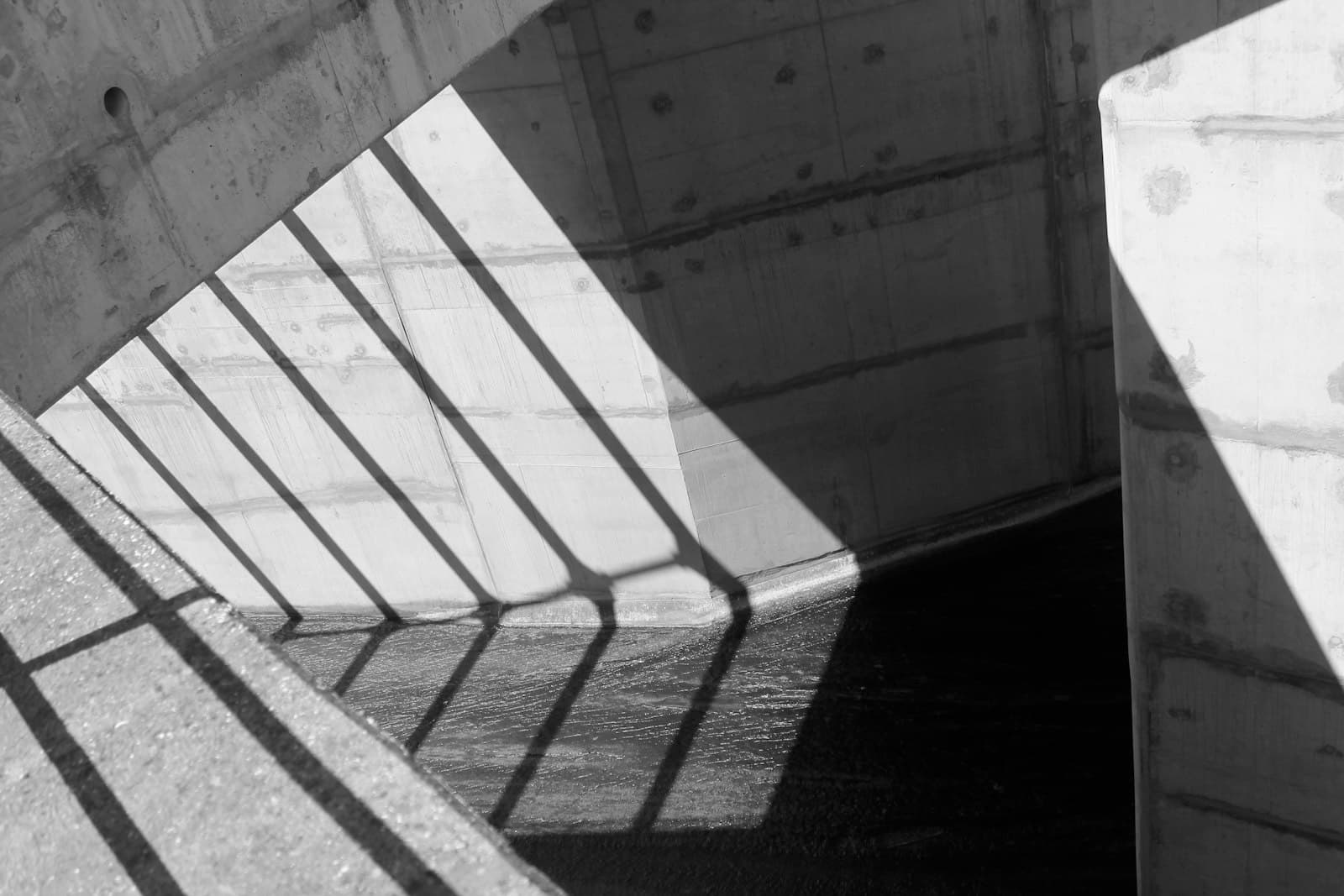
Modelled in 1909 at the height of Analytic Cubism and often called the first Cubist sculpture — the moment the movement's method left the canvas for three dimensions.
Explore sculptors from the same movements and circles.
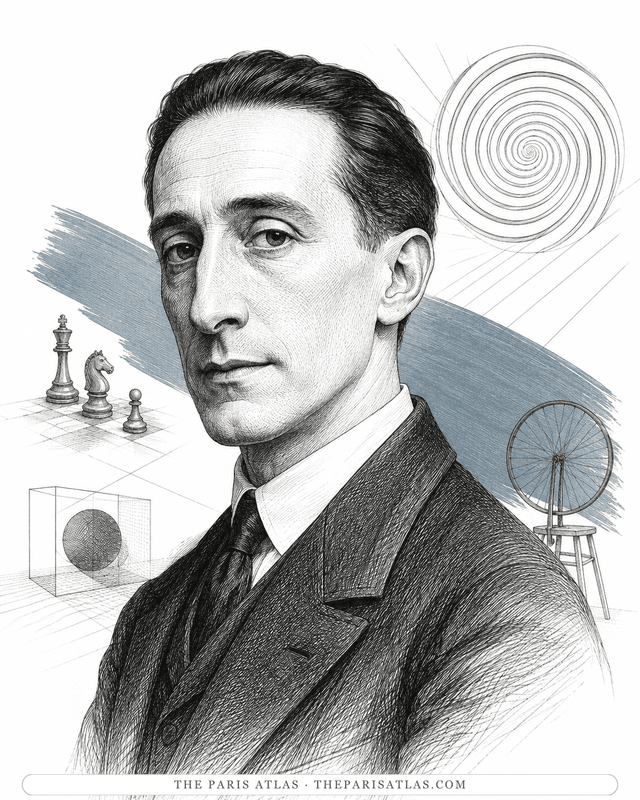
The century's quietest revolutionary — readymades, the abandonment of painting, chess on a Paris rooftop in Entr'acte, and one anemic film of spinning puns signed Rrose Sélavy.
View artist
French-American artist, lifelong friend of Yves Klein, and a founder of New Realism.
View artist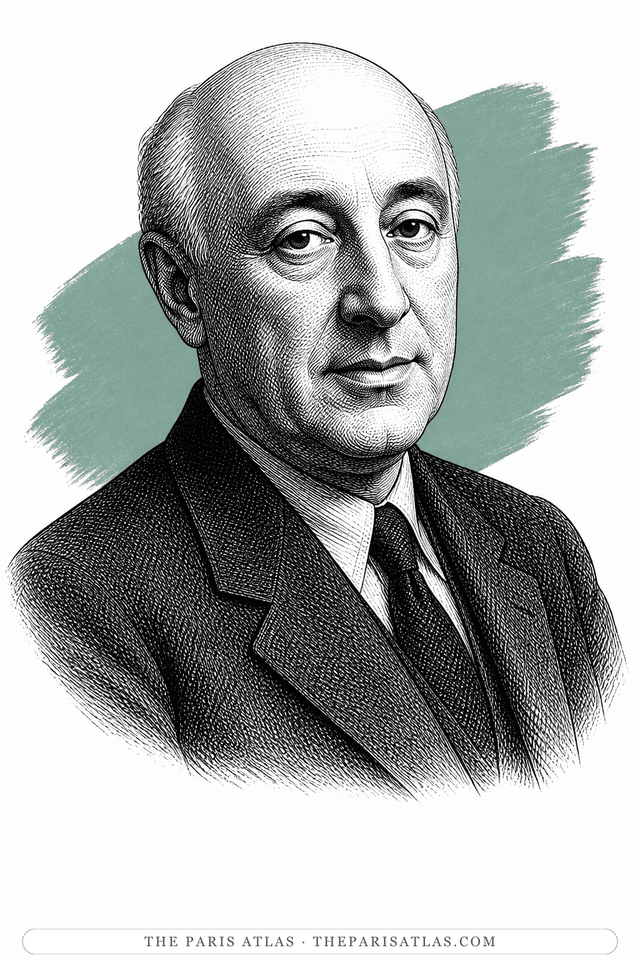
Strasbourg-born sculptor and poet — Hans in German, Jean in French, both all his life — who co-founded Dada at the Cabaret Voltaire in 1916, composed collages by dropping torn paper 'according to the laws of chance', and settled at Meudon outside Paris in a house his wife Sophie Taeuber-Arp designed.
View artistThe sources below include collection records, catalogues, scholarly research, and primary materials that informed this page. They document Head of a Woman (Fernande), its making, and its place in cultural history.

These references provide the documented foundation for this work's history and interpretation. Claim-level citations remain attached to the specific claims they support.
 Explore more resources