What the term means, and when the movement began
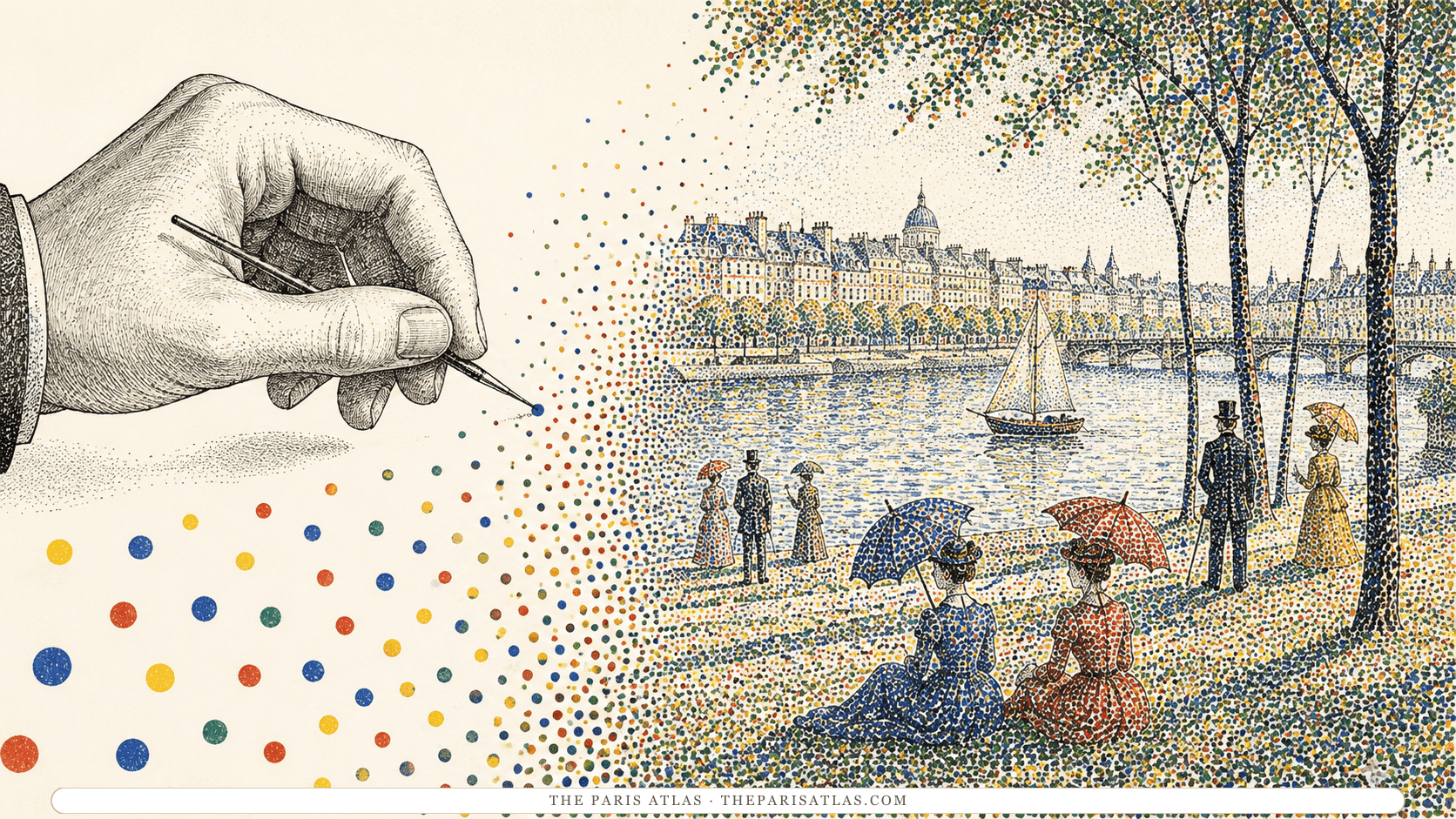
Post-Impressionism is usually associated with the period from the mid-1880s into the opening years of the twentieth century. The year 1886 is a useful starting point because it marked the eighth and final Impressionist group exhibition in Paris, where Seurat’s A Sunday on La Grande Jatte announced a conspicuously different approach to modern painting. It is not an exact boundary. Cézanne’s experiments had begun much earlier, and artists associated with Post-Impressionism continued developing their work well beyond the nineteenth century. The familiar dates are a framework for understanding overlapping developments, not the opening and closing dates of an organization. [4][5]
The British painter and critic Roger Fry established the label through the exhibition Manet and the Post-Impressionists, held in London in 1910. By grouping different artists in relation to Impressionism, he offered the British public a way of understanding work that challenged established expectations of finish, naturalistic color, and coherent pictorial space. The title also positioned Manet as a major predecessor rather than claiming that everyone represented belonged to an identical school. [3]
By Roger Fry’s 1910 exhibition, all four of the painters most commonly associated with Post-Impressionism were dead. Van Gogh died in 1890, Seurat in 1891, Gauguin in 1903, and Cézanne in 1906. None could respond to the category Fry made influential. Their grouping reflects how later critics understood the paintings, rather than a shared identity the artists chose for themselves. [6][7][8][9][10]
Paul Cézanne: the structure of seeing
Cézanne’s importance lies in his determination to make painting answer both to the world in front of him and to the organization of the canvas. Encouraged by Pissarro, he moved away from the heavy, dark handling of his early work toward a lighter palette and sustained study outdoors. Yet he did not simply adopt an Impressionist technique. In landscapes, portraits, still lifes, and bathers, he sought an arrangement of color that would make forms feel substantial without returning to a polished academic finish. [10]
Cézanne’s ambition is often summarized as remaking Poussin from nature. He sought to combine the ordered compositions of the seventeenth-century painter Nicolas Poussin with his own direct study of the world. The resulting pictures are neither straightforward transcriptions nor freely invented abstractions. Patches of color build into a cheek, a hillside, or an apple, while the brushwork remains visible as paint. The viewer is asked to recognize objects and, simultaneously, to notice the process by which they have been assembled. [4][10]
Cézanne repeatedly painted Mont Sainte-Victoire, near his native Aix-en-Provence, to explore relationships among color, depth, and form. In Mont Sainte-Victoire and the Viaduct of the Arc River Valley of 1882–85, a foreground tree interrupts the prospect of fields, railway arches, and the distant mountain. The tree does not simply obstruct a picturesque view: its branches help organize relationships between the nearer forms and the mountain’s slopes. A landscape he had known since childhood became a setting in which to test how observation could be transformed into a durable pictorial order. [15]
The unstable world of The Basket of Apples
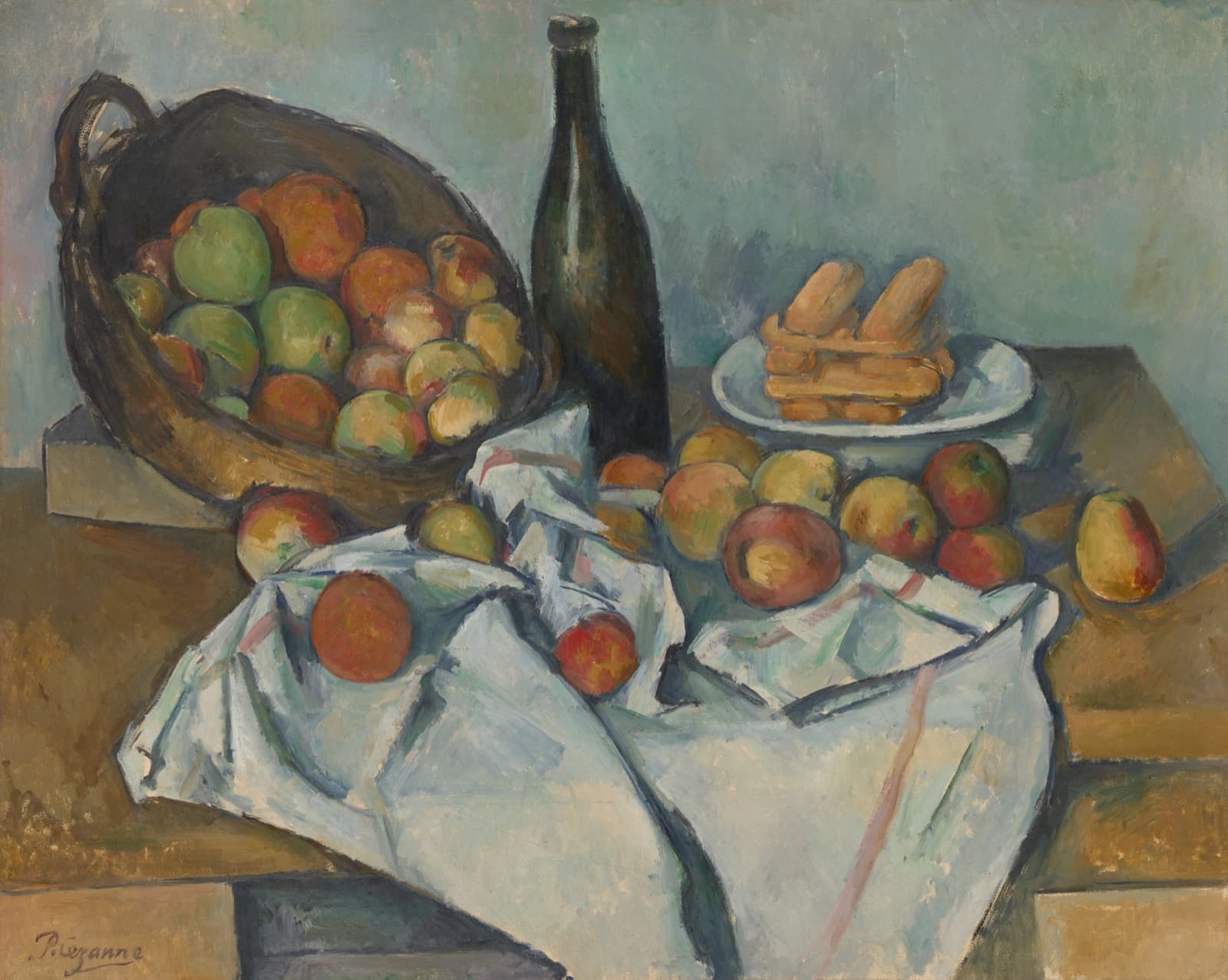
Cézanne’s The Basket of Apples, painted around 1893, turns a domestic arrangement into a problem of balance and perception. The bottle leans, the basket releases a tumbling group of apples, and the tabletop does not align consistently across the white cloth. On the right, stacked langues de chat biscuits seem to occupy their own small, precarious architecture. These discrepancies disturb the expectation that every object should fit comfortably into a single, geometrically consistent space. [11][12]
Cézanne holds The Basket of Apples together through the arrangement of its objects, despite their inconsistent perspectives. The cloth organizes the lower half, the bottle interrupts it vertically, and the fruit carries the eye between them. Cézanne’s achievement depends on these relationships, not simply on the novelty of introducing inconsistent viewpoints. [11][12]
In his figure paintings, Cézanne used the arrangement of bodies and objects to give quiet scenes a sense of weight and stability. In the Card Players series, the customary possibilities for anecdote—cheating, drinking, argument, a dramatic win—give way to the concentration of bodies and the measured arrangement of objects. The version in the Musée d’Orsay reduces the encounter to two absorbed men and a bottle between them. The players’ rounded backs and bent arms frame the upright bottle, giving this ordinary encounter a balanced, stable composition. [16]
What Cézanne meant by geometry
In a letter to Émile Bernard dated 15 April 1904, Cézanne advised treating nature through “the cylinder, the sphere, the cone.” The phrase later became famous as a precursor to Cubism, but the rest of the letter matters. He continued to discuss perspective, the placing of planes, and the blue tones needed to suggest air and depth. This was not a simple instruction to replace nature with geometric diagrams. It was advice about making observed relationships coherent in paint. [17]
In his letter of 15 April 1904, Cézanne urged Émile Bernard to turn away from Gauguin and Van Gogh. The artists whom later histories place beside one another were not necessarily allies in their understanding of painting. Cézanne’s example became enormously productive for Picasso, Braque, and many later painters, but its influence arose through reinterpretation, not through his having drawn up a program for them. [17][18]
Vincent van Gogh: color and brushwork as an expressive language
Van Gogh’s mature style developed with extraordinary speed, but it was not the product of isolation from other art. When he arrived in Paris in 1886, his earlier Dutch paintings had generally favored dark earth colors and weighty treatments of rural life. Exposure to Impressionist painting, divided color, and Japanese prints changed his palette and his handling. He tried out different kinds of marks and contrasts before arriving at the more forceful language associated with his later work. [27]
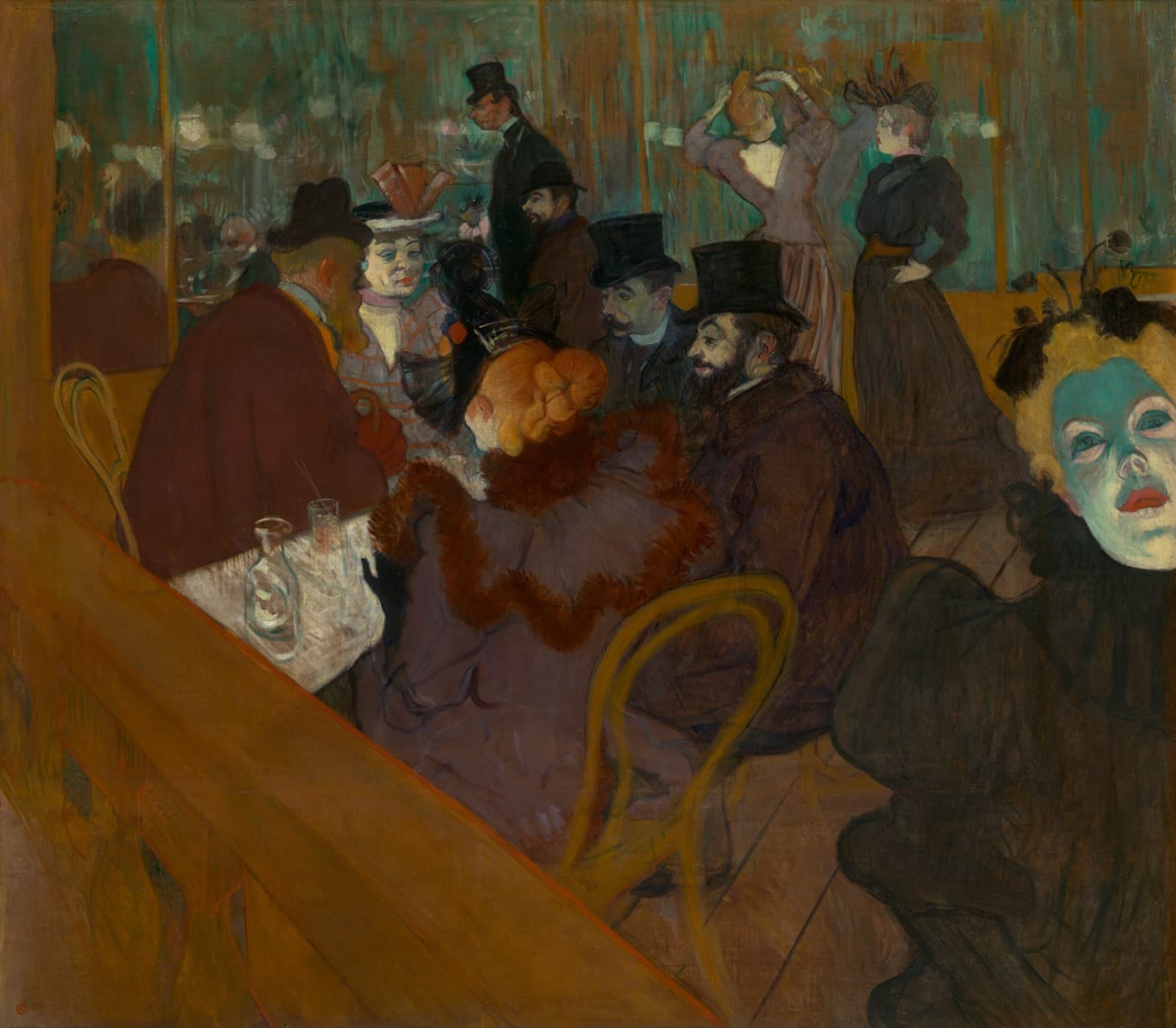
In Paris from 1886 to 1888, Vincent van Gogh formed friendships with other painters around Fernand Cormon’s studio and in Montmartre. His acquaintances included Émile Bernard, Louis Anquetin, and Henri de Toulouse-Lautrec. Lautrec’s 1887 pastel portrait of him records something of this shared milieu. These contacts complicate the familiar legend of a genius entirely cut off from his contemporaries: Van Gogh’s art was intensely individual, but its development depended on looking, discussing, borrowing, and testing. [28]
Arles and the hoped-for artists’ community
Van Gogh moved to Arles in 1888, where he hoped to establish a community of artists. The Yellow House was not simply a private refuge; it was intended as a place where work, conversation, and shared ambitions could reinforce one another. Gauguin joined Van Gogh that autumn with support from Vincent’s brother Theo, an art dealer. Their period together produced important paintings but also exposed differences in temperament and artistic method. Their collaboration ended after Van Gogh cut off his ear during a mental health crisis on 23 December 1888. Gauguin returned to Paris with Theo soon afterward. [29][30]
Van Gogh used his Arles Sunflowers paintings to decorate Gauguin’s room in the Yellow House, and he associated the flowers with gratitude. Their restricted range is part of their achievement: variations of yellow, ocher, green, and related tones distinguish fresh blooms, seed heads, vase, and background without relying on a broad, contrasting spectrum. The subject is recognizable immediately, but the paintings also explore how much variety a seemingly narrow palette can sustain. [31]
Van Gogh’s visible brushwork is often described as spontaneous, yet a painting’s energetic appearance should not be confused with an absence of planning. Repeated strokes can follow the growth of a plant, reinforce a contour, or set one area into rhythmic opposition with another. The work’s emotional intensity arises through these pictorial decisions as well as through the artist’s response to the subject. [27][31]
In a letter to his brother Theo dated 8 September 1888, Van Gogh explained how he chose colors to express emotion. Describing The Night Café, he set the room’s reds against the green billiard table and explained that he wanted these clashes to convey destructive human passions. He had worked through three nights, sleeping during the day. Elsewhere in the letter, he explicitly distinguished color that imitated appearances from color chosen to suggest emotion. The café’s oppressive atmosphere was not an accidental consequence of an unruly technique; it was the effect he was trying to achieve. [32]
Painted at Saint-Rémy in June 1889, The Starry Night is one of the clearest examples of Van Gogh’s combination of observation and invention. The view from the asylum provided a starting point, but the finished painting is not a straightforward copy of what lay outside one window. The village was assembled from other knowledge and imagery, the cypress was given unusual prominence, and the sky was transformed into sweeping, interconnected movements. New York’s Museum of Modern Art (MoMA) notes that the painting was made in daytime sessions rather than simply recorded in a single nocturnal burst. [33]
In The Starry Night, Van Gogh heightened the contrast between a small settlement and an immense sky through his arrangement of buildings, trees, and sweeping curves. Van Gogh’s illness belongs to his biography, but it does not, by itself, explain the painting. Its emotional force also comes from decisions about scale, rhythm, and the relation of one form to another. [33]
Van Gogh died in July 1890 after a final period of painting at Auvers-sur-Oise. Although his mature career lasted only a few years, his surviving pictures and letters record a sustained process of study and revision. He examined what he had made, sought responses from other artists, and tested how color and form could express his experience of a subject. [6][28]
Post-Impressionism and Paris
Paris brought the artists associated with Post-Impressionism into contact with studios, shops, exhibitions, cafés, critics, collectors, and dealers. Montmartre offered friendships and subjects; the Seine and its industrial outskirts supplied modern landscapes; the Académie Julian connected the future Nabis; and the commercial streets around the grands boulevards brought unconventional work into contact with buyers. The movement’s geography therefore includes both the places represented in paintings and the places where paintings became possible to make, exchange, and encounter. [28][19][36][43]
Independent exhibitions: no jury, no prizes
The Société des Artistes Indépendants emerged in 1884, with Albert Dubois-Pillet, Redon, Seurat, and Signac among its founding figures. Its principle was expressed in the motto Ni jury, ni récompense: no jury, no prizes. Abolishing an admission jury did not guarantee critical success, but it removed a major mechanism through which official taste controlled access to exhibition space. [44]
The Société des Artistes Indépendants took shape through several organizational steps in 1884. A winter exhibition followed in December near the Palais de l’Industrie, where Paul Signac exhibited Le Pont d’Austerlitz. The independent exhibiting initiatives of 1884 also provided a route for Seurat’s rejected Bathers at Asnières. These initiatives established an alternative exhibition system in which rejection by the official Salon no longer excluded an artist from public view. [44][19]
The exhibition at Café Volpini
During the Exposition Universelle of 1889, Gauguin and his associates mounted a separate exhibition at the Café des Arts, usually known as Café Volpini, on the Champ-de-Mars. They called themselves the Impressionist and Synthetist Group, a name that retained a connection to an already recognizable artistic movement while asserting a new direction. [45]
The 1889 Café Volpini exhibitors included Gauguin, Émile Bernard, Émile Schuffenecker, Charles Laval, Louis Anquetin, Léon Fauché, Louis Roy, and Georges Daniel de Monfreid. The additional name Ludovic Némo concealed Bernard, who used a pseudonym inspired by Jules Verne. The makeshift venue is part of the exhibition’s significance: an ambitious alternative to official art was being presented in the commercial surroundings of a café during a vast international fair. [45]
Visitors to the Café Volpini exhibition could ask to see prints by Gauguin and Bernard. Gauguin’s suite consisted of ten zincographs and a cover, printed by Edward Ancourt on strongly colored yellow paper. The British Museum records an advertised price of twenty francs for the album. These were not merely reproductions of famous canvases but an attempt to develop a distinctive printed art while making the artist better known. The exhibition achieved little commercial success, yet it became a landmark in the public presentation of Synthetism. [46][45]
For Paul Sérusier and the emerging Nabis, the 1889 Café Volpini exhibition reinforced ideas already set in motion by Sérusier’s work with Gauguin in 1888. [47]
Père Tanguy: materials, credit, and a place to meet
Julien-François Tanguy, affectionately known as Père Tanguy, ran a paint-supplies shop on the rue Clauzel. He accepted paintings in exchange for materials and displayed artists’ work in a setting that also functioned as a meeting place. He also accepted pictures on consignment, helping artists look for buyers. His support operated at a practical level: credit and supplies could determine whether a painter continued working, long before a critic or collector recognized the finished pictures. [35][48]
Van Gogh painted three portraits of the Paris paint supplier Père Tanguy. The 1887 version in the Musée Rodin presents Tanguy frontally, his hands folded and his figure surrounded by Japanese prints. A supplier whose work might otherwise remain invisible in art history becomes the central subject of an ambitious experiment in color and pictorial space. [35]
The sculptor Auguste Rodin eventually acquired Van Gogh’s Père Tanguy. The Musée Rodin’s accounts connect the portrait’s history with Tanguy’s death in 1894 and the writer Octave Mirbeau’s efforts on behalf of Tanguy’s widow. The exact date and circumstances of Rodin’s acquisition remain uncertain. These connections show how friendships and efforts to support artists and their families also influenced the movement of paintings between collections. [48][35]
Theo van Gogh and the professional art trade
Theo van Gogh supported his brother Vincent financially and promoted experimental painters through his work as an art dealer. As the manager of a branch of Boussod, Valadon et Cie, the successor to Goupil, he worked inside an established commercial firm while cautiously creating opportunities for more experimental artists. During the second half of 1887, he increased the visibility of avant-garde painting there; Gauguin became one of the artists who benefited. The gallery may also have been where Gauguin first met the Van Gogh brothers. [43]
By the end of 1887, Gauguin could describe the Goupil house, where Theo van Gogh worked, to his wife as a center for the Impressionists. Such a remark records a shift in the artist’s prospects, not universal acceptance of the new painting. Theo’s position mattered because it brought work from informal circles into a gallery with an existing clientele and commercial standing. [43]
Cafés and restaurants also offered artists places to exhibit. In 1887, Vincent van Gogh arranged a display of Japanese prints at Agostina Segatori’s Café du Tambourin. He also participated in the broader practice of exhibiting modern paintings in eating and drinking establishments. These efforts were not reliably profitable, but they put pictures into circulation when conventional exhibition and sales channels remained limited. [49]
Ambroise Vollard became a major dealer in experimental painting, alongside Père Tanguy, Theo van Gogh, and dealers such as Le Barc de Boutteville. He opened a shop at 37 rue Laffitte in September 1893, later moving to larger premises at number 39, which he inaugurated in 1895 with a Van Gogh exhibition. [50]
In November 1895, Vollard gave Cézanne his first solo exhibition. Working through the painter’s son, he obtained approximately 150 works, probably displayed in rotation rather than all at once. Cézanne was fifty-six. He was not unknown to fellow artists, but the exhibition substantially widened access to his work and strengthened his reputation. For viewers outside the painter’s immediate circle, it offered an unusually sustained encounter with work that had previously been difficult to see. [50]
Jo van Gogh-Bonger and the work of recognition
Jo van Gogh-Bonger, Theo van Gogh’s widow, played a central role in establishing Vincent van Gogh’s posthumous reputation. Following Vincent’s death in 1890 and Theo’s in 1891, she assumed responsibility for much of Vincent’s artistic legacy. She pursued exhibitions, loans, sales, and publication rather than simply storing the pictures until the world changed its mind. [51]
Jo van Gogh-Bonger’s 1905 Van Gogh exhibition at the Stedelijk Museum in Amsterdam brought together 484 works, according to the Van Gogh Museum’s account of Hans Luijten’s archival research. In 1914 she published Vincent’s letters to Theo. These activities made both the paintings and the artist’s thinking available to a widening public. The history of recognition is therefore not only a story about critics belatedly discovering genius; it also involves the practical decisions of someone who preserved, selected, placed, and explained the work. [51]
From Post-Impressionism to twentieth-century art
Post-Impressionism’s influence was not a single line leading toward one inevitable destination. Different artists extracted different possibilities from it. Around 1905, the Fauves, including Henri Matisse and André Derain, intensified the use of color freed from local description. The precedents of Van Gogh, Gauguin, and divided-color painting helped make it possible to construct a landscape or figure through contrasts that were conspicuously chosen rather than passively observed. [21]
Cézanne became especially important to the emergence of Cubism. The 1907 retrospective of his work gave a new generation a major opportunity to study paintings in which solid forms and unstable space coexist. Pablo Picasso and Georges Braque developed these problems in directions Cézanne had not prescribed, making the organization of objects and viewpoints increasingly explicit. Cézanne’s influence depended on how these younger artists adapted his work to their own aims. [52][18]
The expressive and symbolic possibilities associated with Van Gogh and Gauguin also fed into the broader development of modern art beyond France. Meanwhile, the Nabis demonstrated how painting could remain figurative while placing pattern, memory, and the surface itself at the center of attention. These developments contributed to the conditions in which abstraction became possible, but the paintings that made them possible were often deeply attached to recognizable places, people, and objects. [2][38]
The category Post-Impressionism encompasses several distinct ambitions for painting. A work might investigate perception, organize color relationships, construct a symbolic world, or give shape to an intensely personal experience. Its subject no longer supplied a complete explanation of its purpose. [2][18]
Where to see Post-Impressionism in Paris
The Musée d’Orsay holds Post-Impressionist paintings that allow visitors to compare different approaches within one Paris collection. Cézanne’s The Card Players, Seurat’s The Circus, Gauguin’s Arearea, and Sérusier’s The Talisman allow visitors to move between concentrated figure painting, divided color, invented symbolism, and the origins of the Nabis. Seeing these works together also makes clear why the category cannot be recognized through one brushstroke or one kind of subject. [16][7][8][9][36]
For Van Gogh, Orsay’s Starry Night over the Rhône of 1888 must be distinguished from The Starry Night of 1889, which belongs to MoMA in New York. The Paris painting shows the river at Arles, stars above the town, reflections of artificial light on the water, and figures in the foreground. It offers a different relationship between the inhabited city and the night sky. Orsay also holds an 1889 version of The Bedroom at Arles, another opportunity to examine how color and spatial adjustments carry the character of an interior. [53][54]
The Musée Rodin owns Van Gogh’s Père Tanguy, a portrait of the Paris paint supplier. Its presence in a sculptor’s collection is a reminder that artists were also important audiences and collectors for one another. The painting links Van Gogh’s Parisian transformation to the modest commercial world of the paint shop and to the international circulation of Japanese prints. Individual works may be on loan, undergoing conservation, or temporarily off display. Check the museums’ current information before visiting for a particular painting. [35][48]

 View source