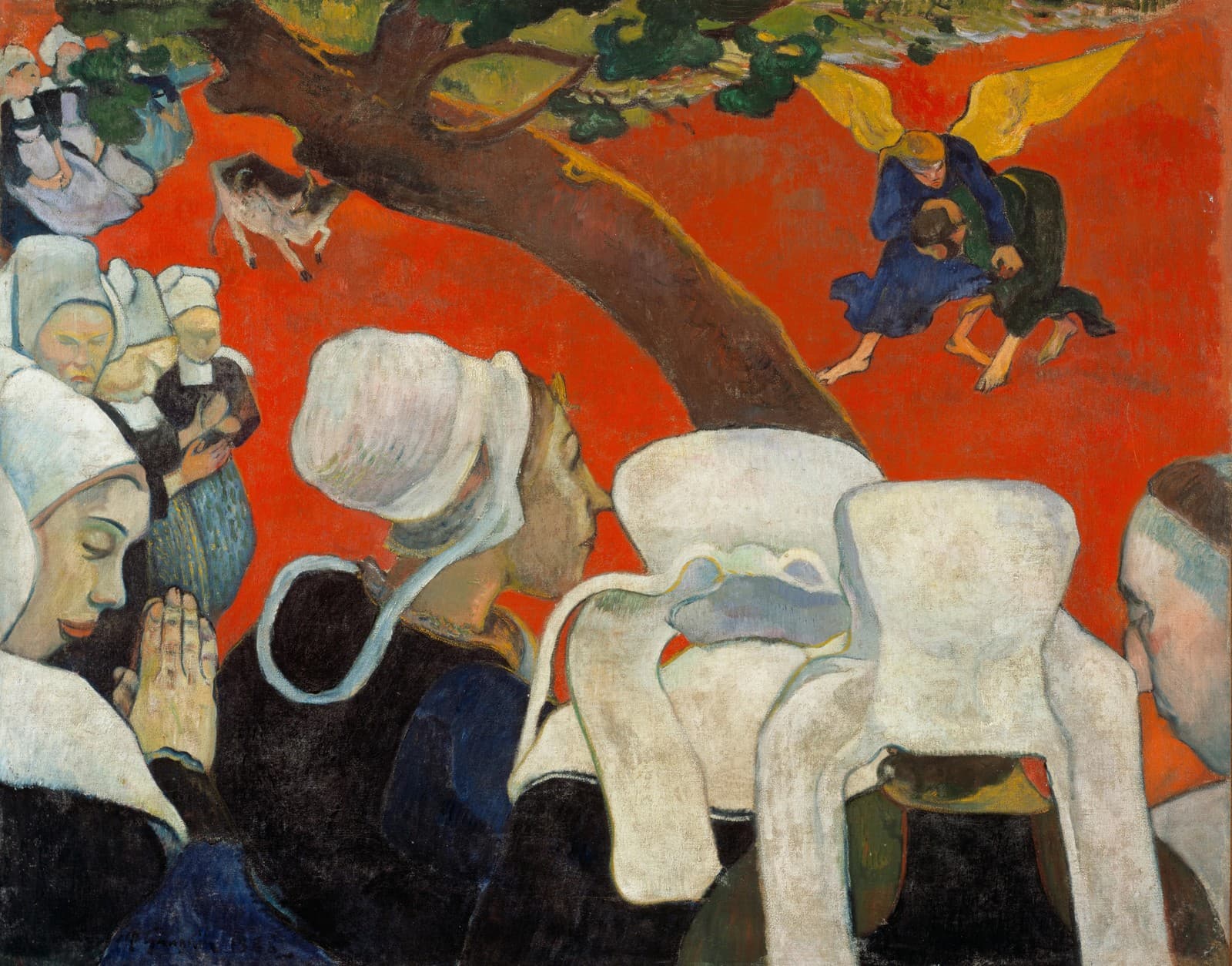
Paul Gauguin painted this in Pont-Aven, Brittany, in 1888: Breton women in white coifs watch Jacob wrestling the angel on a field of pure red. It is the declaration of Synthetism — the first major canvas in which he painted an idea rather than a view. The National Galleries of Scotland bought it in 1925.
A group of Breton women in the starched white coifs and dark dresses of their region fill the foreground, eyes closed or downcast, hands folded. A priest's profile sits in the lower right corner. Across a diagonal tree trunk, in the upper field, two figures wrestle: Jacob and the angel, from the thirty-second chapter of Genesis — the passage the women have just heard preached. A cow grazes at the upper left, small and out of scale.[1]
The ground they occupy is not grass. It is a single unbroken field of red.
A vision, not a view
The picture's subject is not the Bible story. It is the act of belief itself: what the women see with their eyes shut after the sermon. Gauguin split the canvas along the tree — the real women below and to the left, the imagined struggle above and to the right — and used the red field to declare that the upper zone obeys no natural law. The National Galleries of Scotland calls the painting a manifesto for a new approach to painting, and that is how the artists of the time received it.[1]
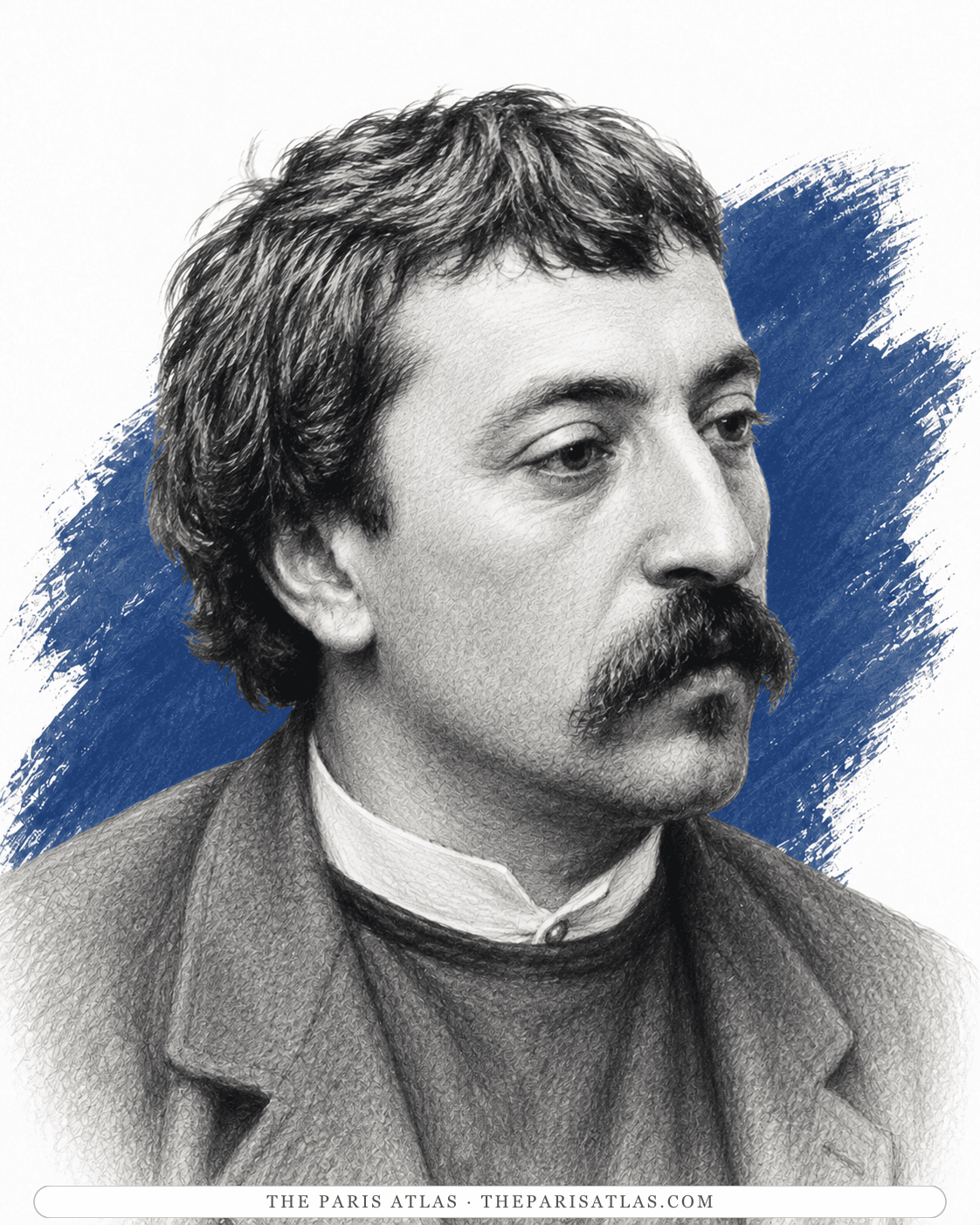
Gauguin believed rural Brittany kept a directness of faith that modern Paris had lost — a selective, romantic reading of a region already full of painters and tourists, but the conviction was sincere, and it gave him his subject. He reportedly offered the finished canvas to a local church; the parish declined it.[2]
Reading the picture, detail by detail
At full size the canvas reads as design — red field, white coifs, diagonal tree. Up close it reads as people. Six details, enlarged from the painting itself, show how much humanity Gauguin built into a picture famous for its abstraction.
Detail: the woman with clasped hands. Her closed lids are drawn with a single line of green shadow, and the praying hands are painted nearly the size of her face. Gauguin's signature and the date 1888 sit just below. — Paul Gauguin, Vision of the Sermon (detail), National Galleries of Scotland; via Wikimedia Commons
The woman with clasped hands is the painting's real subject in miniature. Her closed lids are drawn with a single stroke of green shadow, her lips set, and the praying hands are enlarged to nearly the size of her face — belief given physical weight, the way a child draws what matters biggest. Gauguin signed and dated the canvas directly beneath her, as if to countersign the prayer.
Detail: a coif and profile against the red. The starched linen is painted as one unbroken white shape with a dark contour where it meets the field — the Cloisonnist edge doing its work. — Paul Gauguin, Vision of the Sermon (detail), National Galleries of Scotland; via Wikimedia Commons
The coifs were his excuse for the white shapes, but the faces under them are individuals. This profile runs unbroken from brow to chin against the red, a touch of yellow lighting the ear, the starched linen painted as one flat mass with a dark contour where it meets the field. The Cloisonnist edge — color zones separated like enamel — is easiest to see exactly here.
Detail: Jacob and the angel. The wings are unmodeled chrome yellow, the feet brace against a red that offers no ground line, and the pair cast no shadows — a fight staged nowhere, which is to say in the mind. — Paul Gauguin, Vision of the Sermon (detail), National Galleries of Scotland; via Wikimedia Commons
The wrestlers themselves are painted with deliberate strangeness. The angel's wings are unmodeled chrome yellow; both figures brace bare feet against a red that offers no ground line; neither casts a shadow. The fight is staged nowhere — which is the point, since it is happening inside the women's imagination. Gauguin scaled the pair down and pushed them past the tree so that the vision stays smaller than the visionaries.
Detail: the priest at the corner, eyes down, cropped by the frame. His features have often been read as Gauguin's own — the painter as the sermon's deliverer, letting the vision loose and looking away. — Paul Gauguin, Vision of the Sermon (detail), National Galleries of Scotland; via Wikimedia Commons
At the lower right corner, cropped by the frame, the priest bows his head, eyes down, cheek shaded blue-grey. His features have often been read as Gauguin's own — the man who delivered the sermon placed at the edge of its consequences, looking away from the vision he set loose.
Detail: the cow, and the far group painted small. Scale jumps without perspective to justify it — the vision zone obeys importance, not distance. — Paul Gauguin, Vision of the Sermon (detail), National Galleries of Scotland; via Wikimedia Commons
The cow, outlined in black and crossing the red at the upper left, walks beside a group of figures painted drastically smaller than the foreground women — a jump in scale no perspective explains. In the vision zone, size follows importance rather than distance, a rule Gauguin took from the medieval and popular religious images he admired.
Detail: the coif as pure shape. Cropped alone, the passage is three flat forms — white linen, a wedge of the red field, a grey-pink neighbor. The abstraction the twentieth century argued toward is already here as fact. — Paul Gauguin, Vision of the Sermon (detail), National Galleries of Scotland; via Wikimedia Commons
And one detail with no face at all. Cropped alone, the big foreground coif is three flat forms — white linen, a wedge of the red field, a grey-pink neighbor — and nothing else. The abstraction the twentieth century would spend decades arguing toward is already sitting here, in 1888, wearing Breton starch.
How it is painted
The manner came out of Gauguin's 1888 exchange with the much younger Émile Bernard, who had been experimenting with flat zones of strong color bounded by dark contours — a look drawn from stained glass, popular prints, and Japanese woodblocks. Here the borrowings are legible: the flat red field, the heavy outlines around the coifs, the bold diagonal of the tree and the abrupt cropping both taken from the Japanese prints then circulating in Paris. Depth is compressed until the canvas reads as a designed surface.[2]
The approach was named Synthetism: a painting synthesizes what the artist saw, what the artist remembered, what the artist felt, and the decorative order of color and shape. A field could be red because red made the picture stronger. The permission contained in that sentence is most of twentieth-century painting.[3]
What it led to
The same year, at Pont-Aven, Gauguin stood over Paul Sérusier while Sérusier painted a small landscape on a cigar-box lid, pushing every color toward its purest state. Sérusier carried the panel back to his friends in Paris, who called it The Talisman and formed the group known as the Nabis around what it taught. Through them, and through the Symbolist painters who claimed the Vision immediately, the picture's ideas ran on into Fauvism and Expressionism.[4]
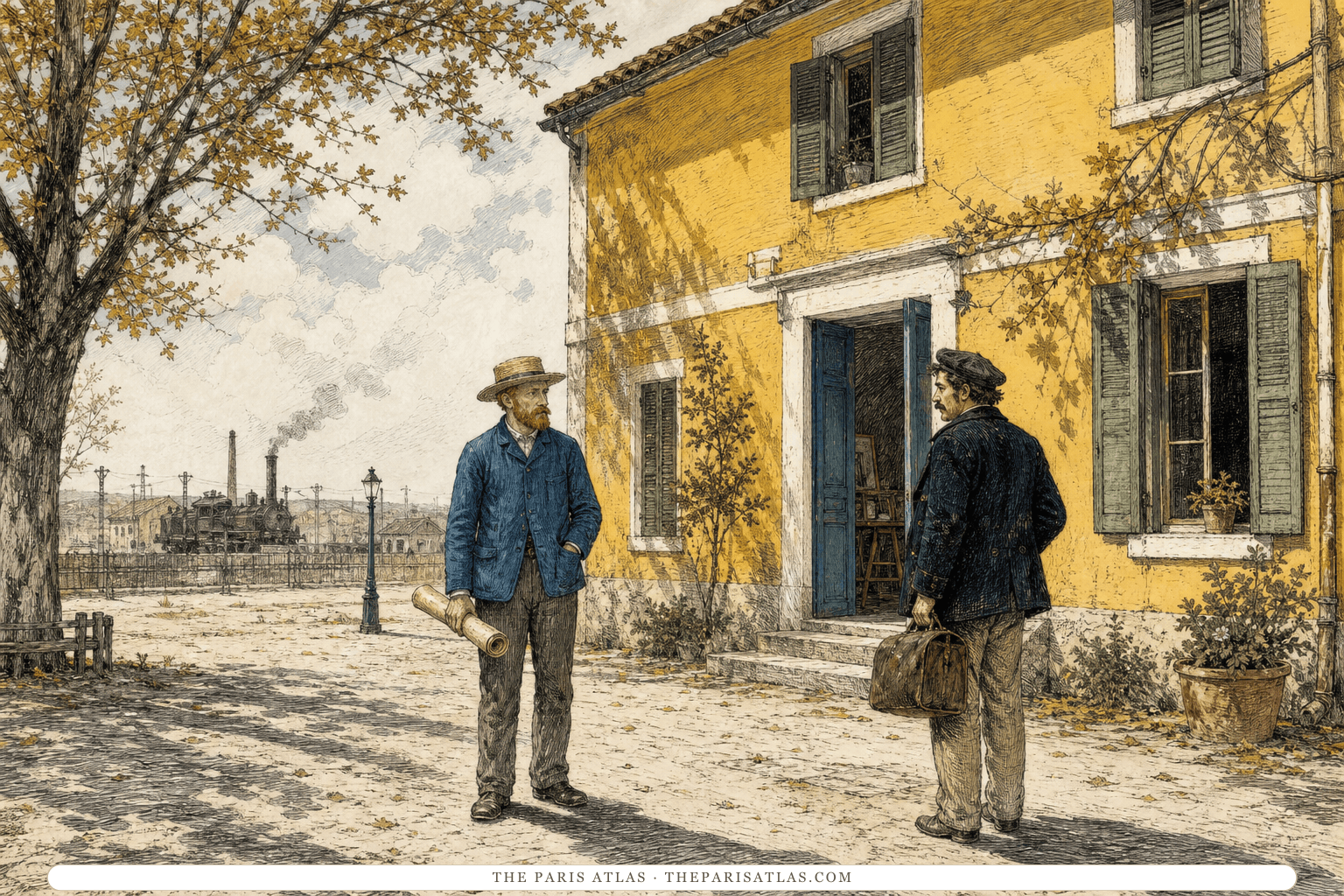
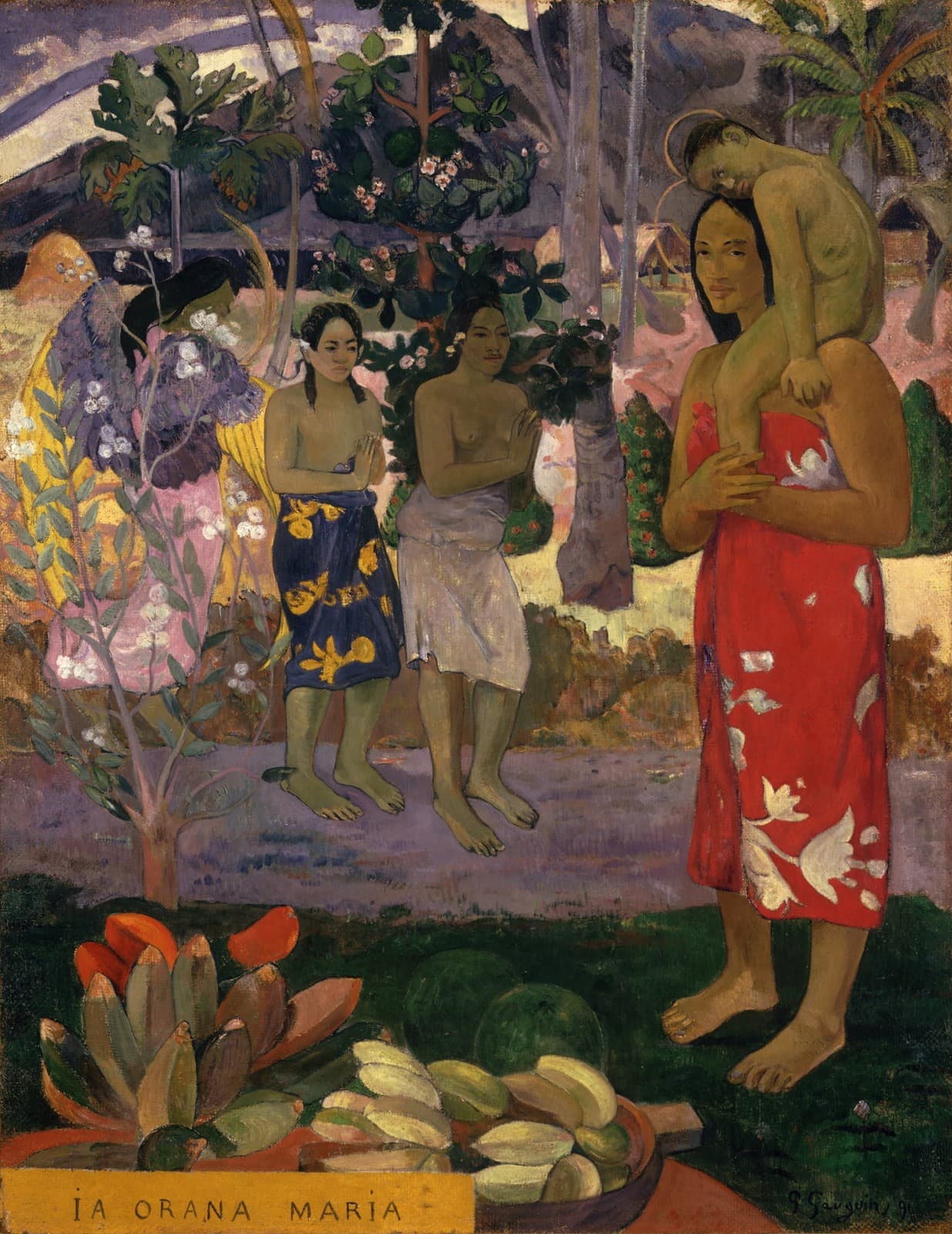
Gauguin himself carried the method to Arles that autumn, to the shared house with Vincent van Gogh, and then to Tahiti, where the invented worlds got larger. This canvas is where the invention began.[2]
Timeline
1886
Gauguin makes his first working stay at Pont-Aven in Brittany.
1888
Paints Vision of the Sermon at Pont-Aven, in the months of his exchange with Émile Bernard; a local parish reportedly declines the gift of the canvas.
1888
Sérusier paints The Talisman under Gauguin's direction; the Nabis form around it in Paris.
1889
Gauguin and his circle show the new manner at the Volpini exhibition on the Paris world's-fair grounds.
1925
Purchased by the National Galleries of Scotland, as NG 1643.
Where to see it
National Galleries of Scotland, Edinburgh
The Mound, Edinburgh EH2 2EL, United Kingdom
Displays and loans can change. Check whether this work is on view before making a special trip.
The Scottish National Gallery in Edinburgh — the National Galleries of Scotland purchased it in 1925, and its accession number is NG 1643.
What does Vision of the Sermon show?
Breton women in white coifs who have just heard a sermon on Jacob wrestling the angel, and — across a diagonal tree, on a field of pure red — the vision itself: the wrestling match from Genesis 32 as the women imagine it. Paul Gauguin painted it at Pont-Aven, Brittany, in 1888.
Why is the ground red?
Because the upper zone of the picture is a vision, not a place, and Gauguin used a flat, unreal red to say so. It is the clearest early statement of his principle that color should serve the picture's meaning and design rather than copy nature — the idea later painters took furthest in Fauvism.
What is Synthetism?
The approach Gauguin developed with Émile Bernard in Brittany in 1888, of which this painting is the declaration: a picture synthesizes observation, memory, feeling, and decorative design, with simplified forms, heavy contours, and flat non-natural color. It fed directly into the Nabis, Symbolism, and Fauvism.
Why is Vision of the Sermon important?
It is the canvas where Gauguin stopped painting what he could see and painted an idea instead — a turning point the National Galleries of Scotland describes as a manifesto for a new approach to painting. Most accounts of modern art's move away from naturalism route through this picture.
Van Gogh wanted a brotherhood of painters in the south. He got Paul Gauguin, nine weeks of side-by-side work, and the most famous quarrel in modern art. What the evidence supports, what only Gauguin's memoir claims, and what the sunflowers meant — round by round.
Explore painters from the same movements and circles.
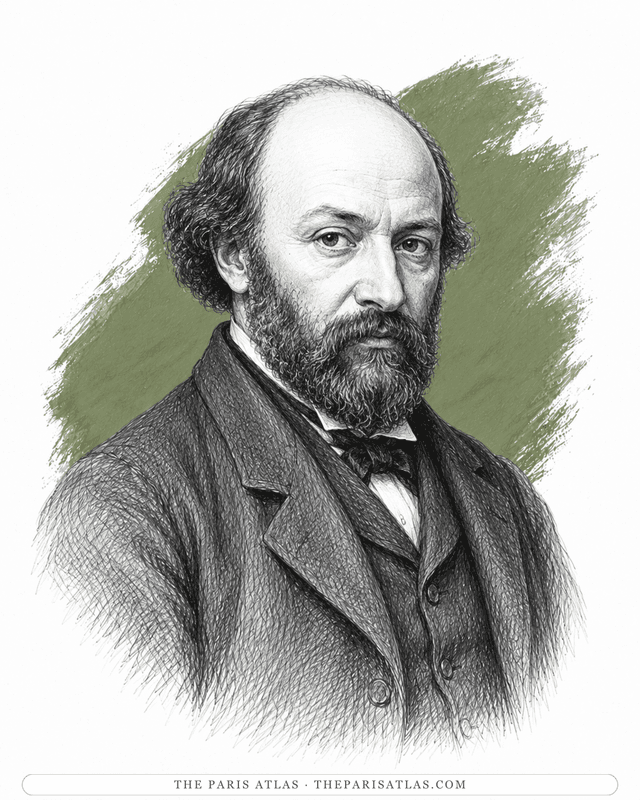
Paul Cézanne
Painter between Impressionism and everything after — shown in the independents' exhibitions, emulated by the Cubists, and present at the Orangerie through 15 works in the Walter-Guillaume collection.
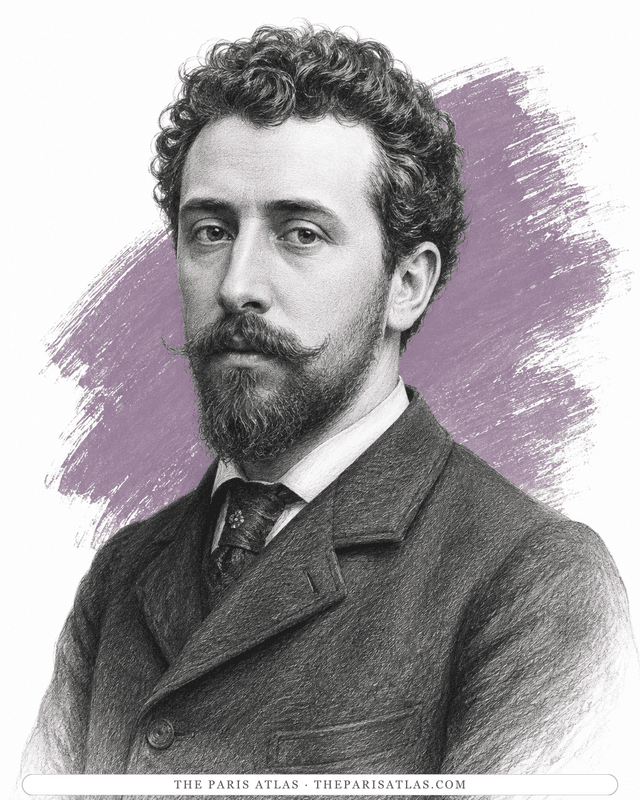
Parisian painter who built pictures from small dots of pure colour on optical principle, co-founded the Salon des Indépendants, and detonated the last Impressionist exhibition of 1886 with A Sunday on La Grande Jatte. He died at thirty-one.
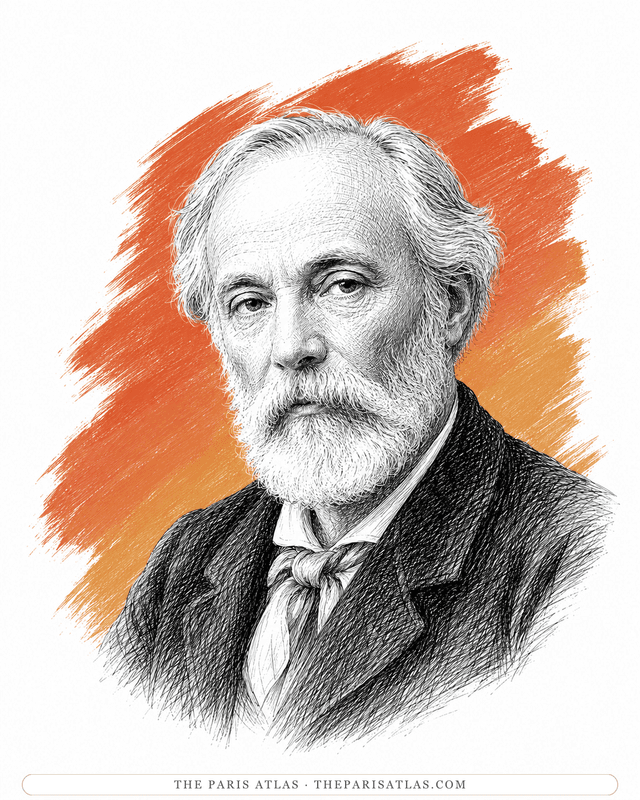
Porcelain painter turned co-founder of Impressionism — the painter of the Moulin de la Galette dance and the Luncheon of the Boating Party, whose later classical turn reached Picasso and Matisse.
Detail: the woman with clasped hands. Her closed lids are drawn with a single line of green shadow, and the praying hands are painted nearly the size of her face. Gauguin's signature and the date 1888 sit just below.1888 · Paul Gauguin, Vision of the Sermon (detail), National Galleries of Scotland; via Wikimedia Commons · Public domainDetail: the coif as pure shape. Cropped alone, the passage is three flat forms — white linen, a wedge of the red field, a grey-pink neighbor. The abstraction the twentieth century argued toward is already here as fact.1888 · Paul Gauguin, Vision of the Sermon (detail), National Galleries of Scotland; via Wikimedia Commons · Public domainDetail: the cow, and the far group painted small. Scale jumps without perspective to justify it — the vision zone obeys importance, not distance.1888 · Paul Gauguin, Vision of the Sermon (detail), National Galleries of Scotland; via Wikimedia Commons · Public domainDetail: Jacob and the angel. The wings are unmodeled chrome yellow, the feet brace against a red that offers no ground line, and the pair cast no shadows — a fight staged nowhere, which is to say in the mind.1888 · Paul Gauguin, Vision of the Sermon (detail), National Galleries of Scotland; via Wikimedia Commons · Public domainDetail: the priest at the corner, eyes down, cropped by the frame. His features have often been read as Gauguin's own — the painter as the sermon's deliverer, letting the vision loose and looking away.1888 · Paul Gauguin, Vision of the Sermon (detail), National Galleries of Scotland; via Wikimedia Commons · Public domainDetail: a coif and profile against the red. The starched linen is painted as one unbroken white shape with a dark contour where it meets the field — the Cloisonnist edge doing its work.1888 · Paul Gauguin, Vision of the Sermon (detail), National Galleries of Scotland; via Wikimedia Commons · Public domain
References
References
The sources below include collection records, catalogues, scholarly research, and primary materials that informed this page. They document Vision of the Sermon (Jacob Wrestling with the Angel), its making, and its place in cultural history.
1abVision of the Sermon (Jacob Wrestling with the Angel), Paul Gauguin
Website
National Galleries of Scotland
Used for
Web source consulted for documented facts and historical context presented on the Vision of the Sermon (Jacob Wrestling with the Angel) page.
These references provide the documented foundation for this work's history and interpretation. Claim-level citations remain attached to the specific claims they support.


 View source