Two Tahitian Women
by Paul Gauguin
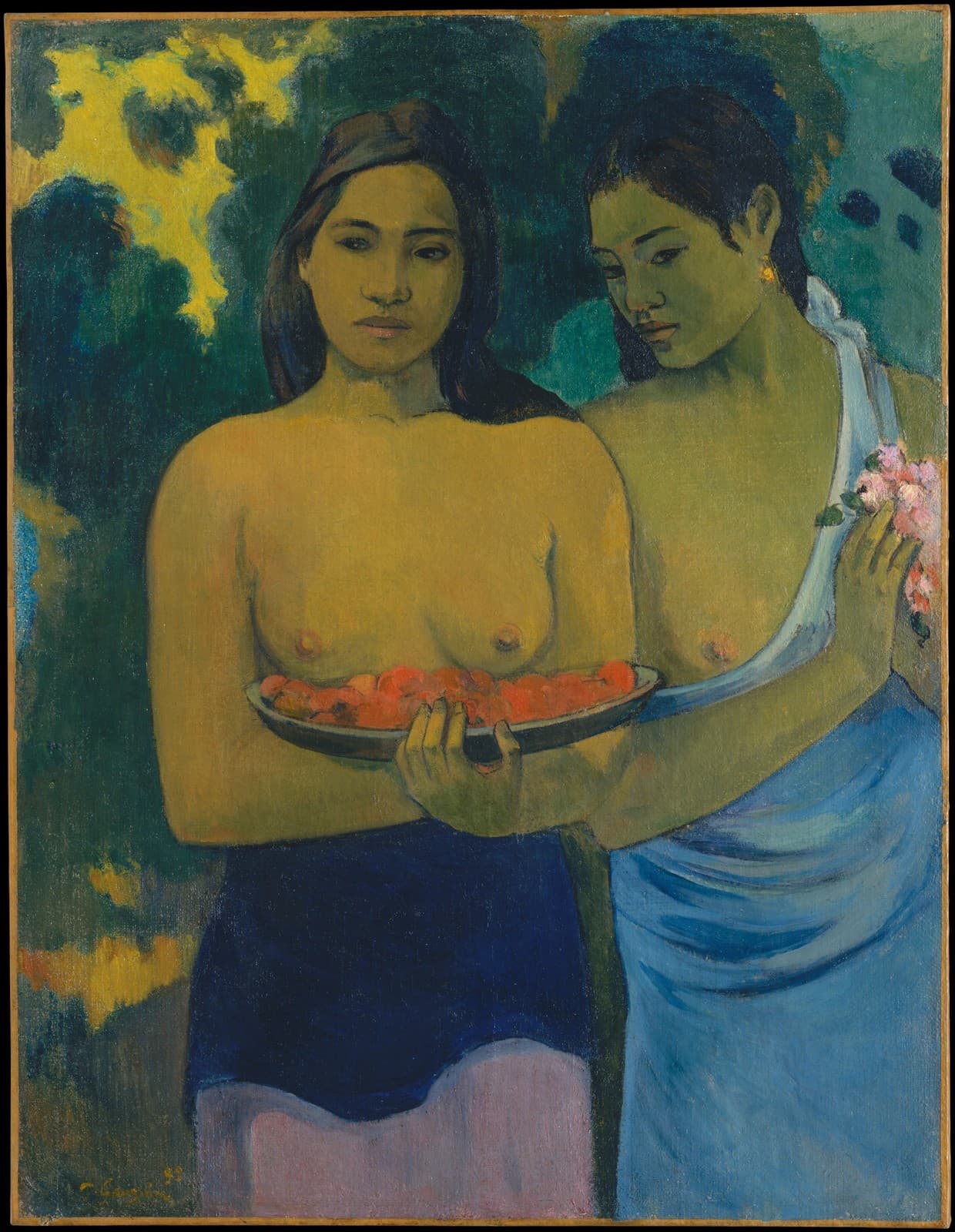
Two women stand close together against a green ground, one carrying mango blossoms on a tray — painted in Tahiti in 1899, in the monumental calm of Gauguin's late manner. The Metropolitan Museum of Art has owned it since William Church Osborn's gift of 1949.
- 1899
- Oil on canvas
About Paul Gauguin
What the painting shows
Two Tahitian women stand shoulder to shoulder, close to the picture plane, against a ground of dense green. The woman at the left, bare to the waist, carries a wooden tray of mango blossoms; her companion, in a pink dress slipped from one shoulder, holds a spray of the same flowers to her chest and inclines her head toward her. Both look past the viewer with the grave, self-contained stillness of Gauguin's late figures.[1]
Nothing happens, and nothing needs to. The picture is a study in presence — two monumental figures, fruit-tray and blossom, and green shade.
The offering picture
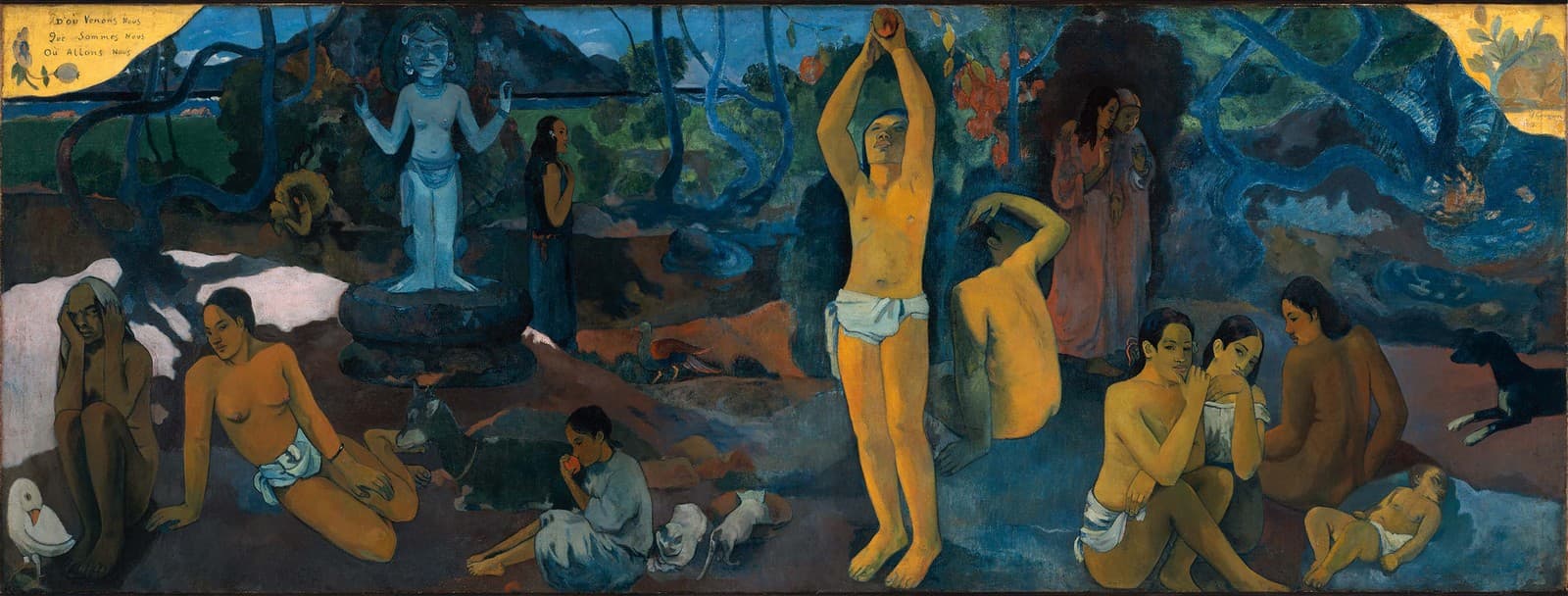
Painted in 1899, in the difficult final Tahitian years between Where Do We Come From and the move to the Marquesas, the canvas belongs to a group of late works in which the drama drains away and what remains is stillness — figures presented frontally, like carvings, holding offerings. The pose and tray deliberately echo classical relief and the fruit-bearers of older art; Gauguin was composing his Tahitian figures into the Western monumental tradition even as he claimed to have escaped it.[1]
The picture also cannot be separated from what it is: an idealized, sexualized image of Polynesian women composed by a French colonist for a European market, in the line of such images his whole Tahitian decade produced. The serenity is real and so is the machinery behind it. Museums now say both, and both belong here.
Reading the picture, detail by detail
The late manner rewards enlargement — the drama is gone and the paint is doing everything. Four details.
The two faces set the picture's chord. The woman on the left meets the light with level, frank stillness; her companion inclines her head, eyes lowered, a gold earring catching the shade. Neither invites nor refuses the viewer. The gravity that earlier Tahitian canvases assigned to gods and spirits has migrated, by 1899, entirely into human presence.[1]
The tray of blossoms is the picture's argument with art history: the offering pose of the Borobudur reliefs — the Javanese temple friezes Gauguin knew from photographs he owned — restaged on Tahiti as if it had originated there. One hand steadies the wood from beneath. The gesture is monumental and domestic at once, a caryatid carrying lunch.[1]
Her companion's flowers are not presented but kept — the spray of pink held close against the drape at her chest, half-enclosed by her fingers. If the tray is an offering made, this is an offering still being considered. The two hands, three inches apart in the composition, hold two different answers to the viewer.
The pale drape falls from shoulder to wrist in three long unbroken strokes against the deep blue of the skirt. Enlarged, the passage shows where the late Gauguin spent his attention: not on symbols or invented gods, but on the weight of cloth, laid in with a calm the early work never wanted.
More details
5.The background loosens around the hair
Yellow shows through the green in irregular patches, with few edges precise enough to identify individual leaves. Beside this loose surface, the dark hair forms a much clearer boundary. The difference in handling brings the figure forward without requiring a carefully measured landscape behind her.
6.The lower colors meet along a shallow curve
A shallow, uneven curve divides dark blue from pale purple near the bottom of the painting. There are few folds to explain this boundary as fabric. Gauguin allows the large color areas to remain simple, giving the small fingers and bright tray above them greater visual emphasis.
How it is painted
The late manner is quieter than the 1892 canvases: the color deeper and less strident, the contours softer, the modeling of the two figures fuller — almost sculptural against the flat green. The composition is a frieze of two, cropped close, with the tray's horizontal locking the design the way a plinth locks a statue.[1]
The golden-brown of the skin against saturated green and the pink of the dress carries the picture's warmth; the design does the rest with almost nothing.
Where it went
The canvas left the Pacific for the European market and passed through distinguished collections before William Church Osborn gave it to the Metropolitan Museum in 1949. Its monumental frontality — figures as carved presences — echoes through early modern figure painting, Picasso's classical periods included.[1]
It remains one of the most reproduced images of Gauguin's late Tahitian work, the calm counterpart to the big questions of the Boston canvas.
Timeline
1899
Painted on Tahiti, in the last years before the move to the Marquesas.
1901
Gauguin leaves Tahiti for Hiva Oa.
1949
Given to the Metropolitan Museum of Art by William Church Osborn.
Where to see it
The Metropolitan Museum of Art, New York
1000 Fifth Avenue, New York, NY 10028, United States
Displays and loans can change. Check whether this work is on view before making a special trip.
Plan your visit on the museum’s official website (opens in a new tab)Frequently asked questions
Where is Two Tahitian Women?
The Metropolitan Museum of Art in New York, a gift of William Church Osborn in 1949.
What does Two Tahitian Women show?
Two women standing close together against a green ground, one carrying a tray of mango blossoms, the other holding a spray of the flowers — painted by Paul Gauguin on Tahiti in 1899, in the still, monumental manner of his late work.
What are the women holding?
Mango blossoms — a trayful carried by the woman at the left, a hand-held spray by her companion. The offering pose deliberately echoes the fruit-bearers of classical relief; Gauguin composed his late figures into the Western monumental tradition he claimed to have left behind.
How does the painting differ from Gauguin's earlier Tahitian work?
It is quieter. The strident color and symbolic machinery of the 1892 canvases give way to deeper tones, softer contours, fuller modeling, and stillness — figures presented like carvings, with nothing narrated. The late manner trades drama for presence.
How should the painting's image of Tahitian women be read?
With both facts in view: it is a work of real formal beauty and calm, and it is an idealized, sexualized image of Polynesian women made by a French colonist for a European market — part of the invented Tahiti his whole decade there produced. Museums now present the work with that context, and this page does the same.
More by Paul Gauguin
If you like Paul Gauguin
Explore painters from the same movements and circles.
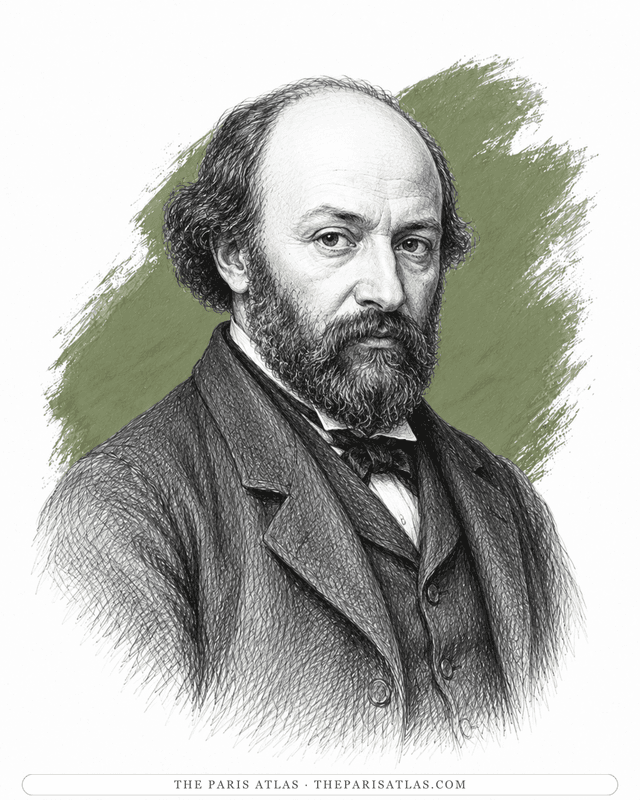
Paul Cézanne
Painter between Impressionism and everything after — shown in the independents' exhibitions, emulated by the Cubists, and present at the Orangerie through 15 works in the Walter-Guillaume collection.
View artist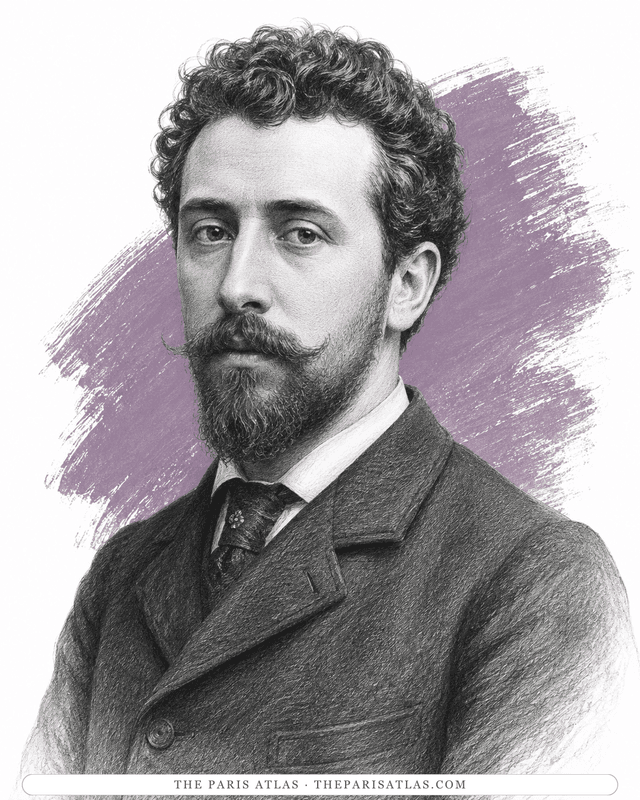
Georges Seurat
Parisian painter who built pictures from small dots of pure colour on optical principle, co-founded the Salon des Indépendants, and detonated the last Impressionist exhibition of 1886 with A Sunday on La Grande Jatte. He died at thirty-one.
View artist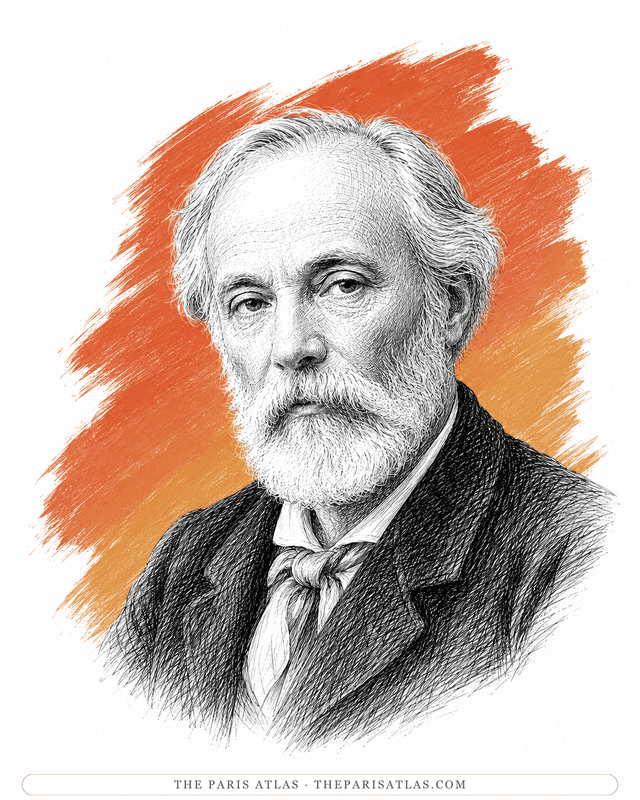
Pierre-Auguste Renoir
Porcelain painter turned co-founder of Impressionism — the painter of the Moulin de la Galette dance and the Luncheon of the Boating Party, whose later classical turn reached Picasso and Matisse.
View artist
In images
References
The sources below include collection records, catalogues, scholarly research, and primary materials that informed this page. They document Two Tahitian Women, its making, and its place in cultural history.


2Paul Gauguin (1848–1903)
WebsiteThe Metropolitan Museum of ArtUsed forWeb source consulted for documented facts and historical context presented on the Two Tahitian Women page.
3Paul Gauguin (1848–1903)
WebsiteNational Gallery, LondonUsed forThe National Gallery's artist profile supplies independent biographical and stylistic context for Gauguin's Tahitian period.
4Gauguin – Tahiti, The Workshop of the Tropics
WebsiteMusée d'OrsayUsed forThe Musée d'Orsay resource documents Gauguin's Tahitian workshop and the cultural setting of his island figures.

5The Lure of the Exotic: Gauguin in New York Collections
Exhibition catalogueThe Metropolitan Museum of Art, 2002Used forThe Metropolitan Museum's own Gauguin catalogue, which shows this painting as number 105 and sets it among the Gauguins held in New York collections.

6Masterpieces of European Painting, 1800–1920, in The Metropolitan Museum of Art
NonfictionThe Metropolitan Museum of Art, 2007Used forSusan Alyson Stein's catalogue entry on this canvas in the Metropolitan Museum's survey of its own European paintings.
These references provide the documented foundation for this work's history and interpretation. Claim-level citations remain attached to the specific claims they support.
 Explore more resources