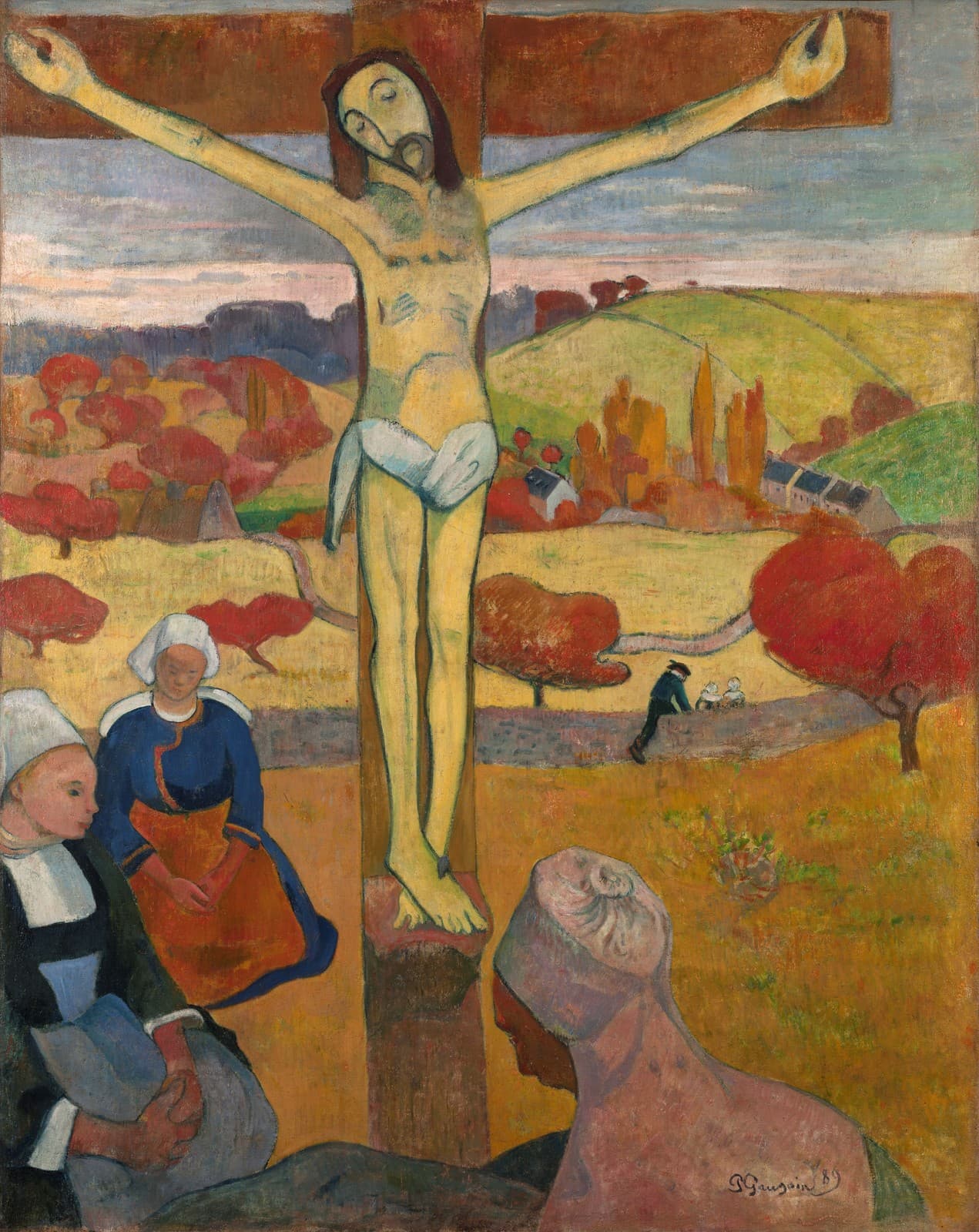
The Yellow Christ
by Paul Gauguin
Paul Gauguin painted this crucifixion in Brittany in 1889, taking the figure of Christ from a seventeenth-century wooden crucifix in the Trémalo chapel near Pont-Aven and setting it in the autumn fields, painted an unbroken yellow. It hangs in the Buffalo AKG Art Museum.
- 1889
- Oil on canvas
About Paul Gauguin
What the painting shows
Christ on the cross, painted yellow, stands in an open Breton field in autumn. Three women in regional dress kneel at the foot of the cross in the poses of the Maries at Calvary; behind them the fields run back in bands of yellow and orange to a village and a line of trees, and a small figure climbs over a wall in the middle distance.[1]
The Buffalo AKG Art Museum records the source of the central figure: a painted wooden crucifix from the seventeenth century that still hangs in the Trémalo chapel outside Pont-Aven. Gauguin moved it out of the chapel and into the landscape.[1]
Calvary in the present tense
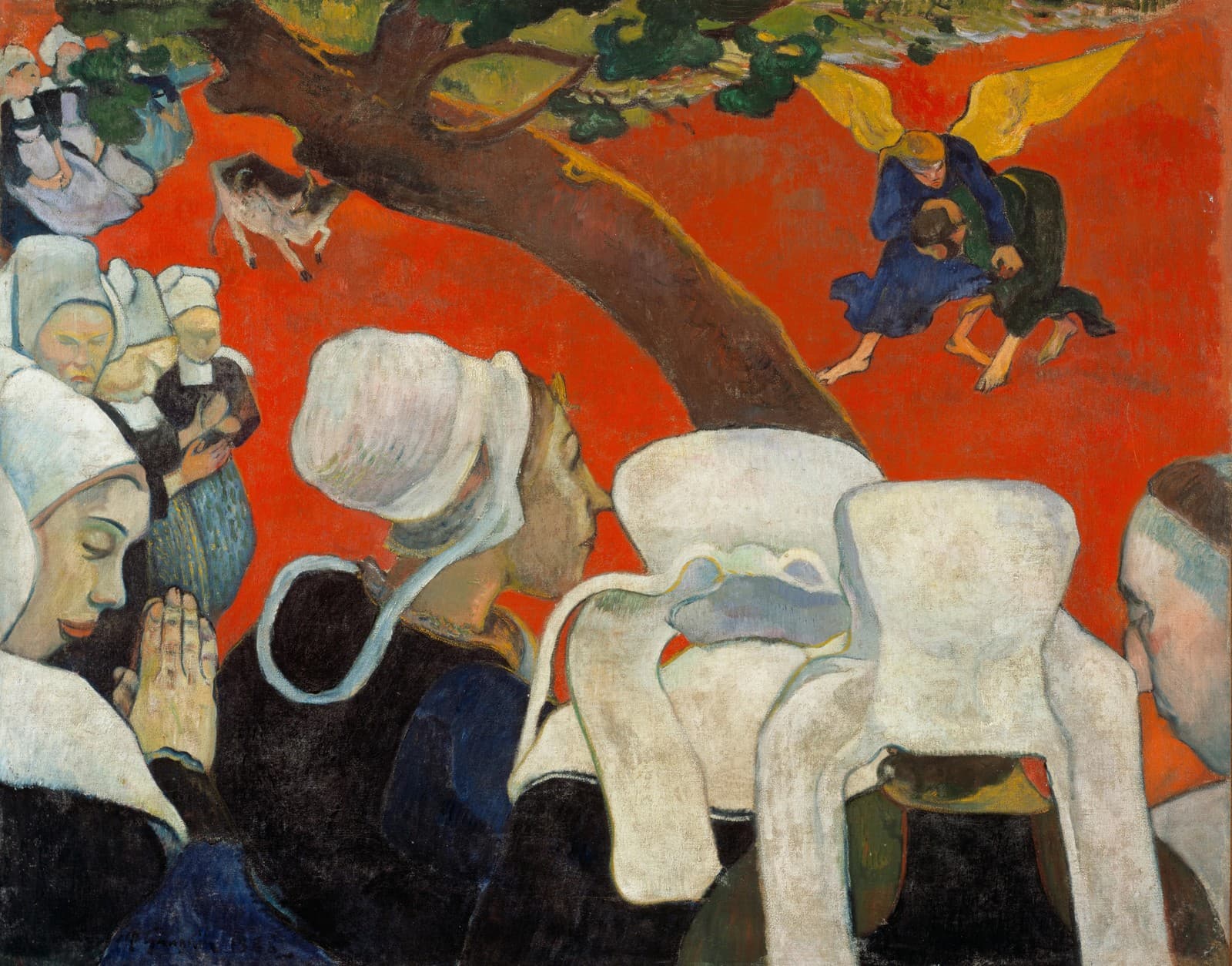
The transposition is the meaning. By setting a carved Christ among living Breton women, Gauguin painted faith as he believed the region practiced it — not as history but as presence, the crucifixion contemporary with the harvest. It is the companion thought to Vision of the Sermon from the year before: religion seen through the believers rather than the theology.[1]
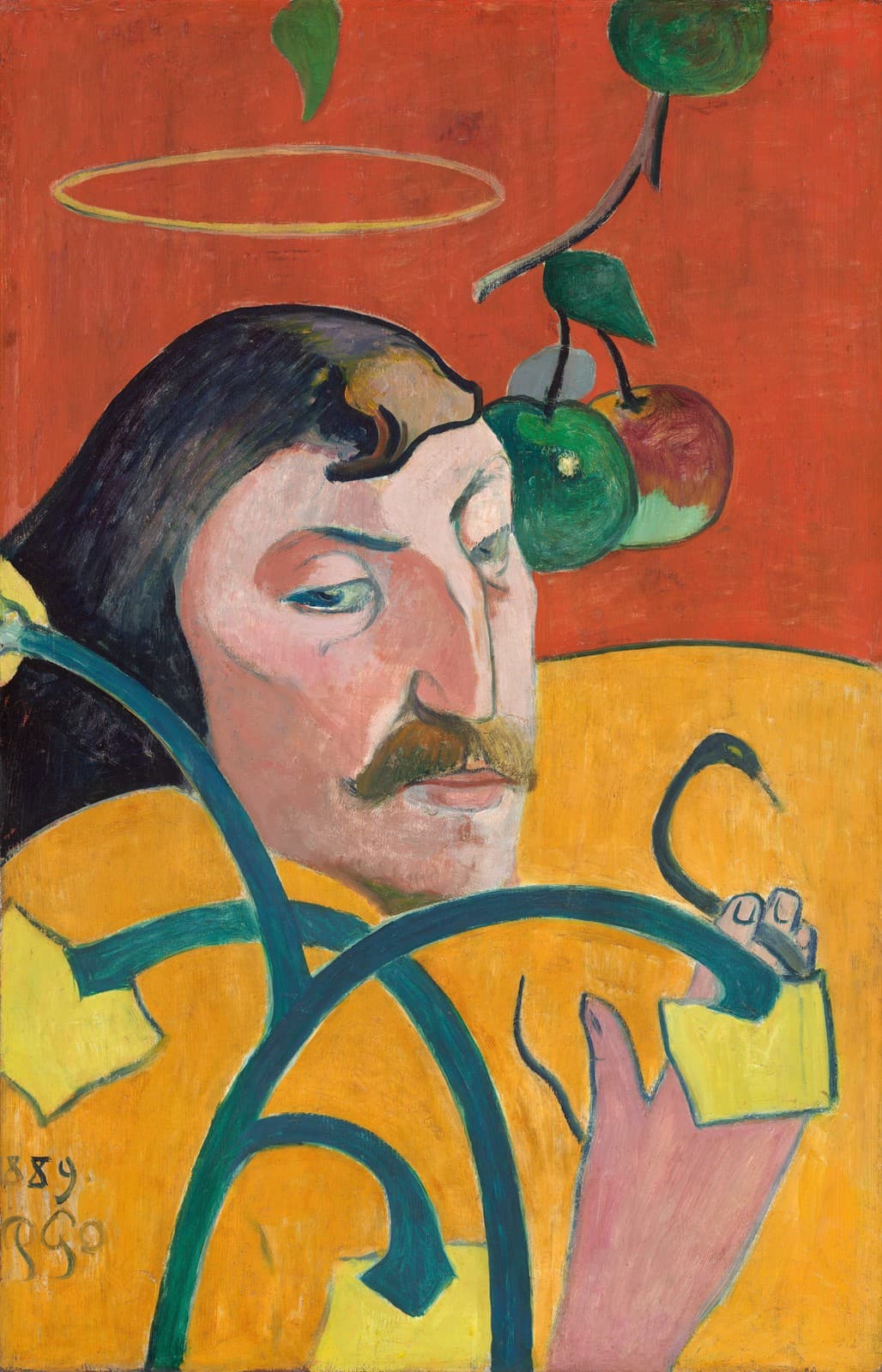
There is a self-portrait buried in it. Gauguin identified his own position — the misunderstood artist suffering for a new art — with the figure on the cross, and said so on canvas: in his Self-Portrait with the Yellow Christ, painted soon after, this picture hangs behind his own head. The martyr pose was part conviction, part performance, and he knew the difference less and less as the years went on.[1]
Reading the picture, detail by detail
The Yellow Christ is usually reproduced whole, as a flat yellow statement. Enlarged, it turns out to be full of people making choices.
The head first. The eyes are closed and the face carries no agony at all — Gauguin kept the wooden calm of the seventeenth-century Trémalo carving he worked from, then hung that calm against a live pink evening sky. The stillness is the sculpture's; the weather is real. The picture's double nature — object and event at once — is settled in this one passage.[1]
At the base of the cross, the picture's whole theology in one pairing: the crossed feet, yellowed like old wood, a single dark line marking the nail — and just below them, in her lap, the kneeling woman's folded hands, reddened by work. Carved suffering above, working flesh below, and no instruction about which to look at first.
The nearest woman kneels with her profile sunk completely in red-brown shadow under her rose coif, the crucifix's feet just above her head. Her expression is unreadable by design — grief, prayer, or the end of a long day in the fields. Gauguin painted Breton faith as he imagined it, from outside, and the shadow is honest about the distance.
And then, in the middle distance, the painting's strangest note: a man in Breton dress swinging his leg over the stone wall, on some errand the picture never explains, while the women kneel and Christ dies in the field. Daily life climbs straight through the crucifixion. Whether he is fleeing the devotion or simply late for something, Gauguin lets him go.
More details
5.Two kneeling women make a second group
The white head coverings separate the kneeling women from the ocher field. The woman at the left edge turns her face toward the cross, while her companion faces forward with her head lowered, her red apron enclosed by dark blue clothing. Those changes of direction keep the group from becoming a repeated decorative shape.
6.The village is compressed into bands of color
The hill rises steeply behind a row of narrow orange trees. Houses appear between the trunks with only a few strokes for walls and roofs. Yellow, green, and red separate the distances more clearly than gradual shading does; the landscape stays legible while approaching the flatness of a pattern.
How it is painted
The yellow is not the yellow of any field. Gauguin keyed the whole landscape to the color of the carved Christ, flattening figure and ground into one decorative register, with the heavy contours and unbroken color zones of the manner he and Émile Bernard had worked out the previous year — the look critics called Cloisonnism, after cloisonné enamel, where metal borders separate fields of color.[1][2]
Depth is compressed; the horizon sits high; the bands of field, wall, and trees stack up the canvas like the registers of a woodblock print. The picture demonstrates the Synthetist principle at full strength: color chosen for meaning and design, not description.
What it led to
The Yellow Christ became one of the defining images of Symbolist painting and of the Pont-Aven school around Gauguin. Its lesson — that a painter could key an entire picture to one emotional color — passed to the Nabis directly and to the Fauves a generation later, and the identification of the artist with the suffering Christ became a repeating figure in modern self-portraiture.[2]
Gauguin left for Tahiti two years after painting it. The method he tested on Breton faith — enter a culture, simplify it into symbol, paint the idea — is the method he took with him, with all the problems that followed.[2]
Timeline
1889
Painted in Brittany, the Christ taken from the seventeenth-century crucifix in the Trémalo chapel near Pont-Aven.
c. 1890–1891
Gauguin paints Self-Portrait with the Yellow Christ, placing this canvas behind his own head.
1891
Gauguin sails for Tahiti.
1946
Acquired by the Albright Art Gallery in Buffalo — today's Buffalo AKG Art Museum.
Where to see it
Buffalo AKG Art Museum
1285 Elmwood Avenue, Buffalo, NY 14222, United States
Displays and loans can change. Check whether this work is on view before making a special trip.
Plan your visit on the museum’s official website (opens in a new tab)Frequently asked questions
Where is The Yellow Christ?
The Buffalo AKG Art Museum in Buffalo, New York — formerly the Albright-Knox Art Gallery.
What does The Yellow Christ show?
Christ on the cross, painted yellow, standing in an autumn field near Pont-Aven in Brittany, with three Breton women kneeling at its foot. Paul Gauguin took the figure from a seventeenth-century painted wooden crucifix in the nearby Trémalo chapel and moved it out of the chapel into the living landscape.
Why is Christ yellow?
Partly because the carved crucifix Gauguin worked from is painted a yellowed tone, and mostly because he keyed the entire canvas — Christ, fields, light — to one color for emotional and decorative effect. Color chosen for meaning rather than description was the core of the Synthetist manner he had just invented.
Is The Yellow Christ a self-portrait?
Not literally, but Gauguin identified himself with the figure. In his Self-Portrait with the Yellow Christ, painted soon afterward, this painting hangs directly behind his own head — the misunderstood artist as the man on the cross. The martyr persona was one he cultivated deliberately.
What style is The Yellow Christ?
Synthetism, in its Cloisonnist form: flat zones of strong color bounded by dark contours, compressed depth, and simplified forms, developed by Gauguin and Émile Bernard in Brittany in 1888–89. The painting is one of the style's defining works.
More by Paul Gauguin
If you like Paul Gauguin
Explore painters from the same movements and circles.
Paul Cézanne
Painter between Impressionism and everything after — shown in the independents' exhibitions, emulated by the Cubists, and present at the Orangerie through 15 works in the Walter-Guillaume collection.
View artist
Georges Seurat
Parisian painter who built pictures from small dots of pure colour on optical principle, co-founded the Salon des Indépendants, and detonated the last Impressionist exhibition of 1886 with A Sunday on La Grande Jatte. He died at thirty-one.
View artist
Pierre-Auguste Renoir
Porcelain painter turned co-founder of Impressionism — the painter of the Moulin de la Galette dance and the Luncheon of the Boating Party, whose later classical turn reached Picasso and Matisse.
View artist
In images
References
The sources below include collection records, catalogues, scholarly research, and primary materials that informed this page. They document The Yellow Christ, its making, and its place in cultural history.


3Paul Gauguin (1848–1903)
WebsiteNational Gallery, LondonUsed forThe National Gallery's artist profile supplies independent context for Gauguin's Breton period and Symbolist style.
4Gauguin – Tahiti, The Workshop of the Tropics
WebsiteMusée d'OrsayUsed forThe Musée d'Orsay resource connects Gauguin's earlier religious symbolism to the studio practice he later developed in Tahiti.
These references provide the documented foundation for this work's history and interpretation. Claim-level citations remain attached to the specific claims they support.
 Explore more resources