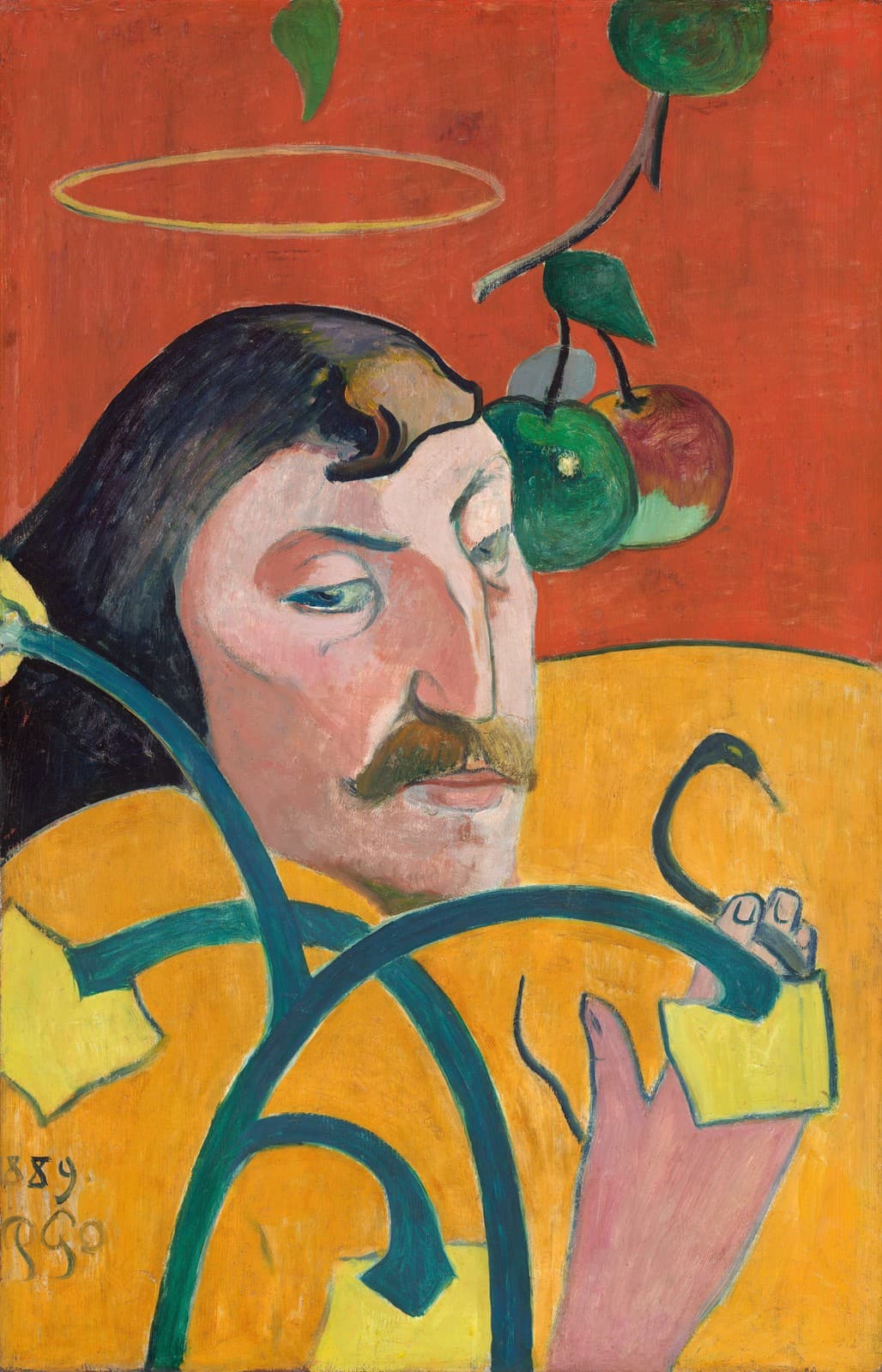
Paul Gauguin painted this self-portrait on a wooden panel at Le Pouldu, Brittany, in 1889: his own head between a halo and hanging apples, a snake threading his fingers, on flat planes of red and yellow. Saint and tempter on one panel. It is in the National Gallery of Art, Washington, from the Chester Dale Collection.
Gauguin's disembodied head, seen in profile-turned-three-quarter with heavy lids and a hooked nose he exaggerated on purpose, floats between two flat fields — red above, yellow below — divided by a wavering line. A thin gold halo hangs over his head. Apples dangle from a branch beside him. Between the fingers of his raised hand runs a small snake, and stylized plants cut across the lower field.[1]
The panel was painted for the dining room of Marie Henry's inn at Le Pouldu, the Breton village where Gauguin and his circle decorated the walls in the winter of 1889.[1]
Saint and tempter
The props are the Garden of Eden's: apples, serpent — and a halo. Gauguin cast himself as both parties to the Fall at once, the tempted saint and the tempting devil, and did it with a straight face that is also a joke. The National Gallery of Art reads the panel as the clearest statement of the persona he built across his self-portraits: outsider, 'savage,' martyr, seducer, whichever the occasion required.[1]
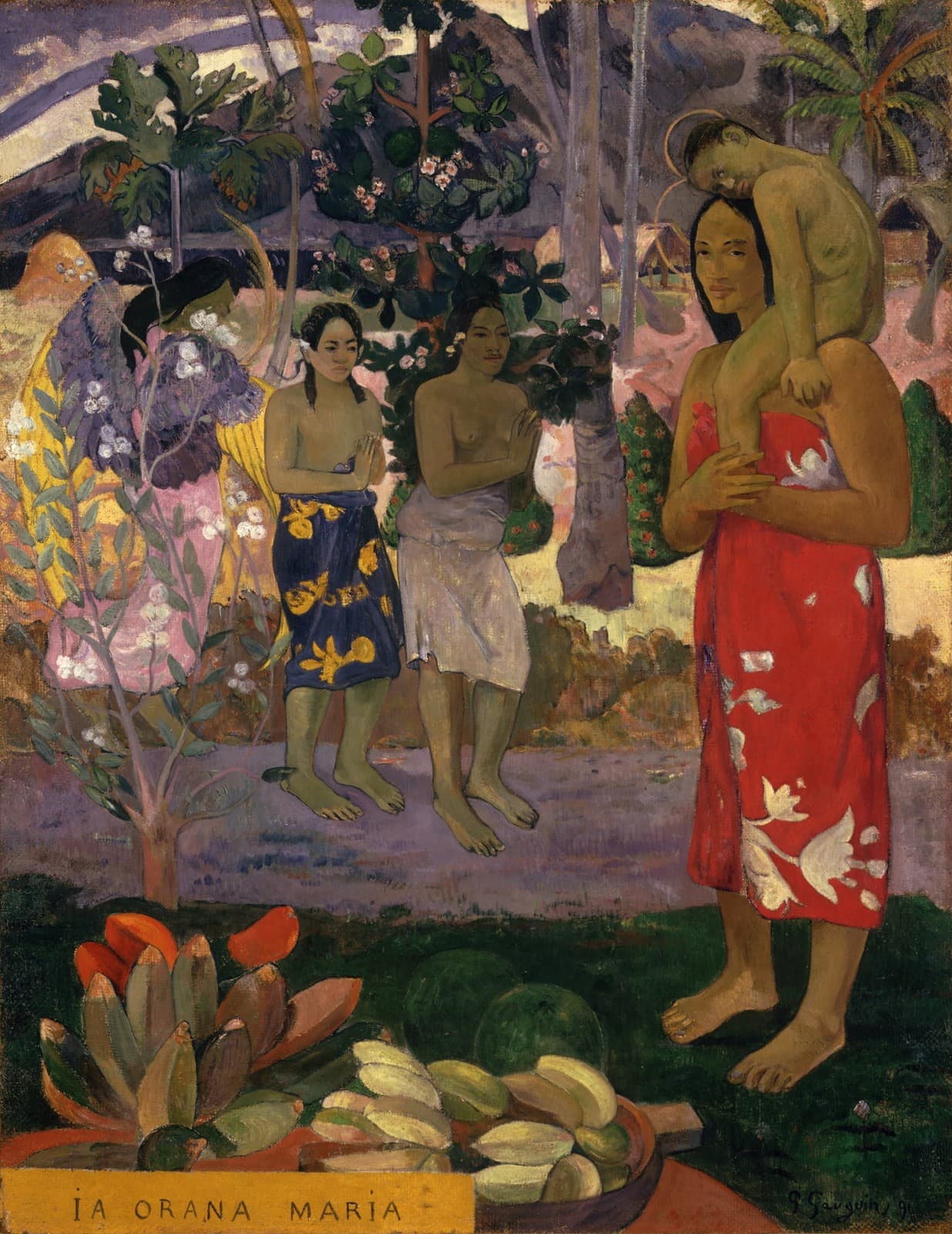
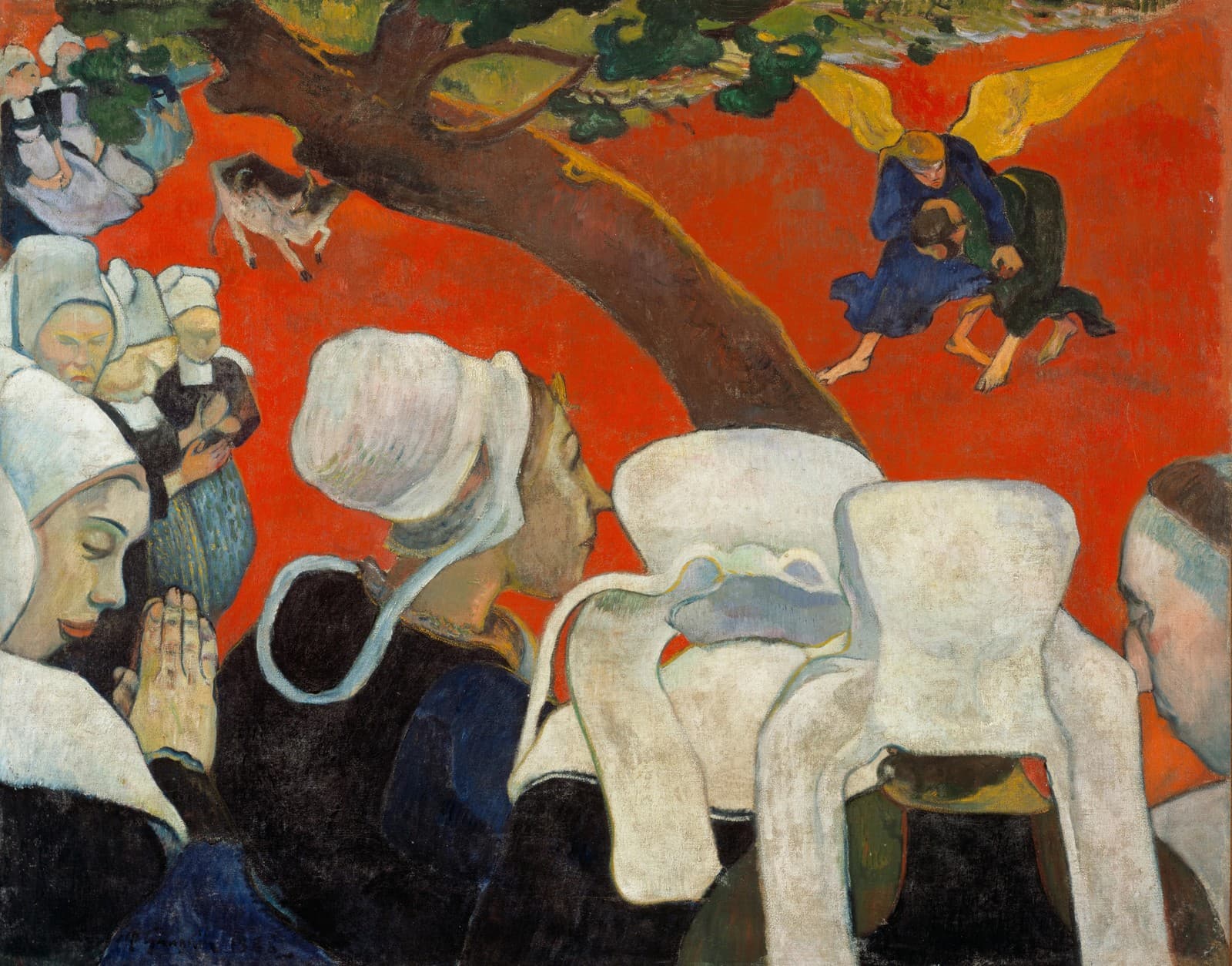
The self-mythologizing was strategic. Gauguin understood that the story of Paul Gauguin helped sell the art of Paul Gauguin, and the self-portraits were the story's illustrations. This one, painted the year after Vision of the Sermon, announces the artist as a spiritual figure operating outside ordinary rules — the exact claim his move to Polynesia two years later was meant to embody.[2]
Reading the picture, detail by detail
On a panel this stylized, the personality lives in the particulars. Four details, enlarged.
Detail: the eyes, cast down and sideways in a look that is either penitent or plotting — he made sure it could be both. The nose is exaggerated on purpose; the apple hangs an inch away. — Paul Gauguin, Self-Portrait with Halo and Snake (detail), National Gallery of Art, Washington; via Wikimedia Commons
The eyes settle the panel's tone. They are cast down and sideways in a look that reads as penitence from one angle and plotting from the other — and Gauguin, who exaggerated his own nose into a hook and hung the apple an inch from his face, made sure both readings survive. The saint's modesty and the tempter's appraisal share one glance.
Detail: the halo, a thin gold hoop floating over the wave of his hair, with the apples of Eden hanging beside it on their stems. Sainthood, worn at an angle. — Paul Gauguin, Self-Portrait with Halo and Snake (detail), National Gallery of Art, Washington; via Wikimedia Commons
The halo is a single thin hoop of gold, floated over the wave of his hair at a slightly rakish angle, with Eden's apples hanging beside it on jointed stems. Sanctity is worn here the way a hat is worn. The flat red field around it refuses any suggestion that this is happening somewhere real.
Detail: the snake, held between two fingers like a cigarette. The tempter's serpent, handled with the boredom of a man who has told this joke before and still enjoys it. — Paul Gauguin, Self-Portrait with Halo and Snake (detail), National Gallery of Art, Washington; via Wikimedia Commons
The snake hangs between two fingers with the offhandedness of a held cigarette. Handling the serpent of the Fall this casually is the panel's best joke and its declaration: the artist claims familiarity with temptation, professional familiarity, the way a snake-handler is familiar with snakes.
Detail: the branch on red. A stem curves across the upper field with the flat, outlined economy of a Japanese print — pure ornament, painted with the same seriousness as the face. — Paul Gauguin, Self-Portrait with Halo and Snake (detail), National Gallery of Art, Washington; via Wikimedia Commons
And one detail with no theology at all: a plant stem curving across the red with the outlined economy of a Japanese print, leaves flattened to pure shape. The panel was painted as dining-room decoration at Marie Henry's inn, and this passage remembers that — ornament made with total seriousness, which was one of Gauguin's lasting arguments.
More details
5.The hair cuts a dark shape into the red
Blue and green strokes run through the dark hair, but its outer edge reads as one continuous shape against the red. The pale cheek presses forward beside it. Gauguin gives the head weight through these adjoining colors, with little need for a shadow behind the sitter.
6.The signature sits among the curling lines
Near the lower edge, the small marks of the date and signature sit beside much thicker green curves. Both occupy the yellow surface without opening a view into a room. The painter's written name becomes another visible mark in a portrait already crowded with signs.
How it is painted
The panel is Synthetism at its most extreme: two flat, unmodulated fields of red and yellow with no depth at all, contours carrying every form, the face alone modeled. The undulating divide between the color zones and the cut stems of the plants come from the Japanese prints Gauguin studied; the whole design reads as ornament first and portrait second, which suits a panel painted as furniture for an inn's dining room.[1]
Painting on wood rather than canvas mattered to him. Gauguin refused the hierarchy that put oil-on-canvas above the decorative arts — he carved, made ceramics, and cut woodblocks all his life — and the Le Pouldu dining room treated painting as decoration without embarrassment.[2]
What it led to
The panel's flat color fields and contour drawing fed straight into the Nabis, who treated it as proof that a picture could be ornament and statement at once. Its theatrical self-presentation — the artist as his own myth — became a durable modern genre; the self-portraits of the Expressionists and of Frida Kahlo's generation descend from this kind of staged identity.
Chester Dale bought the panel in 1928, and it entered the National Gallery of Art with his collection in 1963.[1]
Timeline
1889
Painted at Le Pouldu, Brittany, as part of the decoration of the dining room at Marie Henry's inn.
1891
Gauguin sails for Tahiti, taking the outsider persona with him.
1928
Acquired by the American collector Chester Dale.
1963
Enters the National Gallery of Art, Washington, with the Chester Dale bequest.
Where to see it
National Gallery of Art, Washington
Constitution Avenue NW, between 4th and 6th Streets, Washington, DC 20565, United States
The West Building entrance is at 6th Street; the East Building entrance is at 4th Street. Check the museum’s current display information for the work’s building and gallery.
The National Gallery of Art in Washington, D.C., where it arrived in 1963 with the Chester Dale Collection.
What does the halo and snake mean?
They are the Garden of Eden's props — halo for the saint, snake and apples for the temptation — and Gauguin gave himself all of them at once. The panel casts the artist as both holy man and tempter, the double persona he cultivated across his self-portraits, delivered with a deadpan that is also a joke.
Why did Gauguin paint himself so often?
Because his public identity was part of the work. Across the self-portraits he appears as rebel, outsider, 'savage,' martyr, and here as saint-and-tempter — a deliberate mythology he authored himself, knowing the legend of Paul Gauguin helped sell the paintings of Paul Gauguin.
What was Le Pouldu?
A small Breton coastal village where Gauguin and painters of his circle stayed in 1889–90, after Pont-Aven grew crowded. They decorated the dining room of Marie Henry's inn with paintings and panels; this self-portrait, painted on wood, was part of that scheme.
What style is the painting?
Synthetism at its flattest: two unmodulated fields of red and yellow, forms carried by contour, no depth, with design elements taken from Japanese prints. Only the face is modeled. It is as close to pure decoration as Gauguin's self-portraiture ever came.
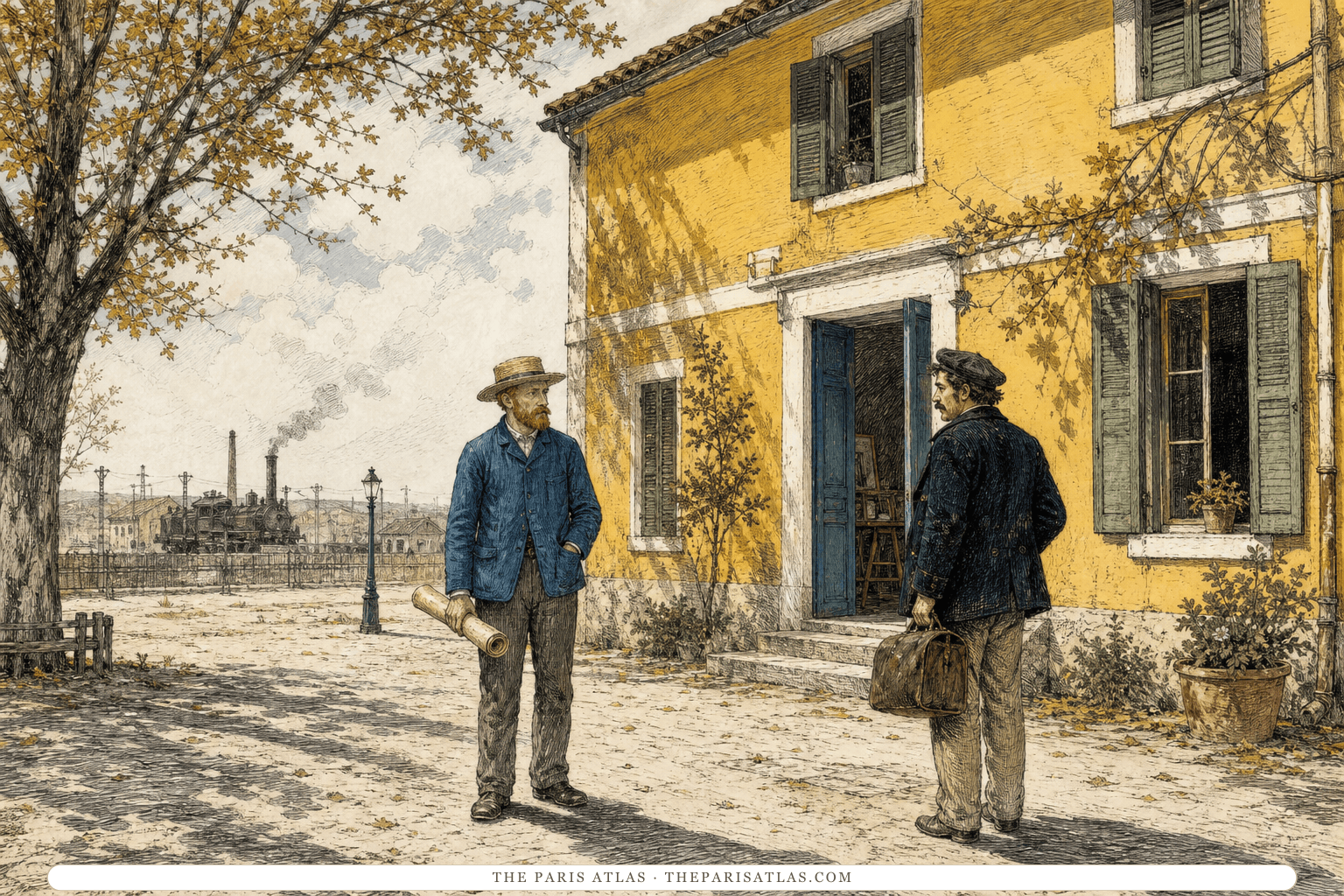
Van Gogh wanted a brotherhood of painters in the south. He got Paul Gauguin, nine weeks of side-by-side work, and the most famous quarrel in modern art. What the evidence supports, what only Gauguin's memoir claims, and what the sunflowers meant — round by round.
Explore painters from the same movements and circles.
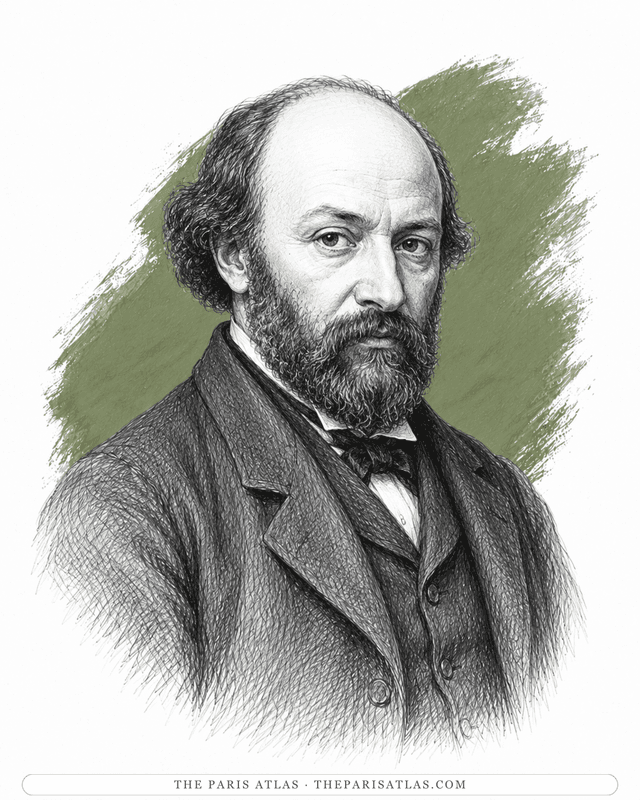
Paul Cézanne
Painter between Impressionism and everything after — shown in the independents' exhibitions, emulated by the Cubists, and present at the Orangerie through 15 works in the Walter-Guillaume collection.
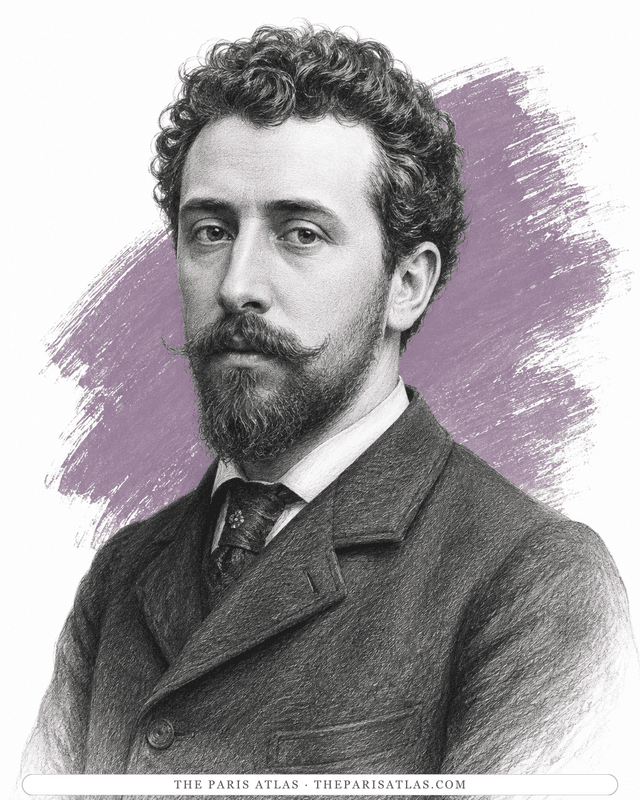
Parisian painter who built pictures from small dots of pure colour on optical principle, co-founded the Salon des Indépendants, and detonated the last Impressionist exhibition of 1886 with A Sunday on La Grande Jatte. He died at thirty-one.
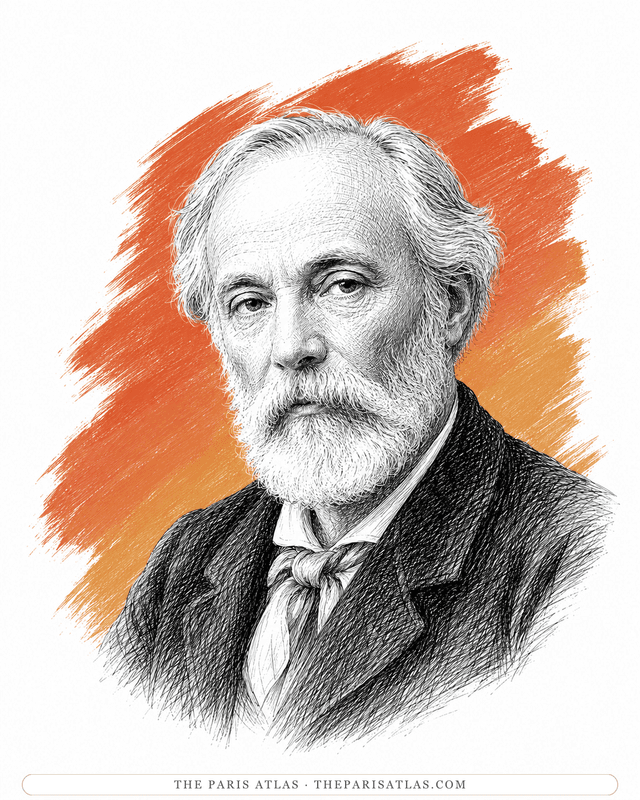
Porcelain painter turned co-founder of Impressionism — the painter of the Moulin de la Galette dance and the Luncheon of the Boating Party, whose later classical turn reached Picasso and Matisse.
Detail: the branch on red. A stem curves across the upper field with the flat, outlined economy of a Japanese print — pure ornament, painted with the same seriousness as the face.1889 · Paul Gauguin, Self-Portrait with Halo and Snake (detail), National Gallery of Art, Washington; via Wikimedia Commons · Public domainDetail: the eyes, cast down and sideways in a look that is either penitent or plotting — he made sure it could be both. The nose is exaggerated on purpose; the apple hangs an inch away.1889 · Paul Gauguin, Self-Portrait with Halo and Snake (detail), National Gallery of Art, Washington; via Wikimedia Commons · Public domainDetail: the halo, a thin gold hoop floating over the wave of his hair, with the apples of Eden hanging beside it on their stems. Sainthood, worn at an angle.1889 · Paul Gauguin, Self-Portrait with Halo and Snake (detail), National Gallery of Art, Washington; via Wikimedia Commons · Public domainDetail: the snake, held between two fingers like a cigarette. The tempter's serpent, handled with the boredom of a man who has told this joke before and still enjoys it.1889 · Paul Gauguin, Self-Portrait with Halo and Snake (detail), National Gallery of Art, Washington; via Wikimedia Commons · Public domain
References
References
The sources below include collection records, catalogues, scholarly research, and primary materials that informed this page. They document Self-Portrait with Halo and Snake, its making, and its place in cultural history.
1abcdeSelf-Portrait (with Halo and Snake), Paul Gauguin, 1889
Website
National Gallery of Art, Washington
Used for
Web source consulted for documented facts and historical context presented on the Self-Portrait with Halo and Snake page.
These references provide the documented foundation for this work's history and interpretation. Claim-level citations remain attached to the specific claims they support.


 View source