Nafea faa ipoipo? (When Will You Marry?)
by Paul Gauguin
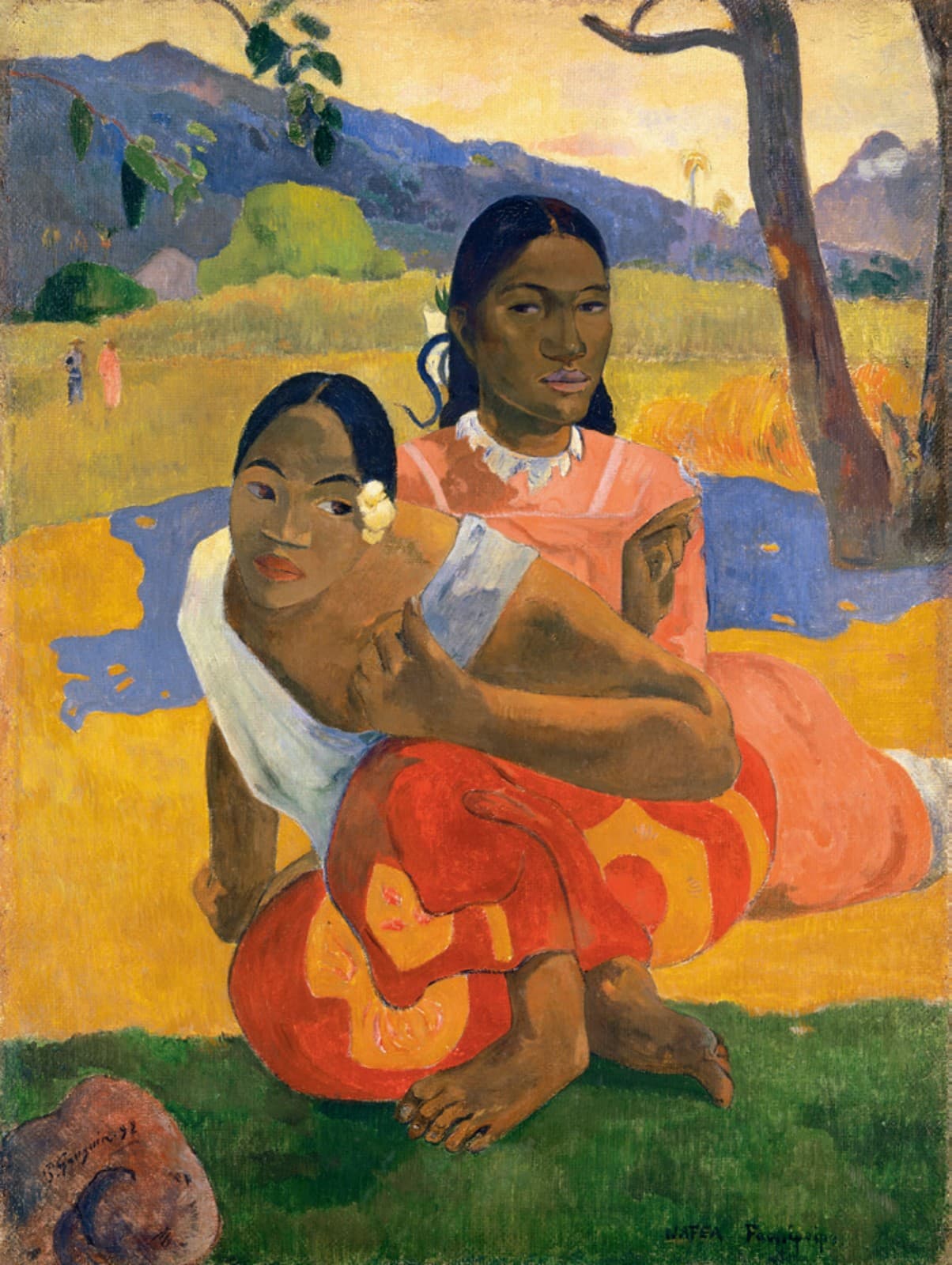
Two Tahitian women on a hillside, painted in 1892: the younger in a traditional pareu with a white tiare flower behind her ear, the older behind her in the high-necked dress of the missions. The Tahitian title asks the question — when will you marry? For decades it hung on loan at the Kunstmuseum Basel; it is now in a private collection.
- 1892
- Oil on canvas
About Paul Gauguin
What the painting shows
Two women rest on a hillside of banded color — pink earth, green scrub, blue mountain. The younger, in front, crouches in a blue pareu with a white tiare flower behind her ear; the older sits behind her in the high-collared pink dress the missionaries brought, one hand raised in a gesture Gauguin borrowed from Buddhist art. The Tahitian question of the title is inscribed at the lower left with the signature.
By the usual reading the flower marks the younger woman as seeking a husband, and the title puts the question in the mouth of the elder — or of the island's expectations generally.
Two Tahitis in one frame
The two costumes are the picture's real subject. Pareu and tiare in the foreground, mission dress behind: the Tahiti Gauguin came looking for and the colonial, Christianized Tahiti he actually found, seated one behind the other on the same hill. Whether he intended the contrast as observation or elegy, it records precisely the collision his whole Tahitian project was built on — the paradise of his imagination assembled inside a colony where that paradise no longer existed, if it ever had.[1]
The question-title is characteristic. Gauguin gave many Tahitian canvases titles in a language he spoke imperfectly, half caption and half mystification, and rarely answered the questions they posed. The ambiguity was deliberate: he wanted pictures that kept the viewer asking.[2]
Reading the picture, detail by detail
The picture's question is asked and answered in its details. Four, enlarged from the canvas.
The two faces carry the whole drama. The younger woman glances sideways, out of the frame, the white tiare at her ear announcing — by the usual reading — that she is looking for a husband; she does not look at us. The elder does, directly, from behind, with a hand already lifting. Between the two gazes sits the title's question, and whoever is asking it.
The elder's costume is the colonial record in pink: the high-collared dress the Christian missions put on Tahitian women. Her raised hand makes a gesture Gauguin took from Buddhist art — one more import laid over the island. In a single figure, the picture holds the Tahiti that missionaries made and the Asia that Gauguin's photograph file supplied.
The younger woman crouches in the traditional pareu, red printed with gold, bare feet pressing the green. This is the Tahiti Gauguin sailed for — worn as clothing in the foreground of the colonial island he actually found, and painted with the flat, saturated conviction he reserved for the world he preferred.
He signed the painting on a stone — P. Gauguin 92, lettered onto the rounded rock beside a bare foot — as if the island itself had taken his name. It is a small joke and a large claim, and entirely in character for a painter who invented the place he claimed to be documenting.
More details
5.The distant figures establish the scale of the field
The distant figures are reduced to narrow upright strokes of pink and blue. They barely interrupt the wide yellow field, yet their size immediately places the seated women much nearer. Gauguin needs only these small bodies to give depth to land otherwise organized in broad bands of color.
6.The tree interrupts the colored bands
A dark trunk rises through the hill and sky, then forks into blunt, widely spaced branches. Its vertical shape interrupts the long horizontal bands behind the women. The tree frames the seated group while keeping the bright background from reading as an unbroken wall of color.
How it is painted
The landscape is stacked in flat bands of high color with no conventional depth — pink against green against blue — and the two figures are locked into the pattern as interlocking shapes, contours heavy, modeling minimal. The composition's calm geometry, with the pyramidal pairing of the women, shows Gauguin at his most decoratively controlled.[2]
The color is not Tahiti's; it is his. Ground does not need to be earth-colored if pink serves the design better — the Synthetist principle carried to the tropics.
Where it went
The canvas returned to Europe with Gauguin in 1893 and eventually entered the Basel collection of Rudolf Staechelin, from which it hung on long-term loan at the Kunstmuseum Basel for decades — the Gauguin generations of Basel visitors knew best. In 2015 the Staechelin family sold it privately, and it has since been reported in a private collection.
Its two-figure, two-worlds design echoes through the later Tahitian work, and its fame — amplified by the 2015 sale — has made it one of the most reproduced images of the first Tahitian stay.
Timeline
1892
Painted during the first Tahitian stay.
1893
Returns to Europe with Gauguin for the Paris exhibition of the Tahitian work.
20th century
Enters the Rudolf Staechelin collection, Basel, and hangs for decades on loan at the Kunstmuseum Basel.
2015
Sold privately by the Staechelin family; since reported in a private collection.
Where to see it
A viewing location has not yet been listed for this work.
Frequently asked questions
What does Nafea faa ipoipo mean?
'When will you marry?' in Tahitian. Gauguin inscribed the question on the canvas beside his signature. By the usual reading, the white tiare flower behind the younger woman's ear marks her as seeking a husband, and the title voices the question hanging over her.
Where is When Will You Marry now?
In a private collection. For decades it hung on long-term loan at the Kunstmuseum Basel from the collection of Rudolf Staechelin; the Staechelin family sold it privately in 2015.
What do the two women's clothes mean?
They put two Tahitis in one frame. The younger woman wears the traditional pareu with a tiare flower; the older wears the high-collared dress the Christian missions brought. Whether read as observation or elegy, the pairing records the collision between the Tahiti of Gauguin's imagination and the colonial island he actually found.
Why did Gauguin title paintings in Tahitian?
Half caption, half mystification. He spoke the language imperfectly — some titles are grammatically irregular — but the Tahitian words insisted on the world he claimed to be painting and kept European viewers at a deliberate distance. Many of the titles are questions he never answers.
What style is the painting?
Synthetism in its Tahitian register: the hillside stacked in flat bands of pink, green, and blue, the two figures locked into the pattern with heavy contours and minimal modeling, color chosen for design rather than description.
More by Paul Gauguin
If you like Paul Gauguin
Explore painters from the same movements and circles.
Paul Cézanne
Painter between Impressionism and everything after — shown in the independents' exhibitions, emulated by the Cubists, and present at the Orangerie through 15 works in the Walter-Guillaume collection.
View artist
Georges Seurat
Parisian painter who built pictures from small dots of pure colour on optical principle, co-founded the Salon des Indépendants, and detonated the last Impressionist exhibition of 1886 with A Sunday on La Grande Jatte. He died at thirty-one.
View artist
Pierre-Auguste Renoir
Porcelain painter turned co-founder of Impressionism — the painter of the Moulin de la Galette dance and the Luncheon of the Boating Party, whose later classical turn reached Picasso and Matisse.
View artist
In images
References
The sources below include collection records, catalogues, scholarly research, and primary materials that informed this page. They document Nafea faa ipoipo? (When Will You Marry?), its making, and its place in cultural history.


1↑Gauguin – Tahiti, The Workshop of the Tropics
WebsiteMusée d'OrsayUsed forThe Musée d'Orsay resource documents Gauguin's Tahitian workshop and the circumstances surrounding this body of work.
3Paul Gauguin (1848–1903)
WebsiteNational Gallery, LondonUsed forWeb source consulted for documented facts and historical context presented on the Nafea faa ipoipo? (When Will You Marry?) page.
4Gauguin exhibition brochure
WebsiteNational Gallery of Art, WashingtonUsed forThe National Gallery of Art's scholarly Gauguin publication provides additional museum context for his Tahitian figures and symbolism.
5Nafea faa ipoipo, el conocido óleo de Gauguin recientemente vendido, ya se puede ver en el Museo Reina Sofía
WebsiteMuseo Nacional Centro de Arte Reina Sofía, 2015Used forThe Museo Reina Sofía's press note on the painting, written when it hung in Madrid in 2015, describes the two figures and the flower behind the younger woman's ear, records that Rudolf Staechelin bought the canvas from the Geneva gallery Maison Moos around 1917–18, and states that the collection has been at the Kunstmuseum Basel since 1956.

6Jahresbericht 2015 der Öffentlichen Kunstsammlung Basel, Kunstmuseum und Museum für Gegenwartskunst
Official recordKunstmuseum BaselUsed forThe Kunstmuseum Basel's own annual report for 2015 records the loss of Gauguin's Nafea faa ipoipo and the departure of seventeen further paintings belonging to the Rudolf Staechelin Family Trust.
7Gauguin masterpiece to leave Basel art museum
PeriodicalSWI swissinfo.ch, 2015Used forContemporaneous report from the Swiss public broadcaster, 5 February 2015, on the Staechelin trust ending its loan to the Kunstmuseum Basel and selling the painting to an undisclosed buyer for an undisclosed sum.
8Staechelin & Ors v ACLBDD Holdings Ltd & Ors [2019] EWCA Civ 817
Official recordThe National Archives, Find Case Law, 2019Used forThe English Court of Appeal judgment in the commission dispute that followed the sale. It is the record that states the price: the trustees of the Rudolf Staechelin Family Trust sold Nafea faa ipoipo for $210 million, not the $300 million reported in 2015.
9Swiss Collections Journey to the United States for Once-in-a-Lifetime Exhibition
WebsiteThe Phillips Collection, 2015Used forThe Phillips Collection's press release for the 2015–16 Staechelin and Im Obersteg exhibition, which showed the painting in Washington before it passed to its new owner.
10Media Release: The Rudolf Staechelin Collection, 31 August – 29 October 2019
WebsiteFondation Beyeler, 2019Used forThe Rudolf Staechelin Family Trust's own announcement of what happened to the rest of the collection: nineteen paintings returned to Basel in 2019, four years after leaving the Kunstmuseum Basel, on a ten-year loan to the Fondation Beyeler.
These references provide the documented foundation for this work's history and interpretation. Claim-level citations remain attached to the specific claims they support.
 Explore more resources