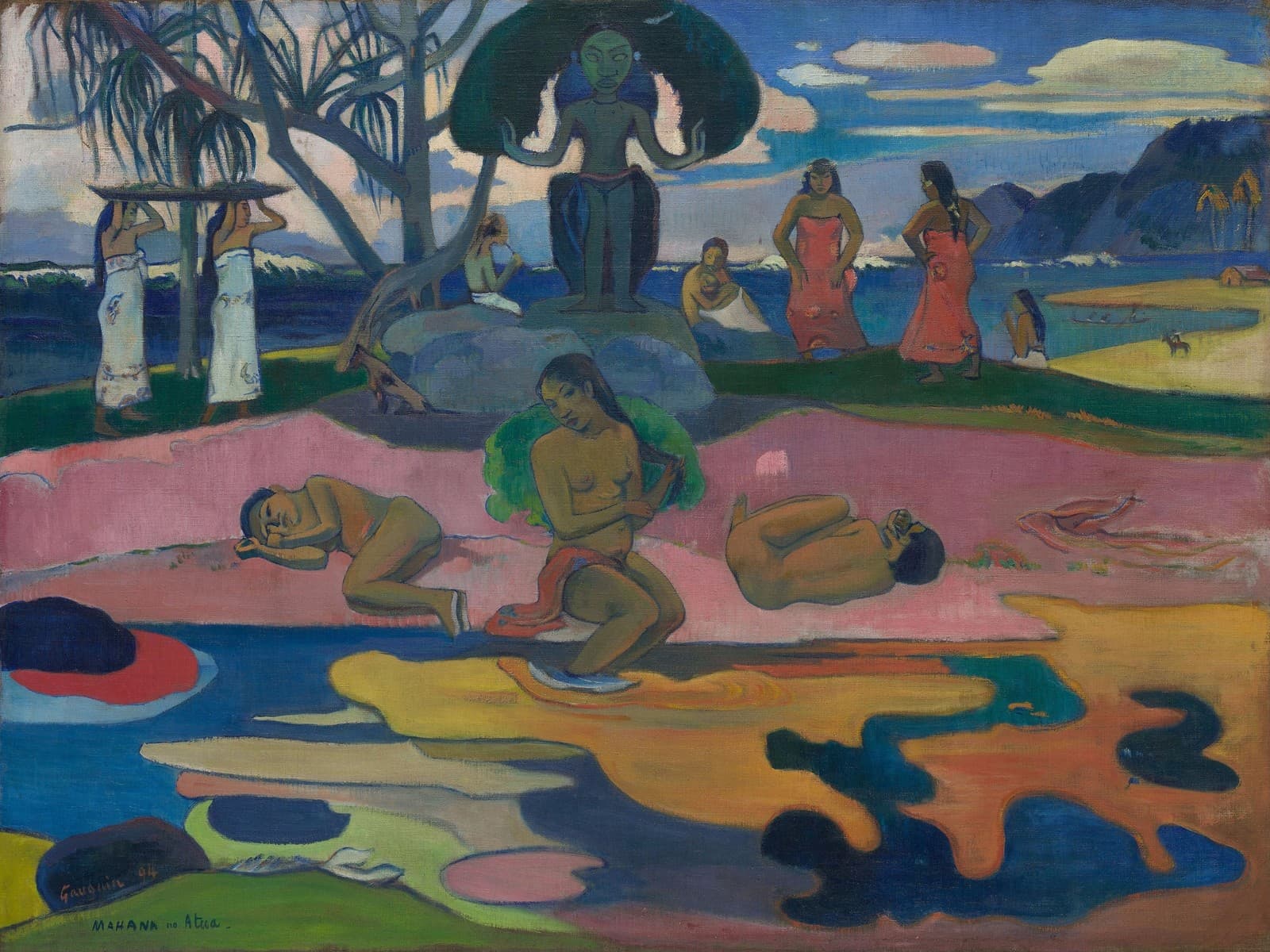
Mahana no atua (Day of the God)
by Paul Gauguin
Gauguin painted this Tahitian scene in Paris in 1894, between his two Pacific stays: a carved idol presides over bathers on a beach, and the pool in the foreground breaks into pure shapes of color that stop describing anything at all. It is in the Art Institute of Chicago.
- 1894
- Oil on canvas
About Paul Gauguin
What the painting shows
A monumental carved idol stands at the center of a beach, arms raised — the goddess Hina of Gauguin's invented pantheon. Around her the scene arranges itself with ceremonial symmetry: women carry offerings, a flute player sits in the middle distance, dancers cross the sand, and three bathers occupy the foreground shore, one dipping her feet in the pool.[1]
The pool itself is the strangest passage. Its surface breaks into interlocking shapes of pink, yellow, green, and violet that answer to no reflection and no light — color set free from anything it might describe.[1]
Tahiti, remembered from a Paris studio
Gauguin was not in Tahiti when he painted this. He was in Paris, between the two stays, working the island up from memory, drawings, and the same borrowed sources as ever — the idol is his own composite deity, closer to the photographs of Asian sculpture he carried than to anything documented on Tahiti. The Art Institute of Chicago calls the scene more imaginative than real, which is exact: it is the Tahiti of his pictures, not of the colony he had left.[1]
The ceremonial symmetry is the meaning. Where the actual island had missionaries and administrators, the painting installs a functioning cult — idol, offerings, music, ritual bathing — an ancient religious day that Gauguin never witnessed because it did not exist in his time. It is his clearest painting of the Polynesia he wanted rather than the one he found.
Reading the picture, detail by detail
The small canvas is built in layers — god, people, water — and each layer plays by different rules. Four details, enlarged.
The idol's face is green, its eyes pale and open, its arms curved outward with white flame-shapes rising behind the hands. No documented Tahitian cult ever carved it: Gauguin assembled his deity from a European book about Polynesia and photographs of Asian sculpture, and painted it presiding as if it had stood on this beach forever. The confidence of the invention is the point.[1]
The three bathers on the pink sand are the picture's middle register — one wringing out her hair, one curled asleep like an unborn child, the third dangling her feet into the yellow water. Read left to right they have been taken for a cycle of life conducted at the god's feet, with the ritual bathing feeding the pool below.[1]
On the shore path, two women in pale printed cloth carry offerings toward the idol; below them a figure sleeps face-down on the pink sand. The rite proceeds whether or not its congregation stays awake — Gauguin's invented religion includes, honestly, the human capacity to nap through it.
And then the bottom of the picture stops describing anything at all. The pool breaks into flat interlocking shapes — yellow, pink, green, blue — that answer to no reflection, no light, no object. Art historians point to this strip of water when they argue about where abstraction begins, and seen alone it makes the case by itself.[1]
More details
5.The standing figures answer the seated group
The upright red dresses make a compact group against the blue distance. Their long vertical forms contrast with the curled and seated bodies on the pink shore below. Gauguin uses posture and color to distinguish the two groups before the viewer has identified any particular gesture.
6.The branches break up the sky
Thin branches cross the pale sky in a web of diagonals. The hanging leaves divide the open areas into smaller, irregular shapes, unlike the broad clouds farther right. This busy canopy concentrates movement at the edge of a scene whose central figure stands rigidly upright.
The pool at the bottom of the picture
The foreground water is the most radical passage Gauguin ever painted. Its flat, contoured shapes of arbitrary color — pink beside acid yellow beside violet — abandon description entirely and function as pure design, decades before abstraction had a name. Art historians point to this pool when tracing the road from Synthetism toward non-representational painting.[1]
Above it the picture stays legible: banded sand, sea, and sky, figures locked in profile like a frieze, the heavy contours and flattened space of the mature manner. The canvas is small — 66 by 87 centimeters — and painted with jewel-like density.[1]
What it led to
The pool's escape from description made the painting a touchstone for later argument about where abstraction began; it is routinely reproduced in histories of modern art for that foreground alone. The invented cult imagery fed the Symbolists immediately and the primitivist currents of early twentieth-century art after them, with all the double edges that word carries.
The canvas entered the Art Institute of Chicago in 1926 with the Helen Birch Bartlett Memorial Collection, one of the great early American collections of Post-Impressionism.[1]
Timeline
1893
Gauguin returns to France from his first Tahitian stay.
1894
Paints Mahana no atua in Paris, from memory and his file of sources.
1895
Leaves France for Tahiti permanently.
1926
Enters the Art Institute of Chicago with the Helen Birch Bartlett Memorial Collection, as 1926.198.
Where to see it
Art Institute of Chicago
111 South Michigan Avenue, Chicago, IL 60603, United States
Displays and loans can change. Check whether this work is on view before making a special trip.
Plan your visit on the museum’s official website (opens in a new tab)Frequently asked questions
What does Mahana no atua mean?
Day of the God, in Tahitian. The god is the central carved idol — the goddess Hina of Gauguin's invented pantheon — presiding over offerings, music, dancing, and ritual bathing on a beach.
Where is Day of the God?
The Art Institute of Chicago, in the Helen Birch Bartlett Memorial Collection since 1926. Its accession number is 1926.198.
Was this painted in Tahiti?
No — in Paris, in 1894, between Gauguin's two Tahitian stays. He worked the scene up from memory, drawings, and the photographs of Asian and Polynesian art he carried; the Art Institute calls it more imaginative than real. The ceremony it depicts is his invention, not a documented Tahitian rite.
Why is the water painted in strange colors?
The foreground pool breaks into flat shapes of pink, yellow, green, and violet that describe no reflection or light — color functioning as pure design. It is one of the earliest passages in European painting to abandon description entirely, and historians of abstraction cite it as a landmark for that reason.
Is the idol a real Tahitian god?
It is Gauguin's composite. He based his 'ancient' Polynesian imagery largely on a European book about the islands and on photographs of Asian sculpture; the Hina of his paintings and carvings is an invention assembled from those sources rather than a documented Tahitian cult image.
More by Paul Gauguin
If you like Paul Gauguin
Explore painters from the same movements and circles.
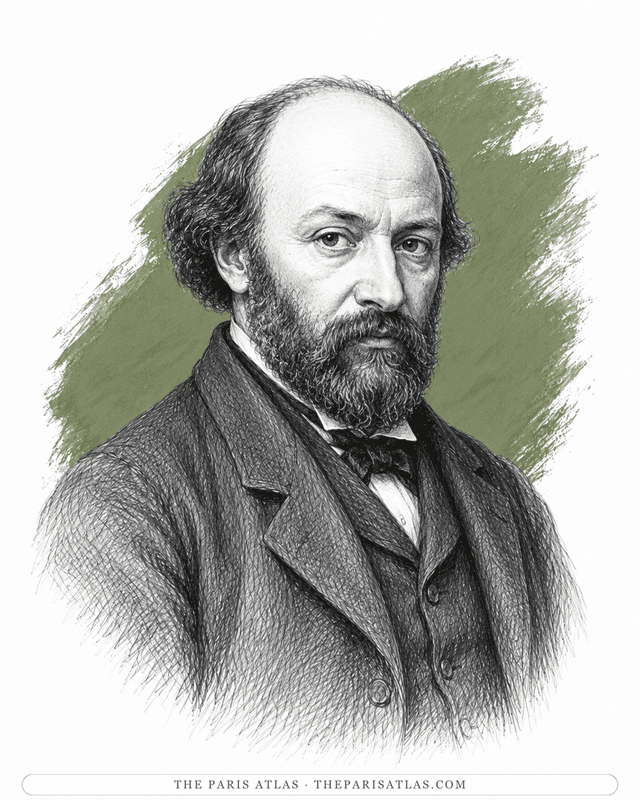
Paul Cézanne
Painter between Impressionism and everything after — shown in the independents' exhibitions, emulated by the Cubists, and present at the Orangerie through 15 works in the Walter-Guillaume collection.
View artist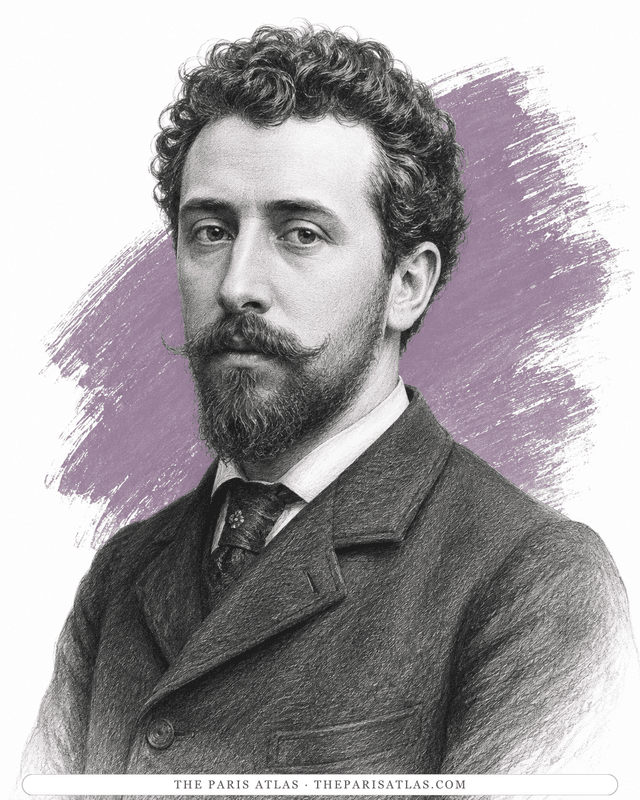
Georges Seurat
Parisian painter who built pictures from small dots of pure colour on optical principle, co-founded the Salon des Indépendants, and detonated the last Impressionist exhibition of 1886 with A Sunday on La Grande Jatte. He died at thirty-one.
View artist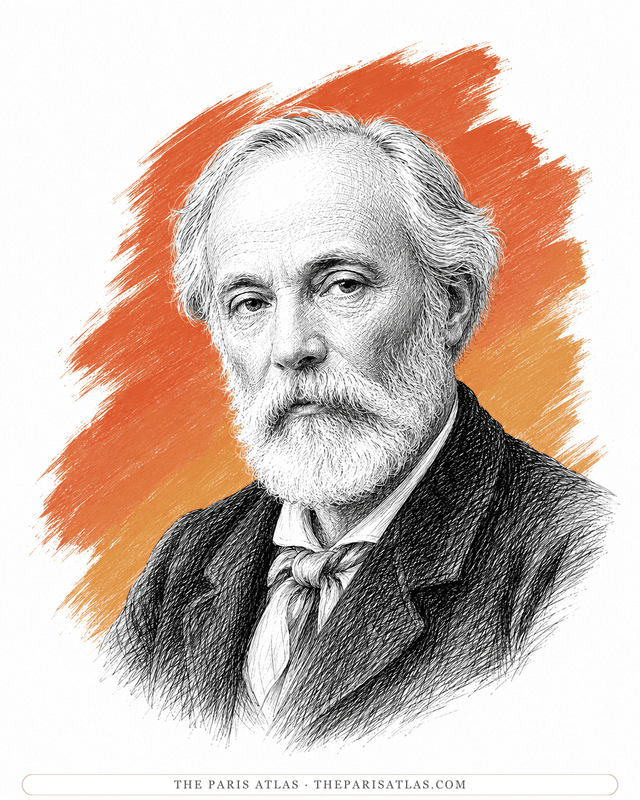
Pierre-Auguste Renoir
Porcelain painter turned co-founder of Impressionism — the painter of the Moulin de la Galette dance and the Luncheon of the Boating Party, whose later classical turn reached Picasso and Matisse.
View artist
In images
References
The sources below include collection records, catalogues, scholarly research, and primary materials that informed this page. They document Mahana no atua (Day of the God), its making, and its place in cultural history.


2Paul Gauguin (1848–1903)
WebsiteThe Metropolitan Museum of ArtUsed forWeb source consulted for documented facts and historical context presented on the Mahana no atua (Day of the God) page.
3Paul Gauguin (1848–1903)
WebsiteNational Gallery, LondonUsed forThe National Gallery's artist profile supplies independent context for Gauguin's Tahitian period and synthetic style.
4Gauguin – Tahiti, The Workshop of the Tropics
WebsiteMusée d'OrsayUsed forThe Musée d'Orsay resource documents the Tahitian workshop, imagery and working conditions behind Gauguin's island paintings.
These references provide the documented foundation for this work's history and interpretation. Claim-level citations remain attached to the specific claims they support.
 Explore more resources