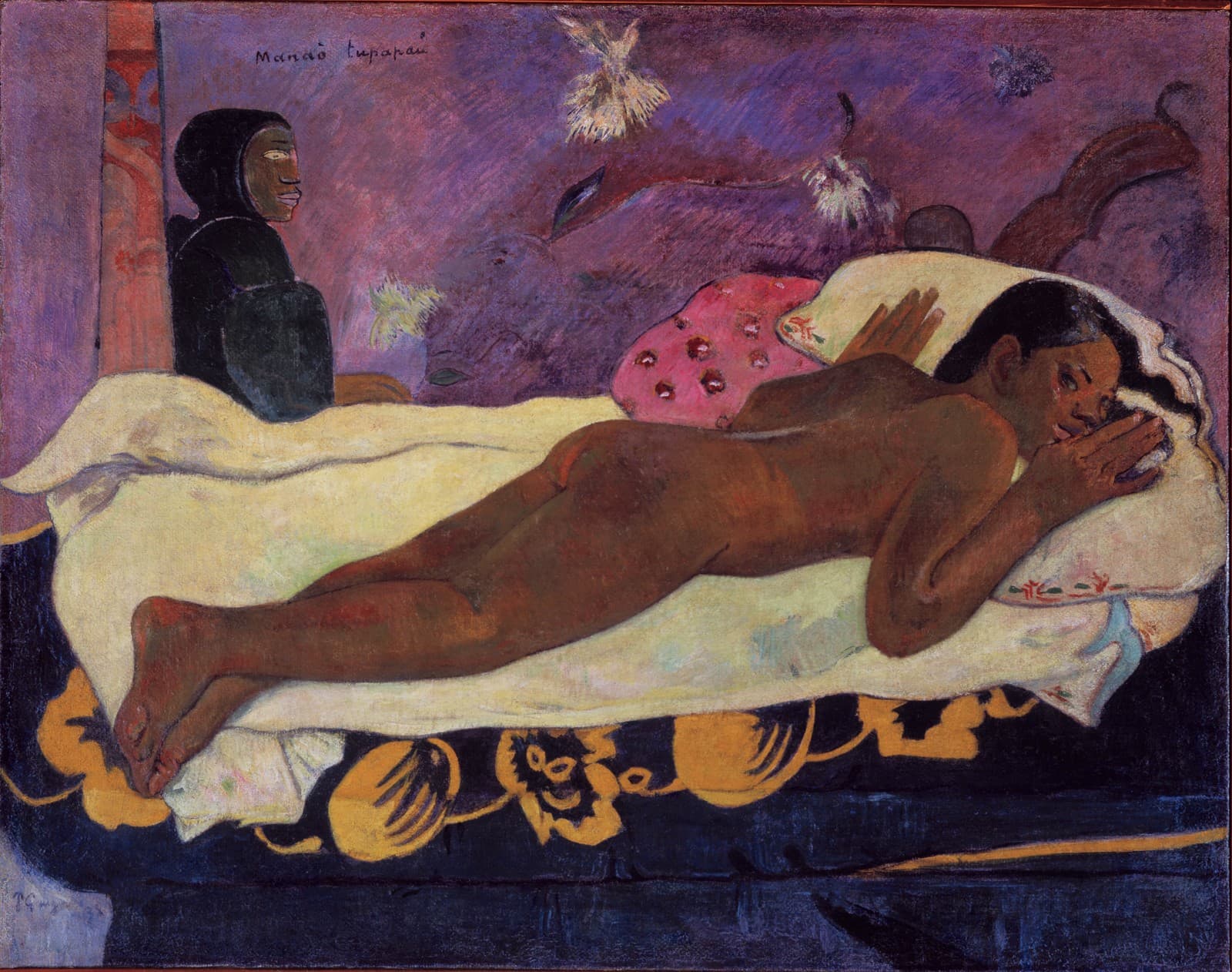
Manao tupapau (Spirit of the Dead Watching)
by Paul Gauguin
Painted in Tahiti in 1892: a young Tahitian woman lies face-down on a bed while the tupapau, the spirit of the dead, sits watching in profile behind her. The sitter is generally identified as Tehamana, the adolescent who lived with Gauguin at Mataiea. The painting, an answer to Manet's Olympia, is in the Buffalo AKG Art Museum.
- 1892
- Oil on canvas
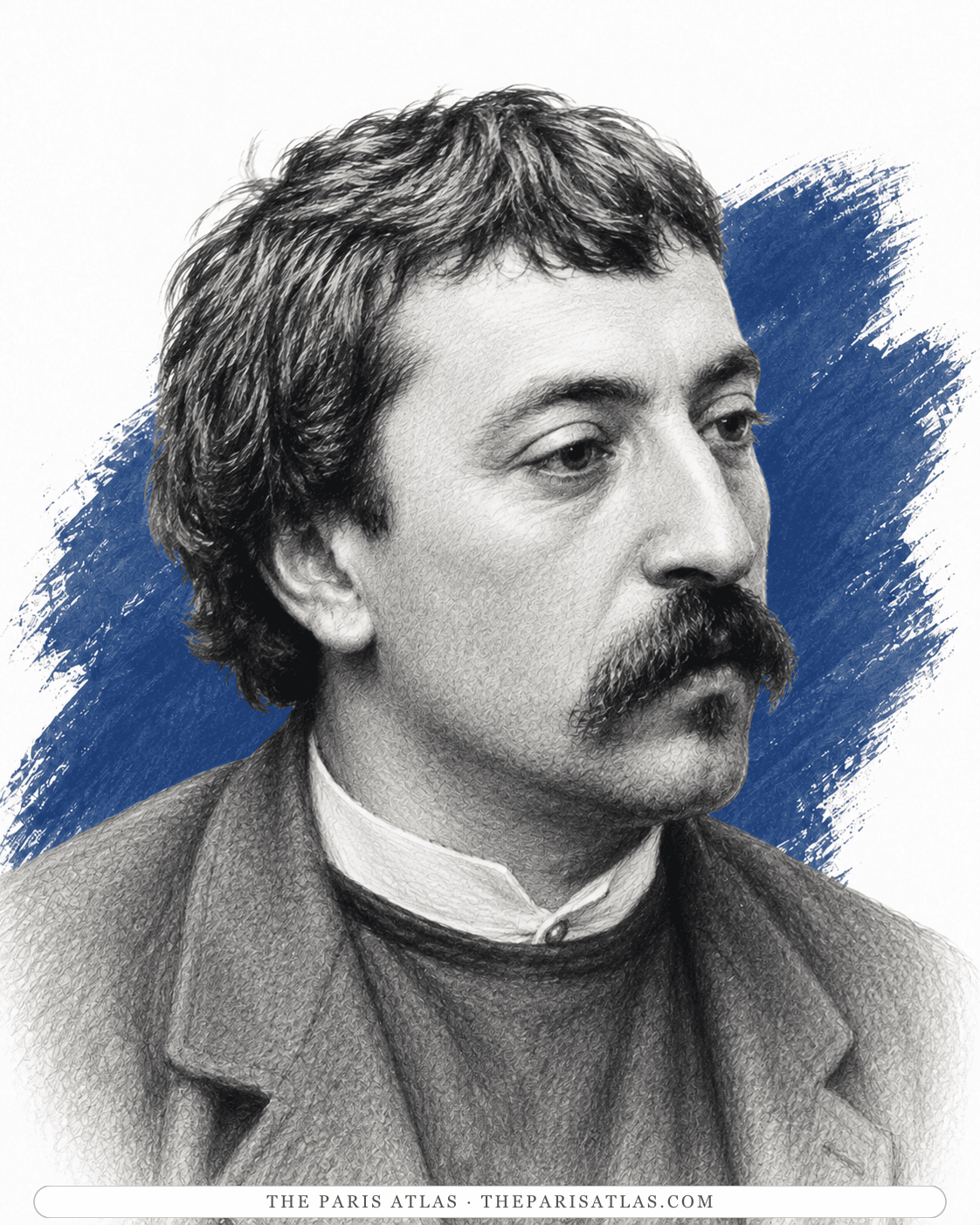
About Paul Gauguin
What the painting shows
A young Tahitian woman lies naked and face-down on a bed, head turned toward the viewer, eyes wide. The sheet under her is pale yellow, the pareu beneath it printed blue. Behind her, in profile against a violet ground scattered with sparks of light, sits a hooded figure in black: the tupapau, the spirit of the dead of Tahitian belief. The Buffalo AKG Art Museum's account is direct — Gauguin said he was painting the Polynesian fear of the spirits of the dead, embodied in the watcher at the bedside.[1]
The sitter is generally identified as Tehamana, the Tahitian adolescent who lived with Gauguin at Mataiea during his first stay.[1]
What Gauguin said it means — twice
Gauguin explained the picture more than once, and hedged it both ways: the girl may be imagining the spirit, or the spirit may be regarding the girl. The title carries the same double sense. He wrote his fullest account in the notebook he kept for his daughter Aline, framing the fear as something he had witnessed — coming home at night, he said, to find the girl rigid with terror of the tupapau in the dark.[1]
The picture is also, deliberately, an answer to Édouard Manet's Olympia, which Gauguin had copied in Paris the year before he sailed. Olympia's confrontational nude faces the viewer from her bed with a servant behind her; Gauguin turned the body over, replaced the servant with a ghost, and traded Manet's cool challenge for fear. The reversal is the point — he wanted a nude whose subject was belief, not display, though the painting has never fully escaped being both.[1]
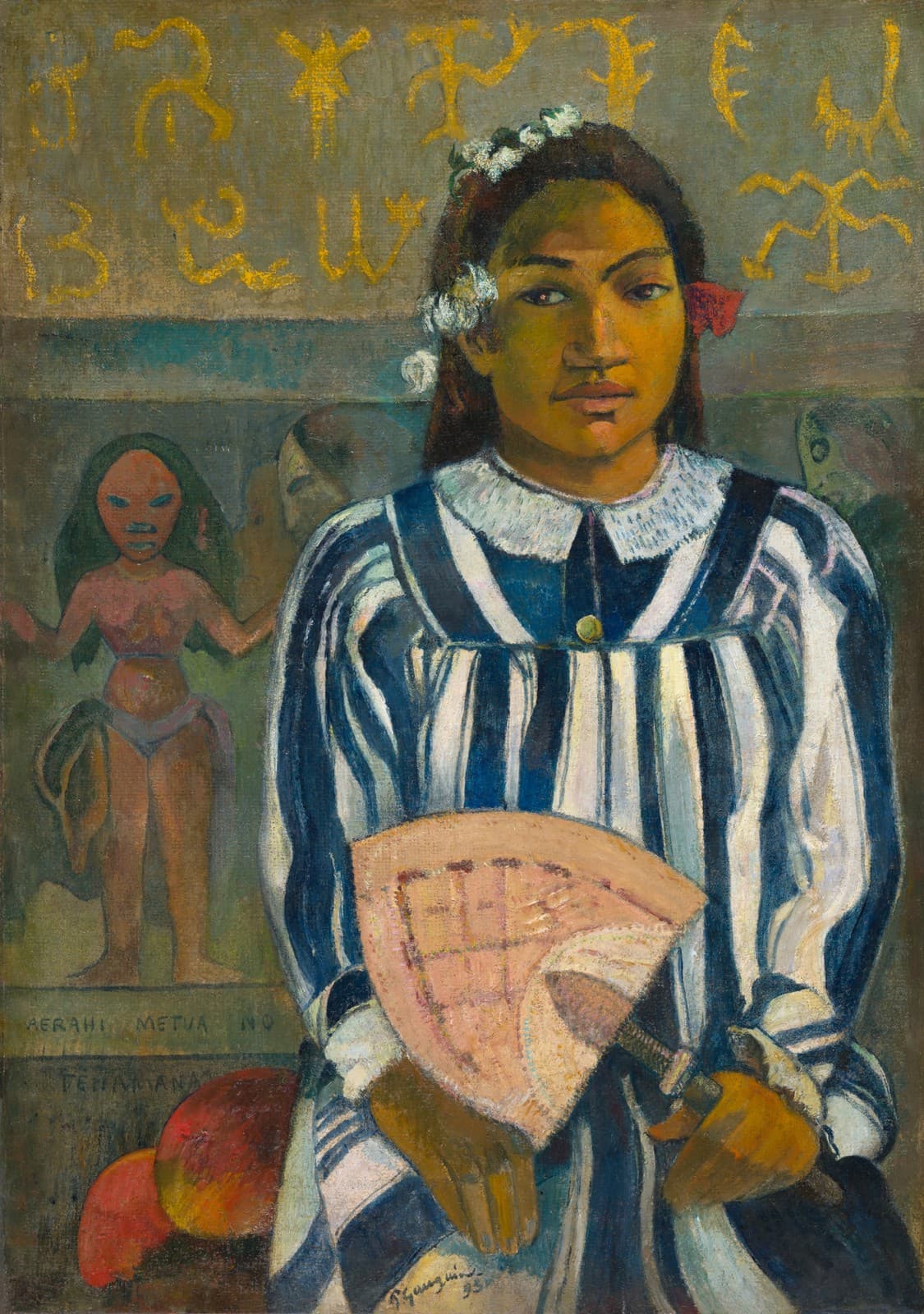
None of this stands outside the colonial facts. The model was an adolescent girl living with a middle-aged French colonist — the Art Institute of Chicago's record for its portrait of Tehamana gives her age as thirteen; recent biography argues about fifteen — and the painting's fame circulated a sexualized image of Polynesian women through Europe. The modern museum literature, Buffalo's included, presents the work and that context together, and so does this page.[2][1]
Reading the picture, detail by detail
The painting's argument lives in its parts. Four details, enlarged from the canvas.
Her eyes first. They are wide open and fixed sideways on the viewer — not on the spirit behind her — with her hands drawn up beside her mouth on the pillow. The fear is held perfectly still, and it implicates whoever is looking: the girl watches the watcher. Every account of the picture's power starts in this exchange.[1]
The tupapau sits in profile by the post, a grey face inside a black hood, and Gauguin paints it as matter-of-factly as he would a neighbor. No transparency, no glow, no theatrical smoke. In the belief the picture depicts, spirits are simply present — and the plain paint takes the belief at its word.[1]
The title is written into the wall itself — Manaò tupapaù, floating on the violet above the spirit's head — beside the pale spark-flowers that dot the darkness. Gauguin wrote that he wanted the background to carry the terror of the night without illustrating it; the sparks are fear rendered as pure color, phosphorescence with no source.[1]
The quietest corner is the most purely painted: the sheet's embroidered edge folding over the blue pareu, yellow flowers burning on the near-black ground. Even in a picture built on dread, Gauguin the decorator keeps working — the bed is beautiful the way the fear is beautiful, in flat, chosen color.
More details
5.The legs stretch against the folds of the sheet
The long legs draw an almost unbroken diagonal toward the left end of the bed. Beneath them, the pale sheet rises and falls in shorter folds. The contrast makes the body appear stretched and held still, while the cloth supplies the small changes of direction around it.
6.A dark band anchors the yellow ornament
Yellow shapes run across the dark blue bedcover like a separate strip of drawing. Their repeated curves answer the larger curves of the body above, but remain emphatically flat. This heavy lower band also gives the bed a firm base beneath the much lighter sheet.
How it is painted
The color carries the fear. The violet ground behind the bed, flecked with phosphorescent sparks, is night as felt rather than seen; Gauguin wrote that he wanted a background that suggested the terror without illustrating it. The girl's body is modeled simply against the flat yellow of the sheet, and the tupapau is painted as plainly as a person — which, in the belief the picture depicts, is exactly what it is.[1]
The composition locks into a few large shapes: the diagonal of the bed, the dark vertical of the spirit, the field of violet. It is the Synthetist machinery — flat zones, symbolic color, compressed depth — turned for the first time to night and dread.
What it led to
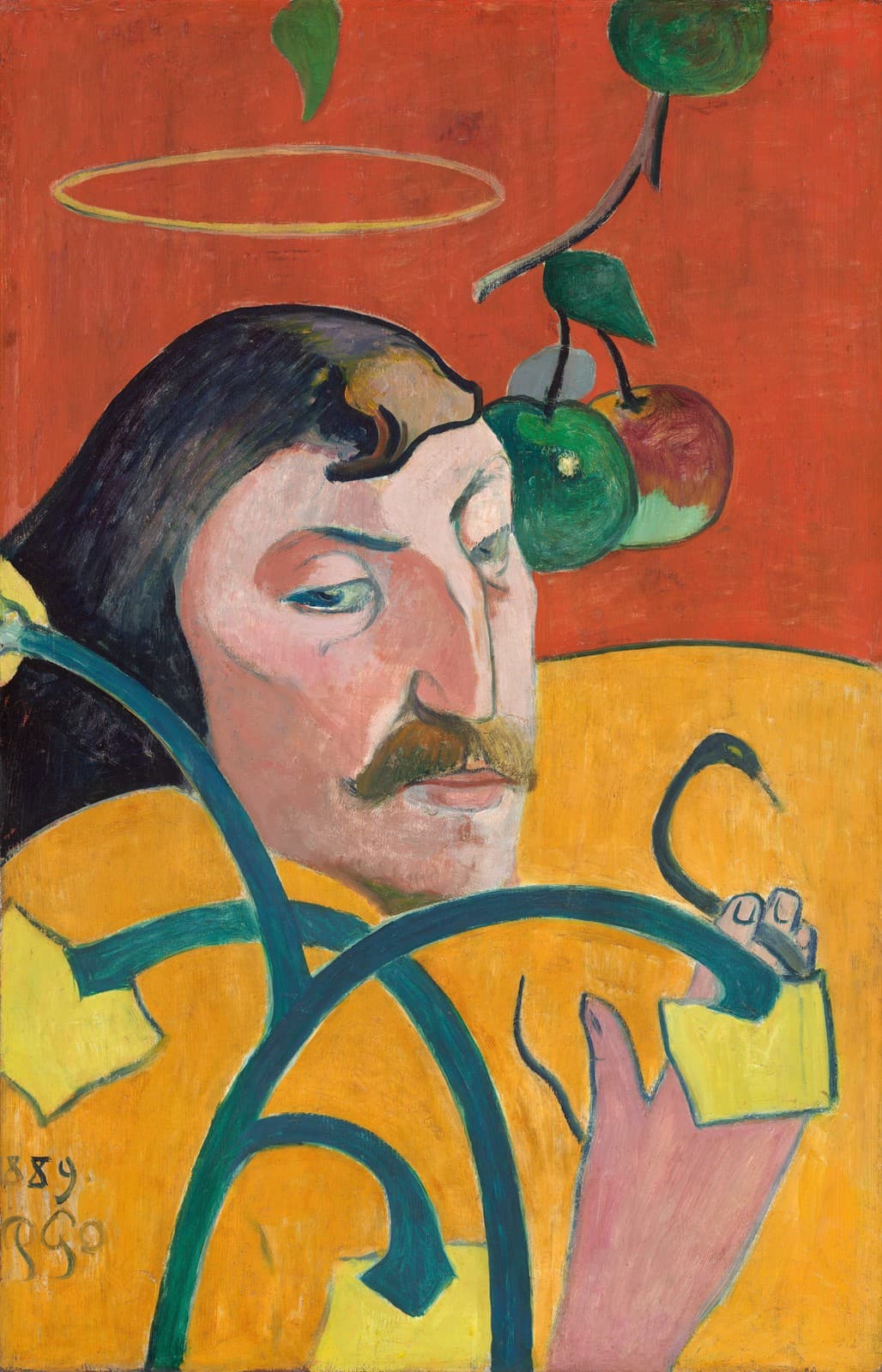
Gauguin treated the picture as a centerpiece: he set it in the background of his own 1893 self-portrait, reworked its motif in woodcuts and lithographs, and defended it in writing for years. Its fusion of the nude with the uncanny fed Symbolism directly and echoes on into Munch and the Expressionists.[1]
It came to Buffalo through the collector A. Conger Goodyear, and it remains the most argued-over canvas of the first Tahitian stay — an argument the painting itself started, by being two pictures at once.[1]
Timeline
1891
Gauguin copies Manet's Olympia in Paris, then sails for Tahiti and settles at Mataiea, where Tehamana comes to live with him.
1892
Paints Manao tupapau at Mataiea.
1893
Writes his account of the picture in the notebook kept for his daughter Aline, and places the canvas in the background of his self-portrait of that year.
1893–1894
Reworks the motif in the Noa Noa woodcuts and in lithography.
1965
Given to the Albright-Knox Art Gallery, Buffalo — today's Buffalo AKG Art Museum — from the collection of A. Conger Goodyear.
Where to see it
Buffalo AKG Art Museum
1285 Elmwood Avenue, Buffalo, NY 14222, United States
Displays and loans can change. Check whether this work is on view before making a special trip.
Plan your visit on the museum’s official website (opens in a new tab)Frequently asked questions
What does Manao tupapau mean?
The Tahitian title carries a deliberate double sense that Gauguin himself pointed out: she thinks of the spirit, or the spirit thinks of her. The usual English title, Spirit of the Dead Watching, keeps the second reading. The tupapau is the spirit of the dead in Tahitian belief, painted as the hooded watcher behind the bed.
Where is Spirit of the Dead Watching?
The Buffalo AKG Art Museum in Buffalo, New York, from the collection of A. Conger Goodyear.
Who is the woman in the painting?
She is generally identified as Tehamana, the Tahitian adolescent who lived with Gauguin at Mataiea during his first stay — thirteen by the Art Institute of Chicago's account of its portrait of her, about fifteen by recent biographical research. The age, and the colonial power imbalance around the relationship, are part of how museums now present the picture.
What does the painting have to do with Manet's Olympia?
It answers it. Gauguin copied Olympia in Paris in 1891, and Manao tupapau reverses it point by point: the nude turned face-down instead of facing the viewer, the servant replaced by a ghost, the modern courtesan's challenge replaced by fear of the spirit world. He wanted a nude whose subject was belief rather than display.
Why is the background violet?
Gauguin keyed the night to the emotion rather than to appearances — a violet ground scattered with sparks of light, meant to carry the terror of the tupapau without illustrating it. Symbolic color in place of natural color was the core of his method, and this is its darkest use in the Tahitian work.
More by Paul Gauguin
If you like Paul Gauguin
Explore painters from the same movements and circles.
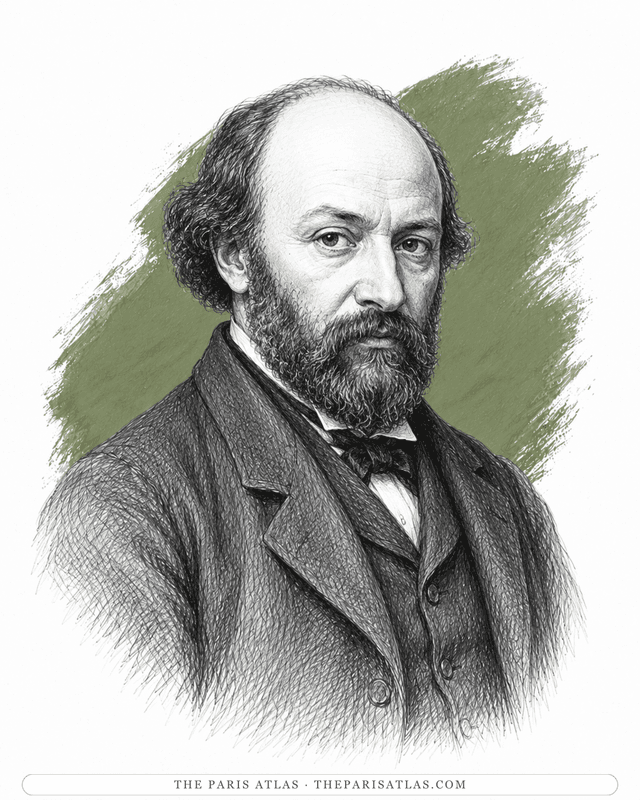
Paul Cézanne
Painter between Impressionism and everything after — shown in the independents' exhibitions, emulated by the Cubists, and present at the Orangerie through 15 works in the Walter-Guillaume collection.
View artist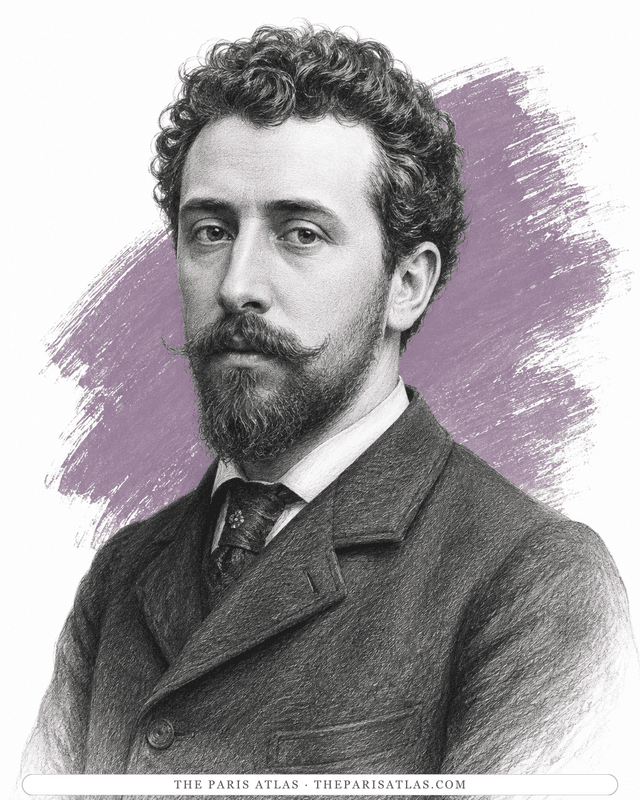
Georges Seurat
Parisian painter who built pictures from small dots of pure colour on optical principle, co-founded the Salon des Indépendants, and detonated the last Impressionist exhibition of 1886 with A Sunday on La Grande Jatte. He died at thirty-one.
View artist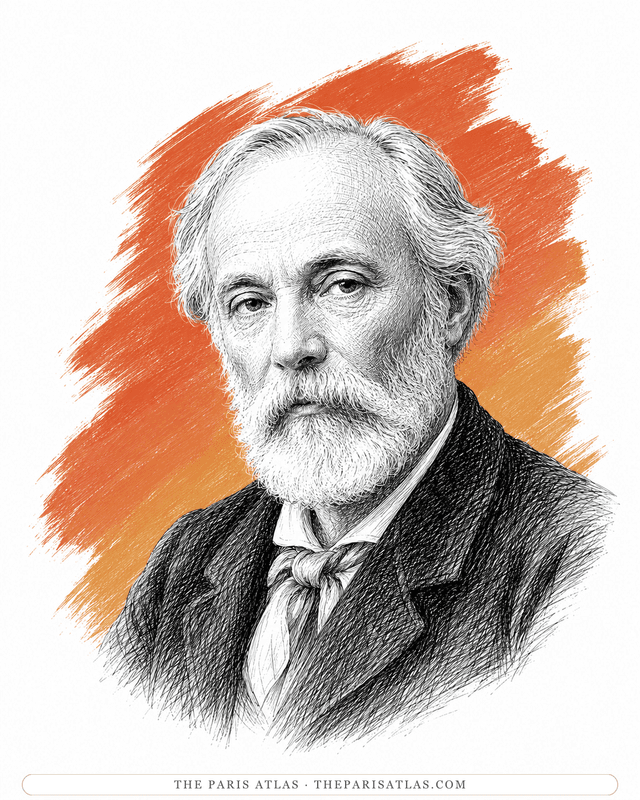
Pierre-Auguste Renoir
Porcelain painter turned co-founder of Impressionism — the painter of the Moulin de la Galette dance and the Luncheon of the Boating Party, whose later classical turn reached Picasso and Matisse.
View artist
In images
References
The sources below include collection records, catalogues, scholarly research, and primary materials that informed this page. They document Manao tupapau (Spirit of the Dead Watching), its making, and its place in cultural history.


2↑Merahi metua no Tehamana (Tehamana Has Many Parents or The Ancestors of Tehamana)
WebsiteArt Institute of ChicagoUsed forWeb source consulted for documented facts and historical context presented on the Manao tupapau (Spirit of the Dead Watching) page.
3Paul Gauguin (1848–1903)
WebsiteThe Metropolitan Museum of ArtUsed forWeb source consulted for documented facts and historical context presented on the Manao tupapau (Spirit of the Dead Watching) page.
4Gauguin exhibition brochure
WebsiteNational Gallery of Art, WashingtonUsed forNational Gallery exhibition scholarship on Tehamana, the tupapau, color, and the title’s double meaning.
These references provide the documented foundation for this work's history and interpretation. Claim-level citations remain attached to the specific claims they support.
 Explore more resources