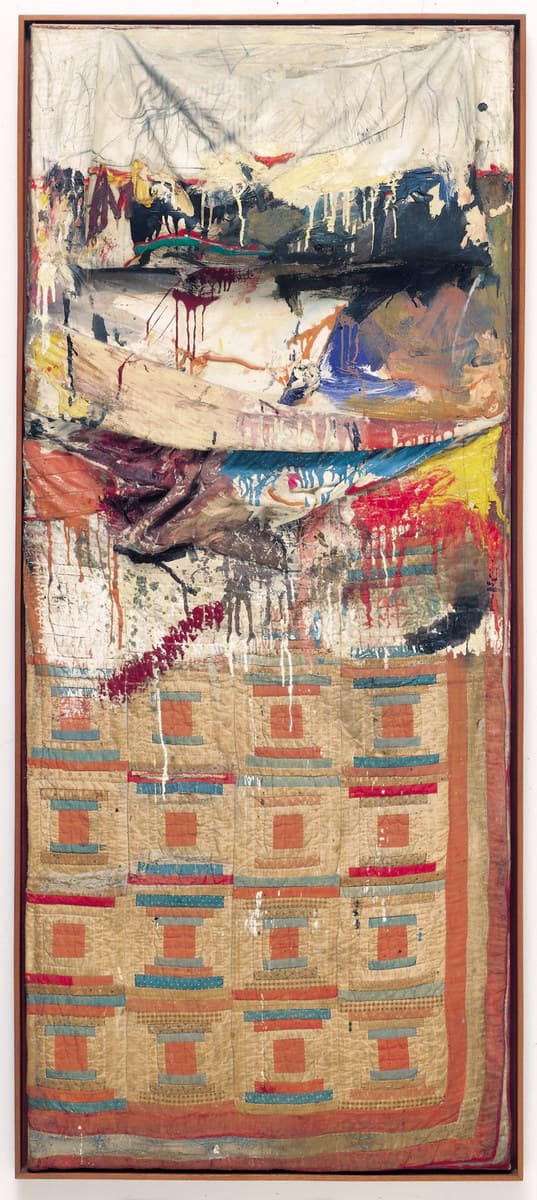
Bed
A quilt, a sheet and a pillow, mounted on wooden supports and hung upright on a wall like a picture, with paint and pencil worked across the top two-thirds. Robert Rauschenberg made it in 1955, when he could not afford canvas. The Museum of Modern Art in New York has held it since 1989.
- 1955
- Oil and pencil on pillow, quilt, and sheet on wood supports
- The Museum of Modern ArtNew York, United States
About Robert Rauschenberg

What the object shows
A tall, narrow rectangle in a plain reddish-brown wooden frame, taller than a person and about the width of a single bed. It hangs vertically, so a viewer reads it as a picture and only then works out that it is bedding.
The bottom half is a patchwork quilt in the Log Cabin pattern. Each block has a small orange-red square at its centre, with bands of blue-grey, red, tan and small printed calicos stepping outwards from it. Four blocks run across the width and the quilting stitches are visible. A rust-orange border strip runs down the right edge, with a paler strip beyond it.
Across the middle lies the pillow, a long pale form in striped ticking, sagging slightly under its own weight. Above it the sheet is pulled taut from the top corners and creased in long diagonals.
Paint takes over from the pillow upwards. Crimson runs down in thin drips; black masses spread across the upper third; there are patches of blue, orange, ochre, yellow and a green and red worm of colour squeezed straight from a tube. Cream drips run down over the pillow and onto the quilt.
The white sheet at the top is drawn on rather than painted. Dense graphite scribbles and hatching cover it, loose and fast, with no image in them.
The Museum of Modern Art gives the materials as oil and pencil on pillow, quilt and sheet on wood supports, and the size as 191.1 by 80 by 20.3 centimetres. The object stands eight inches proud of the wall.
Where the quilt came from
The Robert Rauschenberg Foundation's chronology is specific about it. The quilt was taken at Black Mountain College, near Asheville in North Carolina, from the artist Dorothea Rockburne. Robert Rauschenberg stretched it over a board and painted it because at the time he did not have enough money to buy canvas.
That order of events matters. The quilt was not chosen as a subject and then painted; it was used because it was there and canvas was not. The support came first and the image followed.
The pillow and the sheet went on with it. Because the bedding was his own, the work has usually been read as a self-portrait, and the reading is hard to avoid when the object is the size and shape of the place he slept.
What he painted with
The museum's materials line names oil and pencil. The Foundation's chronology adds two more, and they are not art materials at all: red fingernail polish and striped toothpaste.
Both leave a distinct mark. Nail varnish dries glossy and sits high on cloth; striped toothpaste comes out of the tube in ribbons of two colours at once. The pale ropes of colour running down over the pillow and the quilt are that kind of extrusion rather than brushwork.
Nothing is disguised. The quilt's pattern reads clearly under the paint, the pillow keeps its ticking stripes, and the sheet keeps its creases. Robert Rauschenberg worked on the bedding without covering it.
Spoleto put it in a storage room
Bed went to Italy in the summer of 1958, in an exhibition of young American and Italian artists selected by the Artnews editors Alfred Frankfurter, Thomas B. Hess and Irving Sandler for the Festival of Two Worlds at Spoleto. It ran from 8 to 29 June.
The festival's officials refused to hang it in the main gallery. The Foundation's chronology records that they put the painting in a storage room instead.
The objection is not recorded in the chronology, and the work itself suggests what it might have been. A stained bed hung on a wall invites a reading as a crime scene, and that reading attached to the work early.
The only thing that sold
Robert Rauschenberg's first solo exhibition at the Leo Castelli Gallery in New York ran from 4 to 29 March 1958 and held about twenty Combines. The chronology records the commercial result in one clause: Leo Castelli buys Bed, the only artwork sold.
The dealer kept it for thirty-one years. In 1989 he gave it to the Museum of Modern Art in honour of Alfred H. Barr, Jr., the museum's founding director, and the museum accessioned it on 8 May that year as number 79.1989.
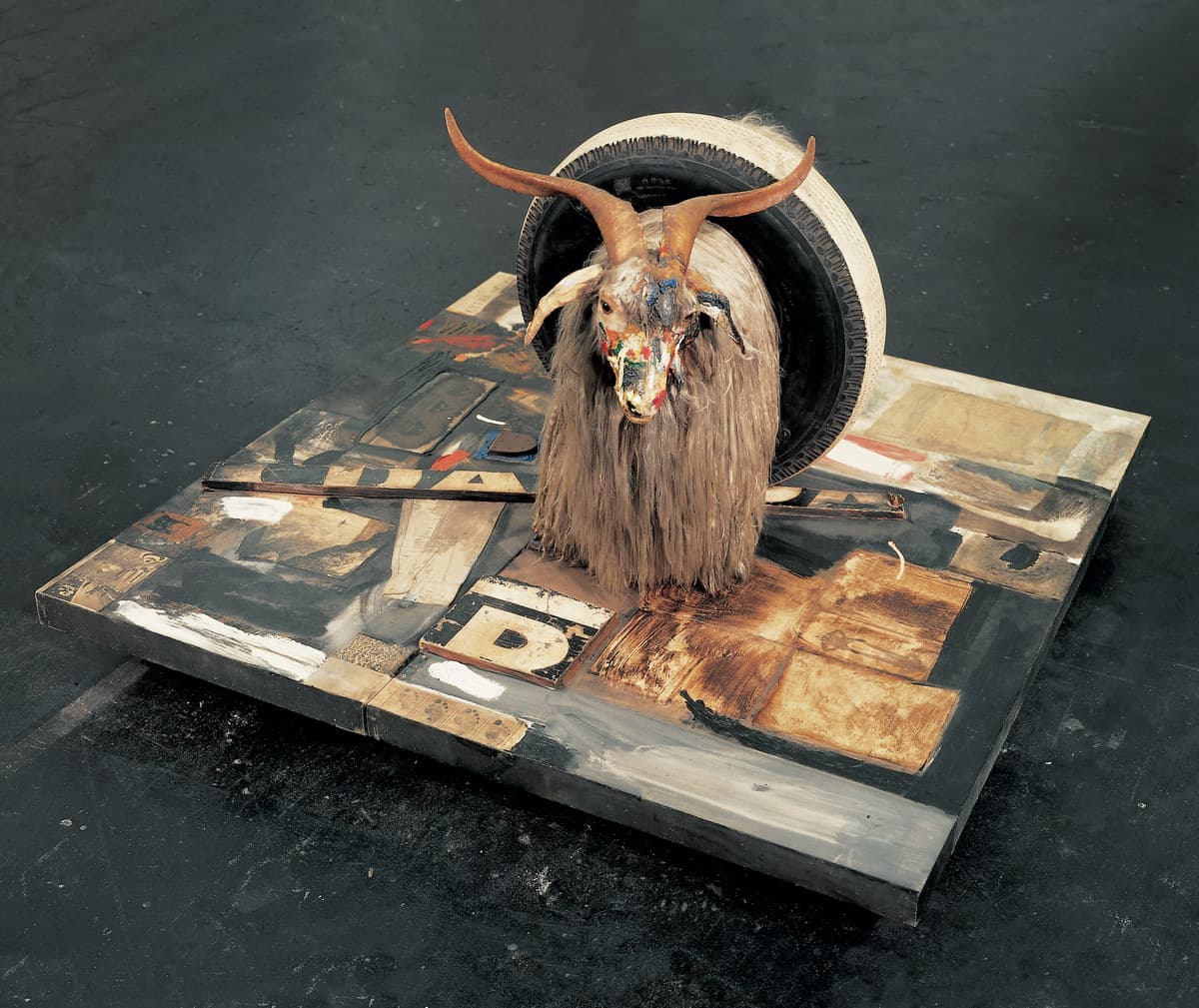
Alfred H. Barr, Jr. had form with Robert Rauschenberg's Combines. When the collector Robert Scull offered to buy Monogram in 1959 and give it to the Museum of Modern Art, Alfred H. Barr, Jr. declined the offer, and the goat went to Stockholm instead.
Where it was shown
Bed travelled steadily once the Spoleto refusal was behind it. It hung at Documenta II in Kassel from 11 July to 11 October 1959, with Thaw and Kickback.
That December it went to Paris. André Breton and Marcel Duchamp included it in the Exposition internationale du surréalisme at the Galerie Daniel Cordier, which opened on 15 December 1959, alongside Odalisk. Jasper Johns showed Target with Plaster Casts in the same exhibition.
It returned to Surrealist company in New York a year later, at the International Surrealist Exhibition at the D'Arcy Galleries, and went to Stockholm in 1962 for 4 Amerikanare, organised by Pontus Hultén at the Moderna Museet.
In 1964 it was in the United States Pavilion at the 32nd Venice Biennale, in the exhibition Four Germinal Painters, the year Robert Rauschenberg won the International Grand Prize in Painting. Canyon hung there too.
By January 1977 the work was the picture used to stand for him. Artnews put him on its cover photographed with Bed by Gianfranco Gorgoni, while his retrospective was at the National Collection of Fine Arts in Washington.
How critics read it
Leo Steinberg used Bed as one of his main examples in arguing against a purely formal account of the Combines. His lecture Encounters with Rauschenberg, published by the University of Chicago Press in 2000, discusses Erased de Kooning Drawing, Bed and Monogram together, and sets his reading against those of Clement Greenberg and Hilton Kramer.
Steinberg's term for what the Combines do is the flatbed picture plane. A painting on that model is not a window onto a scene but a horizontal surface that collects things, tipped up to face the viewer.
Bed is the plainest demonstration of the idea in his catalogue, because the surface it tips up is one a body actually lies on.
Close reading
Reading the work, detail by detail
Bed is photographed square on against a pale wall, hanging upright in its thin reddish frame. The plate therefore shows the front face and nothing else: the work stands eight inches proud of the wall, and none of that depth is visible here.
1.The sheet is drawn on, not painted
The top third is a white sheet pulled tight from the upper corners and creased in long diagonals. It is covered in graphite, scribbled fast, hatched in patches and doubled back on itself. No image forms anywhere in it.
2.Paint starts partway down and stops
Roughly a third of the way down, the drawn sheet gives way to paint in a ragged horizontal line. Above it the cloth is left white; below it black, yellow, ochre and blue mass together. The join is not disguised.
3.Green and red straight from the tube
A thick rope of green and red lies across the surface, raised well above it, with the shape a tube gives when it is squeezed and moved. The Museum of Modern Art's materials line names oil and pencil; the Robert Rauschenberg Foundation's chronology adds red fingernail polish and striped toothpaste.
4.Crimson runs straight down
Dark crimson runs down in thin parallel drips from a loaded patch. The direction is the evidence: the paint was applied with the work already upright, so gravity pulled it towards the foot of the bed rather than across it.
5.The pillow keeps its ticking
The pillow lies across the middle as a long pale form, sagging under its own weight. Its striped ticking still reads through the paint. It is the one element of the three that has kept its own shape rather than being stretched flat.
6.Ribbons rather than brushstrokes
Below the pillow, pale ribbed ropes of colour run downwards over blue and red. They have a channelled profile, not the flat drag of a brush, and they sit high on the cloth. Extruded material behaves this way and paint brushed from a bristle does not.
7.Log Cabin blocks under the paint
The quilt is pieced in the Log Cabin pattern. Each block has a small orange-red square at its centre with bands of blue-grey, red, tan and small printed calicos stepping outwards, four blocks across the width. The quilting stitches show as running lines across the whole field.
8.The paint stops where the quilt begins
Where the painted zone meets the quilt, a dark crimson spatter sits over the patchwork and white drips run down across three or four blocks. Below that the quilt is almost untouched. Two thirds of the object is worked and the bottom third is left as bedding.
9.The quilt's own border runs down the right
A rust-orange border strip runs the full height of the quilt at the right, with a paler strip beyond it before the frame. It is the quilt-maker's finishing, not Robert Rauschenberg's, and it is still doing its job of closing the edge.
10.A frame, and no visible depth
A plain reddish-brown moulding runs around the whole object, which presents it as a picture. The Museum of Modern Art records that it is 20.3 centimetres deep and mounted on wood supports. Photographed square on, that depth is invisible.
Timeline
1955
Made in New York from a quilt taken at Black Mountain College from the artist Dorothea Rockburne, stretched over a board and painted because Robert Rauschenberg could not afford canvas. Red fingernail polish and striped toothpaste go on with the oil and pencil.
1958
Shown in Robert Rauschenberg's first solo exhibition at the Leo Castelli Gallery, 4 to 29 March, among about twenty Combines. Leo Castelli buys it; it is the only work sold.
1958
Sent to the Festival of Two Worlds at Spoleto, 8 to 29 June. Officials refuse to hang it in the main gallery and put it in a storage room.
1959
Exhibited at Documenta II in Kassel, 11 July to 11 October, and from 15 December in the Exposition internationale du surréalisme organised by André Breton and Marcel Duchamp at the Galerie Daniel Cordier in Paris.
1960–61
Shown in the International Surrealist Exhibition at the D'Arcy Galleries, New York, 28 November to 14 January.
1962
Included in 4 Amerikanare at the Moderna Museet in Stockholm, organised by Pontus Hultén, 17 March to 6 May, and travels to the Stedelijk Museum and the Kunsthalle Bern.
1964
Hangs in the United States Pavilion at the 32nd Venice Biennale, 20 June to 18 October, in Four Germinal Painters, the year Robert Rauschenberg takes the International Grand Prize in Painting.
1977
Photographed with Robert Rauschenberg by Gianfranco Gorgoni for the January cover of Artnews, during his retrospective at the National Collection of Fine Arts in Washington.
1989
Given by Leo Castelli to the Museum of Modern Art in honour of Alfred H. Barr, Jr., and accessioned on 8 May as 79.1989.
2000
Discussed at length in Leo Steinberg's Encounters with Rauschenberg, published by the University of Chicago Press on 15 May.
Where to see it
The Museum of Modern Art
11 West 53 Street, New York, NY 10019, United States
The museum's published collection data carried no gallery location for the work when checked in September 2026. Check the museum's record before travelling.
Plan your visit on the museum’s official website (opens in a new tab)Frequently asked questions
Is Bed made from Robert Rauschenberg's own bed?
From bedding, yes. The Museum of Modern Art gives the materials as oil and pencil on pillow, quilt and sheet on wood supports. The Robert Rauschenberg Foundation's chronology records that the quilt came from the artist Dorothea Rockburne at Black Mountain College in North Carolina, and that he used it because he could not afford canvas.
What is Bed painted with?
Oil paint and pencil, according to the Museum of Modern Art. The Robert Rauschenberg Foundation's chronology adds red fingernail polish and striped toothpaste. The pale ribbed runs of colour over the pillow and quilt are squeezed rather than brushed.
How big is Bed?
191.1 by 80 by 20.3 centimetres, or 75 1/4 by 31 1/2 by 8 inches. It hangs vertically on the wall and stands eight inches proud of it, which is what makes it a Combine rather than a painting of a bed.
Why was Bed put in a storage room?
Officials at the Festival of Two Worlds in Spoleto refused to show it in the main gallery in June 1958 and moved it to storage. The Robert Rauschenberg Foundation's chronology records the refusal without recording the reason. The work had been selected for the festival by the Artnews editors Alfred Frankfurter, Thomas B. Hess and Irving Sandler.
Who bought Bed?
The dealer Leo Castelli, out of Robert Rauschenberg's first solo exhibition at his gallery in March 1958. It was the only work in that show to sell. Leo Castelli gave it to the Museum of Modern Art in 1989, in honour of the museum's founding director Alfred H. Barr, Jr.
Where is Bed now?
The Museum of Modern Art in New York owns it as accession number 79.1989, in the Department of Painting and Sculpture. Its record showed no gallery location when checked in September 2026, so check before travelling.
More by Robert Rauschenberg
If you like Robert Rauschenberg
Explore painters from the same movements and circles.

Arman
French-American artist, lifelong friend of Yves Klein, and a founder of New Realism.
View artist
Jean Arp
Strasbourg-born sculptor and poet — Hans in German, Jean in French, both all his life — who co-founded Dada at the Cabaret Voltaire in 1916, composed collages by dropping torn paper 'according to the laws of chance', and settled at Meudon outside Paris in a house his wife Sophie Taeuber-Arp designed.
View artist
Rosa Bonheur
At the horse markets of Paris and in her studio beside the forest of Fontainebleau, Rosa Bonheur gave animals the presence of great portrait subjects. The success of The Horse Fair helped her build a life shaped by her work, financial independence, and the women she loved.
View artist
References
The sources below include collection records, catalogues, scholarly research, and primary materials that informed this page. They document Bed, its making, and its place in cultural history.

1Robert Rauschenberg, Bed, 1955
WebsiteThe Museum of Modern Art, New YorkUsed forThe holding museum's record: the materials line, the dimensions, the credit line, the accession number and the acquisition date of 8 May 1989.
2The Museum of Modern Art collection dataset
Official recordThe Museum of Modern ArtUsed forThe museum's published collection data, the form in which the catalogue fields were checked while moma.org was unreachable to scripted requests.
3Robert Rauschenberg, Bed, 1955 (RRF 55.004)
WebsiteRobert Rauschenberg FoundationUsed forThe Foundation's catalogue entry, which states the medium as Combine: oil and graphite on pillow, quilt, and sheet, mounted on wood support.
4Chronology
WebsiteRobert Rauschenberg FoundationUsed forDorothea Rockburne's quilt, the nail polish and toothpaste, the Castelli sale, the Spoleto storage room, and the exhibition record.
5Fair Use Policy
WebsiteRobert Rauschenberg FoundationUsed forThe rights holder's own position on fair use, and the basis on which the reproduction is shown.
6Robert Rauschenberg, Satellite, 1955
WebsiteWhitney Museum of American ArtUsed forThe Whitney Museum of American Art's rights line for Robert Rauschenberg, which differs from the three others consulted.
7Robert Rauschenberg 1925–2008
WebsiteTateUsed forTate's rights line for Robert Rauschenberg.
These references provide the documented foundation for this work's history and interpretation. Claim-level citations remain attached to the specific claims they support.
 Explore more resources