Monogram
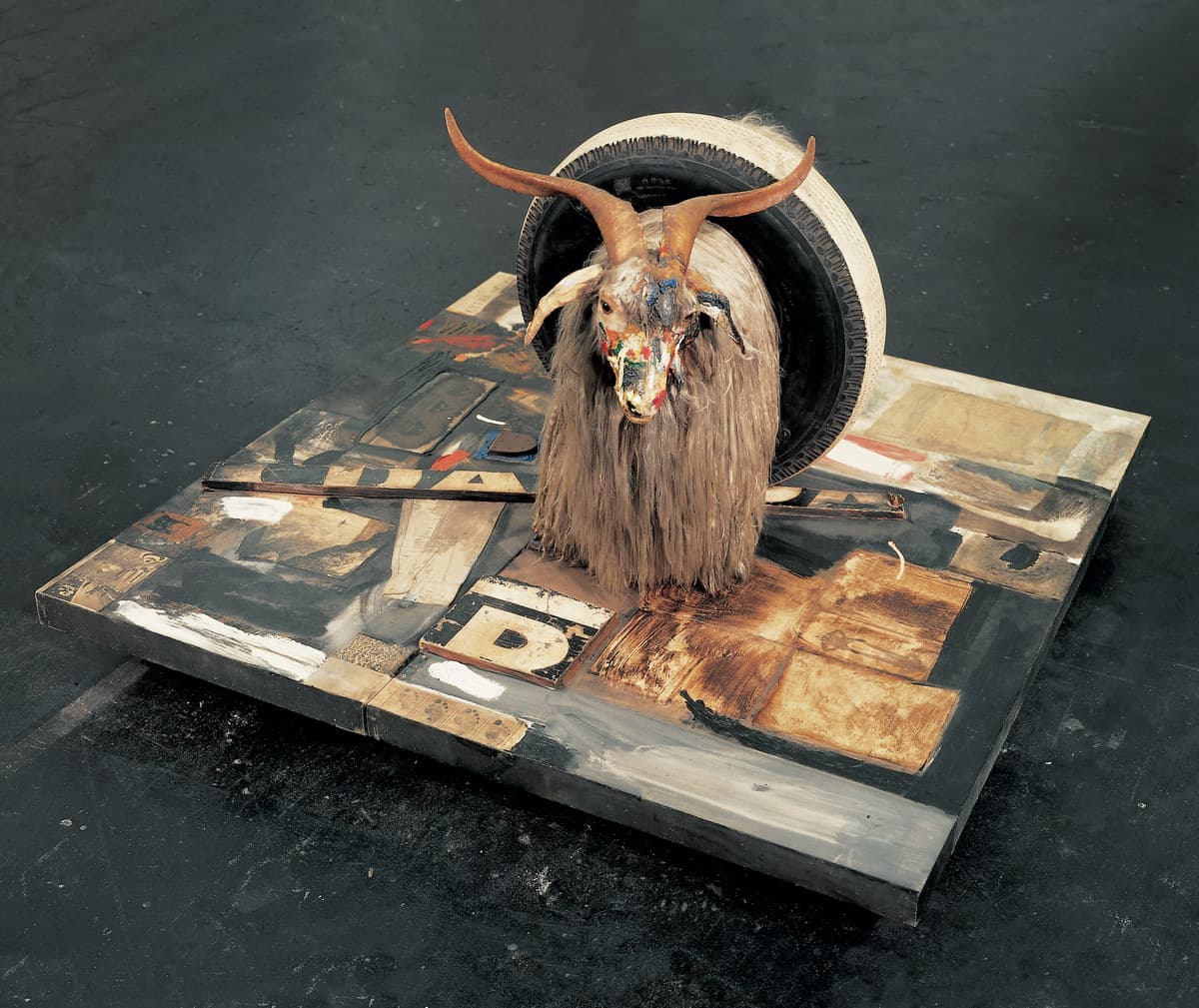
A stuffed Angora goat stands on a square painted canvas laid flat on the floor, with a car tire pushed around its middle and its face smeared with paint. Robert Rauschenberg took four years and three states to arrive at that arrangement, finishing in the winter of 1959. The Moderna Museet in Stockholm has owned it since the mid-1960s.
- 1955–59
- Oil on canvas, printed paper, textile, paper, metal sign, wood, rubber shoe heel, tennis ball, taxidermied Angora goat with paint and painted rubber tire
- Moderna MuseetStockholm, Sweden
About Robert Rauschenberg
What the object shows
The goat stands square in the middle of a low platform, facing the viewer. Its horns curve back and out, pale brown and ridged. Its fleece is long, shaggy and dirty cream, hanging in ropes to the platform so that the legs and feet disappear inside it.
The face has been painted. Red, yellow, blue, green and white are smeared across the muzzle and around the eyes, thick enough to sit up off the hair.
A car tire is pushed down around the body behind the shoulders, so the goat wears it like a collar at the waist. The tread face is black; the sidewalls are painted white, which is what makes the tire read as a pale ring from the front.
The platform is a square canvas laid horizontal and worked like a painting. It is painted in greys, blacks and whites, with collaged panels set into the surface. A board carrying a large black letter D on a cream ground lies just in front of the goat. A wooden lath runs across the left half, standing slightly proud, and a rust-brown scorched rectangle spreads behind the forelegs.
Two small things sit near the left edge. A brown rubber shoe heel, punched with nail holes, rests on a patch of blue paint, and a flat red shape lies beside it. Along the near edge of the platform a pale strip carries a row of small dark footprints.
The Moderna Museet gives the overall measurement as 106.5 by 160.6 by 163.5 centimetres. The museum catalogues the work under both paintings and sculptures, which is an accurate description of the problem it sets.
Fifteen dollars for the goat
Robert Rauschenberg saw the stuffed Angora goat in the window of a secondhand office-furniture store on Seventh Avenue in New York. The asking price was thirty-five dollars. He paid fifteen towards it and took the goat to his studio.
It was the largest object he had ever tried to get into a painting. The Robert Rauschenberg Foundation records that the work then went through three states, documented in drawings and photographs, before it was finished in 1959.
The title came at the end, from the shape the finished thing made. The goat standing inside the tire reminded him of the interwoven letters of a monogram.
Three states over four years
In the first state, of 1955 to 1956, the goat was poised on a shelf attached to a Combine painting. Calvin Tomkins records Robert Rauschenberg's dissatisfaction: the animal looked as though it belonged in a painting, and it could only be seen from one side. That Combine painting was later reworked into a separate work, Rhyme, of 1956.
In the second state, of 1956 to 1958, the goat stood on a wooden platform in front of an upright panel, encircled by the tire with its tread painted white. The panel was salvaged from a dismantled five-panel White Painting of 1951. Robert Rauschenberg still was not satisfied; he felt the goat looked as though it were pulling the painting along behind it.
That upright panel did not survive into the finished work either. It was reworked and absorbed into the central panel of Summerstorm, of 1959.
The third state settled it, on a suggestion from Jasper Johns, whose studio was one floor below. Jasper Johns proposed setting the animal inside a picture on the floor. Robert Rauschenberg laid the square canvas flat, put the goat in the middle of it as if in a pasture, kept the tire and raised the whole platform on four casters.
A preliminary drawing of 1955 shows how differently it might have gone. In it the goat is mounted against a nearly square upright panel and placed behind a ladder. That sheet is now in Jasper Johns's own collection.
What laying it flat did
Leo Steinberg used the Combines to argue that the picture plane had changed function. A traditional painting is an upright window onto another space. A Combine, in his words, is a receptor surface on which objects are scattered, on which data is entered — a tabletop or a bulletin board rather than a view.
Monogram makes the claim literal, because its picture is on the floor and the viewer looks down at it. The art historian Roni Feinstein notes that the collage elements reinforce the horizontality. Four footprints at the edge of the canvas, the heel of a rubber-soled shoe, a street barricade with signboard lettering and photographs all lie flat.
A paint-smeared tennis ball sits on the platform behind the goat's hindquarters.
The Museum of Modern Art turned it down
The finished work was first shown from 31 March to 8 April 1959, in a three-person exhibition with Norman Bluhm and Jean Dubuffet at the Leo Castelli Gallery in New York.
The collector Robert Scull offered to buy it and give it to the Museum of Modern Art. Alfred H. Barr, Jr., the museum's director, declined the offer.
The Moderna Museet in Stockholm bought it instead. The Robert Rauschenberg Foundation's chronology dates the purchase to December 1964; the museum's own credit line reads Purchase 1965 with contribution from The Friends of Moderna Museet, the group known as The Museum of Our Wishes. The Foundation's separate page on the work gives 1964 as well. The two dates are best read as the agreement and the accession.
Moving it is a problem in itself
The work is a heavy horizontal object with a fragile taxidermied animal standing on it, which makes installation a specialist job. Film of the 1977 showing at the San Francisco Museum of Modern Art records the curator Walter Hopps and a team of art handlers putting it in place.
Walter Hopps had proposed Robert Rauschenberg as the living American artist to honour the country's bicentennial, and curated the retrospective that opened at the National Collection of Fine Arts in Washington in 1976 before touring. He stayed closely involved in the installation of Monogram at each venue.
It travelled again for the 1997 retrospective at the Solomon R. Guggenheim Museum in New York, where the artist and Calvin Tomkins were filmed discussing it.
Where it is now
The Moderna Museet in Stockholm holds the work under inventory number NMSK 1963. That is a number, not a date: the museum dates the work 1955 to 1959 and gives the acquisition separately.
Since 23 November 2024 it has anchored an exhibition named after it, Monogram: Robert Rauschenberg and the Moderna Museet Collection, which runs to 30 January 2028. The museum's object record shows it on view in the Study Gallery.
Robert Rauschenberg signed it where nobody standing beside it can see. The signature is on the underside of the platform and reads RAUSCHENBERG 1959, with the title in quotation marks.
Close reading
Reading the work, detail by detail
Monogram is photographed from above and in front, standing on a scuffed dark grey floor. The whole platform is in frame and so is the goat, but the camera is on one side of it: the animal's rear quarters are hidden behind the tire, the underside of the platform is not shown, and the four casters the work runs on are never visible.
1.The face is loaded with paint
Paint is worked over the muzzle and the bridge between the eyes in thick strokes of blue, red, orange, yellow, black and white, standing well up off the hair. The eyes are left dark and clear. The paint is on the animal, not in place of it.
2.The horns are the widest thing above the tire
Both horns sweep back and outwards, ridged along their length, with the tips turning up. They reach wider than the head and cross in front of the pale ring of the tire. A soft pale ear hangs down beside the left horn.
3.The tire's sidewall is painted white
The outward-facing sidewall is painted flat white, which is what makes the tire read as a pale ring rather than a black one. The tread itself is left black, with its blocky pattern intact, and runs around inside the white.
4.Moulded lettering survives on the inner wall
On the black inner wall, raised moulded lettering and a small boxed emblem catch the light. The relief is shallow and the plate cannot resolve the words, so the manufacturer and size stay unread here. It is an unaltered used tire.
5.A board carrying a large black D
Just in front of the goat's forelegs, a square board is set flush into the platform. It carries a single large black capital D on a cream ground inside a black border, with the paint chipped at the edges. It is salvaged signage, laid down as a tile.
6.A scorched brown rectangle behind the forelegs
To the right of the lettered board lies a large rust-brown field, scorched and stained rather than painted, divided by faint lines into panels. A dark shape at its right reads as a pressed sole or a hand. The fleece hangs over its left edge.
7.A rubber shoe heel on a patch of blue
A brown rubber shoe heel lies flat on a square of blue paint, its nail holes still visible as small dots. The Moderna Museet lists it by name in the materials. A flat red shape sits beside it and a white brushstroke runs above.
8.A wooden lath stands proud of the surface
A thin lath crosses the left half of the platform and sits a little above the painted surface, so it throws its own shadow. The platform is not a flat picture: things rest on it at different heights.
9.Footprints along the near edge
A pale strip along the near edge carries a row of small dark rounded prints. The art historian Roni Feinstein reads the four footprints at the canvas edge as part of what insists the surface is horizontal. A person walked on this picture.
10.A printed reproduction near the corner
Near the left corner a pale panel carries a printed reproduction in sepia, with buildings, arches and a standing figure with a disc behind its head. It is collaged flat into the surface and painted around. The image is legible as a picture but not identifiable at this resolution.
11.The edge is a plain dark band, and the casters are out of sight
The corner shows the platform as a slab about a plank deep, its edge painted plain dark, with a shadow underneath it on the concrete. The work stands on four casters. From this angle they are behind the shadow and not in frame.
12.A working floor, not a plinth
The floor around the work is dark grey concrete, scuffed pale in streaks and spotted with old marks. Nothing raises the piece: the picture lies on the same ground the viewer stands on, which is the arrangement Jasper Johns proposed in 1959.
Timeline
1955
Robert Rauschenberg buys a stuffed Angora goat from a secondhand office-furniture store on Seventh Avenue, paying fifteen dollars towards a thirty-five dollar price. A preliminary drawing shows the goat mounted upright behind a ladder.
1955–56
First state: the goat stands on a shelf attached to a Combine painting. Robert Rauschenberg judges that it looks as though it belongs in a painting and can be seen from one side only. The painting is later reworked as Rhyme.
1956–58
Second state: the goat is encircled by a car tire with its tread painted white and set on a wooden platform in front of an upright panel taken from a dismantled five-panel White Painting of 1951. That panel later becomes the centre of Summerstorm.
1959
Final state, completed in the winter. Following Jasper Johns's suggestion, Robert Rauschenberg lays the square canvas flat, centres the goat on it, keeps the tire and mounts the platform on four casters.
1959
Shown 31 March to 8 April at the Leo Castelli Gallery with Norman Bluhm and Jean Dubuffet. Robert Scull offers to buy it for the Museum of Modern Art and Alfred H. Barr, Jr. declines.
1964–65
Acquired by the Moderna Museet in Stockholm. The Robert Rauschenberg Foundation's chronology dates the purchase to December 1964; the museum's credit line reads Purchase 1965, with a contribution from The Friends of Moderna Museet.
1976–78
Travels with the retrospective Robert Rauschenberg, curated by Walter Hopps from the National Collection of Fine Arts in Washington, including the San Francisco Museum of Modern Art showing of 1977 whose installation was filmed.
1997
Shown in Robert Rauschenberg: A Retrospective at the Solomon R. Guggenheim Museum in New York, and discussed on film by the artist and Calvin Tomkins.
2000
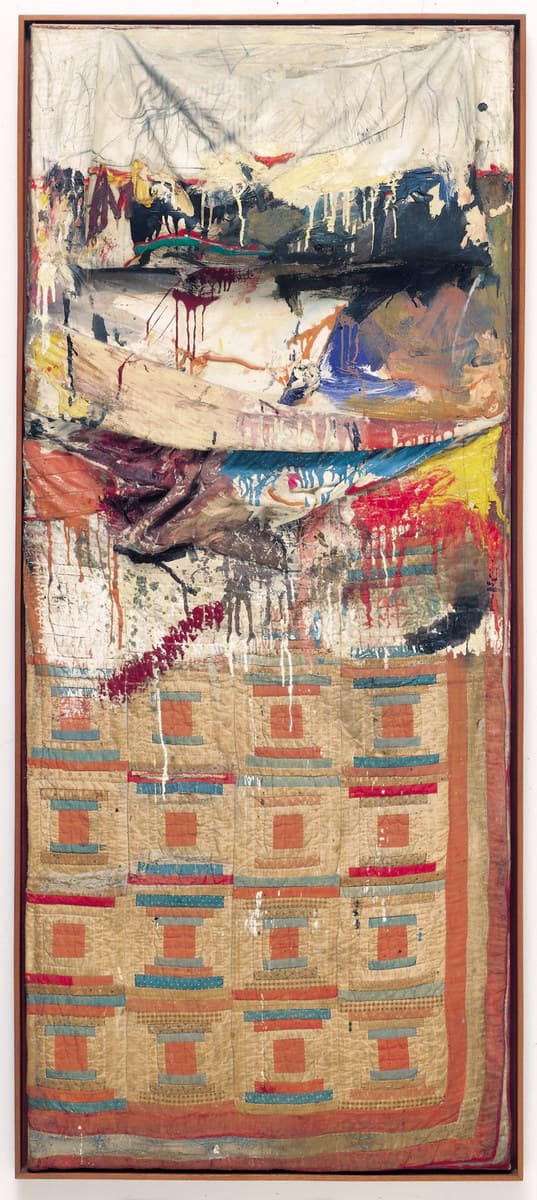
Discussed at length with Bed and Erased de Kooning Drawing in Leo Steinberg's Encounters with Rauschenberg, published by the University of Chicago Press.
2024–28
Anchors Monogram: Robert Rauschenberg and the Moderna Museet Collection at the Moderna Museet, 23 November 2024 to 30 January 2028.
Where to see it
Moderna Museet
Stockholm, Sweden
A public viewing address has not yet been confirmed for this holding.
On view in the Study Gallery in Stockholm, in the exhibition Monogram: Robert Rauschenberg and the Moderna Museet Collection, 23 November 2024 to 30 January 2028.
Frequently asked questions
What is Monogram made of?
The Moderna Museet lists oil on canvas, printed paper, textile, paper, a metal sign, wood, a rubber shoe heel, a tennis ball, and a taxidermied Angora goat with paint and a painted rubber tire. The goat stands on the canvas, which lies flat, and the whole platform runs on four casters.
Why is there a tire around the goat?
It arrived in the second state, in 1956, when Robert Rauschenberg was trying to stop the goat reading as an animal stuck onto a picture. The tire encircles the body behind the shoulders. The title comes from the result: goat and tire interlocked reminded him of the interwoven letters of a monogram.
Where did Robert Rauschenberg get the goat?
From the window of a secondhand office-furniture store on Seventh Avenue in New York, in 1955. The asking price was thirty-five dollars and he paid fifteen towards it. It was the largest object he had attempted to incorporate into a painting.
How many versions of Monogram are there?
One work, arrived at through three states over four years, each documented in drawings and photographs. In the first the goat stood on a shelf against an upright Combine painting. In the second it was ringed by the tire in front of a vertical panel. In the third the canvas was laid on the floor, which is how it stands today.
Why did Jasper Johns matter to Monogram?
He suggested the solution. Jasper Johns's studio was one floor below Robert Rauschenberg's, and the two saw each other's work daily. It was his proposal to set the animal within a picture laid on the floor that produced the final state. The 1955 preliminary drawing for the work is now in his collection.
Why is Monogram in Stockholm and not New York?
Because the Museum of Modern Art said no. The collector Robert Scull offered to buy the work out of its 1959 Leo Castelli showing and give it to the museum, and the director Alfred H. Barr, Jr. declined. The Moderna Museet bought it a few years later.
Can you see Monogram?
Yes. The Moderna Museet in Stockholm has shown it since 23 November 2024 in an exhibition named after it, Monogram: Robert Rauschenberg and the Moderna Museet Collection, scheduled to run until 30 January 2028. The museum's object record lists it on view in the Study Gallery.
More by Robert Rauschenberg
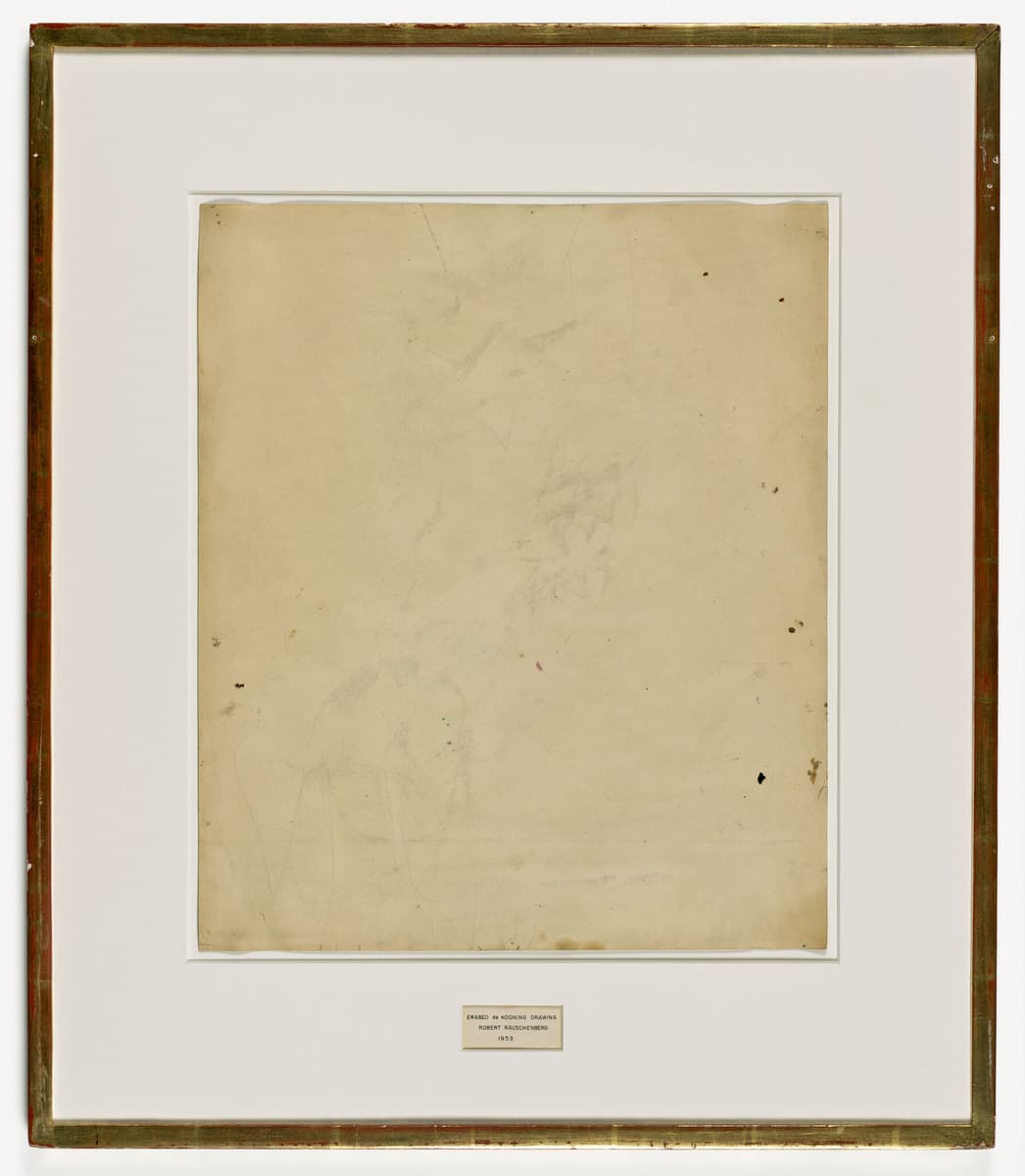
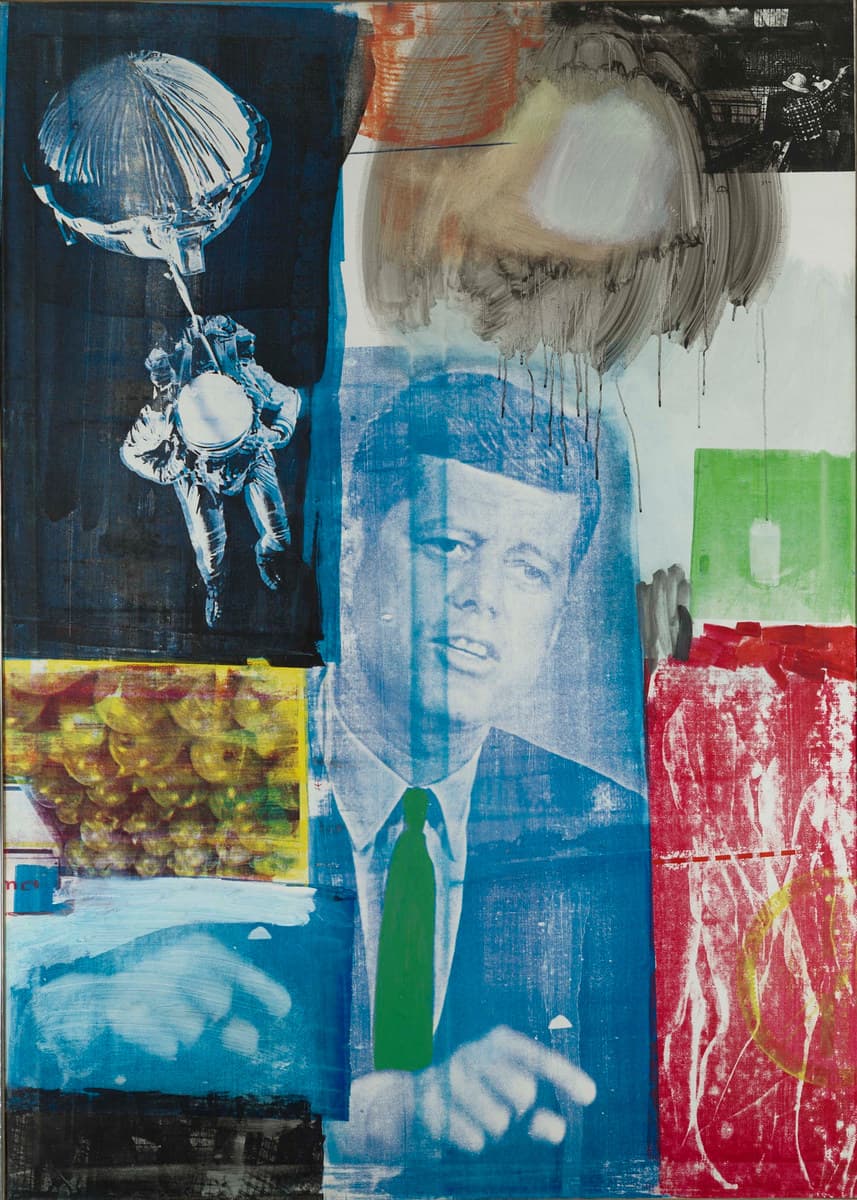
If you like Robert Rauschenberg
Explore sculptors from the same movements and circles.
Arman
French-American artist, lifelong friend of Yves Klein, and a founder of New Realism.
View artist
Jean Arp
Strasbourg-born sculptor and poet — Hans in German, Jean in French, both all his life — who co-founded Dada at the Cabaret Voltaire in 1916, composed collages by dropping torn paper 'according to the laws of chance', and settled at Meudon outside Paris in a house his wife Sophie Taeuber-Arp designed.
View artist
Rosa Bonheur
At the horse markets of Paris and in her studio beside the forest of Fontainebleau, Rosa Bonheur gave animals the presence of great portrait subjects. The success of The Horse Fair helped her build a life shaped by her work, financial independence, and the women she loved.
View artist
References
The sources below include collection records, catalogues, scholarly research, and primary materials that informed this page. They document Monogram, its making, and its place in cultural history.


1Robert Rauschenberg, Monogram, 1955–1959 (NMSK 1963)
WebsiteModerna Museet, StockholmUsed forThe holding museum's record: the materials line, the overall dimensions, the credit line, the inventory number, the signature on the underside and the display location.
2Robert Rauschenberg, Monogram, 1955–59 (RRF 59.024)
WebsiteRobert Rauschenberg FoundationUsed forThe Foundation's catalogue entry, which gives the medium as a Combine and the dimensions in inches.
3Art in Context: Monogram
WebsiteRobert Rauschenberg FoundationUsed forThe three states, the goat's purchase price, Jasper Johns's suggestion, the Leo Castelli showing, Alfred H. Barr, Jr.'s refusal, and Roni Feinstein's reading of the horizontal surface.
4Chronology
WebsiteRobert Rauschenberg FoundationUsed forThe states in sequence, the used-furniture-store purchase, and the December 1964 date for the Moderna Museet acquisition.
5Monogram: Robert Rauschenberg and the Moderna Museet Collection
WebsiteModerna Museet, StockholmUsed forThe exhibition built around the work, 23 November 2024 to 30 January 2028.
6Creative Commons Licensing
WebsiteRobert Rauschenberg FoundationUsed forThe Foundation's release of ten works, Monogram among them, under the Attribution-NonCommercial 4.0 International Creative Commons licence.
7Fair Use Policy
WebsiteRobert Rauschenberg FoundationUsed forThe rights holder's own position on fair use, and the basis on which the reproduction is shown.
These references provide the documented foundation for this work's history and interpretation. Claim-level citations remain attached to the specific claims they support.
 Explore more resources