The Paris AtlasCharting the artists, works, and places worth returning to.
  • Painter
  • Sculptor
  • Printmaker
· American · 1925–2008

Robert Rauschenberg

American artist who combined William S. Burroughs's text with his imagery in the 1981 lithograph series American Pewter with Burroughs.

Details

Lived
1925–2008
Born
22 October 1925
Birthplace
Port Arthur, Texas
Birth name
Milton Ernest Rauschenberg
Died
12 May 2008 · aged 82
Place of death
Captiva Island, Florida
Nationality
American
Profession
Painter, sculptor, printmaker and stage designer
Major works
White Painting, Erased de Kooning Drawing, Bed, Monogram, Canyon, Barge, Stoned Moon series
Roles
PainterSculptorPrintmaker

About Robert Rauschenberg

American painter and multi-media artist who built the Combines out of paint and found objects

Robert Rauschenberg was an American painter and multi-media artist, born Milton Ernest Rauschenberg in Port Arthur, Texas, on 22 October 1925. He is best known for the Combines, made between 1954 and 1964, in which he fixed everyday objects to painted canvas. A Combine could hold a worn quilt, a stuffed goat or a working radio. The results sit between painting and sculpture and settle into neither.

He trained at the Kansas City Art Institute, at the Académie Julian in Paris and at Black Mountain College in North Carolina. At Black Mountain he studied under Josef Albers and met the composer John Cage and the dancer Merce Cunningham. He worked with Cage and Cunningham for decades, designing sets, costumes and lighting for the Merce Cunningham Dance Company. In 1953 he asked the painter Willem de Kooning for a drawing so that he could rub it out, and de Kooning agreed.

In 1964 Rauschenberg won the International Grand Prize in Painting at the Venice Biennale. Two years later he and the Bell Laboratories engineer Billy Klüver founded Experiments in Art and Technology, which paired artists with engineers. From 1970 he lived and worked on Captiva Island in Florida. He died there of heart failure on 12 May 2008, aged 82.

Port Arthur, the Navy, and Black Mountain College, 1925–1952

Milton Ernest Rauschenberg was born in Port Arthur, Texas, on 22 October 1925. His father, Ernest Rauschenberg, worked for the light and power company Gulf States Utilities. His mother was Dora Carolina Matson. His parents were Fundamentalist Christians, and he had a younger sister, Janet Begneaud. At eighteen he entered the University of Texas at Austin to study pharmacology, and left within months. The coursework was hard, he did not yet know he was dyslexic, and he refused to dissect a frog in a biology class.

He was drafted into the United States Navy in 1944 and served as a neuropsychiatric technician at a Navy hospital in California. After his discharge he studied at the Kansas City Art Institute and then at the Académie Julian in Paris. In Paris he met a fellow student, the artist Susan Weil, and changed his first name from Milton to Robert. He and Weil married in the summer of 1950, and their son Christopher was born on 16 July 1951. They separated in June 1952 and divorced in 1953.

In 1948 Rauschenberg followed Susan Weil to Black Mountain College in North Carolina. He went there to study under Josef Albers, a founder of the Bauhaus, hoping that Albers would curb his sloppy working habits. Albers taught strict discipline and allowed no free experiment. Rauschenberg later called himself "Albers' dunce, the outstanding example of what he was not talking about". He found an easier match in the composer John Cage, who encouraged him and remained a friend and collaborator for decades. From 1949 to 1952 he studied at the Art Students League of New York, where he met the painter Cy Twombly.

The White Paintings, Italy with Cy Twombly, and Erased de Kooning Drawing, 1951–1953

Rauschenberg had his first solo exhibition at the Betty Parsons Gallery in New York in the spring of 1951. In the same year he made the White Paintings, panels rolled with ordinary white house paint and left otherwise bare. John Cage described them as "airports for the lights, shadows and particles". Rauschenberg said the surfaces registered whatever happened in the room, so that a viewer could almost tell how many people were standing there. They were shown at Eleanor Ward's Stable Gallery in the autumn of 1953.

The black paintings of 1951 to 1953 followed, worked in matte and glossy black over newspaper glued to canvas, with the newsprint sometimes left visible. Then came the Red Paintings, in which he dripped and pressed red pigment onto grounds of patterned fabric, newspaper, wood and nails. He called red the most difficult color to paint with, and took it on for that reason. Those crowded surfaces led directly to the Combines.

From the autumn of 1952 to the spring of 1953 Rauschenberg traveled in Italy and North Africa with Cy Twombly, who was then his partner. He made collages and small sculptures out of found materials, the Scatole Personali and the Feticci Personali, and showed them in Rome and Florence. Several sold, which surprised him. A critic who reviewed the show suggested he throw the rest away, and he dropped many of the unsold works into the river Arno.

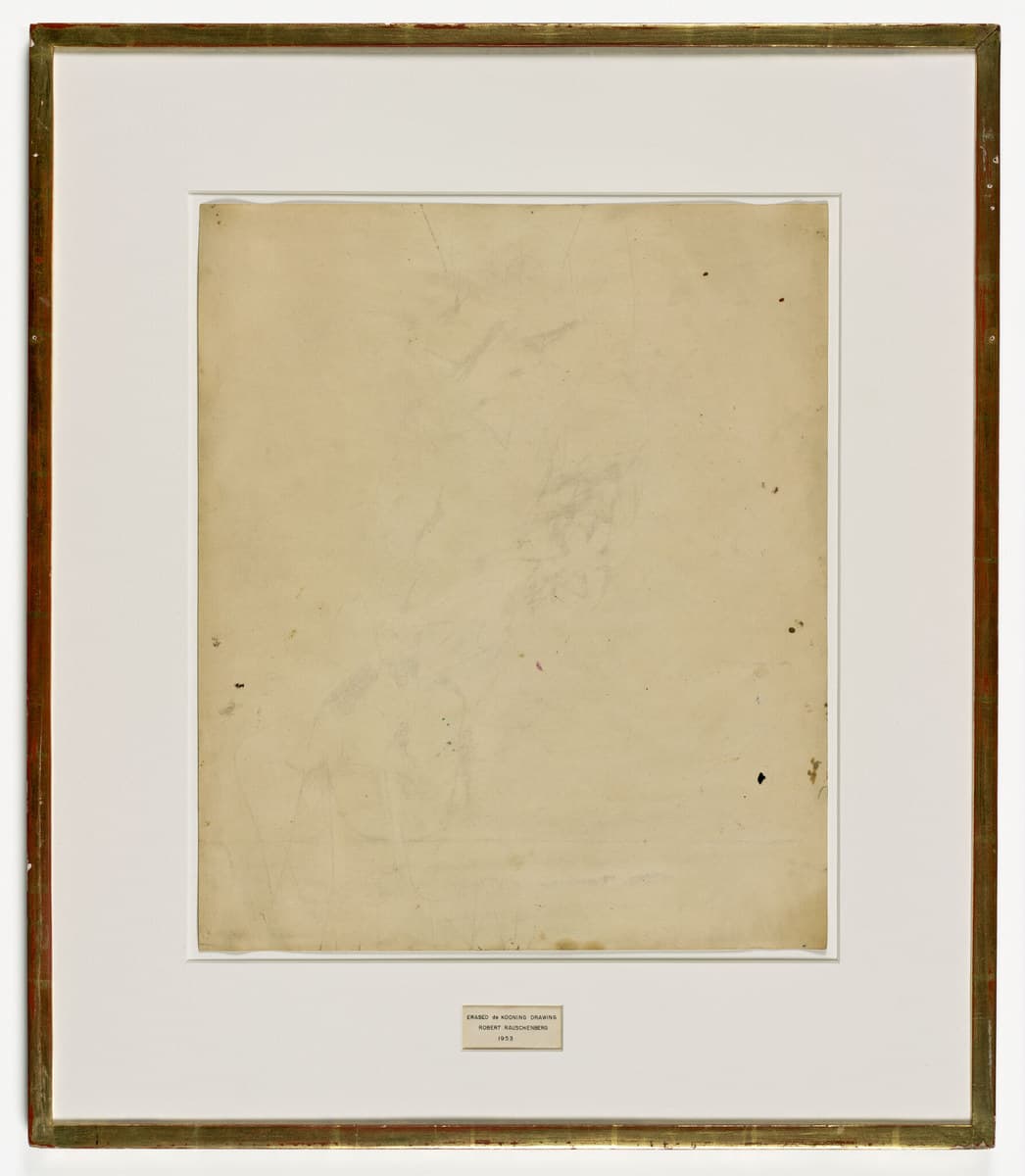
Back in New York in 1953, Rauschenberg asked the Abstract Expressionist painter Willem de Kooning for a drawing that he could erase. De Kooning handed one over knowing exactly what was planned for it. The result, Erased de Kooning Drawing, is a sheet of paper carrying the faint traces of what had been rubbed away. Through the 1950s Rauschenberg paid his way by designing store windows for Tiffany & Co. and Bonwit Teller, first with Susan Weil and later with Jasper Johns, under the shared pseudonym Matson Jones.

The Combines: Bed, Monogram, and Canyon, 1954–1964

From 1954 Rauschenberg gathered discarded objects on the streets of Lower Manhattan and carried them back to the studio. Scrap metal, wood and twine went into the work alongside paint. He called the results Combines. The term covers the years 1954 to 1964, though he used street materials for the rest of his life. Charlene (1954) and Collection (1954–55) were the transitional pieces, collaged with scarves, mirrors, light bulbs and comic strips.

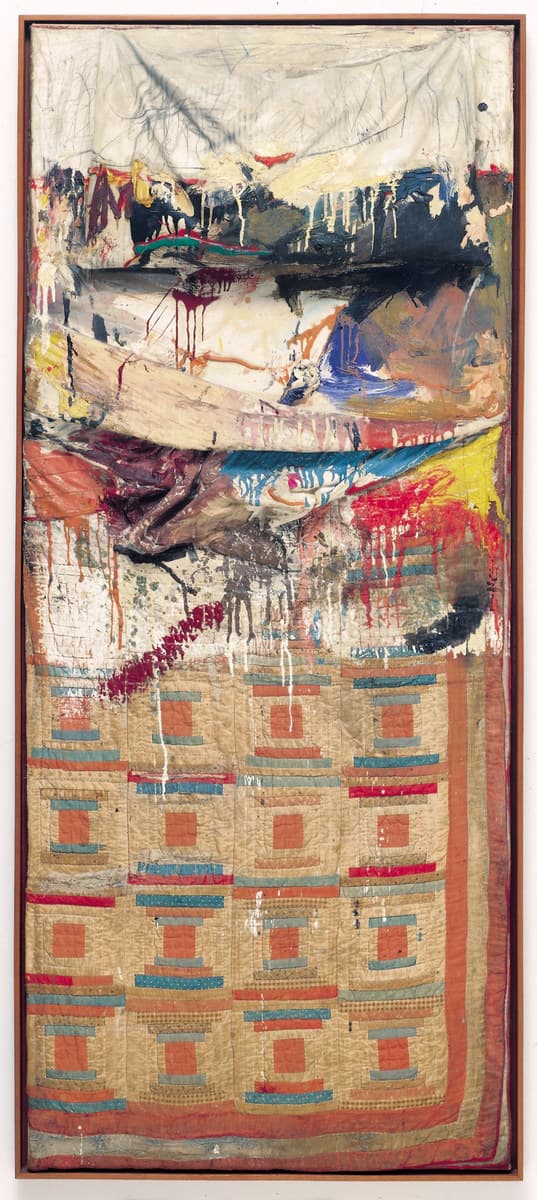
Bed (1955) was made by smearing red paint across a worn quilt, sheet and pillow, then hanging the whole thing on a wall like a picture. Because the bedding was his own, the work is often read as a self-portrait. Some critics read it instead as an image of violence. Rauschenberg called it "one of the friendliest pictures I've ever painted". Leo Castelli mounted a show of the Combines in 1958 and bought Bed himself, which was the exhibition's only sale. It is now in the Museum of Modern Art in New York.

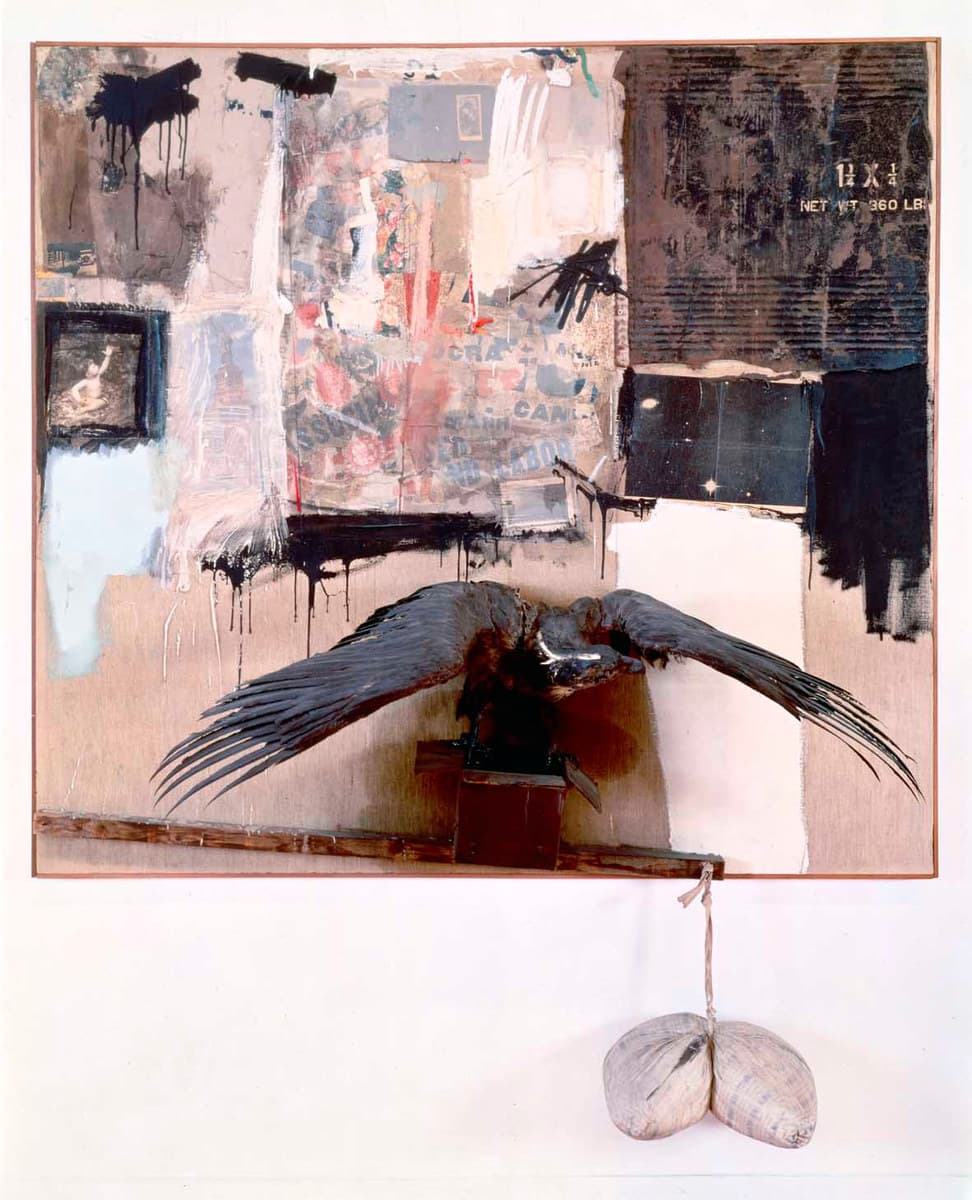
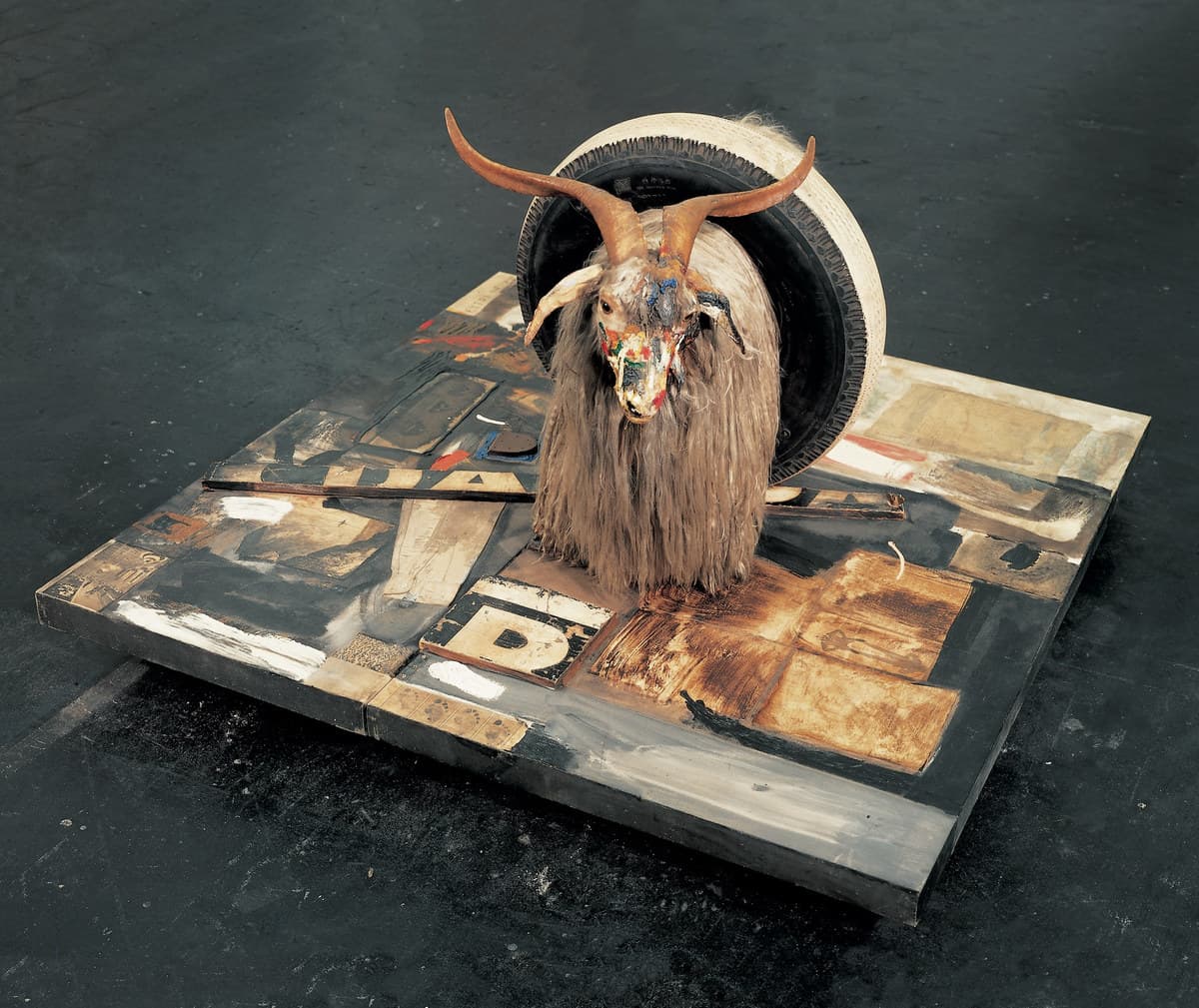
Two of the Combines use taxidermy. Monogram, worked on from 1955 to 1959, is built around a stuffed angora goat. Canyon (1959) carries a stuffed golden eagle that Rauschenberg salvaged from the trash. The eagle later caused legal trouble, because the Bald and Golden Eagle Protection Act of 1940 restricts dealing in such birds.

Rauschenberg's private life ran alongside this work. After his marriage to Susan Weil ended he had relationships with two fellow artists, Cy Twombly and Jasper Johns, and with the poet John Giorno. Critics grouped the work of Rauschenberg and Johns under the label Neo-Dada. For the last twenty-five years of his life his partner was Darryl Pottorf, an artist who had first worked for him as an assistant.

Silkscreens, the Venice Biennale prize, and the Judson dancers, 1962–1967

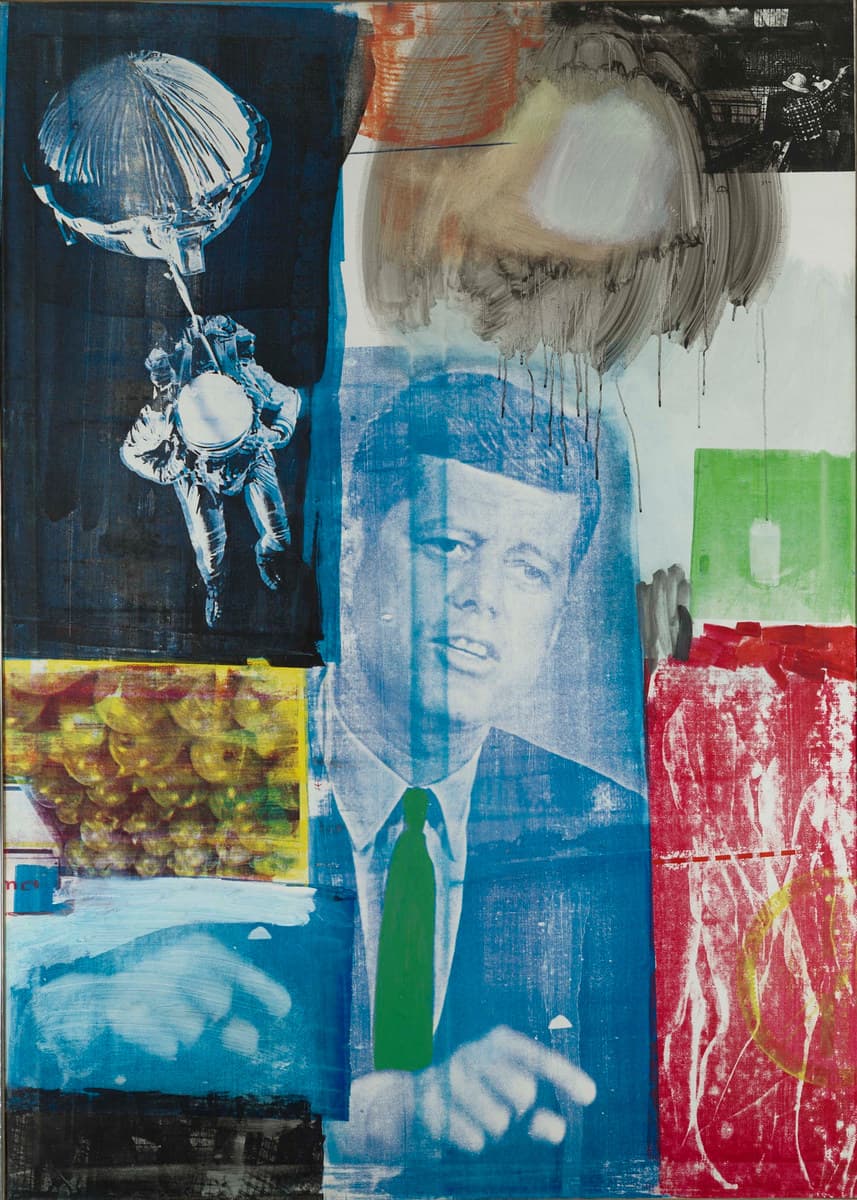
In 1962 Rauschenberg visited Andy Warhol's studio and began transferring photographs to canvas by silkscreen, a process then used for commercial printing. The silkscreen paintings he made between 1962 and 1964 led critics to file his work under Pop art. Barge, made mostly across a single day, runs thirty-two feet long. Trucks, spacecraft, text and part of Diego Velázquez's Rokeby Venus are all recognizable in it.

In 1964 Rauschenberg won the International Grand Prize in Painting at the 32nd Venice Biennale. He was one of the first American artists to take it. James Whistler had won a painting prize in Venice in 1895 and Mark Tobey in 1958. His first career retrospective had opened the year before at the Jewish Museum in New York.

Dance ran through his work from the beginning. At Black Mountain College in 1952 he took part in John Cage's Theatre Piece No. 1, often called the first Happening. He designed sets, lighting and costumes for Merce Cunningham and for Paul Taylor. In May 1963 he choreographed his own first piece, Pelican, for the Judson Dance Theater in Greenwich Village. His full-time work with the Merce Cunningham Dance Company ended after the company's 1964 world tour.

Experiments in Art and Technology, Captiva Island, and the Overseas Culture Interchange, 1966–1991

Rauschenberg had already put working radios, clocks and electric fans into the early Combines. He took the interest further with Billy Klüver, a research scientist at Bell Laboratories. In 1966 they founded Experiments in Art and Technology, a non-profit that paired artists with engineers. That same year Rauschenberg staged Open Score at the 69th Regiment Armory in New York, part of the series 9 Evenings: Theatre and Engineering. Soundings, a light installation that responded to sound in the room, followed in 1968.

NASA invited Rauschenberg to watch the launch of Apollo 11 in 1969. He answered with the Stoned Moon lithographs, which set NASA diagrams and archive images against his own drawing and handwriting. He had bought his first house on Captiva Island, Florida, on 26 July 1968, and he moved there for good in the autumn of 1970. The first Captiva works used what was to hand on the island: the Cardboards of 1971 to 1972 and the Early Egyptians of 1973 to 1974.

Cloth took over in the Captiva years. He printed on fabric with a solvent-transfer method for the Hoarfrost series of 1974 to 1976 and the Spreads of 1975 to 1982. The Jammers of 1975 to 1976 used bright fabrics he had seen in Ahmedabad in India, a city known for its textiles. Where the New York work had been gritty and crowded with images, the Jammers were nearly empty.

In 1984 Rauschenberg announced the Rauschenberg Overseas Culture Interchange at the United Nations, and he paid for almost all of it himself. The tour ran seven years and reached ten countries: Mexico, Chile, Venezuela, China, Tibet, Japan, Cuba, the Soviet Union, Germany and Malaysia. He photographed each place, made work from what he had seen, and showed it locally. He usually left one work behind with a cultural institution in the country. The project closed with an exhibition at the National Gallery of Art in Washington in 1991.

How Rauschenberg worked

Rauschenberg wrote in 1959 that "painting relates to both art and life", and that he tried "to act in that gap between the two". In practice the method began with collecting. He picked up cardboard, clothing, newspaper, metal and wood near wherever he was working, and used them at full size instead of drawing them. He said he wanted something other than what he could make himself, and that an object became a new thing once its surroundings changed.

The second habit was transfer. Rather than paint a photograph, he moved it onto a surface by mechanical means. He started with solvent rubbing, took up silkscreen in 1962, and from the 1990s used digital inkjet. The surfaces he printed on kept changing: canvas, cloth, steel, mirrored aluminum, and wet plaster for the Arcadian Retreats of 1996. In the late transfers he used biodegradable dyes and water rather than chemical solvents.

The third habit was working with other people. Billy Klüver and the engineers of Experiments in Art and Technology built the electronics that his installations needed. Merce Cunningham, Paul Taylor and Trisha Brown gave him stages to design. John Cage supplied the argument that ordinary sound and chance belong inside a work of art. In 1977 Rauschenberg, Cage and Cunningham made the dance piece Travelogue together, their first joint work in thirteen years.

Reception, influence, and his death in 2008

Critics in the 1960s discussed the Combines in formal terms, as questions of color, texture and composition. Leo Steinberg argued against that reading. He wrote that each Combine was "a receptor surface on which objects are scattered, on which data is entered". Steinberg named this the flatbed picture plane, a horizontal surface that collects things rather than an upright window that looks onto a scene.

Rauschenberg also used his standing to argue about how artists are paid. The collector Robert Scull had bought his paintings Thaw and Double Feature for $900 and $2,500. Scull sold them at auction in 1973 for $85,000 and $90,000, and Rauschenberg began lobbying Congress for a share of resale prices. California passed a resale royalty act in 1976. He had already founded Change, Inc. in 1970 to give emergency grants of up to $1,000 to artists in need, and he set up the Robert Rauschenberg Foundation in 1990.

President Bill Clinton awarded him the National Medal of Arts in 1993. The Leonardo da Vinci World Award of Arts followed in 1995 and the Praemium Imperiale in 1998. A retrospective at the Solomon R. Guggenheim Museum in New York in 1997 traveled on to Houston, Cologne and Bilbao. Tate Modern mounted the first posthumous retrospective in 2016, which went on to New York and San Francisco. In 2019 Christie's sold the silkscreen painting Buffalo II for $88.8 million.

Rauschenberg died on 12 May 2008 at his home on Captiva Island, Florida. He was 82, and the cause was heart failure. He had lived and worked on the island since 1970, keeping a base in New York as well. His partner for the last twenty-five years of his life was the artist Darryl Pottorf. The Robert Rauschenberg Foundation, which he had set up in 1990, now runs residencies at the Captiva property and in New York.

Life events

  1. 1925

    Born Milton Ernest Rauschenberg in Port Arthur, Texas, on 22 October.

    Robert Rauschenberg

  2. 1948

    Enrolls at Black Mountain College, studies under Josef Albers, and meets the composer John Cage.

    Robert Rauschenberg

  3. 1950

    Marries the artist Susan Weil in Connecticut; their son Christopher is born in July 1951.

    Robert Rauschenberg

  4. 1951

    Holds his first solo exhibition at the Betty Parsons Gallery in New York and makes the White Paintings.

    Robert Rauschenberg

  5. 1952

    Travels in Italy and North Africa with Cy Twombly, making collages and small sculptures from found materials.

    Robert Rauschenberg

  6. 1953

    Rubs out a drawing given to him by Willem de Kooning, producing Erased de Kooning Drawing.

    Robert Rauschenberg

  7. 1955

    Makes Bed, one of the first Combines, from his own quilt, sheet and pillow smeared with red paint.

    Robert Rauschenberg

  8. 1959

    Finishes Monogram, built around a stuffed angora goat, and Canyon, which carries a stuffed golden eagle.

    Robert Rauschenberg

  9. 1962

    Visits Andy Warhol's studio and starts transferring photographs to canvas by silkscreen.

    Robert Rauschenberg

  10. 1964

    Wins the International Grand Prize in Painting at the 32nd Venice Biennale.

    Robert Rauschenberg

  11. 1966

    Founds Experiments in Art and Technology with the Bell Laboratories engineer Billy Klüver.

    Robert Rauschenberg

  12. 1969

    Watches the launch of Apollo 11 at NASA's invitation and makes the Stoned Moon lithographs.

    Robert Rauschenberg

  13. 1970

    Moves permanently to Captiva Island, Florida, and founds Change, Inc. to give emergency grants to artists.

    Robert Rauschenberg

  14. 1984

    Announces the Rauschenberg Overseas Culture Interchange at the United Nations, funding most of it himself.

    Robert Rauschenberg

  15. 1993

    Receives the National Medal of Arts from President Bill Clinton.

    Robert Rauschenberg

  16. 2008

    Dies of heart failure at his home on Captiva Island on 12 May, aged 82.

    Michael Kimmelman, Robert Rauschenberg, American Artist, Dies at 82 (2008)

People they knew

Documented connections — every one carries its source.

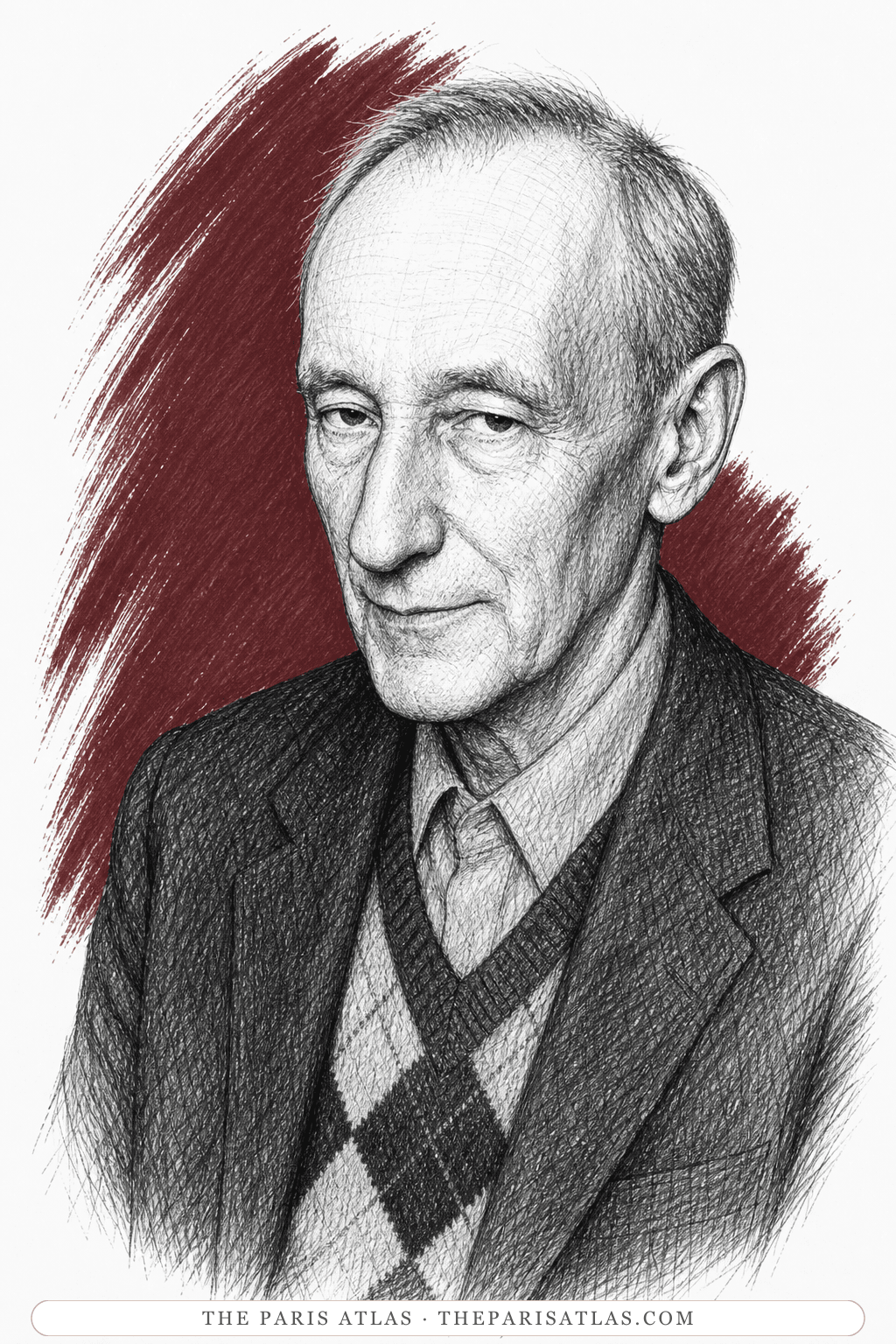
Illustrated portrait of William S. Burroughs

William S. Burroughs

  • Author
  • Painter

Collaborated with · 1981

Burroughs supplied text that Rauschenberg embossed into the six-lithograph series American Pewter with Burroughs.

American Pewter with Burroughs (1981)

Questions about Robert Rauschenberg

Who was Robert Rauschenberg?

Robert Rauschenberg (1925–2008) was an American painter and multi-media artist. He was born in Port Arthur, Texas, trained at Black Mountain College, and worked mainly in New York and on Captiva Island in Florida. He is best known for the Combines of 1954 to 1964, works that attach everyday objects to painted canvas. He also made silkscreen paintings, prints, photographs and stage designs.

What are Rauschenberg's Combines?

The Combines are works Rauschenberg made between 1954 and 1964 that hold real objects as well as paint. He collected clothing, newspaper, scrap metal, wood and other discarded things near his New York studio and fixed them to the canvas. Bed (1955) uses a quilt, a sheet and a pillow. Monogram, finished in 1959, is built around a stuffed angora goat, and Canyon (1959) carries a stuffed golden eagle. They are neither paintings nor sculptures in the usual sense.

What is Erased de Kooning Drawing?

It is a work Rauschenberg made in 1953 by rubbing out a drawing by the painter Willem de Kooning. He asked de Kooning for a drawing specifically so that he could erase it, and de Kooning agreed. What remains is a sheet of paper with the faint traces of the removed marks. Rauschenberg treated the act of erasing as the work itself.

What did Rauschenberg do at Black Mountain College?

He studied there from 1948, mainly to work under Josef Albers, a founder of the Bauhaus. Albers taught a strict design method that Rauschenberg found hard to follow, and he later called himself Albers' dunce. Black Mountain mattered more for the people he met. The composer John Cage and the dancer Merce Cunningham became lifelong collaborators, and in 1952 Rauschenberg took part in Cage's Theatre Piece No. 1, often described as the first Happening.

What was Rauschenberg's relationship with Cy Twombly and Jasper Johns?

Both were fellow artists and, at different times, his romantic partners. Rauschenberg met Cy Twombly at the Art Students League of New York around 1950, and the two traveled together in Italy and North Africa in 1952 and 1953. He was involved with Jasper Johns later in the 1950s, when the two shared work designing store windows under the pseudonym Matson Jones. Critics grouped their paintings together under the label Neo-Dada.

How did Robert Rauschenberg die?

He died of heart failure on 12 May 2008 at his home on Captiva Island, Florida, aged 82. He had lived on the island since 1970 and worked there almost to the end, having kept a studio in New York as well. His partner for the last twenty-five years of his life was the artist Darryl Pottorf. The Robert Rauschenberg Foundation, which he set up in 1990, still runs a residency programme at the Captiva property.

Sourced claims

Every connection the graph holds for Robert, with the evidence behind it.

Collaborated with · 1981

William S. Burroughs

Burroughs supplied text that Rauschenberg embossed into the six-lithograph series American Pewter with Burroughs.

American Pewter with Burroughs (1981)

References

References

The sources below include biographies, scholarly essays, interviews, and primary materials that informed this page. They reflect both the historical record and ongoing critical conversations about Robert Rauschenberg and their work.

  1. 1Robert Rauschenberg

    Website
    Wikipedia
    Used for

    Reference article cross-checked for the chronology, the Combines, the technical series, and the awards.

    View source
  2. 2Robert Rauschenberg, American Artist, Dies at 82

    Periodical
    The New York Times, 2008
    Used for

    Michael Kimmelman's obituary in The New York Times, used for the death and the career summary.

  3. 3Off the Wall: A Portrait of Robert Rauschenberg

    Biography
    Picador, 2005
    Used for

    Calvin Tomkins's biography, the standard account of the New York years.

  1. 4Rauschenberg: Art and Life

    Biography
    Harry N. Abrams, 2004
    Used for

    Mary Lynn Kotz's biography, written with the artist's cooperation.

  2. 5Robert Rauschenberg: A Retrospective

    Exhibition catalogue
    The Solomon R. Guggenheim Museum, 1997
    Used for

    The Guggenheim retrospective catalogue, whose chronology by Joan Young and Susan Davidson underlies most published datings.

  3. 6American Pewter with Burroughs (1981)

    Website
    Robert Rauschenberg Foundation
    Used for

    The Robert Rauschenberg Foundation's record of the 1981 lithograph series made with William S. Burroughs.

    View source
i
Why these sources are here

These references anchor the page in the documented record and in the scholarly conversations around Robert Rauschenberg. Every claim on this page traces back to one or more of the works listed here.

Explore more resources