Erased de Kooning Drawing
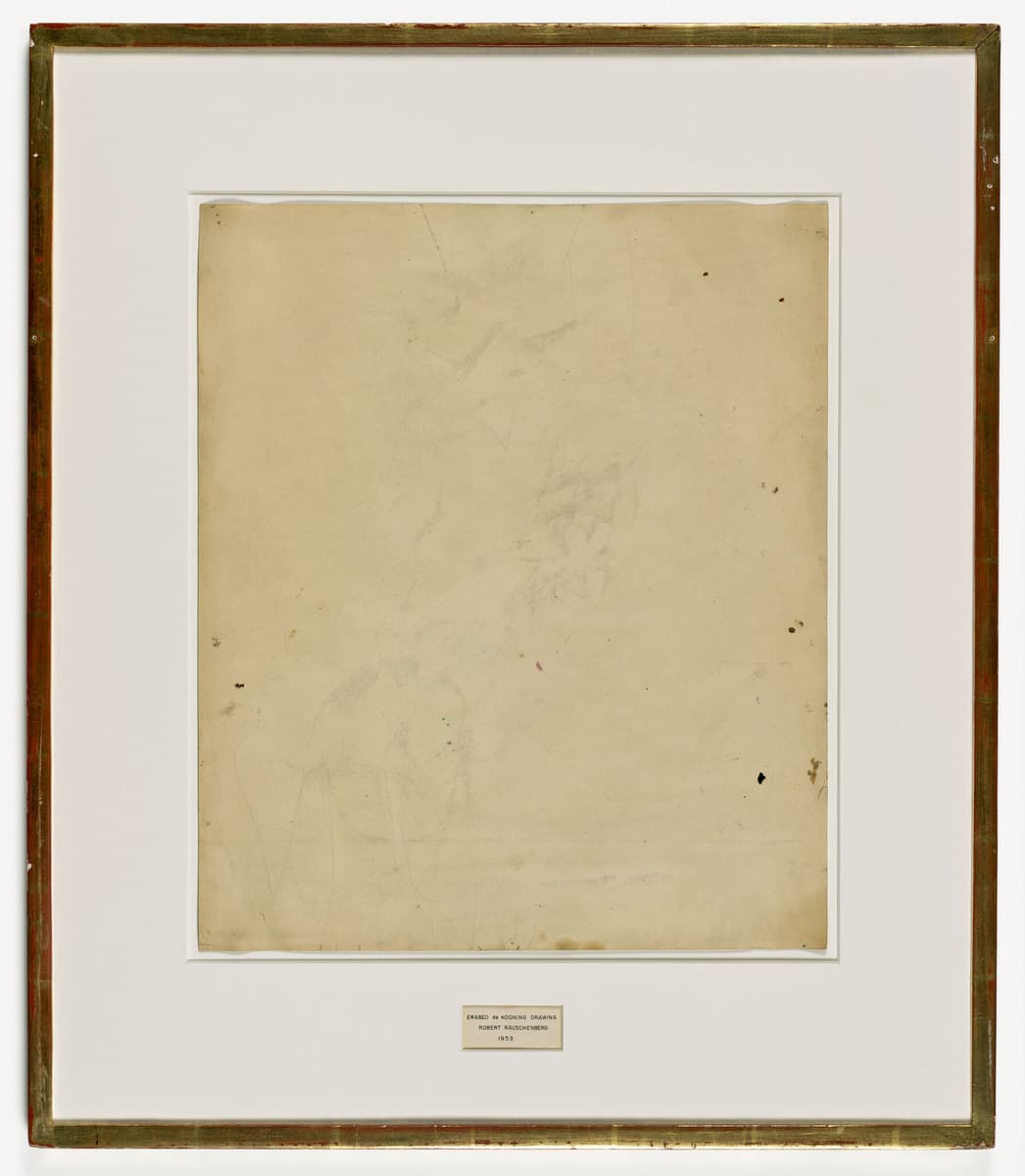
A sheet of cream paper in a gilded frame, carrying the faint grey traces of a drawing that has been rubbed away. Robert Rauschenberg asked the painter Willem de Kooning for a drawing in 1953 specifically in order to erase it, and Willem de Kooning handed one over. Jasper Johns lettered the label beneath it. The San Francisco Museum of Modern Art bought the work in 1998.
- 1953
- Traces of drawing media on paper with label and gilded frame
- San Francisco Museum of Modern ArtSan Francisco, United States
About Robert Rauschenberg
What the framed object shows
A single sheet of paper, warm cream turning to tan, sits behind a white mat in a gilded wooden frame. The gilding is rubbed through in places to a reddish ground underneath, and along the bottom rail it has worn to bare wood and green-brown patches.
The sheet is close to blank. Faint grey marks survive in the upper half, looping and hatching across the centre, and a soft smudge sits to the right of the middle. Lower down, a lighter structure of long strokes runs from the left edge towards the centre, and a faint horizontal line crosses the lower third.
Small dark and reddish spots are scattered near the right edge and along the bottom, the ordinary foxing of a paper seventy years old. The sheet is slightly cockled, so the mat opening catches a shadow along its top edge.
Below the sheet, set into the white mat, is a small cream label in a thin ruled border. It carries three lines of typed capitals: ERASED de KOONING DRAWING, then ROBERT RAUSCHENBERG, then 1953.
The San Francisco Museum of Modern Art gives the materials as traces of drawing media on paper with label and gilded frame. The whole object measures 64.3 by 55.4 by 1.3 centimetres, about 25 by 22 inches.
How he got the drawing
Robert Rauschenberg had been trying to make a work by taking marks away rather than putting them down. He first rubbed out drawings of his own. The San Francisco Museum of Modern Art records his conclusion: for the experiment to mean anything, he had to start from an artwork that was undeniably significant in its own right.
He had already been inside the studio he went to. In early spring 1952 Robert Rauschenberg visited and photographed Willem de Kooning's studio in New York. The museum identifies works in progress in those photographs, among them early states of Woman I, painted between 1950 and 1952, and Woman II of 1952.
In 1953 he went back and asked for a drawing to erase. Willem de Kooning, in the museum's words, somewhat reluctantly agreed. Robert Rauschenberg told the story for the rest of his life, including the detail that he arrived with a bottle of Jack Daniels. In a 1999 interview in the San Francisco Museum of Modern Art's own galleries he called the finished work one of his icons of eccentricities.
The erasing
The museum calls the erasure laborious and says nothing about how long it took. What the object itself records is more useful. A paper board was mounted to the back of the sheet, which the museum's conservators judge Robert Rauschenberg had likely applied to strengthen the paper before he began rubbing.
The drawing he was given was worked in graphite and charcoal. Neither medium comes off cleanly. Charcoal sits on the surface and lifts readily; graphite bites into the fibre and leaves a shadow that an eraser cannot reach.
That difference is why the sheet is not blank. Everything still visible on it is what the rubbing failed to remove.
Jasper Johns lettered the label
Robert Rauschenberg and Jasper Johns worked out together how the erased sheet should be presented. Jasper Johns lettered the inscription using a lettering device, and the San Francisco Museum of Modern Art states that the plain gilded frame and the understated inscription are integral parts of the finished artwork.
The museum puts the reason plainly: without the inscription, a viewer would have no idea what is in the frame, and the piece would be indecipherable. The label is what converts a nearly empty sheet into a record of an act.
Robert Rauschenberg later made the point in writing. A studio assistant inscribed the back of the work in heavy black at his instruction, probably just before it toured with the 1976 retrospective: DO NOT REMOVE DRAWING FROM FRAME. FRAME IS PART OF DRAWING.
What is still on the paper
In 2010 the San Francisco Museum of Modern Art scanned the sheet in infrared light and digitally enhanced the result, to learn what Willem de Kooning had drawn. The enhancement added weight to the surviving graphite and charcoal until the shadowy forms became visible.
The museum reports what appeared. Several figures fill the sheet, worked from different angles and oriented in two directions. A female figure at the lower left is probably related to the Woman series, which occupied Willem de Kooning from 1950 to 1955.
The museum also enters two cautions. Willem de Kooning used erasers himself as part of his drawing method, so some of the lines the scan recovered may have been erased by him before the sheet ever reached Robert Rauschenberg. And the recovered image is far from a finished drawing or even a focused study; what it shows is an artist in process, thinking with pencil and charcoal.
The museum's own conclusion is that seeing the approximation does not change how the finished work reads.
A second de Kooning on the back
In 1988 a conservator from Cranmer Art Conservation removed the backing board, at Robert Rauschenberg's request. The board had turned acidic and had begun to damage the sheet.
Taking it off uncovered something nobody had catalogued. On the back of the same piece of paper was a faint graphite sketch of a female figure by Willem de Kooning, never erased and hidden for thirty-five years by the board Robert Rauschenberg had glued over it.
The work therefore holds drawing by Willem de Kooning on both sides of one sheet: a rubbed-out one on the front and an intact one on the back.
It did not sell
A registry page from the Leo Castelli Gallery in New York records the work on consignment there for five hundred dollars, from March to October 1958. Robert Rauschenberg's first solo exhibition at the gallery ran from 4 to 29 March that year, and the museum reads the consignment as Leo Castelli keeping the drawing in stock afterwards in the hope the show would sell it.
No buyer came. The work went back to the artist, and he kept it for forty years.
It hung on what he called his muse wall. Fred McDarrah photographed the Front Street studio in January 1961 with Robert Rauschenberg and Gloria McDarrah looking at a block of small works pinned to the wall. Erased de Kooning Drawing is in the top row at the far left, and a Willem de Kooning drawing of about 1947 to 1949 hangs two along from it.
The San Francisco Museum of Modern Art bought the work in 1998, through a gift from the collector Phyllis C. Wattis, as accession number 98.298.
Where the story came from
The account of how the work was made is not incidental to it. The San Francisco Museum of Modern Art states that the narrative is central to understanding the artwork, and that it was first fully published in 1964, eleven years after the erasure. Until then it travelled by word of mouth.
Robert Rauschenberg told it many times over the rest of his life and kept the same key details each time. The museum's reference sheet lists the primary published and unpublished versions, including the one he gave on camera in 1999.
The work also had a hostile early reception in print. Reviewing Black, White and Grey at the Wadsworth Atheneum in 1964, Florence Berkman singled it out as the most unusual work in the exhibition, in a notice the museum describes as tepid.
Two artists own what is in the frame
The object carries work by two hands and the marks of a third. Willem de Kooning drew the sheet, Robert Rauschenberg removed most of it, and Jasper Johns lettered the label that says so.
That matters for reproduction as well as for reading. Willem de Kooning died in 1997 and Robert Rauschenberg in 2008, so both artists' contributions remain in copyright, and they are administered separately. The San Francisco Museum of Modern Art prints one line on the object record, © Robert Rauschenberg Foundation, and does not name a second holder.
The graphite sketch on the back is Willem de Kooning's alone. It is the only part of the object he made that nobody rubbed out.
Close reading
Reading the work, detail by detail
The framed object is photographed square on against a pale wall, so the whole of it is in view: the gilded frame, the white mat, the cream sheet and the small lettered label below it. Almost nothing is printed on the sheet, which is the point, and the plate is good enough to find what survives.
1.The sheet is nearly, but not quite, blank
The paper has warmed from cream to tan and is slightly cockled, so the mat opening throws a shadow along its top edge. At normal viewing distance it reads as empty. The marks that survive are grey, thin and broken.
2.Loops and hatching in the upper half
A group of curved and hatched strokes runs across the upper middle, the densest surviving passage on the sheet. Nothing in it resolves into a figure at this resolution. The San Francisco Museum of Modern Art's 2010 infrared scan, which is a separate image, recovered several figures worked from different angles.
3.A soft smudge right of centre
One passage is a rubbed grey mass rather than a line, with no edge anywhere. Charcoal smears when an eraser drags it; graphite polishes into the fibre. The difference between the two is why the sheet is not uniformly clean.
4.A structure of long strokes at the lower left
Below and left of centre, several long strokes run down and across, more legible than anything above them. The museum reports that the enhanced scan shows a female figure at the lower left, probably related to Willem de Kooning's Woman series. What the unaided plate shows is the strokes, not the figure.
5.Foxing along the right edge
Small dark and reddish spots are scattered down the right side and along the bottom. They are age, not drawing. The acidic board mounted behind the sheet was removed in 1988 for exactly this reason.
6.The label, in three lines
A cream label in a thin ruled border sits in a window cut in the mat. It reads ERASED de KOONING DRAWING, then ROBERT RAUSCHENBERG, then 1953. Jasper Johns lettered it with a lettering device. Without it the frame holds an unexplained sheet of paper.
7.The gilding is worn through
Along the bottom rail the gold is rubbed off in long patches, showing the red bole beneath it and, in places, the wood. The frame is not decoration that could be swapped: Robert Rauschenberg had the back inscribed DO NOT REMOVE DRAWING FROM FRAME. FRAME IS PART OF DRAWING.
8.The mat gives the sheet most of the frame
The white mat is deep on every side, so the paper occupies only the middle of the object. The arrangement is a museum presentation applied to a sheet that has had its content removed, and Robert Rauschenberg and Jasper Johns devised it together in 1953.
Timeline
1952
In early spring Robert Rauschenberg visits and photographs Willem de Kooning's New York studio; early states of Woman I and Woman II are identifiable in the pictures.
1953
Robert Rauschenberg asks Willem de Kooning for a drawing to erase. Willem de Kooning agrees, and the erasure is carried out. Jasper Johns letters the label with a lettering device.
1955–56
First exhibited, in Group Drawings at the Poindexter Gallery, New York, 19 December to 4 January.
1958
On consignment at the Leo Castelli Gallery for five hundred dollars from March to October, after Robert Rauschenberg's first solo exhibition there, 4 to 29 March. It does not sell and returns to the artist.
1961
Photographed by Fred McDarrah on the muse wall of the Front Street studio in January, hanging beside a Willem de Kooning drawing.
1964
Shown in Black, White and Grey at the Wadsworth Atheneum, 9 January to 9 February, organised by Samuel Wagstaff; Florence Berkman calls it the most unusual work in the show. The making of the work is fully published for the first time in the same year.
1976–78
Tours with the retrospective Robert Rauschenberg from the National Collection of Fine Arts in Washington to the Museum of Modern Art, the San Francisco Museum of Modern Art, the Albright-Knox Art Gallery and the Art Institute of Chicago. The back is inscribed FRAME IS PART OF DRAWING at about this point.
1988
Cranmer Art Conservation removes the acidic backing board at the artist's request, uncovering an unerased graphite sketch of a female figure by Willem de Kooning on the reverse.
1998
Bought by the San Francisco Museum of Modern Art through a gift of Phyllis C. Wattis, as accession 98.298.
2010
The museum makes an enhanced infrared scan of the sheet, recovering several figures worked from different angles, including one at the lower left probably related to Willem de Kooning's Woman series.
Where to see it
San Francisco Museum of Modern Art
San Francisco, United States
A public viewing address has not yet been confirmed for this holding.
The museum lists the work as not on view at this time. It is a work on paper and is shown in rotation.
Frequently asked questions
What is Erased de Kooning Drawing?
A drawing by Willem de Kooning that Robert Rauschenberg rubbed out in 1953, framed with a label recording what was done. He asked Willem de Kooning for a drawing specifically so that he could erase it. The San Francisco Museum of Modern Art owns it as accession 98.298.
Did Willem de Kooning agree to it?
Yes. The San Francisco Museum of Modern Art records that he agreed somewhat reluctantly, knowing exactly what was planned. Robert Rauschenberg had decided the experiment would only work if he began from an artwork that was undeniably significant, and Willem de Kooning was the artist he most respected.
Can you still see the de Kooning drawing?
Faintly, and better since 2010. The sheet carries grey traces the rubbing could not lift. In 2010 the museum made an infrared scan and enhanced it digitally, which brought out several figures worked from different angles, with a female figure at the lower left probably belonging to the Woman series. Willem de Kooning used erasers himself, so some recovered lines may be his own.
Who wrote the label under the drawing?
Jasper Johns, using a lettering device. It reads ERASED de KOONING DRAWING, then ROBERT RAUSCHENBERG, then 1953. The San Francisco Museum of Modern Art treats the gilded frame and the inscription as integral parts of the work, since without them a viewer would have no way of knowing what the frame holds.
Is there a second drawing on the back?
Yes. In 1988 a conservator removed the acidic backing board at Robert Rauschenberg's request and found a faint graphite sketch of a female figure by Willem de Kooning on the reverse of the sheet. It was never erased, and it had been covered since 1953.
How much was Erased de Kooning Drawing once offered for?
Five hundred dollars. A Leo Castelli Gallery registry page records it on consignment at that price from March to October 1958, after Robert Rauschenberg's first solo show there. Nobody bought it, and he kept the work until the San Francisco Museum of Modern Art acquired it in 1998.
Where can you see Erased de Kooning Drawing?
At the San Francisco Museum of Modern Art, which lists it as not on view at this time. It is a light-sensitive work on paper, so it is shown in rotation rather than hung permanently. Check the museum's record before travelling.
More by Robert Rauschenberg
If you like Robert Rauschenberg
Explore painters from the same movements and circles.
Arman
French-American artist, lifelong friend of Yves Klein, and a founder of New Realism.
View artist
Jean Arp
Strasbourg-born sculptor and poet — Hans in German, Jean in French, both all his life — who co-founded Dada at the Cabaret Voltaire in 1916, composed collages by dropping torn paper 'according to the laws of chance', and settled at Meudon outside Paris in a house his wife Sophie Taeuber-Arp designed.
View artist
Rosa Bonheur
At the horse markets of Paris and in her studio beside the forest of Fontainebleau, Rosa Bonheur gave animals the presence of great portrait subjects. The success of The Horse Fair helped her build a life shaped by her work, financial independence, and the women she loved.
View artist
References
The sources below include collection records, catalogues, scholarly research, and primary materials that informed this page. They document Erased de Kooning Drawing, its making, and its place in cultural history.

1Robert Rauschenberg, Erased de Kooning Drawing, 1953
WebsiteSan Francisco Museum of Modern ArtUsed forThe holding museum's record and essay: the medium line, the dimensions, the credit line, the accession number, the copyright line and the account of the erasure.
2Robert Rauschenberg, Erased de Kooning Drawing, 1953 (RRF 53.D001)
WebsiteRobert Rauschenberg FoundationUsed forThe Robert Rauschenberg Foundation's catalogue entry, which states the medium as traces of drawing media on paper with label hand-lettered in ink, and gilded frame.
3Digitally enhanced infrared scan of Robert Rauschenberg's Erased de Kooning Drawing
WebsiteSan Francisco Museum of Modern ArtUsed forThe museum's account of the 2010 enhanced infrared scan and the figures it recovered.
4Conservation report relating to Robert Rauschenberg's Erased de Kooning Drawing, 1988
WebsiteSan Francisco Museum of Modern ArtUsed forCranmer Art Conservation's 1988 removal of the acidic backing board and the unerased Willem de Kooning sketch it uncovered.
5View of Robert Rauschenberg's Erased de Kooning Drawing (verso, framed) showing labels and inscription
WebsiteSan Francisco Museum of Modern ArtUsed forThe inscription on the back, FRAME IS PART OF DRAWING, and the twenty-six exhibition and shipping labels.
6Registry page from Leo Castelli Gallery listing Robert Rauschenberg's Erased de Kooning Drawing
WebsiteSan Francisco Museum of Modern ArtUsed forThe Leo Castelli Gallery registry page recording the five-hundred-dollar consignment of March to October 1958.
7Detail of Robert Rauschenberg's Erased de Kooning Drawing showing inscription
WebsiteSan Francisco Museum of Modern ArtUsed forThe label as a separate sheet, lettered by Jasper Johns with a lettering device and normally framed by a window in the mat.
8Robert Rauschenberg, contact sheet showing multiple views of Willem de Kooning's studio, 1952
WebsiteSan Francisco Museum of Modern ArtUsed forRobert Rauschenberg's own photographs of Willem de Kooning's studio in early spring 1952, with Woman I and Woman II in progress.
9View of Robert Rauschenberg's Erased de Kooning Drawing (verso, unframed)
WebsiteSan Francisco Museum of Modern ArtUsed forThe photograph of the reverse showing the unerased graphite female figure by Willem de Kooning.
10Robert Rauschenberg discusses Erased de Kooning Drawing at SFMOMA, May 6, 1999
WebsiteSan Francisco Museum of Modern ArtUsed forRobert Rauschenberg on camera at the museum in 1999, calling the work one of his icons of eccentricities and telling the story of the request.
11Robert Rauschenberg at his Front Street studio with Erased de Kooning Drawing
WebsiteSan Francisco Museum of Modern ArtUsed forFred McDarrah's January 1961 photograph of the Front Street muse wall, with the work in the top row beside a Willem de Kooning drawing.
12Florence Berkman on Black, White and Grey, Wadsworth Atheneum, 1964
WebsiteSan Francisco Museum of Modern ArtUsed forFlorence Berkman's review of Black, White and Grey at the Wadsworth Atheneum, which singled the work out as the most unusual in the exhibition.
13Robert Rauschenberg's accounts of the making of Erased de Kooning Drawing
WebsiteSan Francisco Museum of Modern ArtUsed forThe museum's survey of Robert Rauschenberg's published and unpublished tellings, and the note that the story was first fully published in 1964.
14Fair Use Policy
WebsiteRobert Rauschenberg FoundationUsed forThe rights holder's own position on fair use, and the basis on which the reproduction is shown.
These references provide the documented foundation for this work's history and interpretation. Claim-level citations remain attached to the specific claims they support.
 Explore more resources