Retroactive I
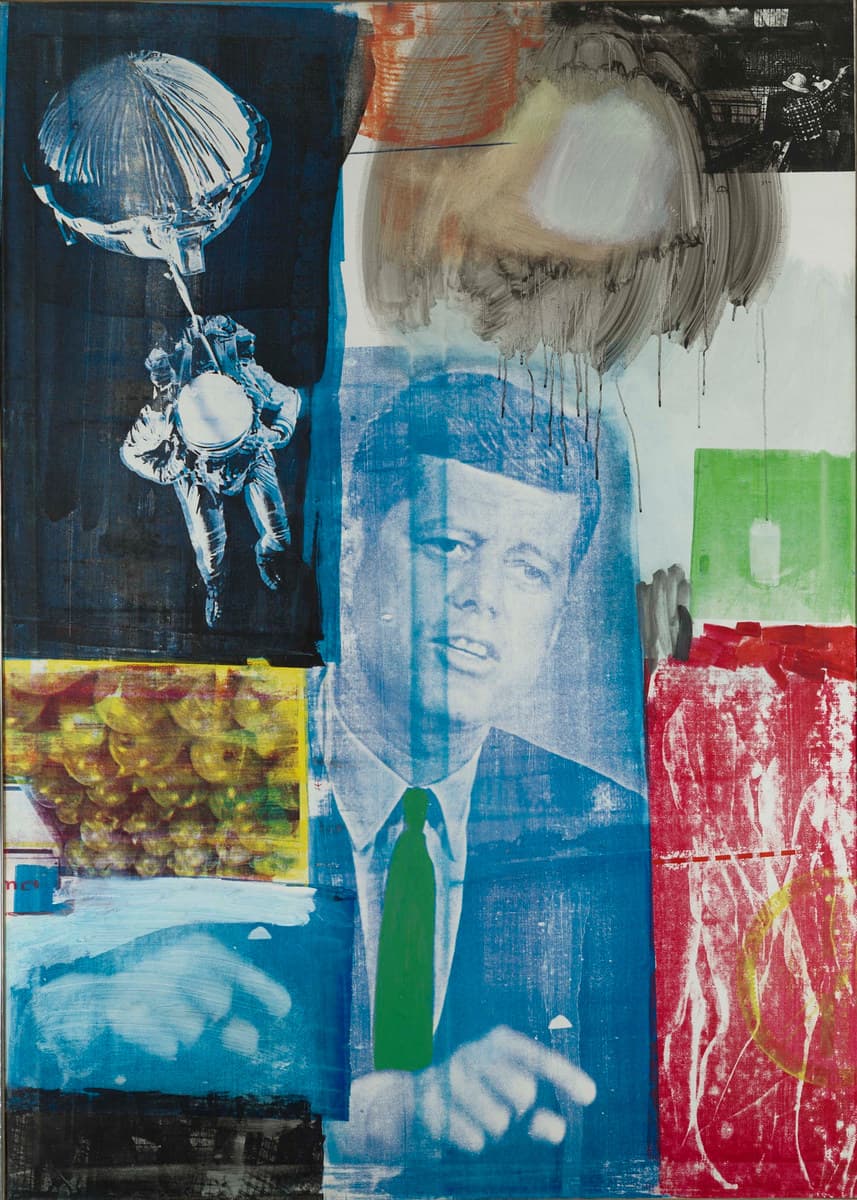
A blue photographic image of John F. Kennedy, arm raised and finger pointing, silkscreened onto a canvas alongside an astronaut under a parachute, a glass of water on a green ground and a crate of fruit. Robert Rauschenberg painted it in 1963, from a Kennedy screen he had ordered shortly before the president was shot. The Wadsworth Atheneum in Hartford has owned it since 1964.
- 1963
- Oil and silkscreen ink on canvas
- Wadsworth Atheneum Museum of ArtHartford, United States
About Robert Rauschenberg
What the painting shows
John F. Kennedy occupies the centre, printed in blue on a blue ground, head and shoulders, mouth open in speech. His right hand comes up at the bottom of the canvas with the index finger extended. A solid green shape is painted over the place where his tie hangs.
The upper left is a dark navy panel carrying a screened photograph in white and pale blue. A parachute canopy fills the top of it, and below hangs a figure in a pressure suit with a large spherical pack strapped across the chest, legs and boots trailing.
Across the top centre a broad grey-brown arc has been brushed in loops over a pale yellow-white oval, with thin black drips running down from it onto the white ground below.
At the top right is a black-and-white screened photograph of scaffolding and girders. A man in a white hard hat and a boldly checked jacket appears twice in it, in two slightly different positions, one with an arm raised.
To the left, a rectangle bordered in yellow holds a screened mass of round fruit heaped several rows deep, printed in yellow, green and dark red. On the right a flat green rectangle carries the pale outline of a drinking glass, apparently full, with a single black paint drip running down and stopping exactly at its rim.
Below the green, a large red field is scraped and streaked with white and carries a loose yellow circle. The bottom edge of the canvas runs into a dark band of scratchy grey and black marks.
The Wadsworth Atheneum gives the medium as oil and silkscreen ink on canvas, and the canvas as 84 by 60 inches, 213.4 by 152.4 centimetres.
The Kennedy screen
The photograph is John F. Kennedy during the second televised presidential debate of 1960, when he was still the senator from Massachusetts. Robert Rauschenberg had ordered the silkscreen made from it shortly before the president was assassinated on 22 November 1963.
That left him with a decision. The Robert Rauschenberg Foundation records that he was in a quandary over whether to use the screen at all. He used it here and in three more paintings of 1964: Retroactive II, Axle and Buffalo II.
He explained the attraction to the critic Calvin Tomkins in plain terms.
What he said about Kennedy
“Kennedy . . . reestablished what a President is supposed to be—somebody special. . . . One of the things that was so shocking about his death was that it was so believable; it wasn't out of scale with the strength and abruptness of all the things he'd done in office.”
Robert Rauschenberg had already made work about the same man. In November 1960 he made the solvent-transfer drawing Election while the results came in on television, and in April 1961 he sent it to the president and Mrs Kennedy as a gift. It was sold from Jacqueline Kennedy Onassis's estate at Sotheby's in New York in 1996.
Where the other pictures come from
The Robert Rauschenberg Foundation identifies each source. The astronaut under the parachute comes from a NASA photograph reproduced in Life on 27 September 1963, showing a space suit fitted with a combined parachute and balloon for use if an astronaut ejected from a Gemini capsule.
The glass of water is his own. It is based on a Polaroid he took around 1962, and the image runs through the whole silkscreen series. Talking about the same glass printed over green in Persimmon, he said he had to change the rest of that painting to destroy the look of poison, because green is what a person associates with a glass of poison.
The doubled figure at the top right is drawn from a time-lapse photograph by Gjon Mili published in Life on 26 October 1962. The Foundation reads the Mili photograph as itself owing something to Marcel Duchamp's Nude Descending a Staircase (No. 2) of 1912, which Robert Rauschenberg had gone to see with Jasper Johns at the Philadelphia Museum of Art in late autumn 1958.
How silkscreen changed the work
Robert Rauschenberg had been moving photographs onto paper since the mid-1950s by rubbing them with solvent, a method that reproduces an image at exactly the size it was printed. In 1962 he visited Andy Warhol's studio and took up silkscreen, a commercial printing process.
The change was one of scale rather than of subject. A photographic screen could be made at any size, so an image clipped from a magazine could arrive on the canvas several feet across. The silkscreen paintings run from 1962 to 1964.
The critics who saw them filed him under Pop art, on the strength of the subject matter and the commercial process. The surfaces themselves argue with that: the screens are printed unevenly, dragged and doubled, and the paint around them is brushed, scraped and allowed to drip.
How it reached Hartford
The collector Susan Morse Hilles bought the newly finished painting in 1964, out of a group exhibition at the Leo Castelli Gallery in New York. She gave it to the Wadsworth Atheneum Museum of Art in Hartford shortly afterwards.
The museum's accession number, 1964.30, carries that year. Its object record dates the painting itself 1963, and the artist's own inscription on the back agrees: RETROACTIVE I, then RAUSCHENBERG 1963, written in red-orange crayon or marker.
One of the Foundation's own pages disagrees with the rest. The list of works released under its Creative Commons licence gives Retroactive I as 1964, while the Foundation's catalogue entry, its essay on the work and the owning museum all give 1963.
Framed, the painting measures 84 3/4 by 60 3/4 inches and stands two inches deep. The museum lists it as currently on view.
Close reading
Reading the work, detail by detail
The painting is photographed flat and whole, edge to edge, in its thin frame. Everything in it is either silkscreened ink or brushed paint on a single canvas, so there is no depth for the camera to lose, and every element described below is legible in the plate.
1.John F. Kennedy, printed blue on blue
The portrait runs almost the full height of the canvas, printed in blue on a blue ground so that the figure and the field are nearly the same colour. The mouth is open. The screen has printed unevenly, breaking up across the jaw and the shoulder.
2.The raised hand, low in the canvas
A hand comes up at the bottom of the canvas with the index finger extended, printed pale against the blue. It is well below the head, so the gesture and the face occupy opposite ends of the picture rather than reading as one movement.
3.A green block where the tie hangs
A solid block of green paint is laid over the screened suit, roughly where a tie falls, with hard edges and no modelling. It is the most opaque thing on the canvas. Nothing of the photograph shows through it.
4.The parachute and the suited figure
On a dark navy panel, a parachute canopy opens at the top and a figure in a pressure suit hangs below it, a large spherical pack strapped across the chest and the boots trailing. The Robert Rauschenberg Foundation identifies the source as a NASA photograph published in Life on 27 September 1963.
5.One man printed twice on the scaffolding
At the top right, a black-and-white photograph shows a lattice of girders and scaffolding. A man in a white hard hat and a boldly checked jacket appears twice in it, in two different positions, one with an arm raised. The Foundation identifies the source as a time-lapse photograph by Gjon Mili published in Life on 26 October 1962.
6.A grey arc brushed over a pale oval
Across the top centre a broad grey-brown arc is dragged in loops over a soft pale yellow-white oval. Thin black drips hang from its lower edge, five or six of them, of uneven length. It is the largest passage in the painting that carries no photograph.
7.A glass of water on green
A flat green rectangle carries the pale screened outline of a drinking glass, apparently full. One black drip runs down from above and stops exactly at the rim. The Foundation records the source as a Polaroid Robert Rauschenberg took himself around 1962.
8.A crate of fruit in a yellow border
A rectangle bordered in bright yellow holds a heaped mass of round fruit, printed several rows deep in yellow, green and dark red. The screen has been pulled unevenly, so the rows blur into one another towards the bottom.
9.Scraped red with a yellow ring
The lower right is a large red field, scraped and streaked so that white shows through in long vertical runs. A loose yellow circle is drawn over it, open at one side. No photograph sits inside it.
10.A dark band closes the foot
Across the bottom left runs a band of scratchy grey and black, crosshatched and dragged, over a pale blue field with soft white forms in it. It closes the picture at the foot in the way the black masses close it at the top.
11.Orange-red at the top edge
A brushed orange-red patch sits at the very top of the canvas, running off the upper edge. It is the warmest colour in the painting and the only substantial one above the grey arc.
Timeline
1958
In late autumn Robert Rauschenberg visits the Philadelphia Museum of Art with Jasper Johns to see the Louise and Walter Arensberg Collection, including Marcel Duchamp's Nude Descending a Staircase (No. 2).
1960
Makes the solvent-transfer drawing Election during the televised broadcast of the presidential results, and sends it to President and Mrs Kennedy as a gift the following April.
1962
Visits Andy Warhol's studio and begins transferring photographs to canvas by silkscreen. Gjon Mili's time-lapse photograph appears in Life on 26 October.
1963
A NASA photograph of a Gemini ejection suit is published in Life on 27 September. Robert Rauschenberg orders the John F. Kennedy screen shortly before the assassination of 22 November, and paints Retroactive I.
1964
Uses the same Kennedy screen in Retroactive II, Axle and Buffalo II. Susan Morse Hilles buys Retroactive I from a group exhibition at the Leo Castelli Gallery and gives it to the Wadsworth Atheneum, which accessions it as 1964.30.
1964
Robert Rauschenberg wins the International Grand Prize in Painting at the 32nd Venice Biennale, the year the silkscreen paintings brought him international attention.
Where to see it
Wadsworth Atheneum Museum of Art
Hartford, United States
A public viewing address has not yet been confirmed for this holding.
The museum's collection record lists the painting as on view. Its public portal is session-based and has no stable link to the object record, so search the collection for the title.
Frequently asked questions
Who is in Retroactive I?
John F. Kennedy, printed from a photograph of the second televised presidential debate of 1960, when he was still a senator. He is shown speaking, with his right hand raised and the index finger extended. An astronaut under a parachute, a doubled figure on scaffolding, a glass of water and a crate of fruit share the canvas.
Was Retroactive I made before or after the assassination?
After. Robert Rauschenberg ordered the silkscreen shortly before John F. Kennedy was shot on 22 November 1963, and the Robert Rauschenberg Foundation records that he was in a quandary about whether to use it. He did, here and in Retroactive II, Axle and Buffalo II of 1964.
Is Retroactive I dated 1963 or 1964?
1963. The Wadsworth Atheneum dates it 1963, the Robert Rauschenberg Foundation's catalogue entry dates it 1963, and the artist inscribed 1963 on the back in red-orange crayon. The number 1964 belongs to the accession, 1964.30, and to the year Susan Morse Hilles bought and donated it. One page on the Foundation's own site lists it as 1964.
What is the green shape over Kennedy's tie?
A block of green paint laid over the screened image, roughly where the tie falls. Green recurs in the silkscreen paintings. Robert Rauschenberg said of a glass of water printed over green in Persimmon that he had to change the whole painting to destroy the look of poison, because that is the association a glass of green carries.
Where does the falling figure come from?
From a NASA photograph reproduced in Life on 27 September 1963, showing a space suit fitted with a combined parachute and balloon for an astronaut ejecting from a Gemini capsule. Robert Rauschenberg put astronauts into a number of works in the 1960s.
Where can you see Retroactive I?
At the Wadsworth Atheneum Museum of Art in Hartford, Connecticut, accession number 1964.30, where the museum's record lists it as on view. The canvas is 84 by 60 inches and the frame adds about three quarters of an inch on each side.
More by Robert Rauschenberg
If you like Robert Rauschenberg
Explore painters from the same movements and circles.
Arman
French-American artist, lifelong friend of Yves Klein, and a founder of New Realism.
View artist
Jean Arp
Strasbourg-born sculptor and poet — Hans in German, Jean in French, both all his life — who co-founded Dada at the Cabaret Voltaire in 1916, composed collages by dropping torn paper 'according to the laws of chance', and settled at Meudon outside Paris in a house his wife Sophie Taeuber-Arp designed.
View artist
Rosa Bonheur
At the horse markets of Paris and in her studio beside the forest of Fontainebleau, Rosa Bonheur gave animals the presence of great portrait subjects. The success of The Horse Fair helped her build a life shaped by her work, financial independence, and the women she loved.
View artist
References
The sources below include collection records, catalogues, scholarly research, and primary materials that informed this page. They document Retroactive I, its making, and its place in cultural history.

1Robert Rauschenberg, Retroactive I, 1963 (1964.30)
WebsiteWadsworth Atheneum Museum of Art, HartfordUsed forThe holding museum's record: the 1963 date, the medium, the canvas and frame dimensions, the credit line, the inscription on the back and the on-view status.
2Robert Rauschenberg, Retroactive I, 1963 (RRF 64.004)
WebsiteRobert Rauschenberg FoundationUsed forThe Foundation's catalogue entry for the painting.
3Art in Context: Retroactive I
WebsiteRobert Rauschenberg FoundationUsed forThe source photographs and their dates, the Kennedy screen ordered before the assassination, the Calvin Tomkins quotation, the Persimmon remark about green, and the Election drawing sent to the White House.
4Chronology
WebsiteRobert Rauschenberg FoundationUsed forThe move to silkscreen after visiting Andy Warhol's studio, and the wider silkscreen-painting series.
5Creative Commons Licensing
WebsiteRobert Rauschenberg FoundationUsed forThe release of ten works, Retroactive I among them, under a Creative Commons licence, and the 1964 date that page gives the painting.
6Fair Use Policy
WebsiteRobert Rauschenberg FoundationUsed forThe rights holder's own position on fair use, and the basis on which the reproduction is shown.
These references provide the documented foundation for this work's history and interpretation. Claim-level citations remain attached to the specific claims they support.
 Explore more resources