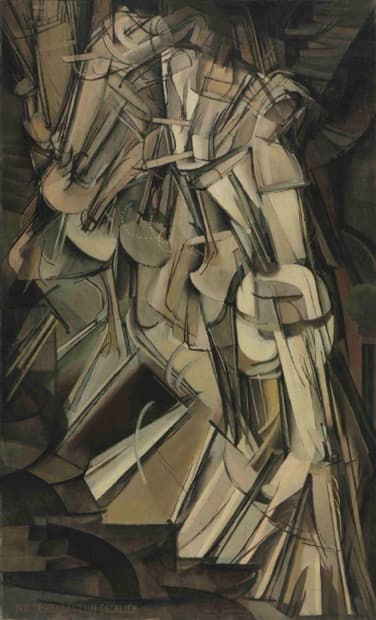
A descending body translated into overlapping ochre planes and repeated stages of motion. Its withdrawal from a Paris exhibition in 1912 and hostile reception at New York's 1913 Armory Show made it an early test of where Cubism ended and a new mechanized image began.
A figure moves diagonally down the canvas, but no single body can be isolated. Brown and ochre planes repeat, overlap, and shift from upper left to lower right. Short directional marks near the feet reinforce the descent, while the title is painted along the lower edge.
The palette and faceting recall Cubism, yet the figure behaves differently from a typical Cubist still life or portrait. It unfolds through time. The result is less an anatomical nude than a diagram of successive bodily positions.
Cubism put into motion
Picasso and Braque had used multiple viewpoints to challenge a stable, single perspective. Duchamp added the problem of duration. Each repeated plane can be read as a stage in the descent, while the whole sequence remains visible at once.
The approach has often been compared with the motion studies of Étienne-Jules Marey and Eadweard Muybridge, which divided an action into successive exposures. It also overlaps with Futurism's interest in speed and modern movement. Duchamp nevertheless arrived at a language that belongs fully to neither Cubism nor Futurism.
A nude without the traditional body
The title promises one of European art's oldest subjects, but the picture withholds beauty, flesh, and a posed individual. The Philadelphia Museum notes that it strips the conventional nude of both sex and recognizable body. “Nude” functions as a category to be tested rather than a description of what viewers can easily see.
The mechanized anonymity matters. The painting turns a human action into a sequence that could almost be engineered or measured, while preserving enough rhythm for the descent to feel bodily.
Withdrawn in Paris
Duchamp submitted the painting to the 1912 Salon des Indépendants. Members of the Cubist group objected to its title and emphasis on motion and asked that he alter or withdraw it. He removed the picture rather than revise it.
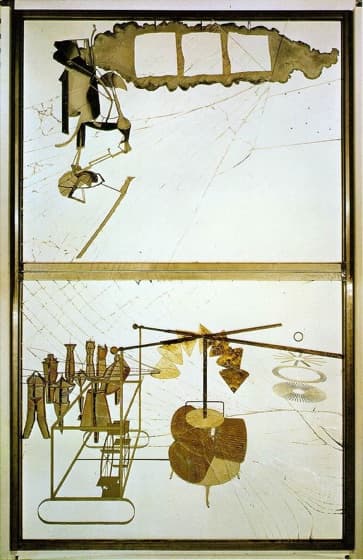
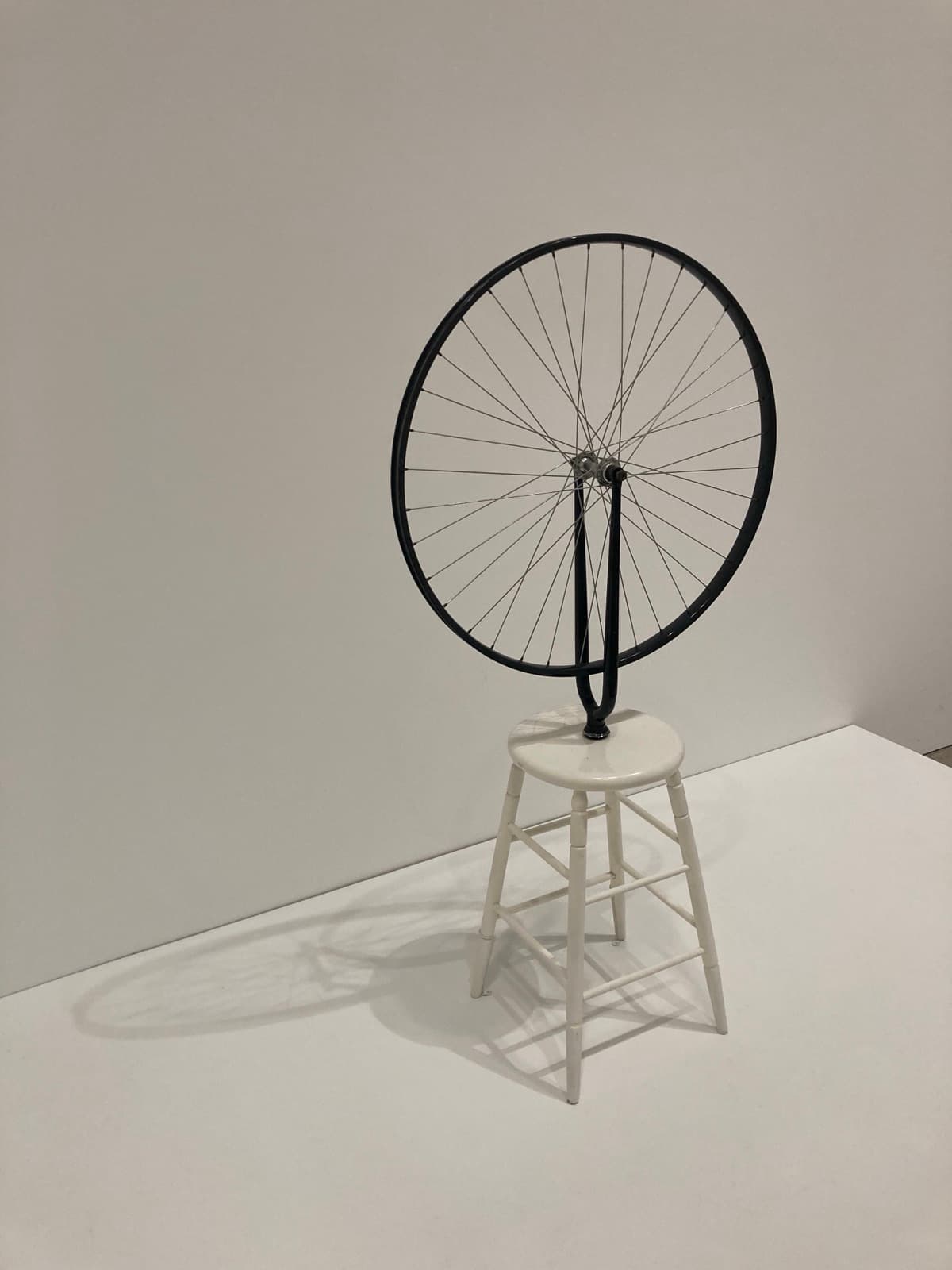
The episode exposed a limit inside an avant-garde movement that was itself challenging academic convention. It also helped move Duchamp away from allegiance to a single style and toward the more independent position he would take with the readymades and The Large Glass.
The Armory Show sensation
The painting reached New York in 1913 with the International Exhibition of Modern Art, known as the Armory Show. Many American reviewers treated it as incomprehensible or comic, and newspapers published parodies. The hostility made it one of the exhibition's most discussed works.
This American scandal differed from the Paris withdrawal. In Paris the dispute concerned the boundaries of Cubism. In New York it became a public argument about modern art itself. Duchamp gained a reputation in the United States before he had visited the country.
The Arensbergs and the second version
The painting eventually entered the collection of Louise and Walter Arensberg, who became Duchamp's most important American patrons and assembled the group of his works now in Philadelphia. Their support placed Nude Descending a Staircase beside the readymades and The Large Glass rather than leaving it as an isolated scandal picture.
In 1916 Duchamp made Nude Descending a Staircase (No. 3), a hand-colored, full-size photographic recreation for the Arensbergs. The later version already treats photography and reproduction as legitimate means of revisiting a painting.
Why the painting matters
Nude Descending a Staircase matters because it brought three problems together: Cubism's fragmented space, the modern study of motion, and the historical genre of the nude. None remains intact after the encounter.
It also marks a hinge in Duchamp's career. The work is still an ambitious oil painting, but its title, diagrammatic structure, and reception point toward an artist increasingly concerned with ideas and systems rather than the refinement of a personal painterly style.
Close reading
Reading the work, detail by detail
Duchamp's figure cannot be isolated in one position because descent is distributed across the whole canvas. The enlarged passages show repetition, diagonal force, and the painted title converting a traditional nude into a record of duration.
1.One body occupies several moments at once
Similar arcs and joint-like forms recur with small shifts rather than assembling into one anatomy. The eye reconstructs a sequence from overlapping positions, as if several exposures had been compressed into one field.
2.The descent has a single diagonal pressure
Short marks near the feet and repeated planes drive from upper left toward lower right. Despite the fragmentation, the action remains unmistakably downward and gives the dense surface a clear direction.
3.The title tells the eye what the body withholds
Words enter the painting as evidence. Without them, the faceted mechanism might remain abstract; with them, viewers test every repeated shape against the promised nude and its movement.
4.Repeated arcs divide one movement into successive positions
Similar curves reappear slightly lower and farther across the canvas. The eye reads those shifts as consecutive stages, much as separate frames can combine into apparent motion.
5.The dark ground prevents a stable room from forming
The surrounding space offers few dependable architectural clues. Without a fixed room, the repeated body fragments carry nearly all the responsibility for explaining direction and speed.
6.The title and number make this one version in an experiment
The designation 'No. 2' matters because Duchamp treated the subject as a problem he could revisit. The painted wording identifies the image while acknowledging an earlier attempt behind it.
Timeline
1912
Painted in Paris. Duchamp's own Cubist associates asked him to withdraw it from the Salon des Indépendants, and he took it down without argument.
1913
Shown at the Armory Show in New York, where press mockery made it one of the exhibition's most discussed works.
1916
Duchamp made a hand-colored, full-size photographic recreation, Nude Descending a Staircase (No. 3), for Louise and Walter Arensberg.
1950
Entered the Philadelphia Museum of Art with the Louise and Walter Arensberg Collection, where it remains.
Where to see it
Philadelphia Museum of Art (The Louise and Walter Arensberg Collection)
2600 Benjamin Franklin Parkway, Philadelphia, PA 19130, United States
Displays and loans can change. Check whether this work is on view before making a special trip.
A 1912 oil painting by Marcel Duchamp showing a figure broken into overlapping planes of motion as it comes down a staircase. It is one of his best-known works and hangs in the Philadelphia Museum of Art.
Why is the figure hard to see?
Duchamp painted successive positions at once. Overlapping planes record stages of a descent, closer to a motion study than to a traditional posed nude.
Why did the Cubists reject it?
When Duchamp submitted it to the 1912 Salon des Indépendants in Paris, fellow Cubists objected to the title and its emphasis on motion, which they felt broke with Cubist principles, and asked him to withdraw it. He did.
Why did it cause a scandal in America?
At the 1913 Armory Show in New York, reviewers and cartoonists mocked its abstract body and unfamiliar movement. The ridicule made it one of the exhibition's most discussed works and established Duchamp's American reputation.
Is it Cubist or Futurist?
It uses Cubist faceting but adds the successive movement associated with chronophotography and Futurism. Its importance lies partly in refusing a clean fit: Duchamp used several modern languages to construct his own diagram of motion.
Why call it a nude if no body is visible?
The title invokes a traditional subject while the painting removes flesh, beauty, and an identifiable sitter. That contradiction turns the category of the nude into part of the work's argument.
What is Nude Descending a Staircase (No. 3)?
A full-size, hand-colored photographic recreation Duchamp made in 1916 for Louise and Walter Arensberg. It shows his early willingness to let photography and reproduction extend an existing painting.
Where is it now?
The Philadelphia Museum of Art, in the Louise and Walter Arensberg Collection.
In the atlas
What the graph records about this work — every claim carries its citation.
Painted out of Cubism in 1912, though it strains against it: the faceted planes are Cubist, but the emphasis on motion — closer to Marey's and Muybridge's chronophotography — is what made Duchamp's fellow Cubists ask him to withdraw it from the Salon des Indépendants.
— Cubism — MoMA, art terms; Encyclopaedia Britannica — Marcel Duchamp
Explore painters from the same movements and circles.
Jean Arp
Strasbourg-born sculptor and poet — Hans in German, Jean in French, both all his life — who co-founded Dada at the Cabaret Voltaire in 1916, composed collages by dropping torn paper 'according to the laws of chance', and settled at Meudon outside Paris in a house his wife Sophie Taeuber-Arp designed.
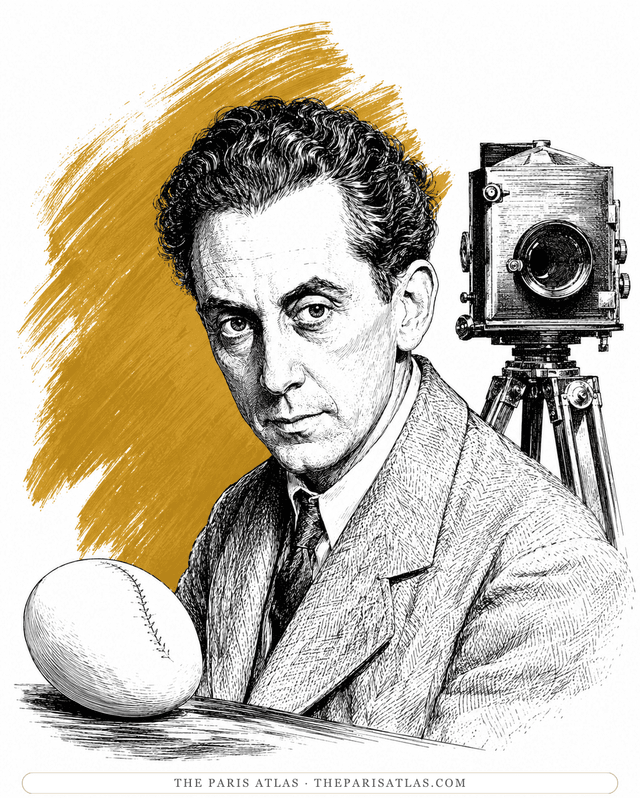
Montparnasse's American eye — portraitist of the whole expatriate quarter, inventor of the rayograph, and maker of films (Emak-Bakia, L'Étoile de mer) that treated the camera as another darkroom.
The sources below include collection records, catalogues, scholarly research, and primary materials that informed this page. They document Nude Descending a Staircase (No. 2), its making, and its place in cultural history.
1Nude Descending a Staircase (No. 2), 1912
Website
Philadelphia Museum of Art
Used for
Web source consulted for documented facts and historical context presented on the Nude Descending a Staircase (No. 2) page.
These references provide the documented foundation for this work's history and interpretation. Claim-level citations remain attached to the specific claims they support.


 View source