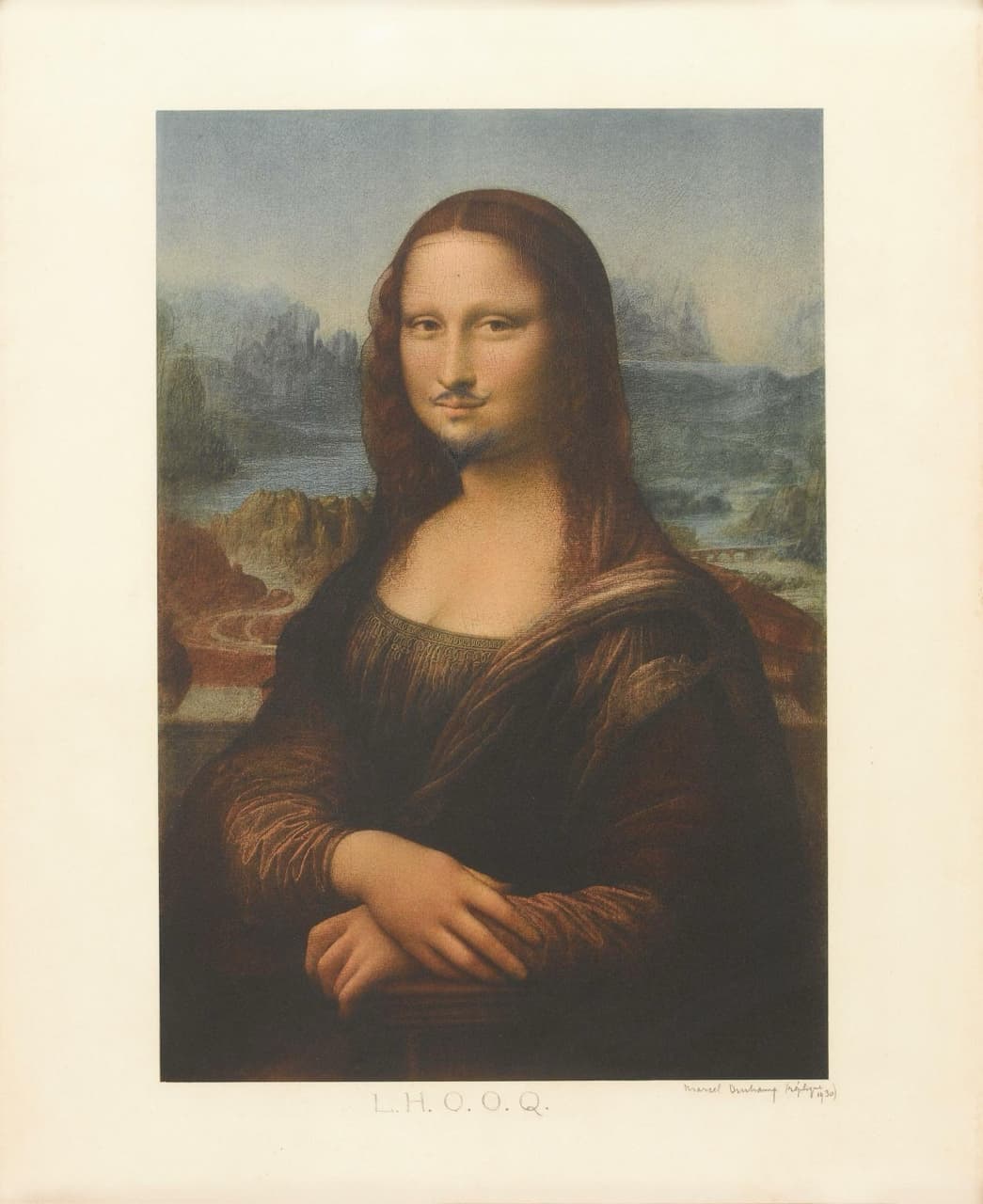
L.H.O.O.Q.
The Mona Lisa with a pencilled moustache and a small beard, and five capital letters that make a crude sexual pun when read aloud in French. Marcel Duchamp made the first version in Paris in 1919. He made this larger replica in 1930 for the poet Louis Aragon. The Centre Pompidou holds it on deposit from the French Communist Party.
- 1919; this replica 1930
- Graphite pencil on a heliogravure print (rectified readymade)
- Centre Pompidou, Musée National d'Art ModerneParis, France
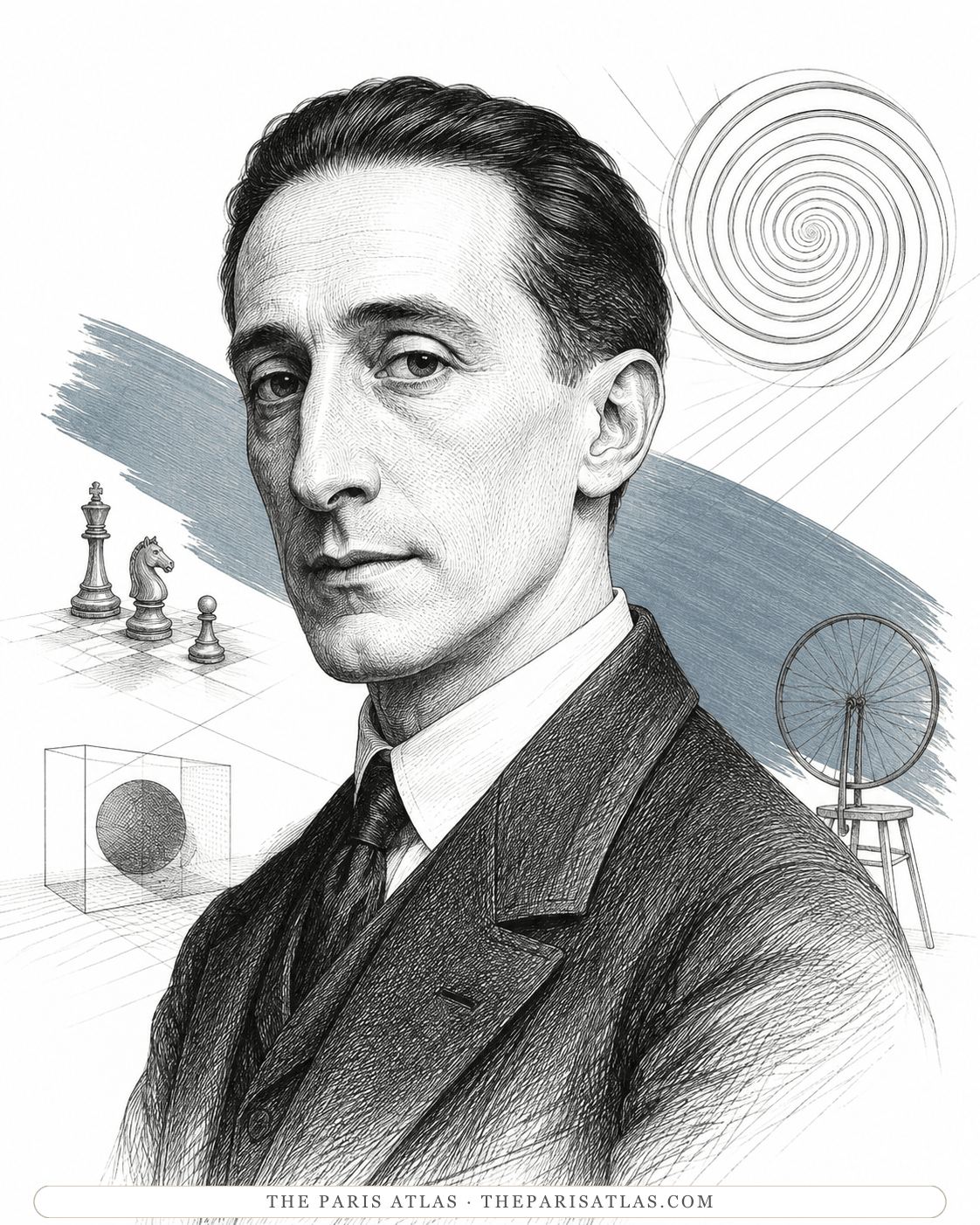
About Marcel Duchamp
What it shows
A colour print of Leonardo da Vinci's Mona Lisa sits on a large cream sheet of paper. On her face, in pencil, are a curled moustache and a small pointed beard. Below the picture are five pencilled capitals, L.H.O.O.Q., and at the lower right a signature.
Everything else is Leonardo da Vinci's picture as the printer reproduced it: the folded hands, the embroidered neckline, the winding road and the misty mountains. Even the fine cracks in the old paint have come through the printing. Marcel Duchamp added nothing to any of it.
A moustache in 1919
Marcel Duchamp made the first L.H.O.O.Q. in Paris in October 1919, just before he left for the United States again. He told the critic Pierre Cabanne that he drew a moustache and a beard, and that was all. He did not show it anywhere.
He started from a cheap colour reproduction of the Mona Lisa, not a painting. In 1953 he told friends that he bought it in a shop near the Louvre on the rue de Rivoli. The scholar André Gervais notes that the sheet is often called a postcard but is not one. The first sheet measured only 19.7 by 12.4 centimetres.
The Centre Pompidou calls the work a rectified readymade: a ready-made object changed by the artist's hand. The museum's catalogue notes that Paris papers had drawn moustaches on the Mona Lisa before. The painting had also been stolen from the Louvre in 1911 and recovered in 1913, so its face was everywhere.
Francis Picabia's copy
Marcel Duchamp took the sheet to the flat of his friend Francis Picabia to pack it, and André Breton saw his recent work there. Francis Picabia used the chance to put L.H.O.O.Q. in his magazine 391 in March 1920. He drew the copy himself, adding the moustache but forgetting the beard.
Francis Picabia captioned it Dada Picture by Marcel Duchamp. Marcel Duchamp told Pierre Cabanne that the copy is often reproduced as his own. Francis Picabia also put the letters L.H.O.O.Q. into his painting Le Double Monde of 1919, now at the Centre Pompidou.
The joke in the letters
The title only works out loud. Said quickly in French, the letters L, H, O, O, Q sound like Elle a chaud au cul. The phrase is a crude sexual pun on the Mona Lisa. Marcel Duchamp told Pierre Cabanne that the letters had no other meaning than to be read out loud.
Marcel Duchamp later explained why he chose the Mona Lisa. The painting was so famous and so admired, he said, that it was very tempting to use it for a scandal. The Centre Pompidou also ties the moustache to his taste for doubles. Around 1920 he took on a female self, Rrose Sélavy, and Man Ray photographed him as her.
A replica for Louis Aragon
Early in 1930 Marcel Duchamp made this larger version in Paris. On 6 February he wrote to the painter Jean Crotti that, just before leaving Paris, he had made a Mona Lisa for Louis Aragon. The same letter says Man Ray had the first one.
The poet Louis Aragon was preparing an exhibition at the gallery of the dealer Camille Goemans in Paris, which opened in March 1930. The show is known by the title of Louis Aragon's catalogue essay, La Peinture au défi. The Centre Pompidou says both versions of L.H.O.O.Q. were shown there together.
Marcel Duchamp signed the new sheet Marcel Duchamp (réplique 1930), calling it a replica in his own hand. He had copied his own joke on a bigger print, and then labelled the copy as a copy.
From the Communist Party to the Pompidou
The sheet belongs to the French Communist Party, whose national headquarters deposited it at the Musée National d'Art Moderne in 2005. The museum's page does not say how the sheet passed from Louis Aragon to the party. In autumn 2005 the sheet hung in the Centre Pompidou's big Dada exhibition.
Marcel Duchamp kept returning to the joke. A small reproduction went into his Boîte-en-valise, his portable museum in a suitcase, and the image was reprinted in several forms up to 1964. In 1965 he made L.H.O.O.Q. Shaved, a Mona Lisa playing card on a printed invitation, now at the Museum of Modern Art.
In autumn 2026 the Centre Pompidou lent the sheet to the Philadelphia Museum of Art for its Marcel Duchamp exhibition, which runs to 31 January 2027.
Close reading
Reading the work, detail by detail
Up close, L.H.O.O.Q. is a printed copy of the Mona Lisa with three things added in pencil: a moustache, a small beard and five capital letters. Marcel Duchamp first did it in Paris in 1919. He made this larger copy in 1930 and signed it as a replica.
1.A moustache in pencil
Marcel Duchamp drew the moustache in pencil straight onto the printed face. The moustache is thick under the nose and thins into two ends that curl upward. The curled ends turn her famous half-smile into something closer to a smirk. Underneath, Leonardo da Vinci's soft mouth is left exactly as it was.
2.A beard made of shading
The beard is not drawn in lines. Marcel Duchamp shaded it, a soft grey patch on the chin that narrows to a point, with the printed skin showing through. When Francis Picabia copied the work for his magazine 391 in 1920, he drew the moustache and forgot the beard. Marcel Duchamp told Pierre Cabanne that the missing beard made the difference.
3.The Mona Lisa as a man
Two small additions make the most famous face in the Louvre look like a man's. The Centre Pompidou links the joke to Marcel Duchamp's love of doubles. Around 1920 he invented a female self, Rrose Sélavy, and Man Ray photographed him dressed as her. The beard and moustache play the same game the other way round.
4.No eyebrows, and he added none
The Mona Lisa has no eyebrows and no lashes, and Marcel Duchamp did not give her any. He changed only the lower half of the face. Her eyes keep their calm, sideways look above the new moustache. Fine cracks run across the printed skin between them.
5.Cracks copied from the old paint
A net of fine cracks covers the forehead and the sky. The cracks are in Leonardo da Vinci's old paint, and the printing process copied them along with everything else. So Marcel Duchamp's pencil sits on a photograph of cracked paint, printed by machine. A thin dark veil runs along the edge of her hair.
6.Five letters in pencil
Below the picture Marcel Duchamp wrote five capital letters in thin pencil: L.H.O.O.Q. Read aloud in French, they sound like Elle a chaud au cul. The phrase is a crude sexual pun on the Mona Lisa. Marcel Duchamp told Pierre Cabanne the letters had no other meaning than to be read out loud.
7.Signed as a replica
At the lower right Marcel Duchamp signed the sheet in pencil and called it a replica: Marcel Duchamp (réplique 1930). He tucked the year in small under the word réplique. The sheet tells us plainly that it copies his own 1919 original. So we are looking at a signed copy of a joke made on a copy of a painting.
8.Leonardo da Vinci's hands, left alone
The folded hands are just as Leonardo da Vinci painted them. Marcel Duchamp left the whole lower part of the picture alone. Every change he made is in the face and in the paper margin. The hands stay graceful and calm, which makes the moustache above look even odder.
9.The embroidered neckline
The neckline of her dress is trimmed with a band of looping embroidery. In the print the embroidery shows as fine gold-coloured lines on dark brown. Leonardo da Vinci's small detail comes through the printing well. Nothing here was touched by Marcel Duchamp's pencil.
10.Folds of the sleeve
Her sleeve is a mass of folds, picked out in bright orange-brown lines. In this print the folds look almost drawn, like chalk on dark paper. On the left, the printed picture stops and the cream paper begins. The hard edge is a reminder that we are looking at a print, not a painting.
11.A bridge in the distance
On the right, behind her shoulder, a small arched bridge crosses a river. Grey-green mountains rise beyond it. The bridge comes straight from Leonardo da Vinci's painting, copied by the printing process. Marcel Duchamp's joke leaves this faraway world alone.
12.A winding road
On the left, a pale road winds through brown hills. Leonardo da Vinci's landscape has no people and no houses, only rocks, water and paths. The dark mass of her hair cuts across the view on the right. At the far left, the print ends in a straight edge against the cream paper.
13.Misty mountains and a lake
Above the road, blue-grey mountains fade into mist over a still lake. The cracks from the old paint cover the sky here too. The printed landscape is as carefully reproduced as the face. The whole of this side is untouched by Marcel Duchamp.
14.Where the print stops
At the top, the printed sky meets the plain cream paper in a straight edge. Up close the sky is grainy, the texture of the printing rather than of paint. A few thin squiggles show in the sky at the lower right. They may be more cracks from the old paint, or marks on this sheet; it is not clear.
15.A wide paper margin
The print sits on a large sheet with a wide cream margin. The Centre Pompidou gives the sheet as 61.5 by 49.5 centimetres, and the printed picture as 48 by 33. The 1919 original measured only 19.7 by 12.4 centimetres, according to the scholar André Gervais. The margin gave Marcel Duchamp room for the title and his signature.
16.Hair falling to the shoulder
Her long brown hair falls in soft waves onto her shoulder. The edge of her cheek glows warm against the hair. With the moustache out of sight, this part of the sheet looks like any souvenir print of the Mona Lisa. Only the face and the margin show Marcel Duchamp's hand.
17.Where Leonardo da Vinci stops and Marcel Duchamp begins
At the bottom of the print, her fingertips rest on the arm of a chair. Below them the picture sinks into dark brown shadow. The printed image stops sharply just above the pencil letters. The hard edge divides Leonardo da Vinci's picture from Marcel Duchamp's words below it.
Timeline
1911
The Mona Lisa is stolen from the Louvre. The painting is recovered in 1913.
October 1919
In Paris, Marcel Duchamp pencils a moustache and beard on a cheap colour reproduction of the Mona Lisa and titles it L.H.O.O.Q.
March 1920
Francis Picabia prints his own copy in the magazine 391, with the moustache but without the beard.
Early 1930
Marcel Duchamp makes this larger replica in Paris for Louis Aragon and signs it as a replica.
March 1930
Both versions are shown at the Galerie Goemans in Paris, in the exhibition introduced by Louis Aragon's essay La Peinture au défi.
1965
Marcel Duchamp makes L.H.O.O.Q. Shaved, a Mona Lisa playing card on a printed invitation.
2005
The French Communist Party deposits the sheet at the Musée National d'Art Moderne; the sheet is shown in the Centre Pompidou's Dada exhibition.
2026
Lent to the Philadelphia Museum of Art for its Marcel Duchamp exhibition, 10 October 2026 to 31 January 2027.
Where to see it
Centre Pompidou, Musée National d'Art Moderne
Paris, France
A public viewing address has not yet been confirmed for this holding.
On loan to the Philadelphia Museum of Art for its Marcel Duchamp exhibition, 10 October 2026 to 31 January 2027, according to the Centre Pompidou's page. Check before a visit.
Frequently asked questions
What does L.H.O.O.Q. mean?
Read aloud in French, the letters sound like Elle a chaud au cul, a crude sexual pun on the Mona Lisa. Marcel Duchamp told Pierre Cabanne that the letters had no other meaning than to be read out loud.
Is the Mona Lisa in L.H.O.O.Q. a postcard?
The 1919 original is usually called a postcard, but the scholar André Gervais says it was a cheap colour reproduction bought in a shop on the rue de Rivoli. This 1930 replica is drawn on a larger print made by heliogravure, a photographic printing process.
Why is there more than one L.H.O.O.Q.?
Marcel Duchamp made the first in 1919. Francis Picabia drew his own copy for 391 in 1920, without the beard. Marcel Duchamp made this larger replica in 1930 for Louis Aragon, and later versions followed, including a shaved one in 1965.
Who owns this L.H.O.O.Q.?
This 1930 replica belongs to the French Communist Party. The sheet has been on deposit at the Musée National d'Art Moderne, Centre Pompidou, since 2005.
Where can I see it?
The sheet belongs to the Centre Pompidou's graphic arts collection. From 10 October 2026 to 31 January 2027 it is on loan to the Philadelphia Museum of Art. Check the Centre Pompidou's page before a visit.
More by Marcel Duchamp
If you like Marcel Duchamp
Explore painters from the same movements and circles.
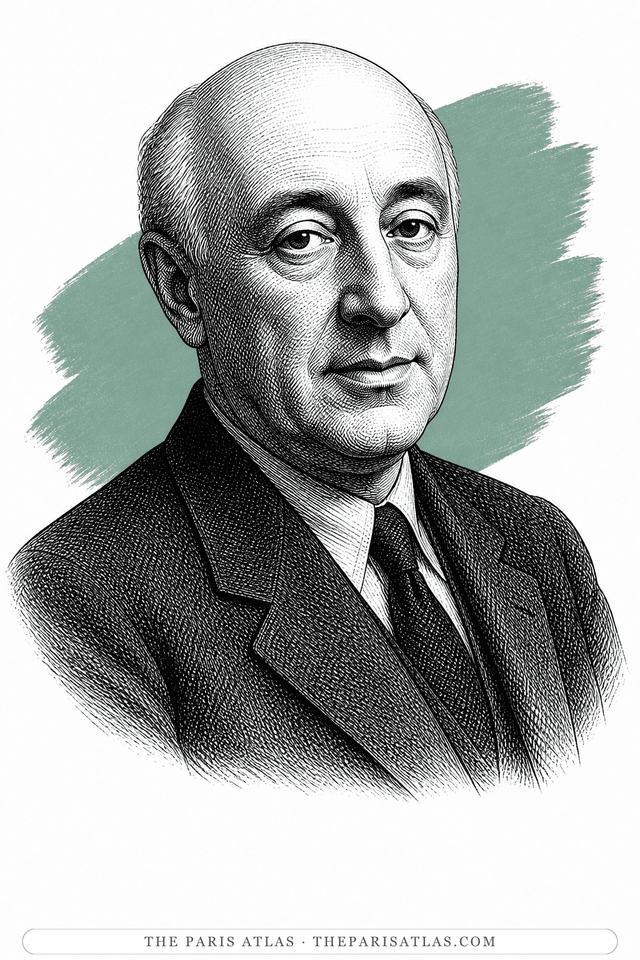
Jean Arp
Strasbourg-born sculptor and poet — Hans in German, Jean in French, both all his life — who co-founded Dada at the Cabaret Voltaire in 1916, composed collages by dropping torn paper 'according to the laws of chance', and settled at Meudon outside Paris in a house his wife Sophie Taeuber-Arp designed.
View artist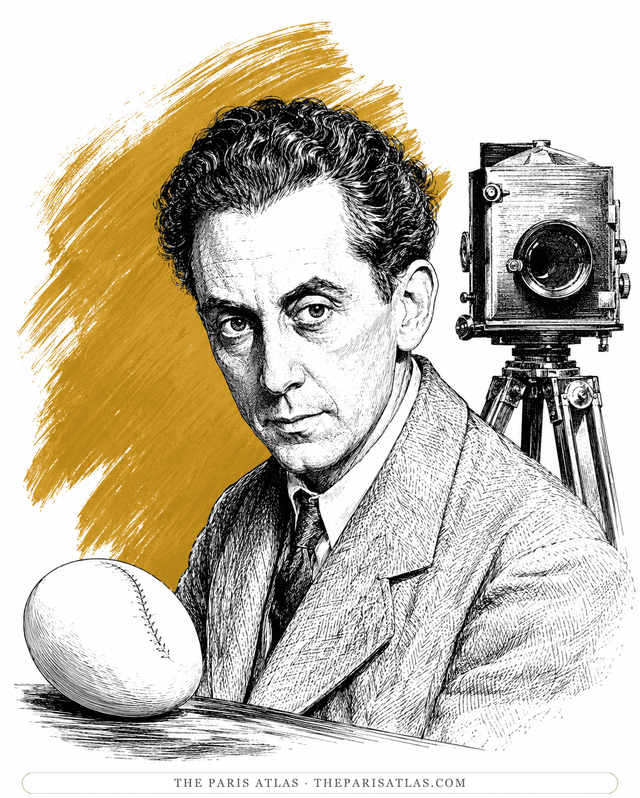
Man Ray
Montparnasse's American eye — portraitist of the whole expatriate quarter, inventor of the rayograph, and maker of films (Emak-Bakia, L'Étoile de mer) that treated the camera as another darkroom.
View artist
Pablo Picasso
The painter whose canvases papered the walls of 27 rue de Fleurus before the writers arrived — the salon's resident modern master.
View artist
References
The sources below include collection records, catalogues, scholarly research, and primary materials that informed this page. They document L.H.O.O.Q., its making, and its place in cultural history.

1Marcel Duchamp, L.H.O.O.Q., 1930
WebsiteCentre Pompidou, Musée national d'art moderneUsed forThe holding museum's record: date, technique, sizes, inscriptions, deposit, loan, rights and photograph credits, the pun, the earlier Mona Lisa jokes, the 1911 theft, Le Double Monde, and the image the close-reading views were cropped from.
2Marcel Duchamp, L.H.O.O.Q. — dossiers ressources sur l'art
WebsiteCentre PompidouUsed forThe Centre Pompidou's teaching dossier: the Galerie Goemans exhibition, both versions shown together, Marcel Duchamp's words on the scandal, Rrose Sélavy and the Boîte-en-valise.
3L.H.O.O.Q., 1930 (150000000044693)
WebsiteDuchamp Research Portal / Centre PompidouUsed forThe research portal's record of the sheet, giving the deposit by the French Communist Party in 2005.

4Pierre Cabanne, Dialogues with Marcel Duchamp (1971 translation; 1987 printing) — Internet Archive scan
NonfictionDa Capo Press, 1971Used forMarcel Duchamp's account of October 1919, Francis Picabia's copy in 391 without the beard, and the letters read phonetically; read on the page in the scan.

5Five Small Things about L.H.O.O.Q.
PeriodicalTout-Fait: The Marcel Duchamp Studies Online JournalUsed forAndré Gervais on the 1919 reproduction bought near the Louvre, its size, the letter to Jean Crotti of 6 February 1930 about the Mona Lisa for Louis Aragon, and the March 1930 exhibition.
6Marcel Duchamp, L.H.O.O.Q. Shaved, 1965 (506.1970)
WebsiteThe Museum of Modern ArtUsed forL.H.O.O.Q. Shaved, the 1965 playing card at the Museum of Modern Art.
7Man Ray, Marcel Duchamp as Rrose Sélavy, c. 1920–1921
WebsitePhiladelphia Museum of ArtUsed forMan Ray's photograph of Marcel Duchamp as Rrose Sélavy, about 1920–1921.
8Portrait de Lisa Gherardini, épouse de Francesco del Giocondo, dit La Joconde ou Monna Lisa (INV 779)
WebsiteMusée du Louvre, 2026Used forThe painting Marcel Duchamp's print reproduces, in the Louvre.
These references provide the documented foundation for this work's history and interpretation. Claim-level citations remain attached to the specific claims they support.
 Explore more resources