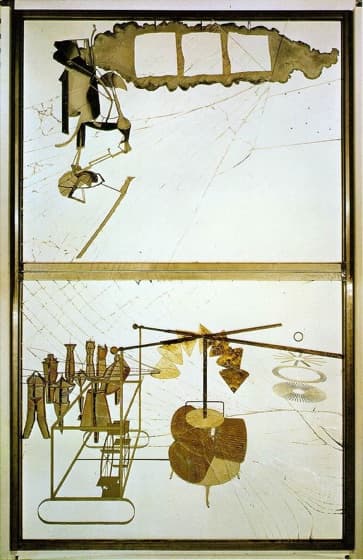
The Bride Stripped Bare by Her Bachelors, Even (The Large Glass)
Duchamp's monumental construction on two panes of glass, made over eight years as an erotic machine, technical diagram, and experiment in transparent pictorial space. He stopped in 1923, later accepted its transit cracks, and treated the work as permanently incomplete.
- 1915–1923
- Oil, varnish, lead foil, lead wire and dust on two glass panels
About Marcel Duchamp
What it is
Two tall panes of glass stand upright inside a metal frame. Duchamp worked them with oil, varnish, lead foil, lead wire, and accumulated dust rather than treating the support like an ordinary canvas. The upper pane contains the Bride, a machine-insect hybrid. Below her are nine mannequin-like Bachelors, a chocolate grinder, sieves, and other devices.[1]
At 277.5 centimetres high, the construction is nearly architectural. It is also transparent. The room, other visitors, and changing light remain visible through the image, so no single background completes it.[1]
A diagram of desire
The two zones stage attraction without contact. The Bride disrobes and emits what the Philadelphia Museum describes as an erotic perfume. The Bachelors respond by producing sexual gases that pass through an elaborate sequence of mechanical forms. A horizontal division keeps the systems permanently apart.[1]
Duchamp replaced conventional bodies with machines, processes, and technical-looking signs. The result resembles an engineering diagram, but its mechanisms cannot perform a practical task. They turn desire into a closed system of anticipation, delay, and failed transmission.[2]
The notes belong to the work
Duchamp planned the project in drawings and written notes beginning in 1912. He later published many of them in The Green Box in 1934. The notes name parts, describe hypothetical operations, and supply verbal associations that cannot be recovered by looking at the glass alone.[1][3]
This relationship between object and text was consequential. The Large Glass is neither a self-contained picture nor an illustration of a finished theory. Viewers move between the physical construction, its title, and a dispersed archive of instructions, puns, and calculations.[2]
Glass, dust, and chance
Transparent glass let Duchamp remove the fixed painted background and expose pictorial illusion as a physical arrangement. He also allowed dust to gather on portions of the lower panel before fixing it with varnish. Time and the studio environment therefore became materials alongside wire and paint.[1]
The approach extends his experiments with chance. Some marks were carefully plotted. Others came from gravity, dust, manufacture, or accident. The work refuses a clean boundary between deliberate design and events that happened to it.[2]
“Definitively unfinished”
Duchamp worked on the glass from 1915 until 1923 and then stopped. His description of it as “definitively unfinished” turns incompletion into a stated condition. Missing operations and unresolved passages are not simply evidence that an artist ran out of time.[1]
The decision also marks his departure from the expectation that a major work must arrive at visual unity. The project remains open to its notes, its surroundings, and later physical changes.
The cracks became part of it
The glass partly shattered in transit at an unknown point in the late 1920s or early 1930s. Duchamp restored it in 1936, reassembling and stabilizing the broken panels rather than replacing them. He later said the symmetrical network of cracks improved the work.[1]
The cracks make the role of chance visible across the whole surface. They also complicate the idea of an original object: the work now includes eight years of fabrication, deliberate incompletion, accidental damage, and the artist's own repair.
Why The Large Glass matters
The Large Glass joins several of Duchamp's central questions in one object: whether art must be painted by hand, whether meaning can reside in a title or note, how chance can enter authorship, and how a work changes when its surroundings remain visible. It stands between conventional painting, sculpture, installation, and conceptual art without settling into any one category.[3]
The Philadelphia Museum calls it a compendium of his recurring subjects, including sexuality, machines, humor, language games, chance, and pictorial illusion. Its influence rests less on a style to imitate than on the permission it gave later artists to treat ideas, instructions, environments, and accidents as parts of a work.[1]
The work in Philadelphia
Katherine S. Dreier, an artist, collector, and cofounder with Duchamp of the Société Anonyme, owned the work and bequeathed it to the Philadelphia Museum of Art. Duchamp oversaw its permanent installation there in 1954.[1]
Its placement within the museum's extensive Duchamp holdings matters. The Large Glass can be read beside the readymades, notes, studies, and later replicas through which the artist repeatedly reconsidered what constitutes an original work.[1]
Close reading
Reading the work, detail by detail
The Large Glass divides desire into an upper Bride and lower Bachelors whose mechanisms never meet. Details of those zones and the later cracks show intention, environment, and accident sharing the same transparent support.
1.The Bride is a body redesigned as apparatus
Organic and machine-like forms cluster above the central division without resolving into a conventional woman. Desire is represented as an operation whose body must be inferred from signs and notes.
2.The Bachelors remain below in a closed system
Nine hollow forms stand beside the grinder, sieves, and connecting lines. Their apparent machinery promises transmission, yet the horizontal boundary keeps every operation permanently short of the Bride.
3.Accidental cracks became final drawing
Damage from transit spreads in fine branching lines across carefully planned forms. Duchamp repaired rather than replaced the panes, accepting chance as a visible collaborator in the work's completed history.
4.The empty middle keeps bride and bachelors apart
A broad zone of glass separates the upper and lower systems. Because the support is transparent, that distance fills with whatever room is behind the work while the imagined relationship remains impossible.
5.The sieves turn desire into a delayed process
Repeated cones suggest sorting, filtering, or grinding rather than direct contact. Duchamp translates desire into a chain of mechanical stages whose purpose remains visible even when its operation cannot be completed.
6.Fixed dust makes waiting part of the material
Duchamp allowed dust to gather on parts of the glass and then fixed selected deposits. Time in the studio therefore became a visible material instead of something cleaned away before exhibition.
Timeline
1912
Duchamp began planning the Bride-and-Bachelors project in drawings and notes after turning away from conventional painting.
1915
Begun in New York, in oil, varnish, lead foil, lead wire and dust worked between two panes of glass.
1923
Left “definitively unfinished” when Duchamp stopped work on it.
1926
Exhibited at the Brooklyn Museum. It later partly shattered in transit, though the museum now dates the accident only to the late 1920s or early 1930s.
1934
Published many of the project's notes and diagrams in The Green Box.
1936
Duchamp reassembled the panes and accepted the symmetrical cracks as part of the work.
1952
Passed to the Philadelphia Museum of Art through the bequest of Katherine S. Dreier.
Where to see it
Philadelphia Museum of Art (Bequest of Katherine S. Dreier)
2600 Benjamin Franklin Parkway, Philadelphia, PA 19130, United States
Displays and loans can change. Check whether this work is on view before making a special trip.
Plan your visit on the museum’s official website (opens in a new tab)Frequently asked questions
What is The Large Glass?
A major work by Marcel Duchamp, made between 1915 and 1923 on two panes of glass in lead foil, wire and dust. Its full title is The Bride Stripped Bare by Her Bachelors, Even. It is in the Philadelphia Museum of Art.
What does it show?
An upper panel with a mechanical Bride and a lower panel with nine Bachelors, a chocolate grinder, and other diagrammatic machines. The two zones turn desire into machinery while keeping the figures permanently separated.
Why is it called unfinished?
Duchamp stopped working on it in 1923 and called it “definitively unfinished.” The phrase makes incompletion part of the work's condition rather than treating the missing passages as an accidental abandonment.
Why is the glass cracked?
It partly shattered in transit in the late 1920s or early 1930s. Duchamp restored and stabilized it in 1936, then accepted the symmetrical cracks as a contribution of chance rather than replacing the panels.
Why are Duchamp's notes important?
The notes name parts of the machine, describe hypothetical operations, and introduce wordplay that cannot be recovered from the glass alone. Many were published in The Green Box in 1934, making text and archive part of how the work is understood.
Why did Duchamp use transparent glass?
Glass removes the fixed background of a canvas. The room, light, and people behind the work remain visible, so its setting continually enters the picture and exposes the image as a physical construction.
Why is it important to later art?
It treats notes, materials, chance, installation, and incompletion as parts of one work. That model helped open routes toward installation and conceptual art, even though the object itself remains singular and painstakingly made.
Where is it now?
The Philadelphia Museum of Art, which received it through the bequest of Katherine S. Dreier.
More by Marcel Duchamp
If you like Marcel Duchamp
Explore painters from the same movements and circles.
Jean Arp
Strasbourg-born sculptor and poet — Hans in German, Jean in French, both all his life — who co-founded Dada at the Cabaret Voltaire in 1916, composed collages by dropping torn paper 'according to the laws of chance', and settled at Meudon outside Paris in a house his wife Sophie Taeuber-Arp designed.
View artist
Man Ray
Montparnasse's American eye — portraitist of the whole expatriate quarter, inventor of the rayograph, and maker of films (Emak-Bakia, L'Étoile de mer) that treated the camera as another darkroom.
View artist
Pablo Picasso
The painter whose canvases papered the walls of 27 rue de Fleurus before the writers arrived — the salon's resident modern master.
View artist
References
The sources below include collection records, catalogues, scholarly research, and primary materials that informed this page. They document The Bride Stripped Bare by Her Bachelors, Even (The Large Glass), its making, and its place in cultural history.



4Marcel Duchamp and the Readymade
WebsiteThe Museum of Modern ArtUsed forWeb source consulted for documented facts and historical context presented on the The Bride Stripped Bare by Her Bachelors, Even (The Large Glass) page.
These references provide the documented foundation for this work's history and interpretation. Claim-level citations remain attached to the specific claims they support.
 Explore more resources