Still Life
by Le Corbusier
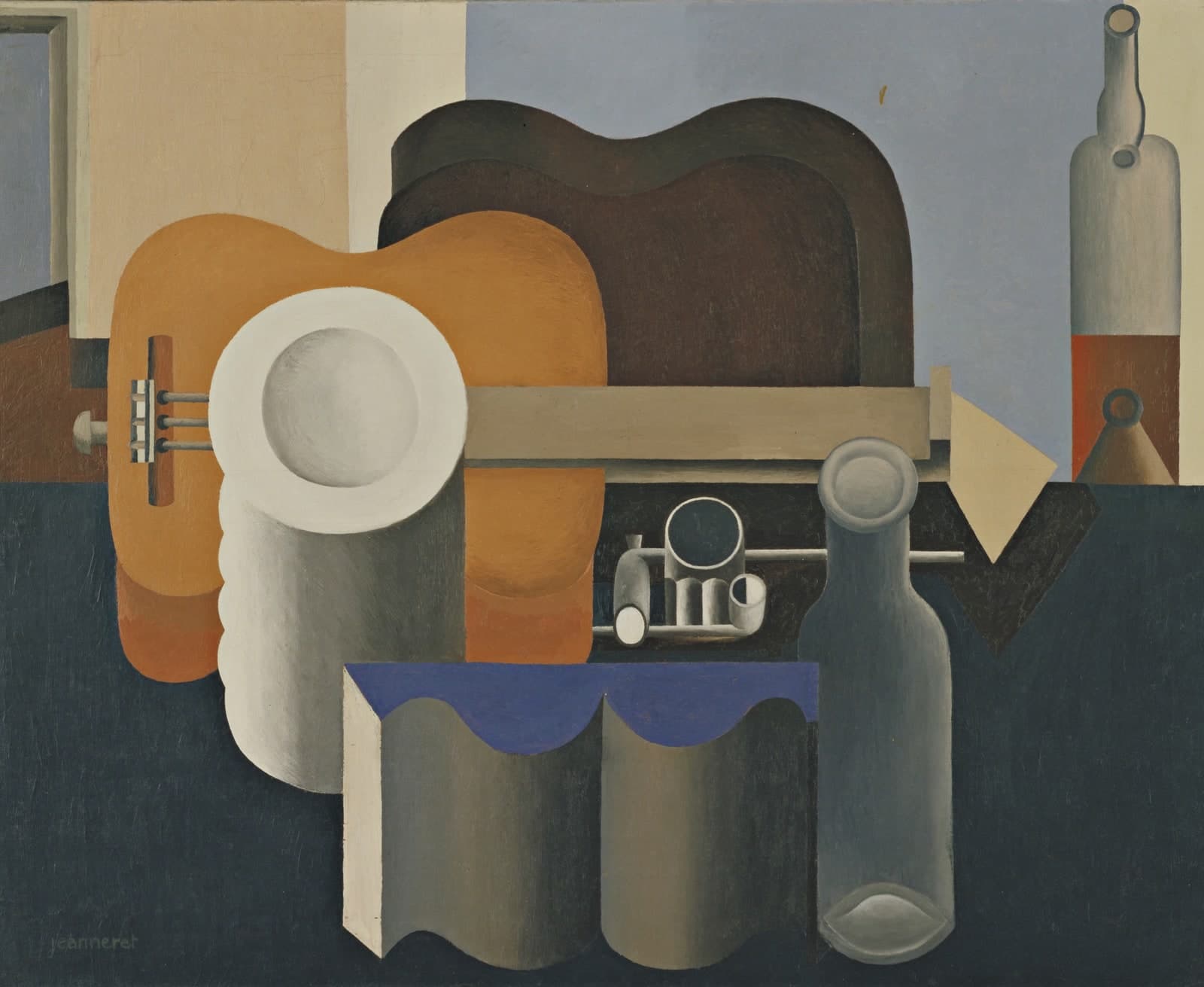
A guitar, a white plate, a stack of plates and two bottles, stacked into one flat frontal arrangement. Charles-Édouard Jeanneret painted it in 1920, the year he began signing his architecture articles Le Corbusier, and signed the canvas with the old name at the lower left. The Museum of Modern Art bought it in December 1937 with the Van Gogh Purchase Fund and catalogues it as 261.1937.
- 1920
- Oil on canvas
- The Museum of Modern ArtNew York, United States
About Le Corbusier
What the painting shows
A guitar fills the left half, seen head-on and flattened to a single orange-tan silhouette with a rust-red patch at its lower edge. Four strings and a bridge are drawn as thin dark lines, and a small pale peg juts out at the far left. A large white plate is laid flat across the place where the soundhole would be, its shallow bowl shaded grey.
Behind the guitar a second, larger body runs across the top of the canvas in dark brown, its upper edge a slow double curve. Below the plate, a white cylinder with a scalloped left edge stands on the table: a stack of plates seen from the side, each rim reading as one bump in the scallop.
A long grey-olive bar crosses the middle of the picture from the guitar to the right edge, ending in a flat beige arrowhead. Two bottles answer each other at different sizes. The small one stands at the top right against a pale blue field, grey with a red-brown band at its foot. The large one stands in front at the lower right, grey-green, its shoulder rounded and its base drawn as a lens-shaped pool of light.
At the bottom centre a grey form folds into two deep scallops against a strip of strong blue, with a white L-shaped edge turning towards the viewer at its left. The background is built from flat panels: cream and beige at the upper left, pale blue at the upper right, and a deep blue-grey field across the whole lower half. The signature, jeanneret, is written in pale letters at the lower left.
How a Purist picture is built
Nothing in the canvas recedes. Every object is given as the flattest profile that still identifies it: a guitar from the front, a plate from above, a bottle from the side, a stack of plates from the edge. The profiles are then laid over one another like cut paper.
The overlaps do the work perspective would normally do. The white plate sits in front of the guitar, the guitar in front of the dark brown body, the grey bar in front of both, and the large bottle in front of everything. Depth is a running order rather than a space.
Two objects appear twice at different sizes: the bottles, and the plates, which are both a single disc laid flat and a stacked column seen edge-on. Charles-Édouard Jeanneret and Amédée Ozenfant had argued in Après le cubisme in 1918 that painting should use clear, impersonal forms of the kind a machine produces. A mass-produced plate is that argument made visible.
What the museum records
The Museum of Modern Art gives the medium as oil on canvas and the size as 80.9 by 99.7 centimetres, or 31 7/8 by 39 1/4 inches. It bought the painting on 3 December 1937 with the Van Gogh Purchase Fund and assigned it the object number 261.1937, in the Department of Painting and Sculpture. Its record lists the work as not on view.
The museum identifies the canvas in installation photographs of Cubism and Abstract Art, which ran from 2 March to 19 April 1936 — twenty months before it owned the picture. It reappears in the galleries repeatedly afterwards. The XXVth Anniversary Exhibition took it in 1954, Art of the Twenties in 1979, Objects of Desire: The Modern Still Life in 1997, and ModernStarts: Things in 1999. It then hung in Painting & Sculpture II from 2004 to 2015.
It was shown in Le Corbusier: An Atlas of Modern Landscapes, the museum's retrospective of 15 June to 23 September 2013. The gallery it has hung in most recently carries a name borrowed from the magazine he and Amédée Ozenfant founded in 1920: 513, The New Spirit in Paris.
Two names in one year
1920 is the year the split happens. He and Amédée Ozenfant launched L'Esprit Nouveau with the poet Paul Dermée, and he began signing his articles on architecture Le Corbusier. The canvas of the same year is signed jeanneret.
The habit outlasted the magazine. He kept the birth name on paintings for years while the pseudonym took over everything else, which is why a museum label for a picture like this one gives both: Le Corbusier, in brackets Charles-Édouard Jeanneret.
Close reading
Reading the work, detail by detail
The Museum of Modern Art's plate shows the canvas edge to edge, with no frame in the picture. Six objects are laid over one another in flat profile — a guitar, a plate, a stack of plates, a second guitar body, and two bottles — against panels of cream, pale blue and deep blue-grey.
1.One white plate, laid over the guitar
A single white plate is laid across the guitar exactly where the soundhole would be, seen from directly above while the guitar is seen from the front. Two incompatible viewpoints are stacked without comment. The plate's rim is unbroken and its bowl is shaded in one soft grey; it is the nearest object in this part of the canvas and covers what it sits on.
2.The plates again, this time stacked edge-on
Below the single plate stands a white column whose left edge is cut into a run of shallow scallops. Each bump is one plate rim, so the stack is the same object as the disc above it, turned ninety degrees. Counting the scallops is how the picture asks to be read: one object, two views, side by side.
3.Four strings and a peg, drawn as thin lines
The only fine drawing in the painting is here: four thin dark strings running over a bridge on the guitar's left side, with a small pale peg projecting past the body's edge. Everything else is painted as a flat area. These few lines are what stop the orange shape from being an abstract silhouette.
4.A second guitar body, behind and in dark brown
A second body crosses the top of the canvas in dark brown, its upper edge a slow double curve — the same guitar profile as the orange one, larger and further back. It passes behind the orange body and behind the grey bar, so it sits third in the running order. Its brown is the darkest colour above the table.
5.A grey bar ending in a beige arrowhead
A grey-olive bar runs from the guitar across to the right of the canvas and stops in a flat beige arrowhead. The bar crosses in front of the dark brown body and behind the large bottle, which fixes both of their positions. It is the one element here that names no household object.
6.The large bottle, in front of everything
The large bottle stands at the lower right, grey-green, its shoulder rounded and its base drawn as a lens-shaped pool of light. It overlaps the grey bar and the deep blue-grey table field, so nothing in the picture is in front of it. Its outline is the tallest unbroken curve on the canvas.
7.The same bottle again, small and at the top
A second, much smaller bottle stands in the top right corner against a pale blue panel, grey with a red-brown band around its foot and a small dark cone beneath it. It repeats the large bottle's profile at a fraction of the size. Doubling an object at two scales is the same move the plates make, one panel to the left.
8.Two deep scallops over a strip of strong blue
At the bottom centre a grey form folds into two deep scallops against the only strip of saturated blue in the painting, with a white L-shaped edge turning towards the viewer on its left. The blue is brighter than anything else on the canvas and is confined to this one band, which pins the composition to the lower edge.
9.Signed jeanneret, in lower case
The signature sits in the lower left corner, written small in pale letters against the deep blue-grey, and reads jeanneret in lower case. The canvas was painted in 1920, the same year he began signing his architecture articles Le Corbusier. The two names were running in parallel when this was made.
Timeline
1918
Charles-Édouard Jeanneret and Amédée Ozenfant publish Après le cubisme and found Purism.
1920
The canvas is painted and signed jeanneret. In the same year the two founders launch L'Esprit Nouveau with Paul Dermée, and he takes Le Corbusier as a byline.
1936
The Museum of Modern Art identifies the painting in installation photographs of Cubism and Abstract Art, 2 March to 19 April.
1937
Bought by the Museum of Modern Art on 3 December with the Van Gogh Purchase Fund, as 261.1937.
1997
Shown in Objects of Desire: The Modern Still Life, 25 May to 26 August.
2013
Shown in Le Corbusier: An Atlas of Modern Landscapes, 15 June to 23 September.
2026
The museum's record lists the painting as not on view.
Where to see it
The Museum of Modern Art
11 West 53 Street, New York, NY 10019, United States
The museum's record lists the painting as not on view. It has hung in gallery 513, The New Spirit in Paris.
Plan your visit on the museum’s official website (opens in a new tab)Frequently asked questions
Where is Le Corbusier's Still Life of 1920?
At the Museum of Modern Art in New York, object number 261.1937. The museum bought it on 3 December 1937 with the Van Gogh Purchase Fund and records it as not on view. It has hung in the gallery the museum calls 513, The New Spirit in Paris.
Why is the painting signed Jeanneret?
Because that was his name. He was born Charles-Édouard Jeanneret in 1887 and only began using Le Corbusier in 1920, as a byline for his architecture articles in the magazine L'Esprit Nouveau. He went on signing paintings Jeanneret for years afterwards, which is why museum labels give both names.
What objects are in the painting?
A guitar in flat orange with four strings drawn on it, and a large white plate laid over its soundhole. Below the plate, a stack of plates seen edge-on as a scalloped white column. Behind, a second guitar body in dark brown, and a long grey bar ending in a beige arrowhead. Two bottles appear at different sizes: a small one at the top right, and a large grey-green one in front at the lower right.
How big is Le Corbusier's Still Life?
80.9 by 99.7 centimetres, which the Museum of Modern Art also gives as 31 7/8 by 39 1/4 inches. It is oil on canvas, wider than it is tall.
What is Purism in painting?
The movement Charles-Édouard Jeanneret founded with the painter Amédée Ozenfant, announced in their 1918 book Après le cubisme. They held that Cubism had drifted into decoration and that painting should use clear, impersonal forms of the kind a machine produces. The still life was their preferred subject, with everyday objects geometrised into flat areas of colour.
Did Le Corbusier paint or was he only an architect?
He painted every working day. The Fondation Le Corbusier records that he gave several hours a day to it and produced more than 450 paintings between 1917 and 1965. He began as a painter in Paris, several years before he built anything there, and never stopped.
More by Le Corbusier
If you like Le Corbusier
Explore painters from the same movements and circles.
- AC
A. M. Cassandre
French poster designer whose advertisements for railways, liners and aperitifs — Nord Express, Dubonnet, Normandie — reduced their subjects to a few commanding shapes.
View artist 
Sonia Delaunay
Painter who arrived from Odessa via St Petersburg in 1905, co-invented Simultanism with Robert Delaunay, made the two-metre folding artist's book La Prose du Transsibérien with the poet Blaise Cendrars in 1913, dressed 1920s Paris from her Atelier Simultané, and in 1964 became the first living woman shown at the Louvre.
View artist- SL
Suzanne Lalique-Haviland
French designer who worked in glass, porcelain, textiles and stage design, and whose contributions to the Lalique firm were often manufactured under her father's signature.
View artist
References
The sources below include collection records, catalogues, scholarly research, and primary materials that informed this page. They document Still Life, its making, and its place in cultural history.

1Le Corbusier (Charles-Édouard Jeanneret), Still Life, 1920 (261.1937)
Official recordThe Museum of Modern Art, New YorkUsed forThe owning museum's object record: title, date, medium, dimensions, credit line, object number, display status, copyright notice and installation history. The live page returned HTTP 403 throughout; the fields were read from the Internet Archive's capture of it.
2The Museum of Modern Art collection dataset (Artworks.csv)
ArchiveThe Museum of Modern Art, New YorkUsed forThe museum's own published collection dataset, used as the second independent check on the catalogue fields and the acquisition date of 3 December 1937.

3Works / Art works / Painting
WebsiteFondation Le CorbusierUsed forPurism, the still life as its subject, and the count of more than 450 paintings between 1917 and 1965.
4Biography, 1917-1922: À nous deux Paris!
WebsiteFondation Le CorbusierUsed forAprès le cubisme, the founding of L'Esprit Nouveau with Amédée Ozenfant and Paul Dermée, and the adoption of the name Le Corbusier in 1920.
5Copyright / Rights management
Official recordFondation Le CorbusierUsed forThe Fondation as universal legatee under the will of 16 June 1965, with ADAGP managing its rights.
These references provide the documented foundation for this work's history and interpretation. Claim-level citations remain attached to the specific claims they support.
 Explore more resources