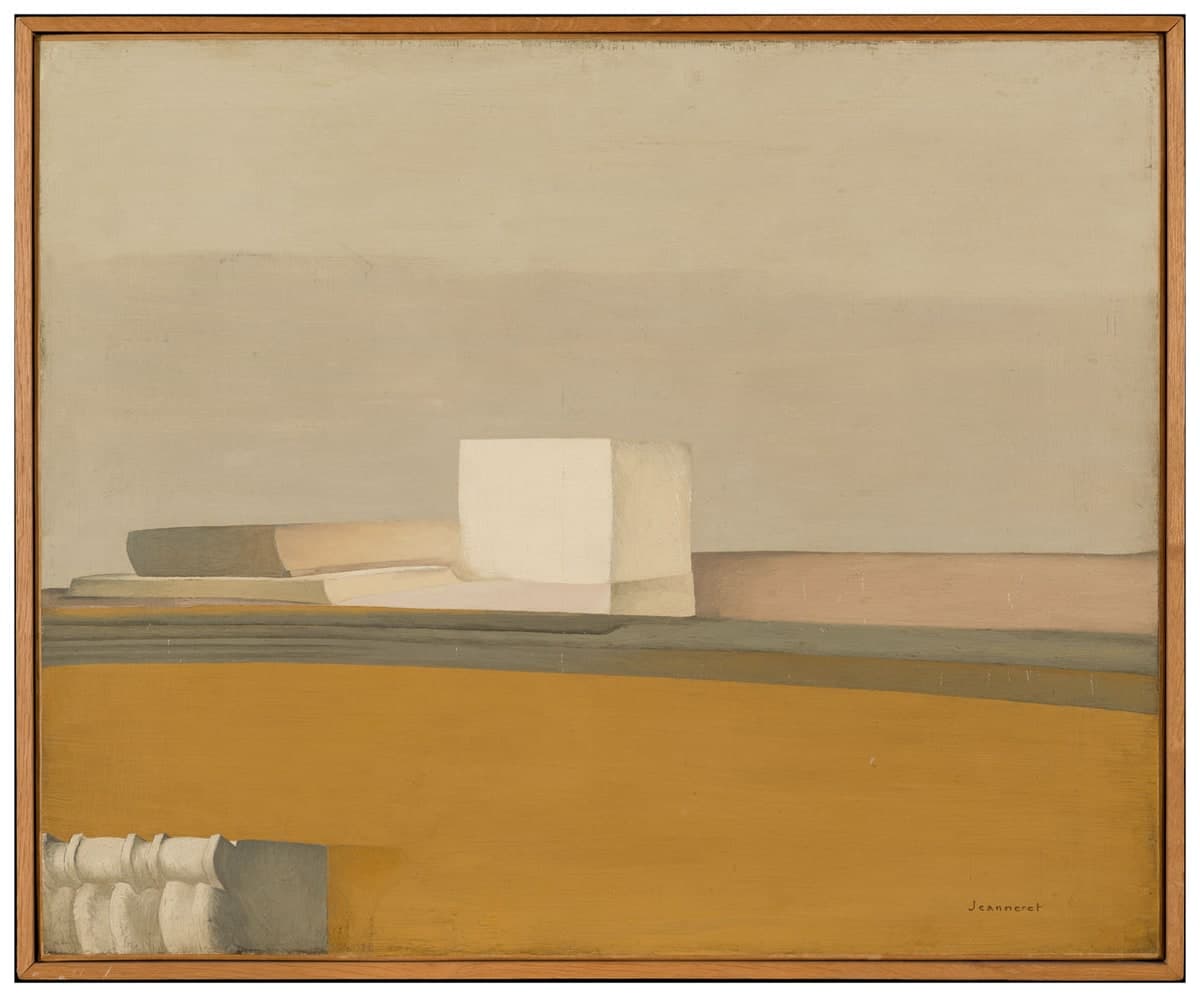
La cheminée
by Le Corbusier
A white cube standing on a mantelpiece, painted in the year Charles-Édouard Jeanneret and Amédée Ozenfant published the manifesto of Purism. He signed it Jeanneret, two years before he began calling himself Le Corbusier, and wrote on the back of the canvas that it was his first painting. The Fondation Le Corbusier holds it in Paris as painting FLC 134.
- 1918
- Oil on canvas
- Fondation Le CorbusierParis, France
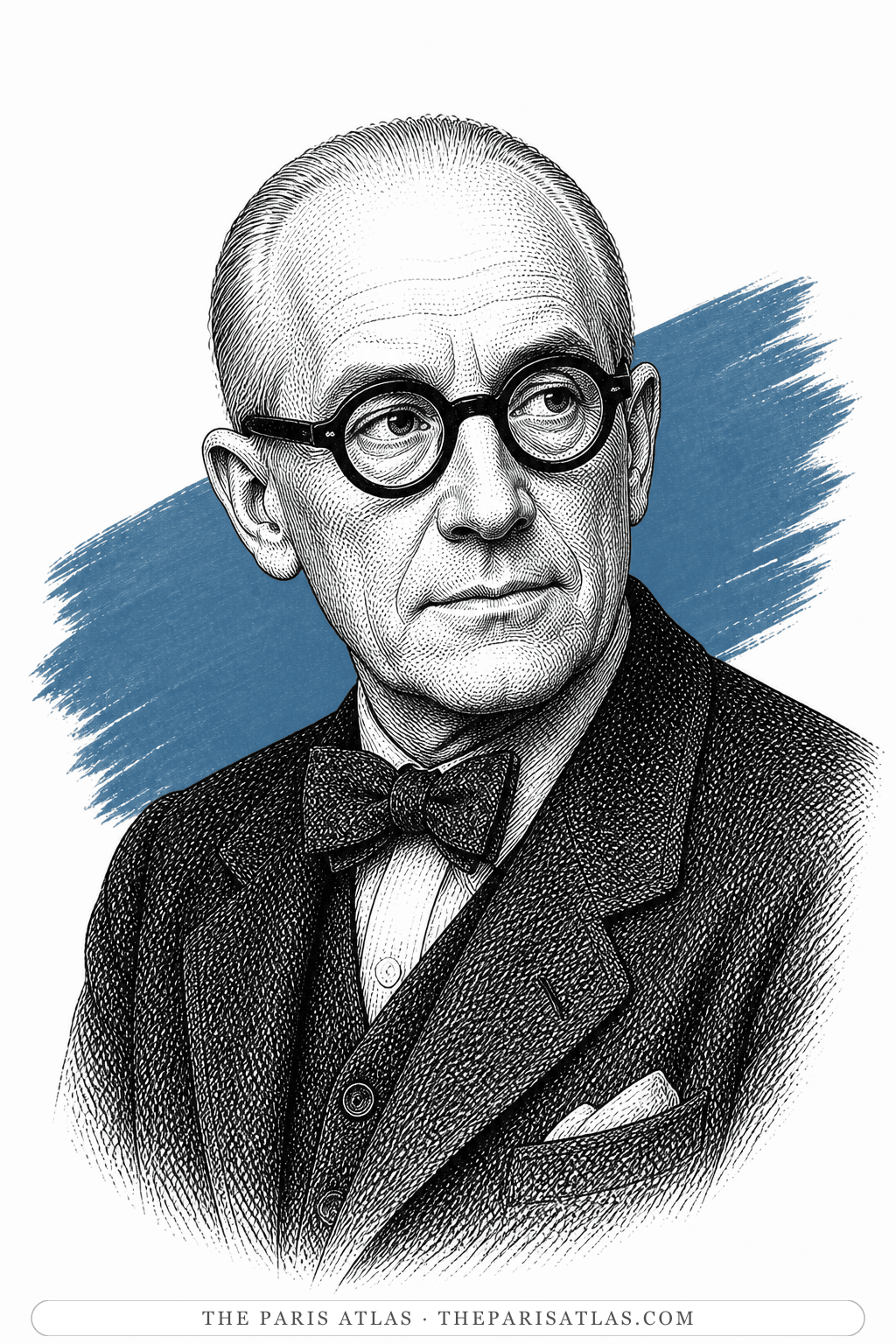
About Le Corbusier
What the painting shows
A white cube sits a little left of centre, high in the picture. Its front face is lit flat, its right side falls into a warm grey, and its top is a pale sliver. Nothing about it is described as marble or plaster or paper. It is a box, given three tones and no texture.
To its left a low horizontal stack runs out towards the edge: a grey-green block at the far end, then a buff wedge, then a pale strip that slides under the cube. To its right a band of dusty pink runs unbroken to the right edge of the canvas. That pink band and the grey-green line beneath it are the mantelshelf, seen almost exactly end-on.
The wall above is one field of putty grey, brushed horizontally, with a faint vertical seam near the top. Below the shelf the canvas turns to a single flat ochre that fills the bottom half. In the bottom left corner a cluster of four small white turned forms stands against a grey rectangle, the only place in the picture where a contour curves more than once.
The canvas measures 60 by 73 centimetres, about twenty-four by twenty-nine inches. The signature, Jeanneret, is written small in dark paint at the lower right. The reproduction the Fondation Le Corbusier publishes shows the canvas inside a plain pale wooden frame.
What he wrote on the back
The Fondation Le Corbusier transcribes the verso in full. It reads "Ceci est mon premier tableau" — this is my first painting — followed by "Octobre 1918 L.C.", and then "la cheminée. 1918" with the signature Jeanneret. The front carries only the surname.
The two names on one object are the whole point of the canvas. Charles-Édouard Jeanneret did not begin signing himself Le Corbusier until 1920, when he and Amédée Ozenfant founded the magazine L'Esprit Nouveau with the poet Paul Dermée and he used it as a byline for his articles on architecture. The initials L.C. on the back therefore cannot be contemporary with the signature on the front.
He went back over his early canvases long afterwards. The Fondation's record for Guitare verticale (1ère version) transcribes a verso reading "Jeanneret signe ici le 24 octobre (19)53 L-C" — Jeanneret signs here on 24 October 1953 — and the record for Nature morte à l'œuf carries the same date on its back. The inscriptions on these paintings are partly a later man annotating an earlier one.
Painted in the year of the manifesto
Charles-Édouard Jeanneret settled in Paris in February 1917 and met the painter Amédée Ozenfant. In 1918 the two published Après le cubisme — After Cubism — which argued that Cubism had softened into decoration and that painting should recover the clarity of a machine. They called the alternative Purism, and they showed together at the Galerie Druet in December 1918.
The Fondation Le Corbusier's own account states the sequence plainly. The work in paint began in 1917, when he was still called Charles-Édouard Jeanneret and had just met Amédée Ozenfant. The still life became their preferred subject, with everyday objects geometrised into flat areas of colour.
A mantelpiece with a white cube on it is not quite that. There is no bottle, no glass, no guitar, no stack of plates. What the canvas does have is the method: flat fields, frontal arrangement, an object reduced to the plainest volume that will still read as itself.
The half of the career usually left out
Le Corbusier is held here, and almost everywhere, as an architect. The Fondation Le Corbusier records that he gave several hours a day to painting and produced more than 450 paintings between 1917 and 1965, and that he was in contact with Fernand Léger, Pablo Picasso, Juan Gris and André Bauchant.
He kept the two practices in separate rooms and, for a while, under separate names. The architecture went out under the byline Le Corbusier; the canvases were signed Jeanneret well into the 1920s. From 1934 he lived at the top of an apartment block of his own design at 24 rue Nungesser-et-Coli, on the Boulogne edge of Paris, and the flat included a painter's studio.
Most of the paintings are oil on canvas, though the Fondation notes that he also used wood, plywood and isorel, a hardboard. In 1948 he made a large painting on isorel panels for his atelier at 35 rue de Sèvres.
Close reading
Reading the work, detail by detail
The Fondation Le Corbusier photographs the canvas square on inside a plain pale wooden frame, which runs around all four edges of the reproduction. Inside it the picture divides into three horizontal zones: a grey wall above, a shelf across the middle, and one flat ochre field below.
1.One white cube, given three tones
A single cube sits a little left of centre and is the brightest thing in the painting. It is described by exactly three flat tones — a bright front, a warm grey right side, a pale top — and nothing else. No texture, no material, no cast shadow. It overlaps the shelf behind it and the low stack to its left, so it reads as the nearest object.
2.Two blocks stacked to the left of it
To the left of the cube a low stack runs out towards the edge in two parts: a grey-green block at the far end and a buff wedge inboard of it, with a pale strip sliding underneath towards the cube. The wedge passes behind the cube, which is how the picture puts one in front of the other without any perspective at all.
3.The shelf is two bands, pink over grey-green
The mantelshelf is not drawn as a solid. It is a dusty-pink band running unbroken to the right edge with a narrower grey-green band under it — the top of the shelf and its front edge, both seen almost exactly end-on. The two bands are the only place in the painting where a line runs the full width.
4.The lower half is one flat ochre
Below the shelf the canvas turns to a single ochre that fills the bottom half and carries no object at all. The brush drag is visible across it in faint horizontal streaks. It is the largest area of one colour in the picture, and the reason the small white cube reads as far away rather than small.
5.Four small white forms in the corner
The bottom left corner holds the only curved contours in the painting: a cluster of four small white forms, each turned with a rounded waist, standing against a grey rectangle. They are the one passage where the brush repeats a shape, and they sit lower and further left than anything else in the composition.
6.Signed Jeanneret, not Le Corbusier
The signature is written small and dark on the ochre, at the lower right. It reads Jeanneret — the name he was born with and used for another decade on paintings. He would not adopt Le Corbusier until 1920. The Fondation Le Corbusier's record adds that the back of the same canvas carries the later initials L.C.
7.The wall above is a single grey field
The upper third is one field of putty grey with horizontal brush drag through it and a faint vertical seam near the top. Nothing hangs on it and nothing interrupts it. The grey is cooler than the ochre below and warmer than the white cube, so it holds the middle of a three-step scale the whole painting works within.
Timeline
1917
Charles-Édouard Jeanneret settles in Paris in February and meets the painter Amédée Ozenfant.
1918
The two publish Après le cubisme, the founding text of Purism, and exhibit together at the Galerie Druet in December.
1918
La cheminée is painted in October and inscribed on the back "Ceci est mon premier tableau". The front is signed Jeanneret.
1920
Jeanneret begins signing his architectural articles in L'Esprit Nouveau as Le Corbusier. The paintings keep the old name for years afterwards.
1953
He annotates early canvases on their backs on 24 October, a habit the Fondation records on two other paintings of the same period.
1965
By a will dated 16 June he makes the Fondation Le Corbusier his universal legatee, which is how the painting is held today as FLC 134.
Where to see it
Fondation Le Corbusier
Paris, France
A public viewing address has not yet been confirmed for this holding.
The Fondation Le Corbusier is based at Maison La Roche, 10 square du Docteur Blanche, Paris. Its collection is not all on permanent display; check the Fondation's record before travelling.
Frequently asked questions
What was Le Corbusier's first painting?
La cheminée, painted in October 1918. He wrote "Ceci est mon premier tableau" — this is my first painting — on the back of the canvas, and the Fondation Le Corbusier transcribes that inscription on its own record for the work. It is oil on canvas, 60 by 73 centimetres, catalogued as painting FLC 134.
Why is La cheminée signed Jeanneret rather than Le Corbusier?
Because it was painted in 1918 and he was still Charles-Édouard Jeanneret, the name he was born with. He began using Le Corbusier as a byline in 1920, in the magazine L'Esprit Nouveau, and kept signing paintings Jeanneret for years after that. The back of this canvas carries the later initials L.C. alongside the earlier signature.
Where can you see La cheminée?
The Fondation Le Corbusier holds it in Paris as painting FLC 134. The Fondation is based at Maison La Roche, 10 square du Docteur Blanche in the 16th arrondissement, which is open to visitors. Its collection is not all on permanent display, so check the Fondation's own record before travelling to see this canvas.
How big is La cheminée?
60 by 73 centimetres, roughly twenty-four by twenty-nine inches — a small canvas, wider than it is tall. The Fondation Le Corbusier gives the dimensions as H 0,60 m by L 0,73 m.
What does La cheminée show?
A white cube on a mantelshelf, seen straight on. A pink band and a grey-green line cross the canvas as the shelf, and a stack of low blocks sits to the left of the cube. A flat ochre field fills the bottom half, with a cluster of four small white turned forms in the bottom left corner. The title means the fireplace.
Did Le Corbusier paint seriously, or was it a hobby?
Seriously, and daily. The Fondation Le Corbusier records that he devoted several hours a day to painting and made more than 450 paintings between 1917 and 1965, alongside sculpture, tapestry, enamel and engraving. He founded Purism with Amédée Ozenfant in 1918, before he had built anything in Paris at all.
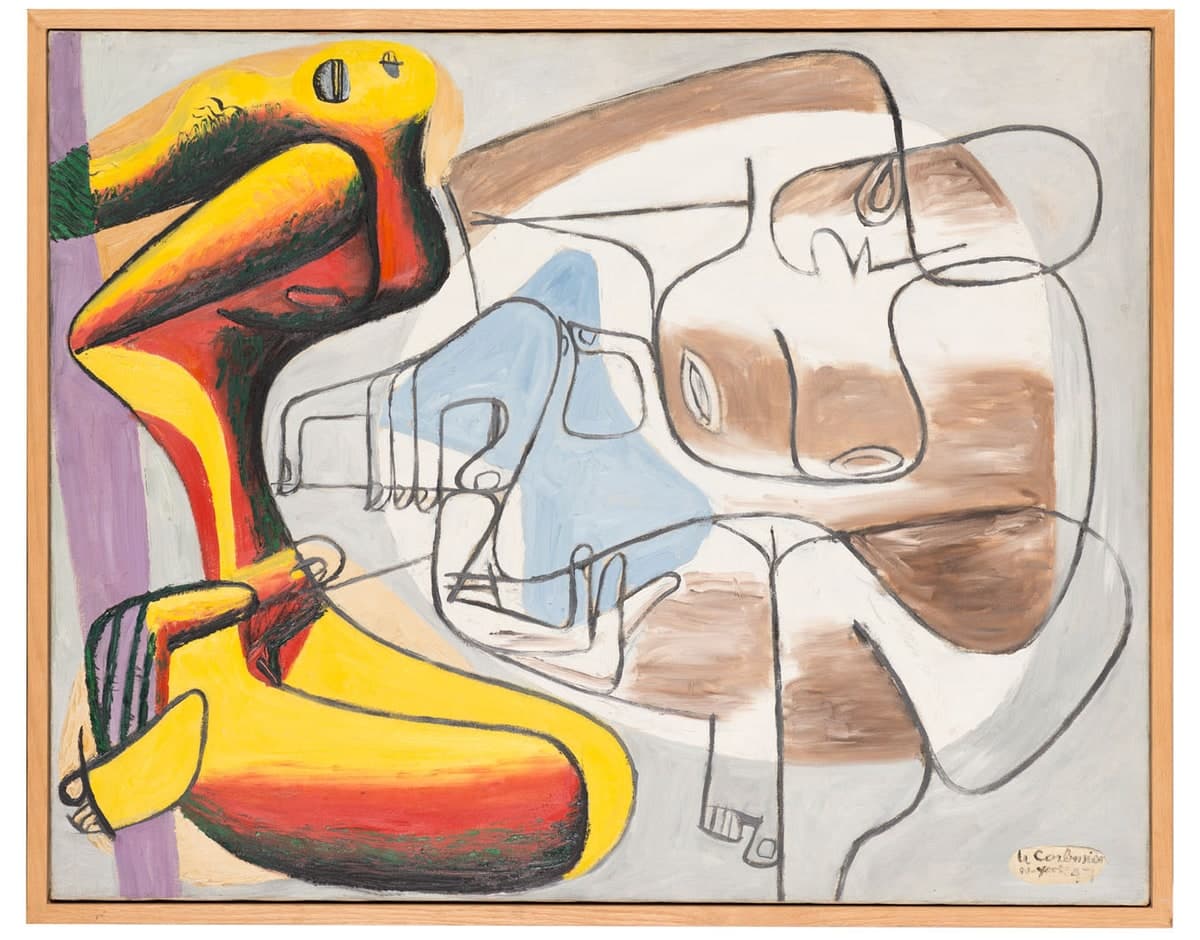
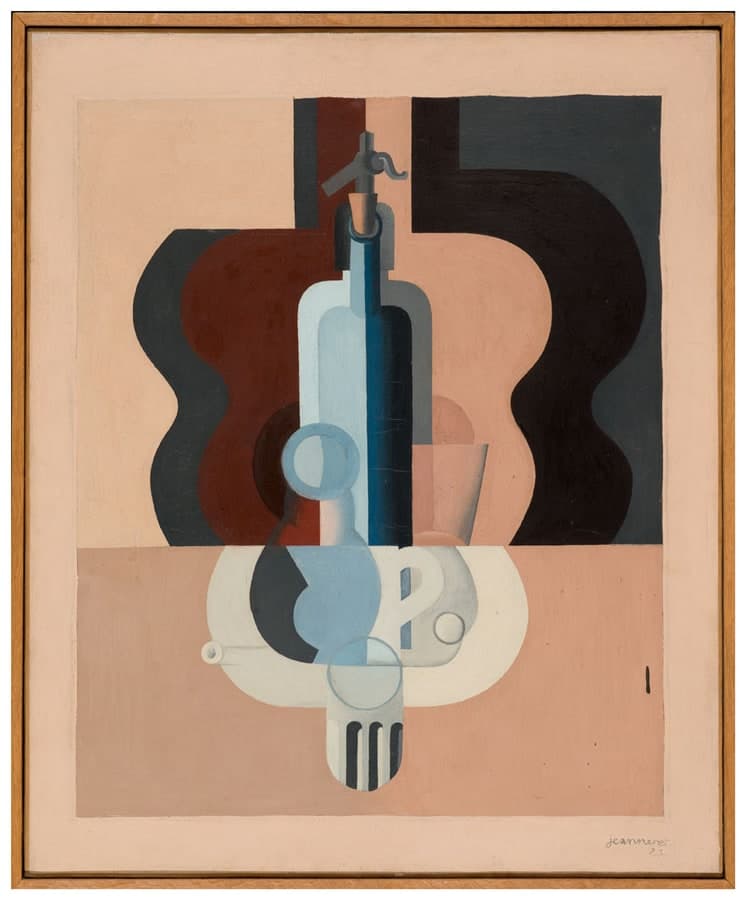
More by Le Corbusier
If you like Le Corbusier
Explore painters from the same movements and circles.
- AC
A. M. Cassandre
French poster designer whose advertisements for railways, liners and aperitifs — Nord Express, Dubonnet, Normandie — reduced their subjects to a few commanding shapes.
View artist 
Sonia Delaunay
Painter who arrived from Odessa via St Petersburg in 1905, co-invented Simultanism with Robert Delaunay, made the two-metre folding artist's book La Prose du Transsibérien with the poet Blaise Cendrars in 1913, dressed 1920s Paris from her Atelier Simultané, and in 1964 became the first living woman shown at the Louvre.
View artist- SL
Suzanne Lalique-Haviland
French designer who worked in glass, porcelain, textiles and stage design, and whose contributions to the Lalique firm were often manufactured under her father's signature.
View artist
References
The sources below include collection records, catalogues, scholarly research, and primary materials that informed this page. They document La cheminée, its making, and its place in cultural history.

1La cheminée, 1918 (painting FLC 134)
Official recordFondation Le CorbusierUsed forThe owning institution's record: medium, dimensions, the signature and the full transcription of the inscription on the back.

2Works / Art works / Painting
WebsiteFondation Le CorbusierUsed forThe Fondation's account of his painting: the 1917 meeting with Amédée Ozenfant, the founding of Purism, the still life as their subject, and more than 450 paintings between 1917 and 1965.
3Guitare verticale (1ère version), 1920 (painting FLC 174)
Official recordFondation Le CorbusierUsed forCited for the verso inscription dated 24 October 1953, evidence that he annotated his early canvases decades later.
4Nature morte à l'œuf, 1919 (painting FLC 136)
Official recordFondation Le CorbusierUsed forA second canvas carrying the same 24 October 1953 annotation on its back.
5Biography, 1917-1922: À nous deux Paris!
WebsiteFondation Le CorbusierUsed forThe move to Paris in 1917, Après le cubisme, the Galerie Druet showing, and the adoption of the name Le Corbusier in 1920.
6Biography, 1929–1938
WebsiteFondation Le CorbusierUsed forThe move in 1934 to the apartment and painting studio at 24 rue Nungesser-et-Coli.
7Copyright / Rights management
Official recordFondation Le CorbusierUsed forThe will of 16 June 1965, the Fondation as universal legatee, ADAGP as its rights agent, and the registered trademarks on the name.
These references provide the documented foundation for this work's history and interpretation. Claim-level citations remain attached to the specific claims they support.
 Explore more resources