Deux figures
by Le Corbusier
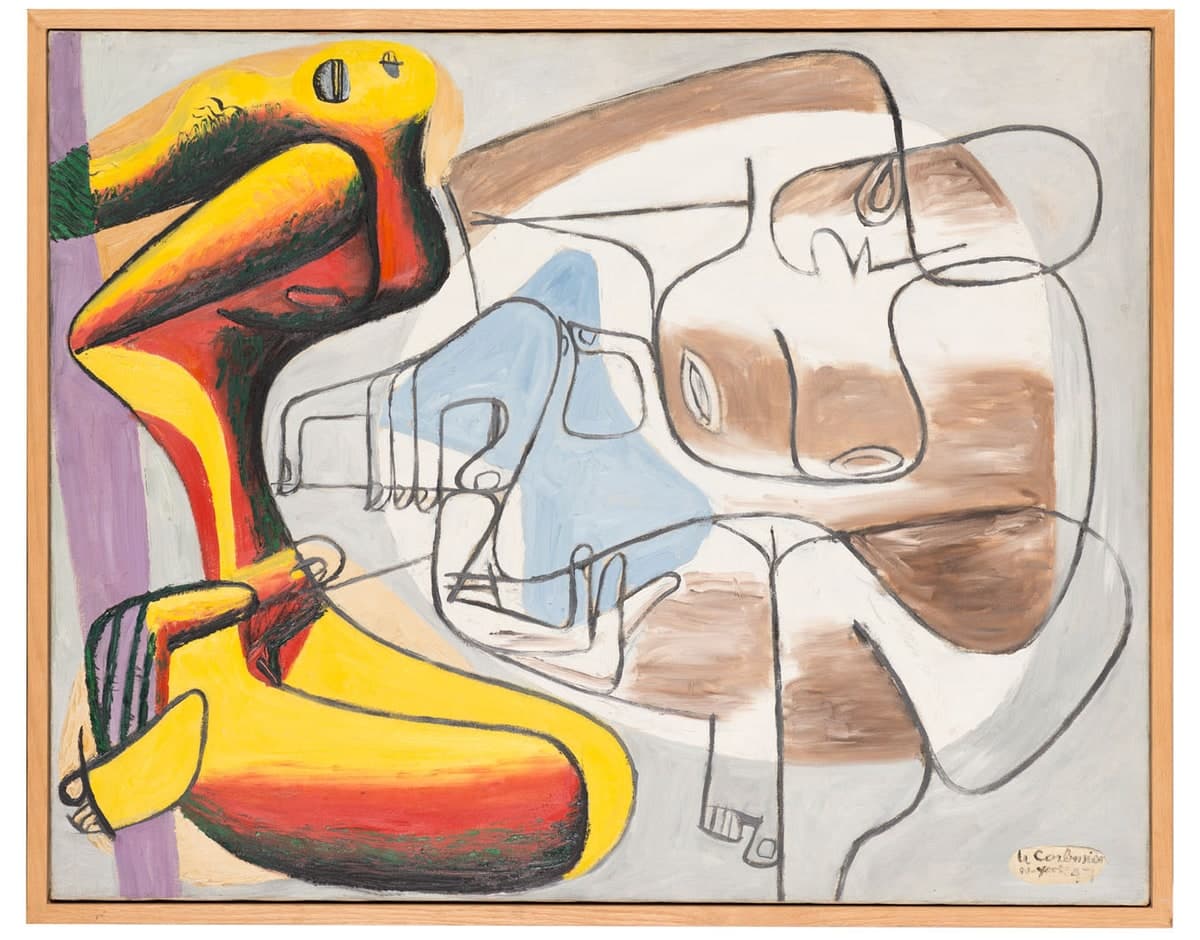
Two figures lying across one canvas, painted in two different languages. The one on the left is built from solid yellow and red inside heavy black outlines; the one on the right is almost entirely thin black line over brown washes. Le Corbusier signed and dated it at the lower right, in New York, in 1947 — and this is the first painting in the atlas's Le Corbusier group signed with that name rather than Jeanneret. The Fondation Le Corbusier holds it as painting FLC 262.
- 1947
- Oil on canvas
- Fondation Le CorbusierParis, France
About Le Corbusier
What the painting shows
The left figure is solid. Yellow and red fill a heavy black contour that turns through the body like a folded ribbon, with dark green hatching along its outer edges. At the top, a head shows a single large eye — a dark oval with a white vertical bar through it — and a small dark loop beside it. A red band crosses the middle of the body, and at the lower left a yellow crescent ends in a small hooked hand.
The right figure is the opposite. It is carried almost entirely in thin black line, with broad brown washes laid loosely inside some of its contours and white left bare elsewhere. A head in profile occupies the top right, with a curling spiral for the ear and a doubled line for the nose and mouth. Lower down, an almond eye with a dark pupil sits above an oval mouth.
Between them, a pale blue wedge rises from the lower centre. Hands cross it: one reaches in from the left with four outlined fingers, another sits below with its fingers drawn as separate strokes. A further small hand appears near the bottom edge, right of centre, drawn in line alone.
A lilac stripe runs down the far left edge behind the yellow figure. Everything else is a pale grey-green field, with a broad white oval behind the drawn figure. The canvas is 81 by 100 centimetres. The signature at the lower right, in brown, reads Le Corbusier over N.york 47. The Fondation Le Corbusier's plate shows the canvas in a plain pale wooden frame.
The date is 1947, not 1939
The painting circulates with a date of 1939. The Fondation Le Corbusier dates it 1947, in its catalogue listing, in its page title, in its caption and in the address of the page itself.
The canvas settles the question on its own. It is signed and dated on the front at the lower right — Le Corbusier / N.york 47 — and the Fondation transcribes exactly that. The signature and the catalogue agree with each other.
1947 also fits where he was. He worked on the United Nations headquarters project in New York that year, without the commission ever becoming his, and the place name written under the signature says the canvas belongs to that stay.
What replaced the bottles
The Purist still life had been a programme: manufactured objects, flat profiles, frontal arrangement. The Fondation Le Corbusier records what came after the break with Amédée Ozenfant — the objects of poetic reaction the Surrealists favoured, the female figure and the figure of the bull.
Two figures is squarely in that second half. The subject is bodies rather than vessels, the contours curve where the Purist outlines were straight or scalloped, and the paint is dragged and scrubbed rather than laid flat.
The two halves of the canvas are painted as if by two different hands. One figure is colour without drawing; the other is drawing without colour. Whether that contrast is the picture's subject is a reading, not a documented statement of his, and the Fondation's record makes no claim about it.
The name on the front
The signature is the plainest evidence of the split this group of paintings is about. The 1918 canvas reads Jeanneret. The 1921 canvas reads Jeanneret 21. The 1924 canvas in Chicago is signed with the same surname and the year.
Here it reads Le Corbusier. He had used the name as a byline since 1920 and been a French citizen since 19 September 1930, and by 1947 it had taken over the paintings too.
He kept both practices going to the end. He died on 27 August 1965 while swimming at Roquebrune-Cap-Martin, and by a will dated 16 June that year he made the Fondation Le Corbusier his universal legatee, which is why the canvas is in Paris.
Close reading
Reading the work, detail by detail
The Fondation Le Corbusier photographs the canvas square on in a plain pale wooden frame. Inside it two figures lie across the width, painted in two incompatible ways: the left one in solid colour inside heavy outlines, the right one almost entirely in thin contour line over loose brown washes.
1.One eye, a dark oval crossed by a white bar
The head of the left figure carries one eye and no second one: a dark oval with a vertical white bar through it, set into flat yellow, with a small dark loop to its right. There is no nose and no mouth. The eye is the only feature, and it is drawn as a sign rather than modelled.
2.The left figure is colour without drawing
The left figure is filled entirely with flat yellow and red, held inside black outlines several millimetres thick, with dark green hatching scratched along its outer edges. Nothing inside the shape is drawn — no fingers, no folds, no features below the head. It is the only opaque, fully covered area in the painting.
3.A lilac stripe down the far left edge
A vertical lilac band runs the full height of the canvas at the extreme left, behind the yellow figure and against the pale grey-green ground. It is the only band of that colour in the painting and the only element that touches both the top and bottom edges. The yellow figure overlaps it.
4.The right figure's head, in line alone
The right figure's head sits at the top right and is drawn in thin black line with no outline weight at all: a spiral for the ear, a doubled looping line for the nose and mouth. Brown wash is brushed loosely behind and across it without following the drawing. Line and colour are deliberately out of register here.
5.A second eye, drawn not painted
The right figure carries its own eye, an almond with a dark pupil, drawn in thin line on bare white with an oval mouth below and to the right. Set against the left figure's single painted eye, the canvas gives the same feature twice in two different techniques, about half a metre apart.
6.A pale blue wedge between the two figures
A pale blue wedge rises from the lower centre, the only blue in the painting, and contour lines run straight across it as if it were not there. It sits between the two figures and belongs to neither. It is filled with a flat, thin wash rather than the opaque colour used on the left.
7.A hand with four outlined fingers
A hand reaches in from the left across the blue wedge with four fingers outlined separately and no thumb shown. It is drawn entirely in line, over both the blue wash and the white ground, and the fingers are the same width along their whole length. Two more hands appear elsewhere in the canvas, drawn the same way.
8.A third hand, near the bottom edge
A small hand sits near the bottom edge, right of centre, its fingers reduced to short parallel strokes. It is the lowest drawn element in the picture and belongs to no clearly identifiable limb. The ground under it is the same pale grey-green that fills the rest of the background.
9.Signed Le Corbusier, and New York
The signature at the lower right is written in brown over the pale ground and reads Le Corbusier on the upper line, N.york and 47 beneath. It is the only one of the five canvases in this group signed with the adopted name; the 1918, 1921 and 1924 paintings all read Jeanneret. The place and the year are written together.
Timeline
1920
Charles-Édouard Jeanneret begins signing his architectural articles Le Corbusier in L'Esprit Nouveau.
1930
Granted French nationality by decree on 19 September.
1947
He works on the United Nations headquarters project in New York. The canvas is signed there: Le Corbusier / N.york 47.
1965
By a will dated 16 June he makes the Fondation Le Corbusier his universal legatee. He dies on 27 August at Roquebrune-Cap-Martin.
2026
The Fondation Le Corbusier catalogues the canvas as painting FLC 262 and dates it 1947.
Where to see it
Fondation Le Corbusier
Paris, France
A public viewing address has not yet been confirmed for this holding.
The Fondation Le Corbusier is based at Maison La Roche, 10 square du Docteur Blanche, Paris. Its collection is not all on permanent display; check the Fondation's record before travelling.
Frequently asked questions
When did Le Corbusier paint Deux figures?
1947. The Fondation Le Corbusier dates it to that year throughout its record, and the canvas is signed and dated on the front at the lower right: Le Corbusier / N.york 47. A date of 1939 circulates for the painting and is not supported by the owning institution or by the signature.
Where is Deux figures?
The Fondation Le Corbusier holds it in Paris as painting FLC 262. The Fondation is based at Maison La Roche, 10 square du Docteur Blanche in the 16th arrondissement. Its collection is not all on permanent display, so check the Fondation's own record before travelling to see this canvas.
Why is this one signed Le Corbusier when the early paintings are signed Jeanneret?
Because the name had finally crossed over. He was born Charles-Édouard Jeanneret, took Le Corbusier as a byline for architecture writing in 1920, and went on signing paintings with his birth name through the Purist years. By 1947 the pseudonym was on the canvases as well.
What does Deux figures show?
Two figures lying across the canvas. The left one is solid yellow and red inside heavy black outlines, with a single large eye at the top and dark green hatching along its edges. The right one is drawn almost entirely in thin black line over loose brown washes, with a profile head at the top right. A pale blue wedge and several drawn hands sit between them.
How big is Deux figures?
81 by 100 centimetres, wider than it is tall. The Fondation Le Corbusier gives the dimensions as H 0,81 m by L 1,00 m and the medium as oil on canvas.
What did Le Corbusier paint after Purism?
Figures and bulls. The Fondation Le Corbusier records that after his break with Amédée Ozenfant he turned to the objects of poetic reaction the Surrealists favoured, to the woman and to the figure of the bull. The Taureau series runs to ten canvases in the Fondation's own catalogue, dated between 1952 and 1963.
More by Le Corbusier
If you like Le Corbusier
Explore painters from the same movements and circles.
- AC
A. M. Cassandre
French poster designer whose advertisements for railways, liners and aperitifs — Nord Express, Dubonnet, Normandie — reduced their subjects to a few commanding shapes.
View artist 
Sonia Delaunay
Painter who arrived from Odessa via St Petersburg in 1905, co-invented Simultanism with Robert Delaunay, made the two-metre folding artist's book La Prose du Transsibérien with the poet Blaise Cendrars in 1913, dressed 1920s Paris from her Atelier Simultané, and in 1964 became the first living woman shown at the Louvre.
View artist- SL
Suzanne Lalique-Haviland
French designer who worked in glass, porcelain, textiles and stage design, and whose contributions to the Lalique firm were often manufactured under her father's signature.
View artist
References
The sources below include collection records, catalogues, scholarly research, and primary materials that informed this page. They document Deux figures, its making, and its place in cultural history.

1Deux figures, 1947 (painting FLC 262)
Official recordFondation Le CorbusierUsed forThe owning institution's record: the 1947 date, medium, dimensions and the signature Le Corbusier / N.York 47.

2Works / Art works / Painting
WebsiteFondation Le CorbusierUsed forThe turn after the break with Amédée Ozenfant to the female figure and the bull, and the Fondation's catalogue of the Taureau series.
3Biography, 1947-1951: Major projects
WebsiteFondation Le CorbusierUsed forThe 1947 work on the United Nations headquarters project in New York.
4Biography, 1929–1938
WebsiteFondation Le CorbusierUsed forFrench nationality by decree on 19 September 1930.
5Biography, 1961-1965: Recognition and legacy
WebsiteFondation Le CorbusierUsed forThe death at Roquebrune-Cap-Martin on 27 August 1965.
6Copyright / Rights management
Official recordFondation Le CorbusierUsed forThe will of 16 June 1965, the Fondation as universal legatee, ADAGP as its rights agent, the perpetual moral right, and the registered trademarks on the name.
These references provide the documented foundation for this work's history and interpretation. Claim-level citations remain attached to the specific claims they support.
 Explore more resources