Still Life Filled with Space
by Le Corbusier
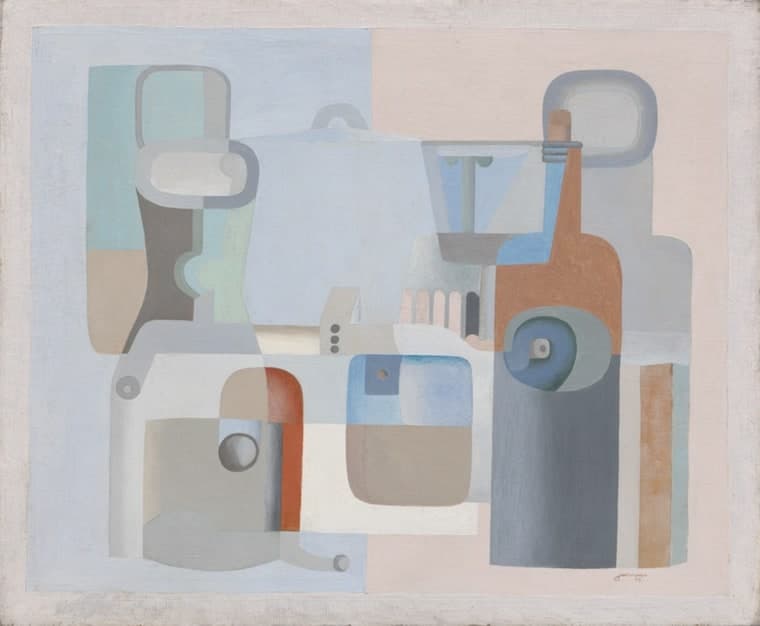
Bottles, a pot and a stack of vessels, laid over a ground split between pale blue and pale pink. Charles-Édouard Jeanneret painted it in 1924, at the end of the Purist decade, and he and Amédée Ozenfant reproduced it in their book La peinture moderne in 1927. The Art Institute of Chicago received it in 2007 in the bequest of Richard S. Zeisler and catalogues it as 2007.279.
- 1924
- Oil on canvas
- Art Institute of ChicagoChicago, United States
About Le Corbusier
What the painting shows
The ground is two colours meeting on one vertical seam a little left of centre: pale blue on the left, pale pink on the right. Neither half is a wall or a table. They simply divide the canvas, and every object is laid across the join as if the division were not there.
Two matching rounded rectangles stand at the top corners, drawn as outlines with paler centres — the same shape twice, once in blue-green at the left and once in grey at the right. Between them a large pale blue-grey mass fills the middle of the upper half, with a small arched handle on top, reading as a lidded pot.
Below the right-hand outline an orange-brown bottle stands with a stepped grey neck and a collar, its body broad and flat. Beneath it sits a grey-blue circle inside a pale green oval with a white dot at the centre, and below that a large slate-grey cylinder running down to the bottom edge. Along the far right two narrow vertical bands, one tan and one pale blue-green, close the composition.
The lower left is a wide pale grey rounded rectangle holding a beige field, a grey sphere shaded light at the top, and a rust-orange band curving down its right side. To its right a white horizontal band crosses the canvas, and on it a pale blue rounded square carries a small dark brown dot near its top left corner. A short white block near the centre has three small dark dots stacked at its left edge, with a row of narrow pink and white stripes beside it. A small grey ball rests on the white band below. The signature is written small at the lower right, with the numerals 24 beneath it.
They put it in their own book
The Art Institute of Chicago's publication history for the canvas opens with Amédée Ozenfant and Charles-Edouard Jeanneret, La peinture moderne, published in Paris by Les Éditions G. Crès & Cie in 1927, where it appears as an illustration.
That is not a critic reproducing a painting. It is the two founders of Purism choosing this canvas to stand for the argument, three years after it was made and at the point when their partnership was ending.
The title the museum uses, Still Life Filled with Space, names what the picture does with its ground. A Purist still life of 1920 tends to sit objects on a dark table against a flat wall. Here the two pale fields do not describe a room at all, and the objects float across their seam.
How it reached Chicago
The museum records the chain in three steps. The Pierre Matisse Gallery in New York held it by 29 January 1960 and sold it to the collector Richard S. Zeisler on that date, with the receipt in the curatorial file. Richard S. Zeisler bequeathed it to the Art Institute of Chicago in 2007.
Before Chicago it was a New York picture for decades. The Sidney Janis Gallery showed it in The Classic Spirit in 20th Century Art in 1964, as catalogue number 7. Two years later it appeared in Seven Decades: 1895–1965: Cross Currents In Modern Art, mounted by the Public Education Association of the City of New York from 26 April to 21 May 1966.
Since the bequest it has travelled twice. The Kimbell Art Museum in Fort Worth showed it in The Age of Picasso and Matisse: Modern Masters from the Art Institute of Chicago, 6 October 2013 to 16 February 2014. Wrightwood 659 in Chicago showed it in Ando and Le Corbusier: Masters of Architecture, 12 October to 15 December 2018. The museum lists it as not on view.
The end of the partnership
1924 is the last full year of the Purist collaboration as a working partnership. In September that year he opened the atelier at 35 rue de Sèvres in Paris that he kept for the rest of his life, and the architecture began to take the larger share.
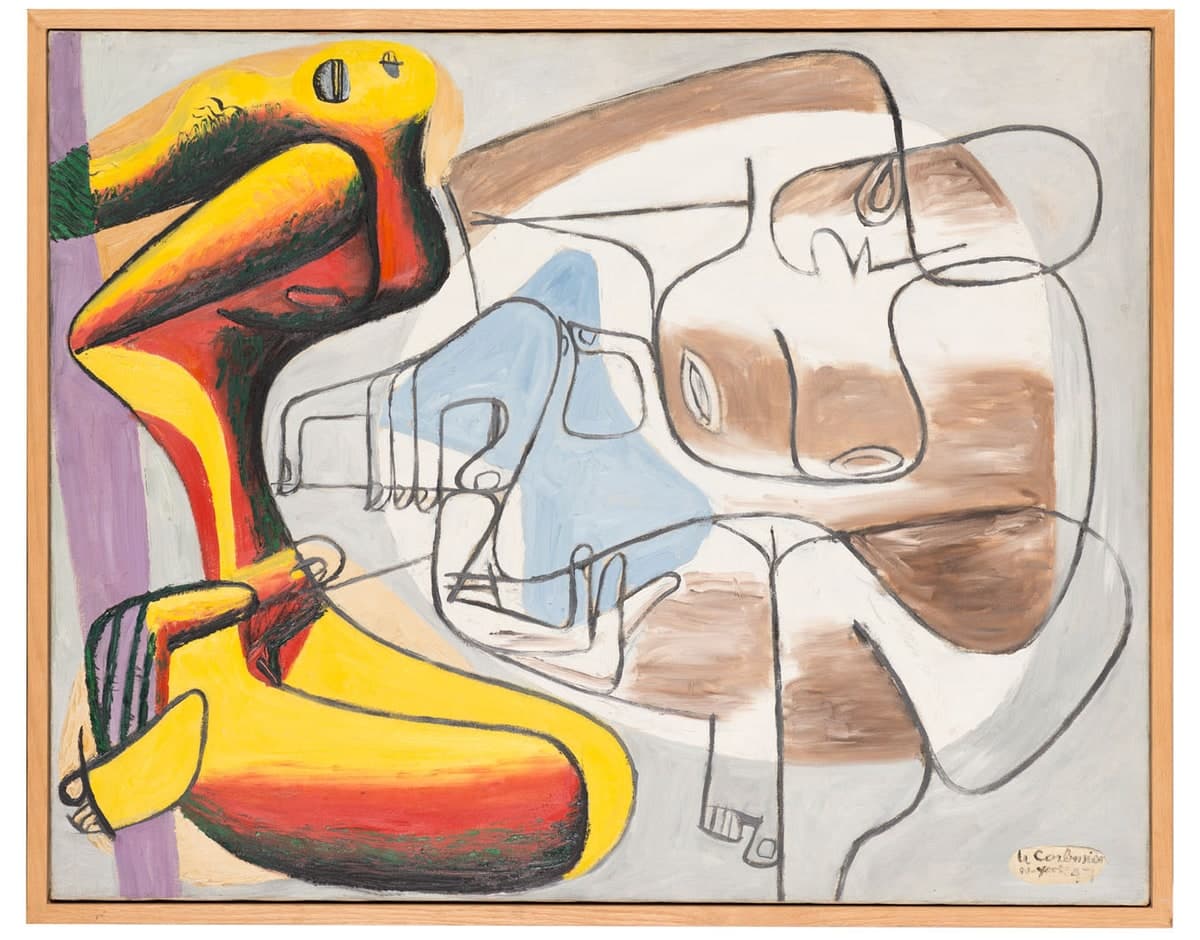
The Fondation Le Corbusier states what happened to the painting afterwards. After the break with Amédée Ozenfant he turned to the objects of poetic reaction the Surrealists favoured, to the female figure and to the bull. The still life did not disappear, but it stopped being the programme.
He did not stop painting. The Fondation records more than 450 paintings between 1917 and 1965 and several hours a day given to the work, alongside sculpture, tapestry, enamel and engraving.
Close reading
Reading the work, detail by detail
The Art Institute of Chicago's plate shows the canvas in a pale painted frame that runs around all four sides. Inside it the ground is split down a vertical seam, pale blue on the left and pale blue-pink on the right, and every object is laid across that join.
1.The ground is split down one vertical seam
A single vertical seam runs from top to bottom a little left of centre, separating a pale blue field from a pale pink one. Neither half describes a wall or a table. Objects cross the join without changing colour or breaking, which is the picture's way of refusing to say where anything is standing.
2.The same rounded outline, twice
A rounded rectangle drawn as an outline with a paler centre stands in the top right corner. Its twin stands in the top left, drawn in blue-green instead of grey. Two of the same shape, one at each upper corner, both empty in the middle: the composition is bracketed rather than framed.
3.A lidded mass with one small arched handle
The largest object sits in the upper middle: a pale blue-grey mass with a small arched handle on top, which is the only thing identifying it as a lid. It passes in front of both corner outlines and behind nothing, so it is the nearest object in the top half. Its colour is barely darker than the blue ground behind it.
4.One orange-brown bottle, with a stepped neck
The only strong colour in the upper half is a single orange-brown bottle at the right, its body broad and flat and its neck stepped into two grey collars. It overlaps the grey corner outline behind it and the slate cylinder below. In a canvas otherwise built from pale blues, greys and creams, it is the one object that announces itself.
5.A grey-blue circle inside a pale green oval
Below the orange bottle a grey-blue circle sits inside a pale green oval, with a single small white dot at the centre. It reads as a bottle's base seen from underneath, laid into the picture next to the same bottle seen from the side. One object, two views, three centimetres apart.
6.A slate cylinder running to the bottom edge
A large slate-grey cylinder with a rounded top runs from the middle of the canvas down to the bottom edge. It is the darkest area in the painting and the only object that touches the lower border. The orange bottle sits directly above it and overlaps its top.
7.A grey sphere and a rust-orange band, lower left
The lower left holds a wide pale grey rounded rectangle containing a beige field, a single grey sphere lit from above, and a rust-orange band curving down its right edge. The sphere is the only fully rounded form in the painting and the rust band the only other warm colour besides the bottle.
8.Three stacked dots, and a row of narrow stripes
Near the centre a short white block carries three small dark dots stacked vertically at its left edge, with a row of narrow pink and white stripes running beside it. They are the smallest marks in the painting and the only repeated rhythm in it — three dots, then a comb of stripes, at the exact middle of the canvas.
9.The signature, with the year beneath it
The signature is written very small in dark paint at the lower right, with the numerals 24 beneath it. It is on the pink half of the ground, clear of the slate cylinder. The Art Institute of Chicago's own record for the canvas lists no inscription, so the signature is legible here and uncatalogued there.
Timeline
1918
Amédée Ozenfant and Charles-Édouard Jeanneret publish Après le cubisme and found Purism.
1924
The canvas is painted. In September he opens the atelier at 35 rue de Sèvres, which he keeps until his death.
1927
Reproduced in Amédée Ozenfant and Charles-Edouard Jeanneret, La peinture moderne (Paris: Les Éditions G. Crès & Cie).
1960
Held by the Pierre Matisse Gallery, New York, by 29 January and sold to Richard S. Zeisler on that date.
1964
Shown at the Sidney Janis Gallery, New York, in The Classic Spirit in 20th Century Art, catalogue number 7.
1966
Shown in Seven Decades: 1895–1965: Cross Currents In Modern Art, New York, 26 April to 21 May.
2007
Bequeathed to the Art Institute of Chicago by Richard S. Zeisler, as 2007.279.
2018
Shown at Wrightwood 659, Chicago, in Ando and Le Corbusier: Masters of Architecture, 12 October to 15 December.
Where to see it
Art Institute of Chicago
111 South Michigan Avenue, Chicago, IL 60603, United States
The museum records the painting as not on view.
Plan your visit on the museum’s official website (opens in a new tab)Frequently asked questions
Where is Still Life Filled with Space?
At the Art Institute of Chicago, reference number 2007.279, in the Department of Modern Art. It came to the museum in 2007 as a bequest from the collector Richard S. Zeisler. The museum records it as not on view.
Who painted Still Life Filled with Space?
Le Corbusier, whom the Art Institute of Chicago catalogues under the full form Le Corbusier (Charles-Édouard Jeanneret), French, born Switzerland, 1887–1965. He painted it in 1924, during the years he was known mainly as a painter and had built very little.
How big is Still Life Filled with Space?
60.3 by 73 centimetres, which the museum also gives as 23 3/4 by 28 3/4 inches. It is oil on canvas, wider than it is tall.
What does Still Life Filled with Space show?
A group of vessels over a ground split down the middle between pale blue and pale pink. Two matching rounded outlines stand at the top corners, and a lidded pot with a small arched handle fills the upper middle. An orange-brown bottle with a stepped neck stands at the right above a large slate cylinder, and a grey sphere sits inside a pale rounded rectangle at the lower left.
Did Le Corbusier publish this painting himself?
Yes. The Art Institute of Chicago's publication history begins with La peinture moderne, the book Amédée Ozenfant and Charles-Edouard Jeanneret published in Paris through Les Éditions G. Crès & Cie in 1927, where the canvas appears as an illustration.
What happened to Le Corbusier's painting after Purism?
It changed subject rather than stopping. The Fondation Le Corbusier records that after the break with Amédée Ozenfant he took up the objects of poetic reaction the Surrealists favoured, the female figure and the bull. He kept painting daily and left more than 450 paintings made between 1917 and 1965.
More by Le Corbusier
If you like Le Corbusier
Explore painters from the same movements and circles.
- AC
A. M. Cassandre
French poster designer whose advertisements for railways, liners and aperitifs — Nord Express, Dubonnet, Normandie — reduced their subjects to a few commanding shapes.
View artist 
Sonia Delaunay
Painter who arrived from Odessa via St Petersburg in 1905, co-invented Simultanism with Robert Delaunay, made the two-metre folding artist's book La Prose du Transsibérien with the poet Blaise Cendrars in 1913, dressed 1920s Paris from her Atelier Simultané, and in 1964 became the first living woman shown at the Louvre.
View artist- SL
Suzanne Lalique-Haviland
French designer who worked in glass, porcelain, textiles and stage design, and whose contributions to the Lalique firm were often manufactured under her father's signature.
View artist
References
The sources below include collection records, catalogues, scholarly research, and primary materials that informed this page. They document Still Life Filled with Space, its making, and its place in cultural history.

1Le Corbusier (Charles-Édouard Jeanneret), Still Life Filled with Space, 1924 (2007.279)
Official recordArt Institute of ChicagoUsed forThe owning museum's record: title, date, medium, dimensions, credit line, reference number, display status, copyright notice, provenance, exhibition history and publication history.

2Works / Art works / Painting
WebsiteFondation Le CorbusierUsed forThe turn after the break with Amédée Ozenfant to the female figure and the bull, and the count of more than 450 paintings between 1917 and 1965.
3Biography, 1923-1925: Becoming Le Corbusier
WebsiteFondation Le CorbusierUsed forThe opening of the atelier at 35 rue de Sèvres in September 1924.
4Biography, 1917-1922: À nous deux Paris!
WebsiteFondation Le CorbusierUsed forAprès le cubisme and the founding of Purism with Amédée Ozenfant.
5Copyright / Rights management
Official recordFondation Le CorbusierUsed forThe Fondation as universal legatee under the will of 16 June 1965, with ADAGP managing its rights.
These references provide the documented foundation for this work's history and interpretation. Claim-level citations remain attached to the specific claims they support.
 Explore more resources