Nature morte au siphon
by Le Corbusier
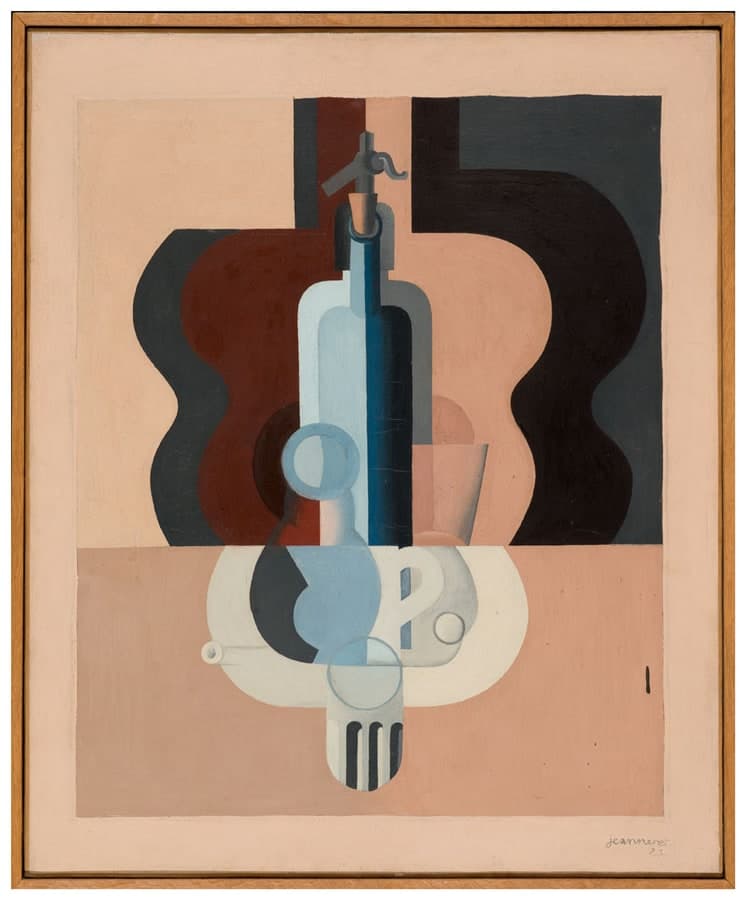
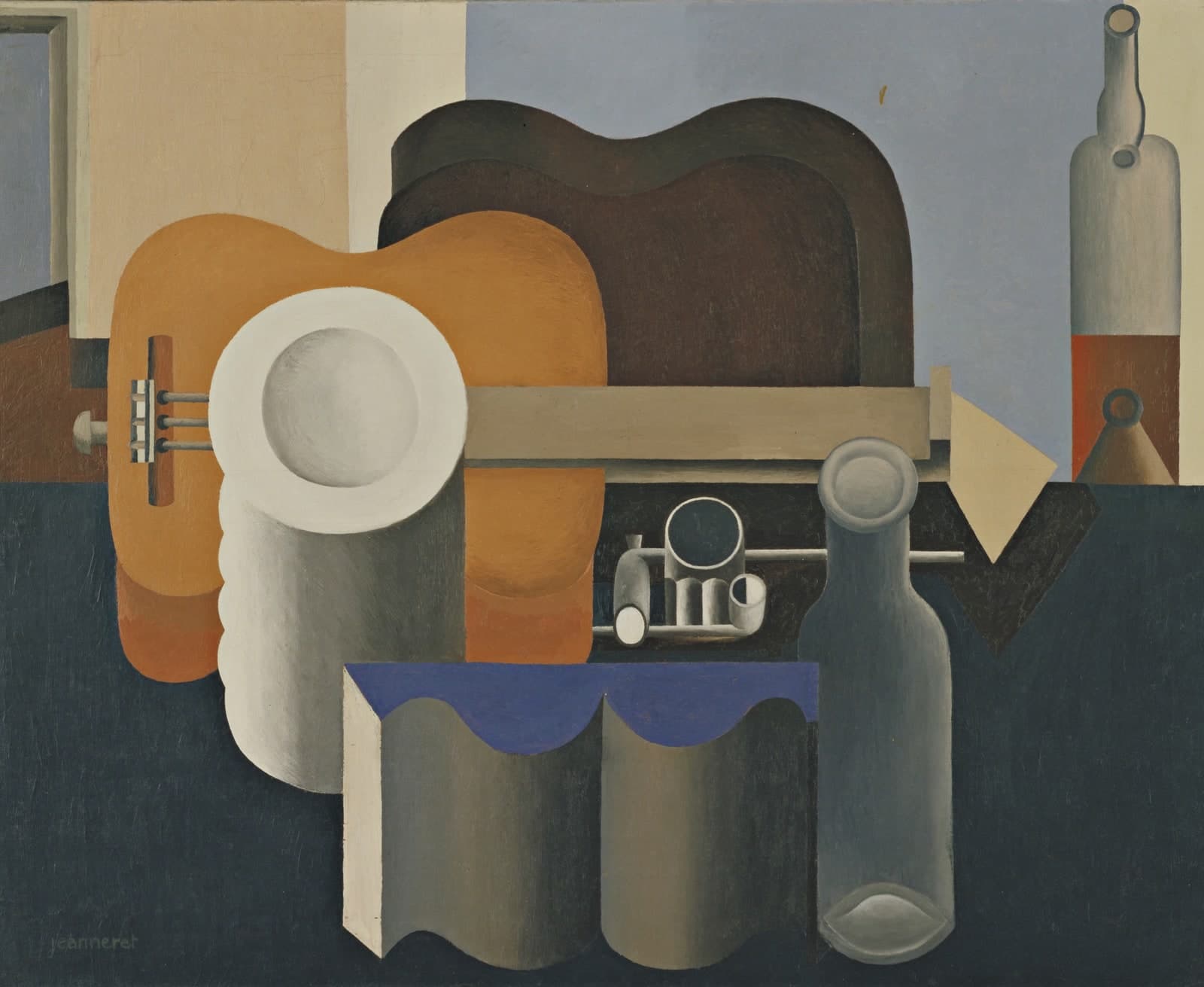
A soda siphon standing upright between two guitars, with a dish, a glass and a fork below it. Charles-Édouard Jeanneret painted it in 1921 and signed it with the year at the lower right. The Fondation Le Corbusier holds it in Paris as painting FLC 139, and catalogues a second canvas of the same title from 1928, which is why the year belongs in the address.
- 1921
- Oil on canvas
- Fondation Le CorbusierParis, France
About Le Corbusier

What the painting shows
A siphon stands dead centre and runs almost the full height of the composition. Its body is split down the middle, pale blue-white on the left and deep navy on the right. Above it sits a narrow tan neck and a grey tap, from which a dark lever curls to the right like a question mark.
Two guitars stand behind it, both given as outlines rather than objects. The one on the left is a dark grey contour filled with deep red-brown; the one on the right is solid black, its double curve cut against the pink ground. A red vertical band runs up behind the siphon's neck. To the right of the siphon a pale cream tumbler tapers downward, rounded at the lip.
Below, a broad white dish lies flat across the canvas like a kidney, wider than anything above it. Circles are cut into it and laid over it. A pale blue disc overlaps at the upper left, a smaller white circle sits at the right, and a white loop reads as a handle. A small grey knob on a thin stem reaches out to the left. A second pale blue circle sits at the bottom, and over it a white fork points down with four dark tines.
The background is two flats of dusty pink divided by one straight horizontal edge across the middle — wall above, table below. The canvas is 73 by 60 centimetres, taller than it is wide. Jeanneret and the numerals 21 are written in grey at the lower right. The Fondation Le Corbusier's plate shows the canvas in a plain pale wooden frame, with a wide painted border around the composition.
Why a siphon
A soda siphon is a manufactured object with no handmade variation in it. It is turned, threaded, pressurised and identical to every other siphon of its model, which is exactly the quality Charles-Édouard Jeanneret and Amédée Ozenfant had asked painting to take up in Après le cubisme in 1918.
The Fondation Le Corbusier describes the Purist method plainly. The still life was their favoured genre, and everyday objects were geometrised into flat areas of colour. The siphon here is drawn as two vertical halves and a cylinder, with the tap given just enough detail to name it.
Set against that, the guitars are the older subject. A guitar had been the standard Cubist prop for a decade by 1921, and both of these are reduced to their profile and pushed behind the machine-made object. The picture is arranged so the siphon wins.
Two canvases share the title
The Fondation Le Corbusier's catalogue of his paintings lists Nature morte au siphon twice, once in 1921 and once in 1928. Neither title is qualified further, so the year is the only thing separating them.
This is the 1921 canvas, painting FLC 139. The signature on the front agrees: Jeanneret, followed by 21.
Repeated titles are ordinary in his painting. The Fondation's catalogue also carries two canvases called Divinité baroque, both dated 1943, and ten paintings in the Taureau series — nine of them numbered from I to XVI, and one simply called Taureau.
Still signing Jeanneret
By 1921 the name Le Corbusier was a year old and belonged to the architecture. He had begun using it in 1920 in L'Esprit Nouveau, the magazine he founded with Amédée Ozenfant and the poet Paul Dermée, as a byline for his articles.
The paintings kept the birth name. On this canvas the signature is Jeanneret, and it stays Jeanneret through the Purist decade. The habit is documented on the objects themselves: the front of La cheminée of 1918 reads Jeanneret, and so does the front of Nature morte du Pavillon de l'Esprit Nouveau of 1924.
Close reading
Reading the work, detail by detail
The Fondation Le Corbusier photographs the canvas upright in a plain pale wooden frame. Inside the frame a wide painted border of dusty pink surrounds the composition, which is arranged vertically around a single siphon, with two guitar profiles behind it and a dish of small objects below.
1.The siphon's tap, and its curled lever
The top of the siphon is the most specific drawing in the painting: a grey tap head sitting on a narrow tan neck, with a dark lever curling away to the right in a single hooked stroke. Everything below it is simplified to flat areas, so this one mechanical detail is what identifies the whole object.
2.One body, split into two flat halves
The siphon's body is cut straight down the middle into a pale blue-white left half and a deep navy right half, with no blend between them. Roundness is stated as two flat colours meeting on a line rather than modelled. It is one object and the strongest vertical in the picture.
3.The right-hand guitar, solid black
On the right stands a guitar reduced to a filled black profile, its double curve cut hard against the pink ground behind. There is no soundhole, no strings and no bridge — only the outline. It passes behind the siphon, so it sits second in the running order.
4.The left-hand guitar, outlined in grey over red-brown
A second guitar stands to the left, drawn as a dark grey contour and filled with deep red-brown rather than black. Two instruments, the same profile, two treatments. Both are pushed behind the siphon, which is the arrangement's whole argument: the manufactured object takes the front.
5.A single pale tumbler at the right
One tumbler stands between the siphon and the black guitar, pale cream and tapering downward with a rounded lip. It overlaps the black profile and is overlapped in turn by the siphon, which places it in the middle of the stack. It is the only drinking glass in the picture.
6.A broad white dish, with circles cut into it
A single white dish lies flat across the lower third, wider than anything above it, its outline a soft kidney shape. Circles are set into and over it: a pale blue disc overlapping at the upper left, a smaller white circle at the right, a white loop reading as a handle, and a small grey knob on a thin stem reaching left. The dish sits in front of the pink table field and behind the fork.
7.A fork, four dark tines pointing down
At the bottom of the composition a white fork points down with four dark tines, laid over a pale blue circle. It is the lowest object and the only one whose edges are parallel rather than curved. Counting the tines is straightforward: four, evenly spaced, each drawn as a separate dark stroke.
8.One straight line divides wall from table
A single straight horizontal edge runs across the composition where the wall meets the table. Both fields are dusty pink; only the value changes. There is no thickness, no shadow and no receding surface, so the table is a line rather than a plane.
9.Signed Jeanneret, dated 21
The signature is written in grey at the lower right, on the pink field below the composition, and reads Jeanneret with the numerals 21 underneath. The year matters here because the Fondation Le Corbusier catalogues a second canvas under exactly this title, dated 1928.
Timeline
1918
Après le cubisme is published and Purism is founded, with the still life as its subject.
1920
L'Esprit Nouveau is launched and Charles-Édouard Jeanneret begins signing architectural articles Le Corbusier.
1921
The canvas is painted and signed Jeanneret 21 at the lower right.
1928
A second canvas titled Nature morte au siphon is painted; the Fondation Le Corbusier catalogues both.
1965
By a will dated 16 June he makes the Fondation Le Corbusier his universal legatee, which is how the canvas is held today as FLC 139.
Where to see it
Fondation Le Corbusier
Paris, France
A public viewing address has not yet been confirmed for this holding.
The Fondation Le Corbusier is based at Maison La Roche, 10 square du Docteur Blanche, Paris. Its collection is not all on permanent display; check the Fondation's record before travelling.
Frequently asked questions
Where is Le Corbusier's Nature morte au siphon?
The Fondation Le Corbusier holds it in Paris as painting FLC 139. The Fondation is based at Maison La Roche, 10 square du Docteur Blanche in the 16th arrondissement. Its collection is not all on permanent display, so check the Fondation's own record before travelling to see this canvas.
Are there two paintings called Nature morte au siphon?
Yes. The Fondation Le Corbusier's catalogue lists one from 1921 and one from 1928 under exactly the same title. This is the 1921 canvas, catalogued as FLC 139 and signed Jeanneret 21 on the front.
What is in Nature morte au siphon?
A soda siphon standing upright at the centre, its body split between pale blue and navy, with a grey tap and a curled lever at the top. Two guitars stand behind it as flat outlines, one dark red-brown and one black. A pale tumbler sits to the right, and below there is a broad white dish with circles cut into it, a pale blue disc and a white fork with four dark tines.
How big is Nature morte au siphon?
73 by 60 centimetres, taller than it is wide. The Fondation Le Corbusier gives the dimensions as H 0,73 m by L 0,60 m and the medium as oil on canvas.
Why did the Purists paint bottles and glasses?
Because they were manufactured and identical. Charles-Édouard Jeanneret and Amédée Ozenfant argued in Après le cubisme in 1918 that painting should recover the clarity of a machine, and standard objects — bottles, glasses, plates, a siphon — carried no handmade accident to get in the way. The Fondation Le Corbusier records the still life as their favourite genre.
Is Nature morte au siphon signed Le Corbusier?
No. It is signed Jeanneret, with the year 21, at the lower right. He had taken Le Corbusier as a byline for his architecture writing in 1920 but went on signing paintings with his birth name, Charles-Édouard Jeanneret, through the 1920s.
More by Le Corbusier
If you like Le Corbusier
Explore painters from the same movements and circles.
- AC
A. M. Cassandre
French poster designer whose advertisements for railways, liners and aperitifs — Nord Express, Dubonnet, Normandie — reduced their subjects to a few commanding shapes.
View artist 
Sonia Delaunay
Painter who arrived from Odessa via St Petersburg in 1905, co-invented Simultanism with Robert Delaunay, made the two-metre folding artist's book La Prose du Transsibérien with the poet Blaise Cendrars in 1913, dressed 1920s Paris from her Atelier Simultané, and in 1964 became the first living woman shown at the Louvre.
View artist- SL
Suzanne Lalique-Haviland
French designer who worked in glass, porcelain, textiles and stage design, and whose contributions to the Lalique firm were often manufactured under her father's signature.
View artist
References
The sources below include collection records, catalogues, scholarly research, and primary materials that informed this page. They document Nature morte au siphon, its making, and its place in cultural history.


1Nature morte au siphon, 1921 (painting FLC 139)
Official recordFondation Le CorbusierUsed forThe owning institution's record: medium, dimensions and the signature Jeanneret 21.

2Works / Art works / Painting
WebsiteFondation Le CorbusierUsed forThe Fondation's catalogue of his paintings, which lists a second Nature morte au siphon of 1928, two canvases called Divinité baroque and the numbered Taureau series; also its account of Purism and the still life.
3La cheminée, 1918 (painting FLC 134)
Official recordFondation Le CorbusierUsed forCited for the Jeanneret signature on the 1918 canvas.
4Nature morte du Pavillon de l'Esprit Nouveau, 1924 (painting FLC 141)
Official recordFondation Le CorbusierUsed forCited for the signature Jeanneret 24, evidence that the birth name stayed on the paintings through the Purist decade.
5Biography, 1917-1922: À nous deux Paris!
WebsiteFondation Le CorbusierUsed forAprès le cubisme, L'Esprit Nouveau with Amédée Ozenfant and Paul Dermée, and the adoption of the name Le Corbusier in 1920.
6Copyright / Rights management
Official recordFondation Le CorbusierUsed forThe will of 16 June 1965, the Fondation as universal legatee, and ADAGP as its rights agent.
These references provide the documented foundation for this work's history and interpretation. Claim-level citations remain attached to the specific claims they support.
 Explore more resources