Swimming
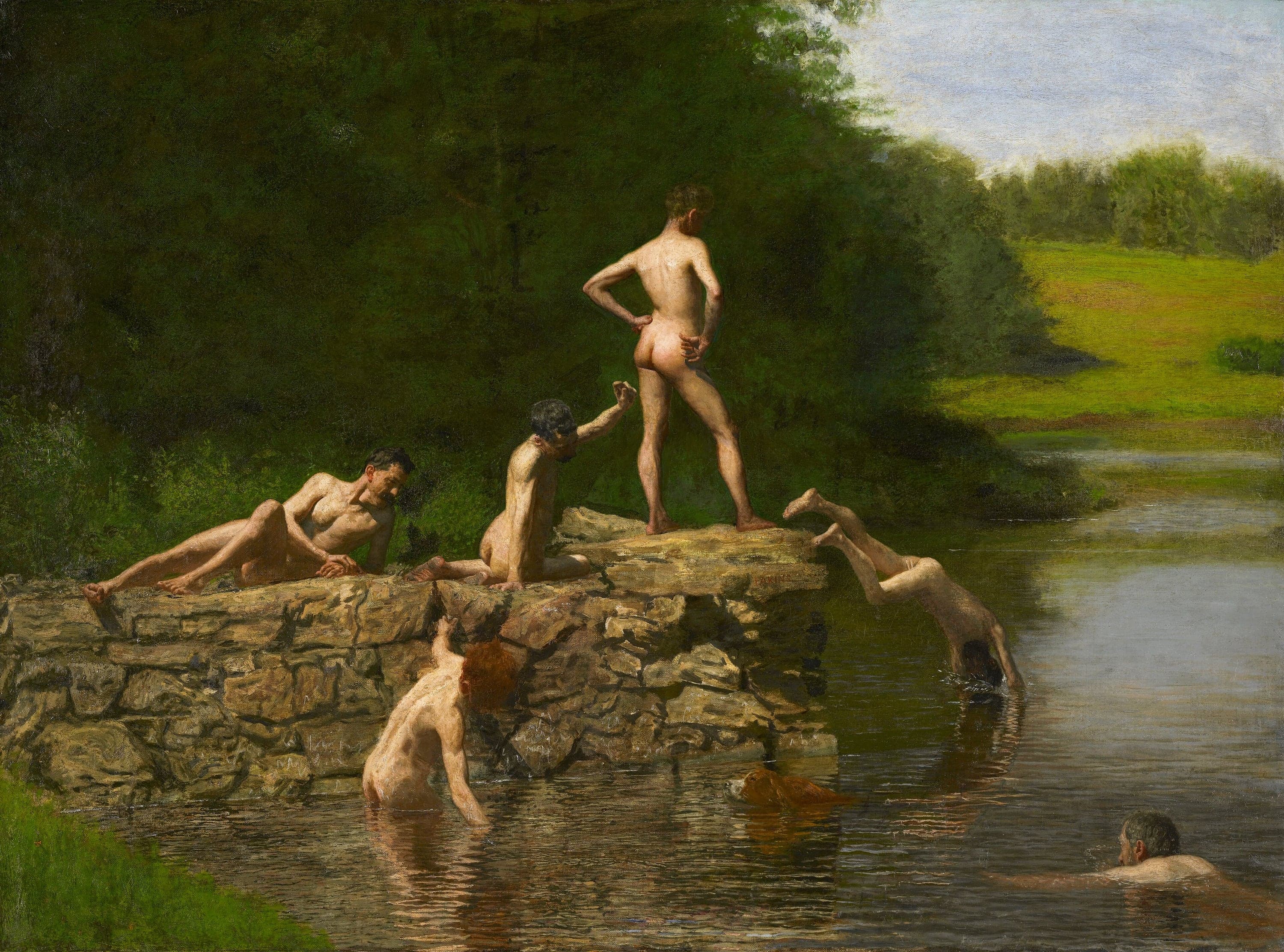
Six naked men and a red setter are in and around a pool below an old stone pier: one reclines, one sits, one stands with his hands on his hips, one dives, one wades and one swims. Thomas Eakins painted it in 1885 for Edward Hornor Coates, chairman of instruction at the Pennsylvania Academy of the Fine Arts, who declined it. The Amon Carter Museum of American Art in Fort Worth has owned it since 1990.
- 1885
- Oil on canvas
- Amon Carter Museum of American ArtFort Worth, United States
About Thomas Eakins

What the painting shows
Six naked men and a dog are in and around a pool of green water below a pier of rough stone. At the left a man with a moustache lies back on the rock, propped on one arm, looking down at the water. Beside him a dark-haired man sits with his right arm raised, pointing towards the water. Behind them a third stands with his hands on his hips, seen from behind, at the top of the group. A fourth is caught in mid-dive at the right, legs in the air, his head already in the water and the splash rising around him.
A red-haired man wades below the pier with his back to the viewer. At the bottom right the head and shoulders of a swimmer move through the water. The Amon Carter Museum of American Art identifies him as Thomas Eakins, swimming towards his dog, Harry, whose red head shows in the water at the centre. The museum's record says the figures were identifiable as portraits of the artist and several of his male students. Martin A. Berger's 1997 article in American Art names the five others as Talcott Williams, Benjamin Fox, J. Laurie Wallace, Jesse Godley and George Reynolds.
Dark woods close the scene on the left and behind, and a sunlit meadow opens at the upper right. The stone pier, according to Doreen Bolger and Sarah Cash's 1996 catalogue, is the foundation of a mill on Mill Creek demolished in 1873, at Dove Lake outside Philadelphia. No clothes, shoes or bathing house appear anywhere. The canvas is 69.5 by 92.4 centimetres, and Eakins signed and dated it in red on the pier, EAKINS 1885, in letters that have faded almost to the colour of the rock.
Coates's commission and the Academy
Edward Hornor Coates, a Philadelphia businessman who chaired the Committee on Instruction at the Pennsylvania Academy of the Fine Arts, commissioned the picture in 1884. He offered $800, the largest sum Eakins had yet been offered for a painting, according to Bolger and Cash. Eakins was then head of the Academy's school, where, in the words of the museum's handbook, he made the study of the nude integral to his teaching and encouraged students to pose nude for one another.
The painting was shown at the Academy's annual exhibition in the autumn of 1885. Coates then returned it. In a letter of 27 November 1885, quoted by Bolger and Cash, he told Eakins that one of his chief ideas had been a picture that might some day join the Academy's collection. Other pictures, he added, might be more representative. He took The Pathetic Song instead and paid the $800 for that.
The museum's handbook says the picture proved enormously controversial, drawing charges of indecency because the figures were identifiable portraits of the artist and his students. Within months, in 1886, the Academy forced Eakins to resign, after he removed the loincloth from a male model in a class where women students were present. He wrote to Coates soon afterwards to explain himself.
“I see no impropriety in looking at the most beautiful of Nature's works, the naked figure. If there is impropriety, then just where does such impropriety begin? Is it wrong to look at a picture of a naked figure or at a statue?”
The nude had been the centre of his own training. At the École des Beaux-Arts in Paris he had drawn and painted from the living model under Jean-Léon Gérôme, and in Léon Bonnat's studio he had taken on an insistence on anatomical exactness, according to William Innes Homer. Darrel Sewell's 1982 catalogue for the Philadelphia Museum of Art traces the reclining figure at the left to the Dying Gaul, the Hellenistic marble in Rome. Sewell reads the picture as an attempt to set classical poses in a modern scene.
Title, date and the cleaning of 1993
Eakins did not call the picture The Swimming Hole. Bolger and Claire M. Barry, writing in The Magazine Antiques in 1994, found that title first used in 1917, probably at the suggestion of the painter's widow, Susan Macdowell Eakins. Eakins's own titles, Swimming in 1885 and The Swimmers in 1886, named the action and the figures rather than the place. The museum has returned to Swimming.
The date was wrong for decades too. A conservator had misread and strengthened the inscription as 1883, and that year was long accepted as the date Eakins began work. Eakins had painted his signature and date in a fugitive red lake pigment that faded to illegibility, and the Metropolitan Museum's 1917 catalogue listed the picture as not signed or dated. The cleaning of 1993 by Barry and the staff of the Amon Carter and Kimbell museums recovered the true inscription, 1885, and removed layers of darkened varnish that had hidden the brushwork.
From Fort Worth's library to the Carter
After Coates returned it the painting stayed with Eakins for the rest of his life. Bolger and Barry record one more showing in his lifetime, at Louisville, Kentucky, in 1886. It appeared in the memorial exhibitions of 1917, then in 1925 was bought from his widow by the Friends of Art of the Fort Worth Art Association, and for years hung in the city's public library.
In 1990 its owner by then, the Modern Art Museum of Fort Worth, proposed selling it to fund an endowment for contemporary art. The Amon Carter raised ten million dollars from some five thousand foundations, companies and individuals and bought it that June. The museum's credit line names the Amon G. Carter Foundation, the Sid W. Richardson Foundation and the people of Fort Worth among the donors. It is accession number 1990.19.1 and, as of September 2026, on view.
Close reading
Reading the work, detail by detail
Count the figures from the top of the pyramid down: the standing man, the diver, the reclining and seated men on the rock, the wader in the water, the painter swimming towards his dog. Then find the faded signature on the pier.
1.The standing figure
The standing man is at the top of the group. Doreen Bolger and Sarah Cash's catalogue describes the poses as running from reclining to sitting to standing to diving, each figure placed so that no genitals are visible.
2.The diver
The dive is the one moment of fast movement in the picture. Charles Bregler, a student of Eakins, recalled that the diving figure was the hardest to paint and was first modelled in wax, an account Darrel Sewell's 1982 catalogue records.
3.The reclining man
Sewell's 1982 catalogue traces this pose to the Dying Gaul, the Hellenistic marble in the Capitoline Museums in Rome. Martin A. Berger's 1997 article identifies the reclining man as Talcott Williams.
4.The seated man pointing
The seated man's gesture leads the eye up to the standing figure, in the reading Lloyd Goodrich gave of the composition as a pyramid. Berger's article identifies him as Benjamin Fox.
5.The red-haired wader
The wader climbs or leans towards the rock from the water. His red hair is the warmest colour in the picture, and Bolger and Cash note that the water beside him is still enough to hold a clear reflection.
6.Eakins swimming
The Amon Carter Museum of American Art identifies the swimmer as Thomas Eakins, heading towards his dog. The ripple he makes is one of the only two signs of movement in the water, with the diver's splash.
7.Harry
The museum names the dog as Harry, Eakins's setter. He is painted at the centre of the lower half, in the same reddish brown as the wader's hair.
8.The faded signature
Eakins signed and dated the picture in a red lake pigment that faded almost to the colour of the rock; the Metropolitan Museum's 1917 catalogue listed the work as not signed or dated. The cleaning of 1993 recovered the inscription and the date 1885, which a conservator had earlier misread as 1883.
9.The meadow
The one open view in the picture is the lit meadow at the upper right. Everywhere else the woods close in, and Bolger and Cash observe that no clothes, shoes or bathing house appear in the scene.
Timeline
1884
Commissioned by Edward Hornor Coates, chairman of the Pennsylvania Academy's Committee on Instruction, for $800.
1885
Painted, and signed and dated in red on the rock pier. Shown at the Academy's autumn exhibition; Coates returns it in a letter of 27 November and takes The Pathetic Song instead.
1886
The Academy forces Eakins to resign. The picture is shown at Louisville, Kentucky, its last public showing in his lifetime.
1917
Number 42 in the Metropolitan Museum of Art's memorial loan exhibition, catalogued as not signed or dated, and first called The Swimming Hole.
1925
Bought from Susan Macdowell Eakins by the Friends of Art, Fort Worth Art Association, and hung in the city's public library.
1990
Bought in June by the Amon Carter Museum of American Art for ten million dollars raised from some five thousand donors. Accessioned as 1990.19.1.
1993
Cleaned by Claire M. Barry and colleagues, who recover the original inscription and correct the date from 1883 to 1885.
1996
Doreen Bolger and Sarah Cash publish Thomas Eakins and the Swimming Picture for the Amon Carter.
Where to see it
Amon Carter Museum of American Art
Fort Worth, United States
A public viewing address has not yet been confirmed for this holding.
On view, according to the museum's record in September 2026.
Frequently asked questions
Where is Swimming, also called The Swimming Hole?
At the Amon Carter Museum of American Art in Fort Worth, Texas, accession number 1990.19.1. The museum's record in September 2026 lists it on view.
Who are the men in The Swimming Hole?
The Amon Carter identifies the swimmer at the bottom right as Thomas Eakins, heading towards his dog Harry, and says the other figures were recognisable portraits of his male students. Martin A. Berger's 1997 article in American Art names them as Talcott Williams, Benjamin Fox, J. Laurie Wallace, Jesse Godley and George Reynolds.
Why is the painting called Swimming rather than The Swimming Hole?
Because Swimming was Eakins's own title in 1885. The Swimming Hole was first used in 1917, the year after his death, probably at the suggestion of his widow, according to Doreen Bolger and Claire M. Barry. The Amon Carter has returned to the artist's title.
Why did Edward Hornor Coates refuse the painting?
His letter of 27 November 1885 said he had wanted a picture that might one day join the Academy's collection and that other works were more representative. Bolger and Cash think the subject was too sensitive for the Academy's directors, who had forbidden Eakins from using students as models. Coates took The Pathetic Song instead and paid the $800 for that.
Where is Thomas Eakins in The Swimming Hole?
In the water at the bottom right, only his head and shoulders showing, swimming towards the red setter in the centre. The Amon Carter's record names the dog as Harry.
When was The Swimming Hole painted?
In 1885. The date read 1883 for decades because a conservator had misinterpreted the faded inscription. The cleaning of 1993 recovered the original signature and date, EAKINS 1885, painted in a red pigment that had faded almost to invisibility.
More by Thomas Eakins
If you like Thomas Eakins
Explore painters from the same movements and circles.

Rosa Bonheur
At the horse markets of Paris and in her studio beside the forest of Fontainebleau, Rosa Bonheur gave animals the presence of great portrait subjects. The success of The Horse Fair helped her build a life shaped by her work, financial independence, and the women she loved.
View artist
Henri Cartier-Bresson
French photographer who turned a pocket-sized 35mm camera into an instrument of split-second composition — the idea the world knows as 'the decisive moment'. He trained as a painter, was taken prisoner in 1940 and escaped on his third try, photographed the Liberation of Paris in August 1944, co-founded the photographer-owned agency Magnum Photos in 1947, gave up reporting for drawing in the 1970s, and left Paris a foundation in the Marais that deliberately hangs no permanent display of his own pictures.
View artist
Aaron Douglas
The painter who gave the Harlem Renaissance — the flowering of Black American writing, music and art between the world wars — its look, in flat purple silhouettes in profile, ringed by bands of light. He moved to Harlem in 1925 with Paris as the eventual destination, got there in 1931, spent a year at the Académie Scandinave, a private art school in the city, and came home to paint the four murals that are still the centrepiece of the Schomburg Center, the New York Public Library's Harlem research library on Black history.
View artist
References
The sources below include collection records, catalogues, scholarly research, and primary materials that informed this page. They document Swimming, its making, and its place in cultural history.


1Swimming, Thomas Eakins
WebsiteAmon Carter Museum of American ArtUsed forWeb source consulted for documented facts and historical context presented on the Swimming page.

2Thomas Eakins's Swimming Hole
PeriodicalThe Magazine Antiques, vol. 145, no. 3, 1994Used forContemporary reporting or criticism used to document the historical reception and context of Swimming.
3Thomas Eakins and the Swimming Picture
Exhibition catalogueAmon Carter Museum, Fort Worth, 1996Used forCatalogue scholarship used to verify attribution, provenance, chronology, and interpretive context for Swimming.
4Modernity and Gender in Thomas Eakins' Swimming
PeriodicalAmerican Art, vol. 11, no. 3, pp. 33–47, 1997Used forContemporary reporting or criticism used to document the historical reception and context of Swimming.
5Biography: 1886: Eakins Resigns: Indicted by Rumor
WebsiteWHYY, Thomas Eakins: Scenes from Modern Life film companion site, 2002Used forWeb source consulted for documented facts and historical context presented on the Swimming page.
6Thomas Eakins: Artist of Philadelphia
Exhibition cataloguePhiladelphia Museum of Art, 1982Used forCatalogue scholarship used to verify attribution, provenance, chronology, and interpretive context for Swimming.
7Loan Exhibition of the Works of Thomas Eakins, November 5 to December 3, 1917
Exhibition catalogueThe Metropolitan Museum of Art, 1917Used forCatalogue scholarship used to verify attribution, provenance, chronology, and interpretive context for Swimming.
8Thomas Eakins: His Life and Art
BiographyAbbeville Press, 1992Used forBiographical evidence used to verify chronology, relationships, and historical context connected to Swimming.
These references provide the documented foundation for this work's history and interpretation. Claim-level citations remain attached to the specific claims they support.
 Explore more resources