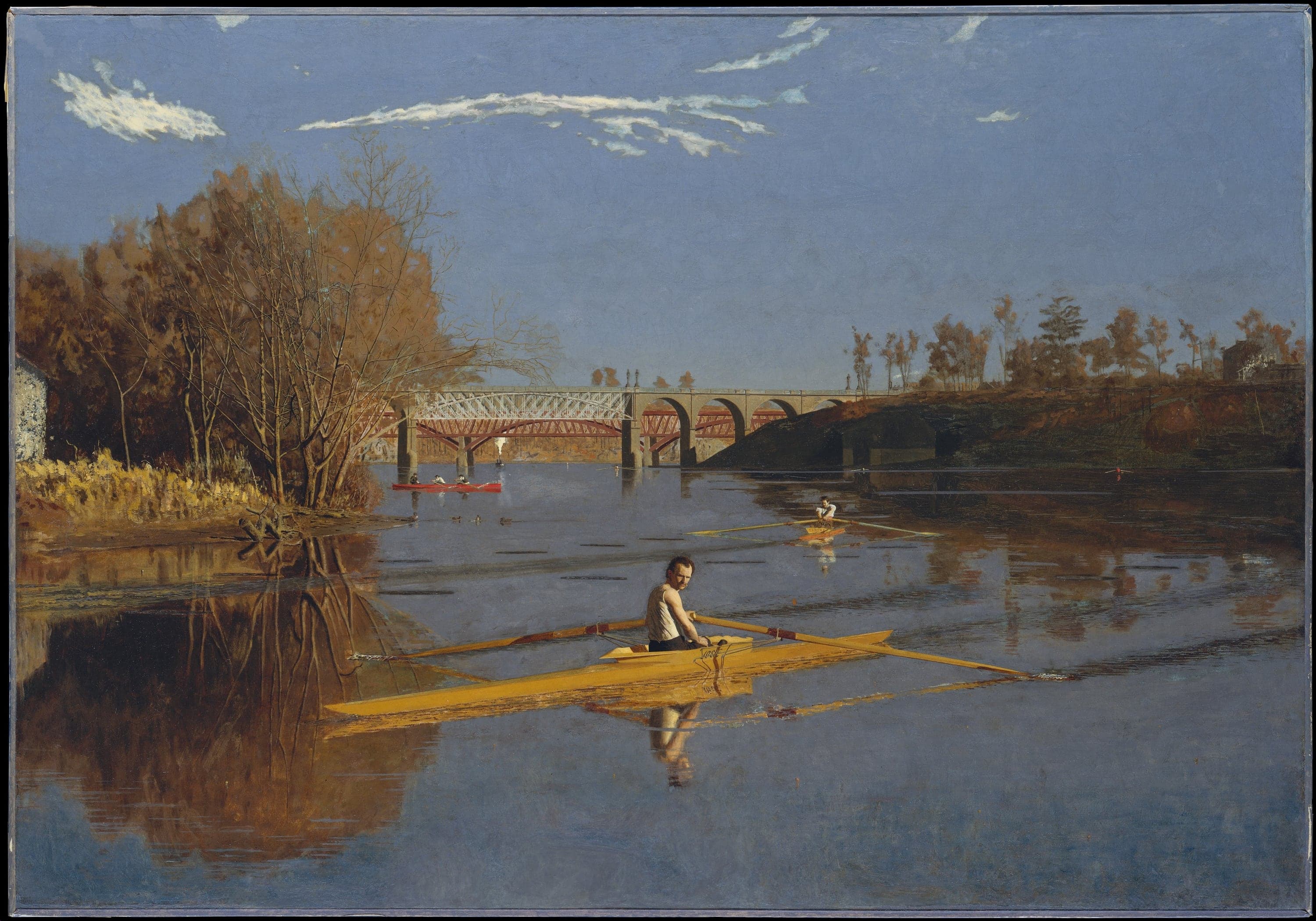
The Champion Single Sculls (Max Schmitt in a Single Scull)
Max Schmitt, a Philadelphia lawyer and champion amateur rower, rests on his oars in a single scull on the Schuylkill River and turns to look towards the viewer. Thomas Eakins painted the picture in 1871, within a year of coming home from Paris, and put himself in a second scull in the middle distance. The Metropolitan Museum of Art bought it in 1934.
- 1871
- Oil on canvas
- The Metropolitan Museum of ArtNew York, United States
About Thomas Eakins
What the painting shows
A man in a white sleeveless shirt sits in a pale yellow racing scull in the foreground, his oars trailing in the water. He has dark hair and a moustache and looks back over his shoulder towards the viewer. The name Josie is written in script on the hull beside his hands. Long dark streaks on the water behind him mark where his oars have been.
A second sculler in a white shirt rows away in the middle distance in an orange-red boat. That is Thomas Eakins, and the museum records his signature and the date, EAKINS 1871, on the stern of that scull rather than in a corner of the canvas. A red boat with three rowers sits under the bridge, a small steam launch trails white smoke beneath the far span, and four ducks float on the water between.
Two bridges cross the river: an iron truss on stone piers in front, and a stone bridge with round arches behind it. The trees on the left bank are bare or turning, and the sky is blue with thin streaks of cloud. The water is still enough to reflect the rower, his boat, the bridges and the corner of a stone house at the far left. The canvas is 81.9 by 117.5 centimetres.
Max Schmitt and the race of October 1870
The Metropolitan Museum of Art identifies the rower as Max Schmitt, born in 1843 and dead in 1900, a school friend of Eakins who became an attorney and a skilled amateur rower. The museum believes the painting commemorates his victory in an important race on the Schuylkill in October 1870. Eakins had returned to Philadelphia from Europe that year, and the museum calls the picture the first major work in his series of sculling paintings and watercolours, the one that launched his professional career.
Eakins did not paint the race. The Smarthistory essay on the picture by Meg Floryan describes the choice: Schmitt is shown at rest during a late-afternoon practice session rather than at the height of the effort. Eakins rowed himself, and the museum notes that he depicted himself pulling the oars of a scull in the middle distance.
The painting was first shown to mixed reviews. One critic, quoted in the Smarthistory essay, wrote of a scattered effect and of the artist dealing so boldly and broadly with the commonplace in nature.
What Paris left in the picture
Eakins had spent 1866 to 1870 abroad. He entered the École des Beaux-Arts in Paris and worked under Jean-Léon Gérôme, only the second American pupil Gérôme took, and he also attended the studio of Léon Bonnat, according to William Innes Homer's biography. A six-month stay in Spain followed, where he studied Diego Velázquez.
Floryan's essay reads the rowing picture as a blend of the influences of Gérôme, Bonnat and Velázquez, worked into a labour-intensive style aimed at truth to nature. She also points to Gérôme's river scenes of the Near East, and to those of Frederick Arthur Bridgman, and sees Eakins bringing that kind of subject home to the Schuylkill. Signing the picture on his own boat, in her reading, is the artist's sense of humour.
From Schmitt's house to the Met
The museum's provenance runs from Max Schmitt in Philadelphia to his wife, recorded as Mrs. Louise S. M. Nache, who kept it until 1930. Susan Macdowell Eakins, the painter's widow, owned it from 1930 to 1933, and it was with Babcock Galleries in New York in 1930 and 1931. The museum bought it from Milch Galleries, New York, in 1934 with the Alfred N. Punnett Endowment Fund and a gift from George D. Pratt. Its accession number is 34.92.
It hangs in Gallery 763 of The American Wing at The Met Fifth Avenue, according to the museum's record in September 2026.
Close reading
Reading the work, detail by detail
Begin with the rower looking back, then find the name on his boat, the painter rowing away with his signature on the stern, and the small traffic on the river: a red boat, a steam launch and four ducks under the bridges.
1.Max Schmitt looks back
Schmitt is resting, not racing. The Metropolitan Museum of Art identifies him as a school friend of Eakins who became an attorney and a skilled amateur rower, and Meg Floryan's Smarthistory essay reads the scene as a pause in a late-afternoon practice session.
2.The name on the hull
The boat carries a name, Josie, written in script on the hull where the rigger meets it. The riggers, the triangular metal braces holding the oarlocks clear of the narrow hull, are what made a racing scull faster than a rowing boat.
3.Eakins in the second scull
The second sculler is Thomas Eakins, who the museum says depicted himself pulling the oars in the middle distance. The museum records the signature and date, EAKINS 1871, on this boat's stern; in the reproduction it reads as a line of small dark letters on the orange hull.
4.The red boat and the ducks
A red boat with three rowers crosses under the far bridge, and four ducks sit on the water nearer the viewer. They are the smallest figures in the picture and the only other life on the river besides the two scullers and the launch.
5.The two bridges
Two bridges close the view upriver: an iron truss on stone piers in front and a stone bridge with round arches behind it. Their reflections run down into the water below, broken only by the boats.
6.The steam launch
A small steam launch puffs under the bridge, its white plume the one sign of a motor on a river given over to rowing. It is painted with a few strokes, at the scale of the ducks.
7.The reflection
The water is calm enough to hold a full reflection of Schmitt and his boat. The dark streaks across it are the marks of oar strokes, which Floryan's essay counts among the signs that the race is over and the rower is drifting.
8.The bare trees
The trees on the bank have lost most of their leaves, which fits the museum's dating of Schmitt's race to October 1870. Eakins drew every branch against the sky.
9.The corner of a house
A building is cut off by the left edge of the canvas, the only architecture in the picture apart from the bridges. The reeds in front of it are the same rust and yellow as the trees.
Timeline
1866–70
Thomas Eakins studies in Paris under Jean-Léon Gérôme at the École des Beaux-Arts, attends Léon Bonnat's studio, and spends six months in Spain.
1870
Returns to Philadelphia. In October his school friend Max Schmitt wins an important single-sculls race on the Schuylkill River.
1871
Painted, and signed and dated on the stern of Eakins's own scull. First shown to mixed reviews.
1900
Max Schmitt dies. The painting stays with his wife.
1930
Passes to Susan Macdowell Eakins, the painter's widow, and is with Babcock Galleries in New York in 1930 and 1931.
1934
Bought by the Metropolitan Museum of Art from Milch Galleries, New York, as 34.92.
Where to see it
The Metropolitan Museum of Art
1000 Fifth Avenue, New York, NY 10028, United States
On view in Gallery 763 of The American Wing at The Met Fifth Avenue, according to the museum's record in September 2026.
Plan your visit on the museum’s official website (opens in a new tab)Frequently asked questions
Where is The Champion Single Sculls?
At the Metropolitan Museum of Art in New York, accession number 34.92. The museum's record in September 2026 lists it on view in Gallery 763 of The American Wing at The Met Fifth Avenue.
Who was Max Schmitt?
A school friend of Thomas Eakins who became an attorney and a skilled amateur rower, according to the Metropolitan Museum. He lived from 1843 to 1900. The museum believes the painting commemorates his victory in an important race on the Schuylkill River in October 1870.
Why does the painting have two titles?
The Metropolitan Museum gives both. The Champion Single Sculls is the museum's title, and Max Schmitt in a Single Scull, the name in common use, follows it in parentheses. They refer to the same 1871 canvas.
Where is Thomas Eakins in The Champion Single Sculls?
He is the second sculler, rowing away in the orange-red boat in the middle distance. The museum records his signature and the date, EAKINS 1871, on the stern of that boat rather than in a corner of the canvas.
How big is The Champion Single Sculls?
81.9 by 117.5 centimetres, or 32 1/4 by 46 1/4 inches, in oil on canvas. Meg Floryan's Smarthistory essay puts it at roughly two and a half by four feet, and notes that its calm mood matches its modest size.
What river and what time of year does the painting show?
The Schuylkill River in Philadelphia, where Schmitt's race was rowed in October 1870. The trees on the bank are bare or turning, and the Smarthistory essay reads the light as a late afternoon.
More by Thomas Eakins
If you like Thomas Eakins
Explore painters from the same movements and circles.
Rosa Bonheur
At the horse markets of Paris and in her studio beside the forest of Fontainebleau, Rosa Bonheur gave animals the presence of great portrait subjects. The success of The Horse Fair helped her build a life shaped by her work, financial independence, and the women she loved.
View artist
Henri Cartier-Bresson
French photographer who turned a pocket-sized 35mm camera into an instrument of split-second composition — the idea the world knows as 'the decisive moment'. He trained as a painter, was taken prisoner in 1940 and escaped on his third try, photographed the Liberation of Paris in August 1944, co-founded the photographer-owned agency Magnum Photos in 1947, gave up reporting for drawing in the 1970s, and left Paris a foundation in the Marais that deliberately hangs no permanent display of his own pictures.
View artist
Aaron Douglas
The painter who gave the Harlem Renaissance — the flowering of Black American writing, music and art between the world wars — its look, in flat purple silhouettes in profile, ringed by bands of light. He moved to Harlem in 1925 with Paris as the eventual destination, got there in 1931, spent a year at the Académie Scandinave, a private art school in the city, and came home to paint the four murals that are still the centrepiece of the Schomburg Center, the New York Public Library's Harlem research library on Black history.
View artist
References
The sources below include collection records, catalogues, scholarly research, and primary materials that informed this page. They document The Champion Single Sculls (Max Schmitt in a Single Scull), its making, and its place in cultural history.


1The Champion Single Sculls (Max Schmitt in a Single Scull), Thomas Eakins
WebsiteThe Metropolitan Museum of ArtUsed forWeb source consulted for documented facts and historical context presented on the The Champion Single Sculls (Max Schmitt in a Single Scull) page.
2Thomas Eakins, The Champion Single Sculls (Max Schmitt in a Single Scull)
WebsiteSmarthistoryUsed forWeb source consulted for documented facts and historical context presented on the The Champion Single Sculls (Max Schmitt in a Single Scull) page.
3Thomas Eakins: His Life and Art
BiographyAbbeville Press, 1992Used forBiographical evidence used to verify chronology, relationships, and historical context connected to The Champion Single Sculls (Max Schmitt in a Single Scull).

4Thomas Eakins
Exhibition cataloguePhiladelphia Museum of Art, 2001Used forCatalogue scholarship used to verify attribution, provenance, chronology, and interpretive context for The Champion Single Sculls (Max Schmitt in a Single Scull).
These references provide the documented foundation for this work's history and interpretation. Claim-level citations remain attached to the specific claims they support.
 Explore more resources