Miss Amelia Van Buren
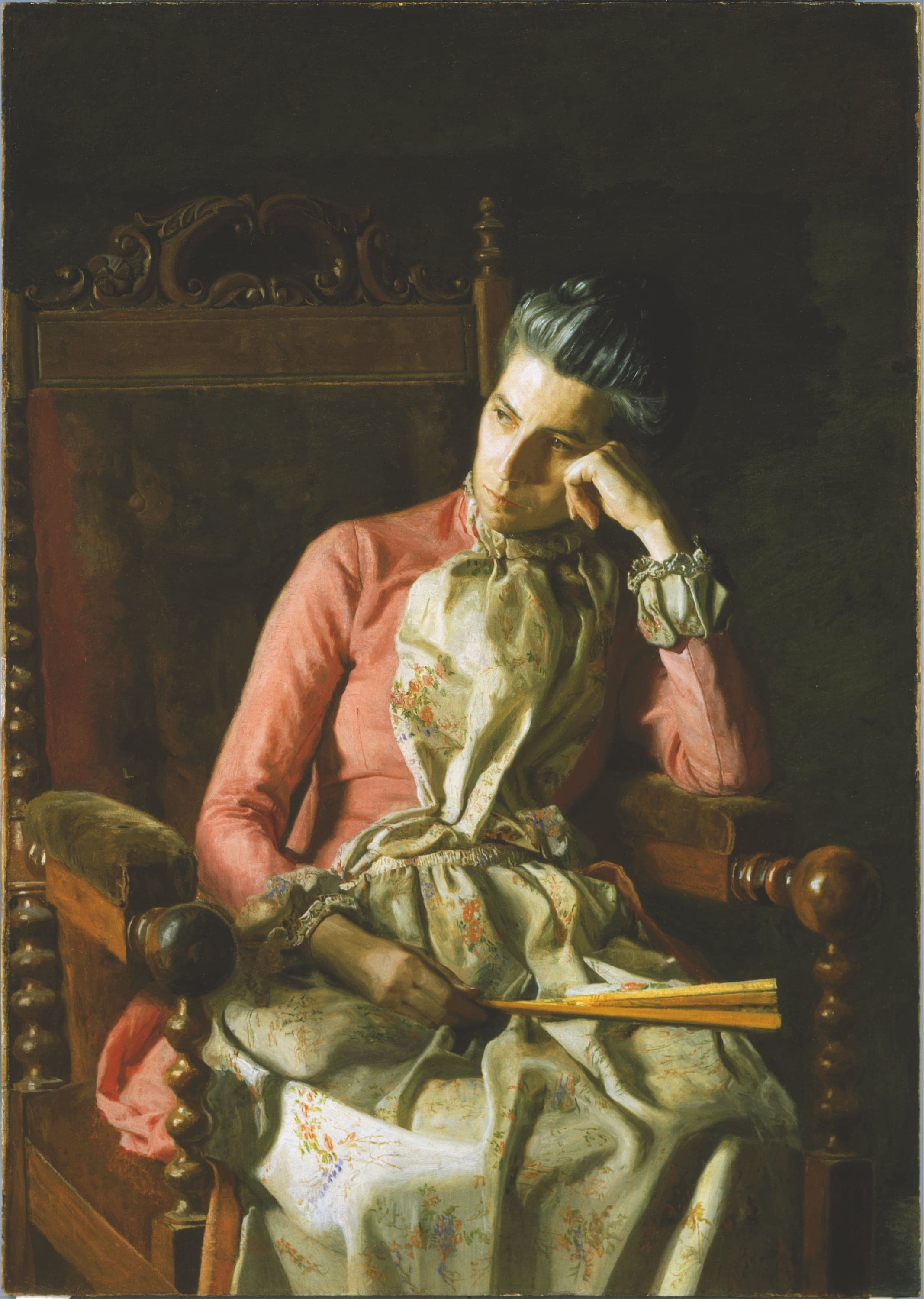
A woman with greying hair sits in a heavy carved chair, her head resting on her left hand and a folded yellow fan in her right. She wears a coral-pink bodice over a cream dress printed with small flowers. Thomas Eakins painted Amelia Van Buren, a former pupil and a friend of his family, in Philadelphia about 1891. Duncan Phillips bought the portrait for his gallery in Washington in 1927.
- c. 1891
- Oil on canvas
- The Phillips Collection, Washington, D.C.Washington, D.C., United States
About Thomas Eakins
What the painting shows
A woman sits in a heavy carved chair against a dark background, turned a little to the viewer's left. Her greying hair is pulled straight back, and her head rests on her left hand, the elbow on the arm of the chair and a ruffled cuff at the wrist. Her eyes look off to the left, past the light, and her mouth is closed. The light comes from the left and lies across her forehead, her cheek and the top of her hand.
She wears a coral-pink bodice with long sleeves and a ruffled collar under her chin. The front of the dress and the skirt are cream, printed with small flowers in orange, green and blue. Her right hand lies in her lap holding a folded yellow fan. The chair has a carved crest rail, turned posts and big turned knobs at the ends of the arms, with red upholstery on the back. Darrel Sewell's 2001 catalogue calls it a Jacobean-revival chair that Eakins often used for his studio portraits.
The canvas is 114.3 by 81.3 centimetres, 45 by 32 inches. The Phillips Collection dates it about 1891.
Amelia Van Buren
The Phillips Collection records that Amelia Van Buren was born in 1856 and was listed by 1880 as an artist in colour. She came to the Pennsylvania Academy of the Fine Arts in 1884 and took Eakins's life classes, and her friendship with the Eakins family lasted the rest of her life. She later turned to photography and gave up painting for it.
In 1886 Eakins described her in a letter quoted in Sewell's catalogue: a lady of perhaps thirty years or more, from Detroit, who had come to the Academy to study figure painting in the hope of supporting herself. He called her grave, earnest, thoughtful and industrious, and said she soon surpassed her fellows. William Innes Homer's biography tells of an episode that his opponents at the Academy used against him. He had once undressed in front of her, in private, to explain a point of anatomy. He wrote that he could not have given the explanation by words only.
After she stopped studying with him, Van Buren often stayed at the Eakins house on Mount Vernon Street, and Sewell suggests she sat for the portrait on one of those visits. The date of about 1891 is the one most scholars accept, according to John Wilmerding's 1993 monograph, though Sewell notes a long stay from December 1888 to August 1889 as another possibility. Charles Bregler, another Eakins student, recalled watching for several hours one afternoon while Eakins painted the portrait in silence.
What the Phillips sees in it
The Phillips Collection's note on the picture begins with the resignation. After Eakins was forced out of the Academy in 1886 he concentrated almost entirely on portraiture, and the museum counts this among his finest. He centred his attention, it says, on Van Buren's face and hands: her weary head leans on her curved hand, the other rests in her lap, and she looks towards but not into the strong light from the left.
Eakins had studied at the École des Beaux-Arts in Paris under Jean-Léon Gérôme and in the studio of Léon Bonnat, whose insistence on anatomical exactness he carried home, according to William Innes Homer. Wilmerding contrasts the two arms here: the supporting arm solid and architectural, the anchor of the portrait, and the other hand shadowed and limp.
“This portrait … is characterized with the deepest reverence and respect but without so much as a trace of the desire to please the sitter … or the public …. Her humanity is offered to us in its outer physical manifestation with sincere patient exactitude.”
Later judgements have been warmer than the first ones. Sewell records that the portrait was only the second of a woman outside his family that Eakins showed in public, and that it drew little notice at the Philadelphia preview of the World's Columbian Exposition or in Chicago in 1893. William Innes Homer called it superb. John Canaday, writing in Horizon in 1964, called it the finest of all American portraits. John Updike saw in it the discomfort and grieving inwardness that he found in the best of Eakins's portraits.
From the sitter to the Phillips
The painting belonged to Van Buren herself by 1893, possibly as a gift from the artist, according to Wilmerding. In 1927 the Phillips Memorial Gallery in Washington, now The Phillips Collection, bought it from her. Its credit line reads Acquired 1927, and its object number is 0632. The museum is at 1600 21st Street NW.
Close reading
Reading the work, detail by detail
The Phillips says Eakins put his attention on the face and the hands, so start there: the head on one hand, the fan in the other. Then the hair, the ruffled collar, the pink bodice and the carved chair that holds her up.
1.The face
The Phillips Collection describes her as looking towards but not into the strong light from the left. Sewell's 2001 catalogue reads the broad forehead as a sign of the sitter's intellectual presence.
2.The hand at the temple
Her left hand takes the weight of her head, the elbow on the arm of the chair. John Wilmerding calls this supporting arm solid and architectural, the anchor of the portrait.
3.The hair
The hair is greying and pulled back without ornament. The Phillips gives her birth year as 1856, so she was about thirty-five when the picture was painted around 1891.
4.The ruffled collar
The collar and the cuff at the wrist are the same grey-white ruffle. Between them the front of the dress carries the small printed flowers that run down into the skirt.
5.The pink bodice
The pink of the bodice is the strongest colour in the picture. Duncan Phillips, in the words the museum quotes, admired Eakins's sense of colour and texture as much as his respect for the sitter.
6.The hand and the fan
Her right hand holds a folded yellow fan in her lap. Wilmerding contrasts it with the arm supporting her head: this hand is shadowed and limp where the other is solid.
7.The carved crest of the chair
The chair is a Jacobean-revival piece that Eakins often used for studio portraits, according to Sewell's 2001 catalogue. Its carving is painted with enough detail to read and no more.
8.The turned finial
The arms of the chair end in large turned knobs. The one on the right takes a highlight from the same light that falls on the sitter's face.
9.The chair knob and the cuff
On the left the chair's knob sits beside the ruffled cuff of her right sleeve. The upholstered arm behind it is worn, and its red shows through under the sitter's elbow.
Timeline
1884
Amelia Van Buren takes Thomas Eakins's life classes at the Pennsylvania Academy of the Fine Arts.
1886
Eakins describes her in a letter as grave, earnest, thoughtful and industrious. The Academy forces him to resign the same year.
c. 1891
Painted, most likely during one of Van Buren's stays at the Eakins house on Mount Vernon Street, Philadelphia.
1893
Shown at the Philadelphia preview of the World's Columbian Exposition and in Chicago, with little notice in the press.
1927
Bought from Van Buren by the Phillips Memorial Gallery, Washington. Object number 0632.
1964
John Canaday calls it the finest of all American portraits in Horizon.
Where to see it
The Phillips Collection, Washington, D.C.
1600 21st Street NW, Washington, DC 20009, United States
Displays and loans can change. Check whether this work is on view before making a special trip.
Plan your visit on the museum’s official website (opens in a new tab)Frequently asked questions
Where is Miss Amelia Van Buren?
At The Phillips Collection, 1600 21st Street NW, Washington, D.C., object number 0632. The museum acquired it in 1927. Check the museum's collection page before travelling, since the painting's display can change.
Who was Amelia Van Buren?
A painter turned photographer, born in 1856, who took Thomas Eakins's life classes at the Pennsylvania Academy of the Fine Arts in 1884 and stayed a friend of the Eakins family for life, according to The Phillips Collection. Eakins described her in 1886 as grave, earnest, thoughtful and industrious, and said she soon surpassed her fellow students.
What is she holding in the portrait?
A folded yellow fan, in her right hand, which rests in her lap. Her left hand supports her head, with the elbow on the arm of the chair.
How big is Miss Amelia Van Buren?
114.3 by 81.3 centimetres, or 45 by 32 inches, in oil on canvas, in upright format. The figure is close to life size.
When was Miss Amelia Van Buren painted?
About 1891, the date The Phillips Collection gives and the one most scholars accept, according to John Wilmerding. Darrel Sewell's catalogue notes that Van Buren also stayed with the Eakins family from December 1888 to August 1889, which leaves a slightly earlier date possible.
Why is the portrait admired?
The Phillips Collection counts it among Eakins's finest portraits and quotes Duncan Phillips on its reverence for the sitter and its refusal to flatter her. John Canaday called it the finest of all American portraits in 1964, and William Innes Homer called it superb.
More by Thomas Eakins
If you like Thomas Eakins
Explore painters from the same movements and circles.
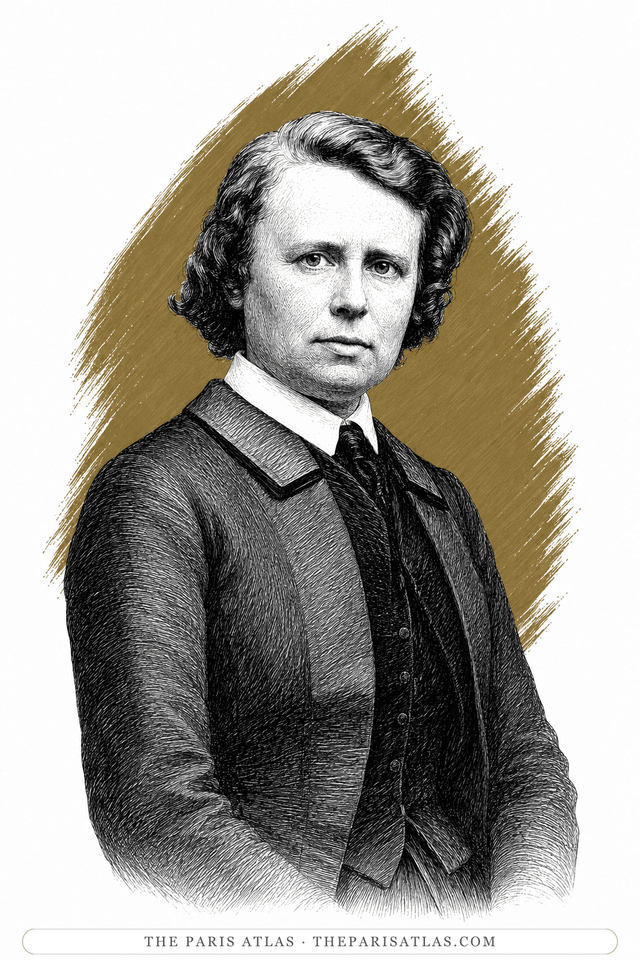
Rosa Bonheur
At the horse markets of Paris and in her studio beside the forest of Fontainebleau, Rosa Bonheur gave animals the presence of great portrait subjects. The success of The Horse Fair helped her build a life shaped by her work, financial independence, and the women she loved.
View artist
Henri Cartier-Bresson
French photographer who turned a pocket-sized 35mm camera into an instrument of split-second composition — the idea the world knows as 'the decisive moment'. He trained as a painter, was taken prisoner in 1940 and escaped on his third try, photographed the Liberation of Paris in August 1944, co-founded the photographer-owned agency Magnum Photos in 1947, gave up reporting for drawing in the 1970s, and left Paris a foundation in the Marais that deliberately hangs no permanent display of his own pictures.
View artist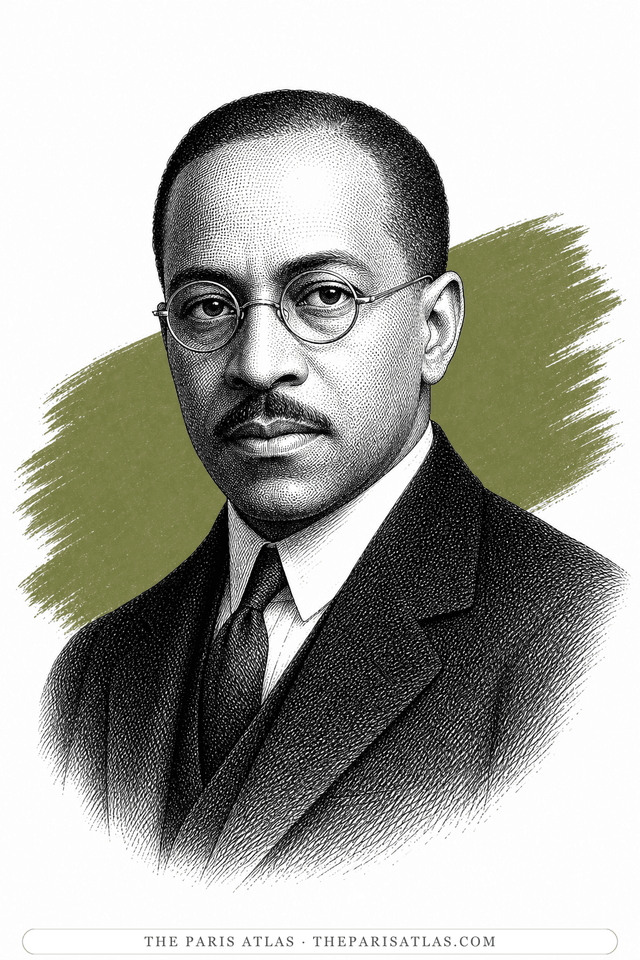
Aaron Douglas
The painter who gave the Harlem Renaissance — the flowering of Black American writing, music and art between the world wars — its look, in flat purple silhouettes in profile, ringed by bands of light. He moved to Harlem in 1925 with Paris as the eventual destination, got there in 1931, spent a year at the Académie Scandinave, a private art school in the city, and came home to paint the four murals that are still the centrepiece of the Schomburg Center, the New York Public Library's Harlem research library on Black history.
View artist
References
The sources below include collection records, catalogues, scholarly research, and primary materials that informed this page. They document Miss Amelia Van Buren, its making, and its place in cultural history.


1Miss Amelia Van Buren
WebsiteThe Phillips CollectionUsed forWeb source consulted for documented facts and historical context presented on the Miss Amelia Van Buren page.

2Thomas Eakins
Exhibition cataloguePhiladelphia Museum of Art, 2001Used forCatalogue scholarship used to verify attribution, provenance, chronology, and interpretive context for Miss Amelia Van Buren.

3Thomas Eakins
NonfictionSmithsonian Institution Press, 1993Used forPublished analysis and historical context used in preparing the Miss Amelia Van Buren page.
4Thomas Eakins: His Life and Art
BiographyAbbeville Press, 1992Used forBiographical evidence used to verify chronology, relationships, and historical context connected to Miss Amelia Van Buren.
5Thomas Eakins: Familiar Truths in Clear and Beautiful Language
PeriodicalHorizon, vol. 6, no. 4, 1964Used forContemporary reporting or criticism used to document the historical reception and context of Miss Amelia Van Buren.
6Still Looking
EssaysAlfred A. Knopf, 2005Used forPublished analysis and historical context used in preparing the Miss Amelia Van Buren page.
These references provide the documented foundation for this work's history and interpretation. Claim-level citations remain attached to the specific claims they support.
 Explore more resources